Virtual Receptionist Services That Win Moving Jobs

Think about the front-desk employee you wish you had. The one who never sleeps, never misses a call, and never needs a lunch break. That’s the promise of a virtual receptionist service for your moving company. It’s not just a fancy answering service; it's an extension of your business operations, built to capture every single lead and turn calls into booked jobs, even when you're out on a move.
What a Virtual Receptionist Really Means for Movers
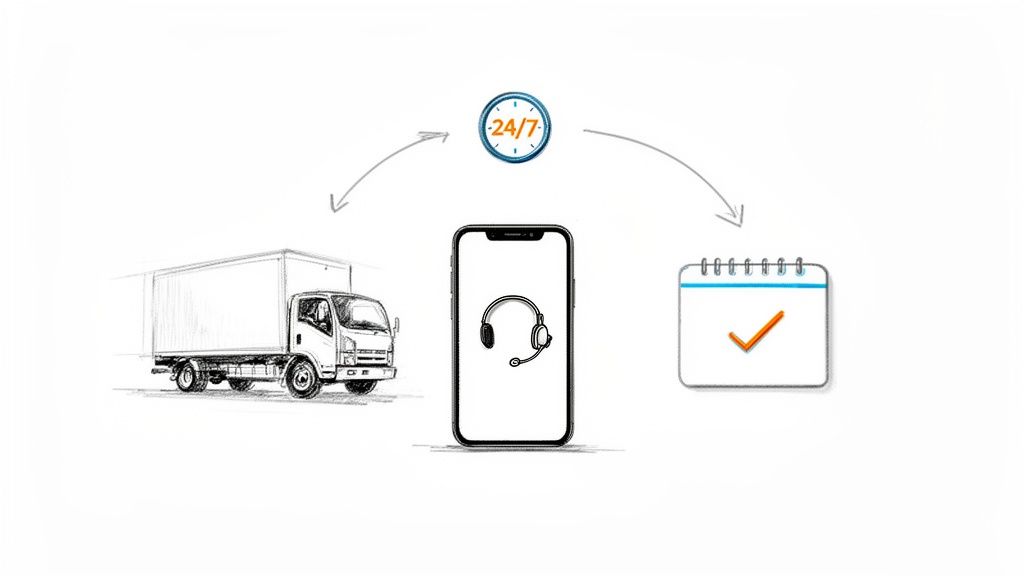
For a moving company owner, a ringing phone is the sound of money. But what happens when you’re on-site with a crew, driving a truck, or it’s 8 PM on a Sunday? Every call that hits voicemail is a job walking straight over to your competitor. This is the exact operational bottleneck virtual receptionist services were made to fix.
At its core, a virtual receptionist is a service that handles your calls and customer chats from outside your office. It becomes your front line, making sure every potential customer gets a professional and immediate answer. But it’s about a lot more than just picking up the phone; it’s about smart, meaningful engagement that moves a lead closer to booking.
The Two Flavors of Virtual Receptionists
These services really come in two main flavors. Understanding the difference is critical for any mover looking to tighten up their front-office operations and reduce missed call revenue loss.
- Live Agent Services: This is the traditional model. A real person, working from a call center, answers your calls using a script you provide. They can take messages, transfer calls, and maybe do some basic scheduling.
- AI-Powered Receptionists: This is the modern, automated approach. An intelligent AI system answers calls instantly, talks naturally with customers, and can handle complex tasks like lead qualification and booking without a human stepping in. For most movers, this is where the real competitive advantage lies.
While live agents can offer a human touch, they have their limits. Per-minute billing can get wildly expensive during your busy season, and they often lack the deep industry knowledge to handle mover-specific questions, leading to generic, unhelpful conversations.
How an AI Receptionist Specifically Helps a Moving Company
An AI-powered receptionist does way more than just take a message. It becomes a core part of your sales process, built from the ground up to handle the specific needs of a moving company.
When a customer calls, the AI can:
- Answer Instantly, 24/7: Holiday? Midnight? The middle of your busiest Saturday ever? The call gets answered on the first ring. Missed calls stop being a source of lost revenue.
- Qualify Leads the Right Way: The AI is trained to ask the questions that matter. It can figure out the move size ("Are you moving a one-bedroom apartment or a four-bedroom house?"), ask about tricky items like pianos or antiques, and confirm move dates.
- Book Jobs Right into Your Calendar: By plugging into your scheduling software, the AI checks your availability in real-time and books a confirmed job on the spot. It's call-to-calendar integration that works, even sending a confirmation text to the customer.
- Handle Repetitive Questions: It can field common questions like "What are your hours?" or "Are you licensed and insured?" freeing you and your crew up to focus on the actual moves.
For a moving company with 1 to 20 trucks, the biggest bottleneck is usually the owner or a single dispatcher trying to do everything at once. An AI receptionist shatters that bottleneck, ensuring leads get captured and jobs get booked automatically, even when you're completely slammed during the summer rush.
This isn't futuristic tech anymore; it's a practical tool that helps you win jobs. Speed determines who wins in this business. When a customer is ready to book, the first company that gives them a professional, confident answer usually gets the job. Automation makes sure you are always that first company.
If you want to go deeper into how this works, there’s a great complete guide on an AI chatbot for customer support that covers the nuts and bolts. But the takeaway is simple: these services make sure no lead ever falls through the cracks again.
Calculating the Real Cost of a Missed Call
Every time your phone rings and you can't pick up, it's more than just a missed call—it’s revenue walking out the door. It’s easy for a busy moving company owner to shrug it off. A few missed calls here and there feels like the cost of doing business, right?
But when you actually run the numbers, they can be gut-wrenching.
Let’s get real for a second. Imagine your five-truck operation misses just eight calls a week during your busy season. That doesn't sound like a crisis, but that small leak in your lead pipeline adds up fast.
If your average moving job brings in $1,500 and you book about 25% of the qualified leads who call, those eight missed calls aren't just voicemails. They're two lost jobs. Every. Single. Week.
That’s $3,000 per week in revenue you never see. Over a month, that’s $12,000 gone. And annually? That tiny leak has turned into a massive $144,000 hole in your bottom line.
Annual Revenue Loss from Missed Calls Example
To put it in perspective, here's how quickly the losses can multiply for a small moving company. This table shows the potential annual hit to your revenue based on just a few missed calls each week.
| Missed Calls per Week | Potential Lost Jobs per Month | Potential Monthly Revenue Loss (@ $1,500/job) | Potential Annual Revenue Loss |
|---|---|---|---|
| 4 | 4 | $6,000 | $72,000 |
| 6 | 6 | $9,000 | $108,000 |
| 8 | 8 | $12,000 | $144,000 |
| 10 | 10 | $15,000 | $180,000 |
Seeing the numbers laid out like this makes it clear: missed calls aren't a minor issue. It's a significant financial drain that could be funding another truck, hiring another crew, or going straight into your pocket.
It's Deeper Than Just One Lost Job
Losing the immediate booking is painful enough, but the real damage runs much deeper. People shopping for movers are in a hurry. When they need a quote, they need it now. Most of them won't bother calling you back; they just click on the next mover in their Google search.
When a potential customer hits your voicemail, you don’t just lose a single job. You also lose out on:
- Future Referrals: A happy customer is your best marketing tool. They'll refer friends and family for years to come. That one missed call just erased all those potential future jobs.
- Customer Lifetime Value: People move more than once. The person you missed today could have been a repeat customer for their next three moves.
- Your Local Reputation: The first impression is everything. An immediate, professional answer tells a customer you're reliable. A voicemail tells them you're disorganized or too swamped to handle their business, tarnishing your brand right out of the gate.
The heart of the problem is speed. The first mover to give a prospect a confident, helpful answer almost always wins the job. Your competitors using virtual receptionist services are answering instantly, quoting the move, and getting it on the schedule before you even see the missed call notification.
How to Figure Out Your Own Losses
You can do this math for your own moving company. Just grab a pen and paper and plug in your numbers:
- Estimate Your Missed Calls per Week: Be honest. How many calls go unanswered when your crews are on a job, or after your office closes at 5 PM?
- Find Your Average Job Value: What's the typical revenue you see from a standard local move?
- Know Your Booking Rate: What percentage of qualified callers do you usually turn into booked jobs?
Got those numbers? The formula is painfully simple:
(Missed Calls per Week) x (Booking Rate %) x (Average Job Value) = Weekly Revenue Loss
This exercise reframes the problem. It’s not a small annoyance; it's a critical financial drain on your business. You can go even deeper by checking out our guide on the real cost of missing just 4 calls per week. Understanding this number is the first step to finally plugging that leak.
Essential Features Your Virtual Receptionist Must Have
When you're looking for a virtual receptionist, it's easy to get bogged down in feature lists. But for a moving company, not just any service will cut it. A generic solution isn’t built for the fast-paced, specific demands of your business. It won't know what a "long carry" is, and it certainly can't quote a 3-bedroom apartment with stairs.
To make sure you’re investing in a tool that actually books jobs—instead of just taking messages—there are a few non-negotiable features you need. Think of this as your checklist for building a more profitable front office. Each one solves a real-world problem that costs movers time and, more importantly, money.
24/7/365 Availability
First and foremost, you need 24/7 availability. This isn't a luxury; it's a necessity. Your potential customers aren’t just shopping for movers between 9 AM and 5 PM. They’re planning their lives after work, on weekends, and even on holidays. If a hot lead calls at 7 PM on a Tuesday and hits your voicemail, they're not leaving a message. They're calling the next mover on their list.
An always-on service means you capture every single opportunity, especially during seasonal spikes. It turns what used to be your competitor's prime time into your own. This is where AI-powered receptionists really shine, offering round-the-clock coverage without the sky-high cost of overnight live agents.
Just look at the numbers. A few missed calls a week can add up to tens of thousands in lost revenue every year. This is a problem that 24/7 availability solves instantly.
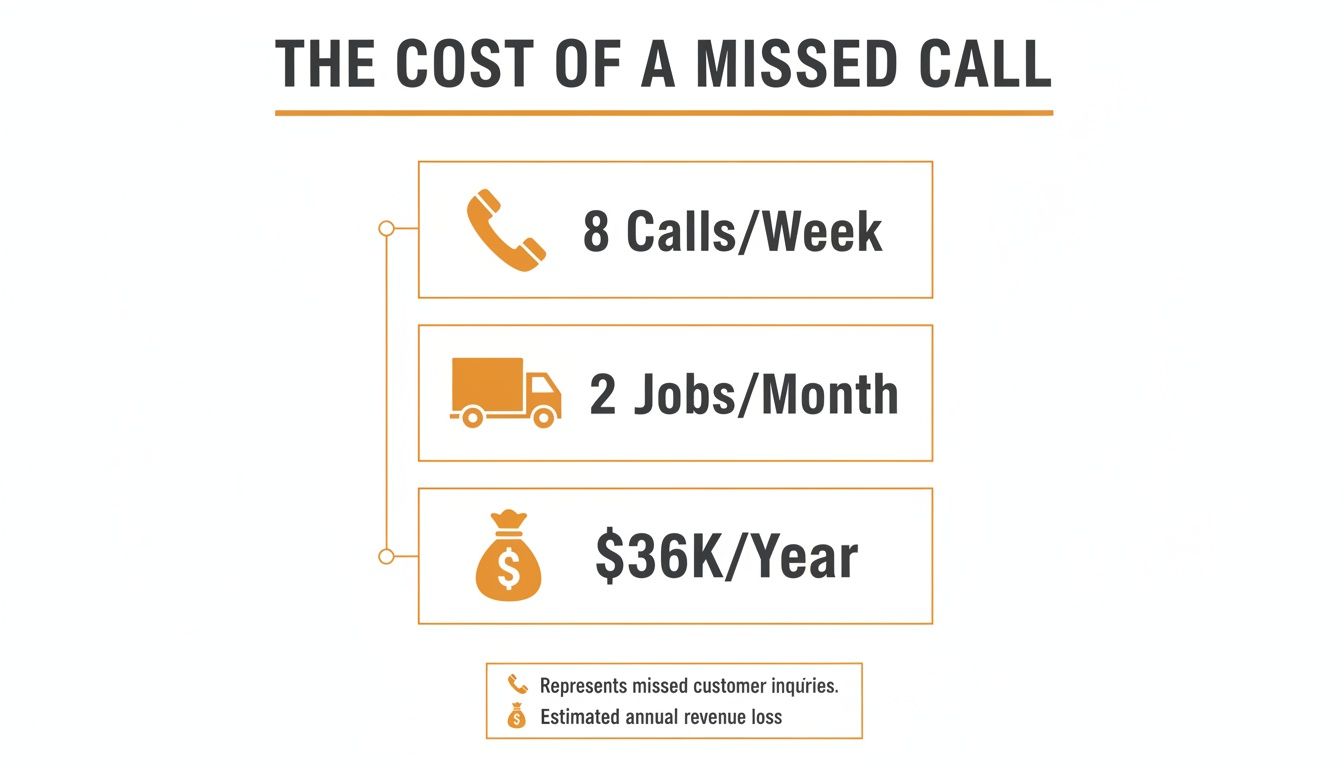
The math is simple: the cost of missed jobs is way higher than the investment in a system that makes sure you never miss a call again.
Seamless Calendar and Software Integration
A virtual receptionist should feel like a part of your team, not another clunky piece of software you have to wrestle with. That's why you need a service offering seamless call-to-calendar integration with the tools you already rely on, whether it's Google Calendar, Outlook, or your moving company CRM like SmartMoving or Supermove.
This integration is what separates a basic answering service from a true booking machine.
- Real-Time Availability Checks: The receptionist can see your crew's live schedule and know immediately if you can handle a job on a specific date.
- Automatic Booking: It can schedule a confirmed move directly into your calendar without you lifting a finger. No more manual data entry.
- No More Double-Booking: By syncing with your actual schedule, it eliminates the costly and unprofessional mistake of booking two jobs at the same time.
Without this, you’re just paying for a glorified message-taker. You’re still stuck doing the manual work of transferring notes into your calendar. True automation means the system does the work for you.
A key principle for movers is this: if a technology doesn’t reduce your workload, it’s the wrong technology. Your virtual receptionist should simplify operations, not add another layer of complexity.
Intelligent and Mover-Specific Lead Qualification
A great virtual receptionist doesn't just answer the phone; it asks the right questions. For a moving company, this means performing intelligent lead qualification that’s built for your industry. A generic script just won't cut it.
Your system needs to be smart enough to ask—and understand the answers to—questions like:
- "What are the pickup and drop-off zip codes?"
- "Are you moving from a house or an apartment? How many bedrooms?"
- "Any large or specialty items, like a piano, a safe, or a hot tub?"
- "How many flights of stairs are we looking at for each location?"
This is the information you need to give an accurate quote, schedule the right-sized crew, and send the right truck. An AI receptionist trained specifically on moving industry conversations can handle this flawlessly, making sure every lead is properly qualified before it ever lands on your desk.
Automated Follow-Up and Booking Capabilities
Finally, the ability to close the loop is what turns a caller into a booked job. Your virtual receptionist has to do more than just talk; it needs features that automatically push the booking process forward.
Look for these critical capabilities:
- Automated Quote Follow-Ups: After giving a quote, the system should automatically send follow-up texts and emails. This single action dramatically increases your booking rate.
- First-Call Booking: The holy grail. The system should be able to quote, confirm, and schedule the move in one efficient conversation.
When a customer gets an instant, professional quote followed by prompt, automated communication, it builds a massive amount of trust. It tells them you run a tight ship, making them far more likely to choose you over a competitor who takes hours to call back. These features are the engine of revenue growth for modern moving companies.
Understanding the ROI of an AI Receptionist
As a moving company owner, you know your numbers. You track fuel costs, insurance premiums, and crew wages down to the penny. But what about the cost of your front office? When you run the numbers on how you handle calls, you’ll find one of the biggest opportunities to boost your profitability.
Let's break down the return on investment (ROI) for an AI receptionist. This isn’t just about trimming expenses; it’s about making your entire operation more profitable from the very first call.
Comparing Your Options: The Financial Reality
When it comes to answering the phone, you’ve got three main choices. Each comes with a wildly different price tag and, more importantly, a different level of effectiveness in booking jobs.
- The In-House Receptionist: A full-time employee feels like the gold standard, but the costs are staggering. You’re on the hook for a salary, benefits, payroll taxes, training, and paid time off. This easily adds up to $40,000 to $50,000 per year, and that person only works eight hours a day, five days a week, leaving you exposed after hours and on weekends.
- The Traditional Answering Service: This looks cheaper on paper, but the costs are a black box and often punish you for being busy. Most charge by the minute, and those minutes stack up fast during your peak season. A sudden flood of calls can leave you with a shocking bill for a service that usually just takes a message anyway.
- The Modern AI Receptionist: This model is all about predictable, flat-rate pricing. For a low monthly fee, you get 24/7 coverage that actively works to book jobs, not just jot down a name and number. Automation stops being a cost center and becomes a powerful revenue machine.
The financial difference is night and day. An AI solution is typically 85-95% cheaper than a traditional live answering service. For a small moving company, this can mean saving thousands of dollars every month while capturing more leads than ever before.
The "One Booked Job" Rule
Calculating the ROI for an AI receptionist is dead simple. Think about what a single moving job is worth to your company. Is it $1,200? $1,800? Maybe more?
The Golden Rule of Automation ROI: If your AI receptionist captures just one moving job you otherwise would have missed, it has likely paid for itself for the entire year. Every job it books after that is pure profit.
That’s not hyperbole. One single job that comes in after hours or while your whole team is on-site instantly covers the low monthly cost of the service. An effective AI receptionist for small business is built from the ground up to pay for itself many times over.
Beyond Cost Savings: The True Value
While the cost savings are huge, the real ROI comes from generating more revenue and making your operation smoother. When you and your dispatchers are freed from the grind of answering the same repetitive calls, you can finally focus on high-value tasks that grow the business.
- Higher Booking Rates: Faster, more professional, and consistent responses win more jobs. Simple as that.
- Lower Operational Overhead: Less time wasted on manual data entry and juggling schedules means your team can be more productive.
- Focus on Growth: Instead of being chained to the phone, you can manage your crews, optimize routes, and actually think about your business strategy.
To really get a handle on what an AI receptionist brings to the table, it helps to apply simple strategies to measure marketing ROI and see its direct financial impact. When you stop seeing automation as an expense and start seeing it as a tool that directly drives revenue, the investment becomes a no-brainer.
How to Implement a Virtual Receptionist in Your Moving Company
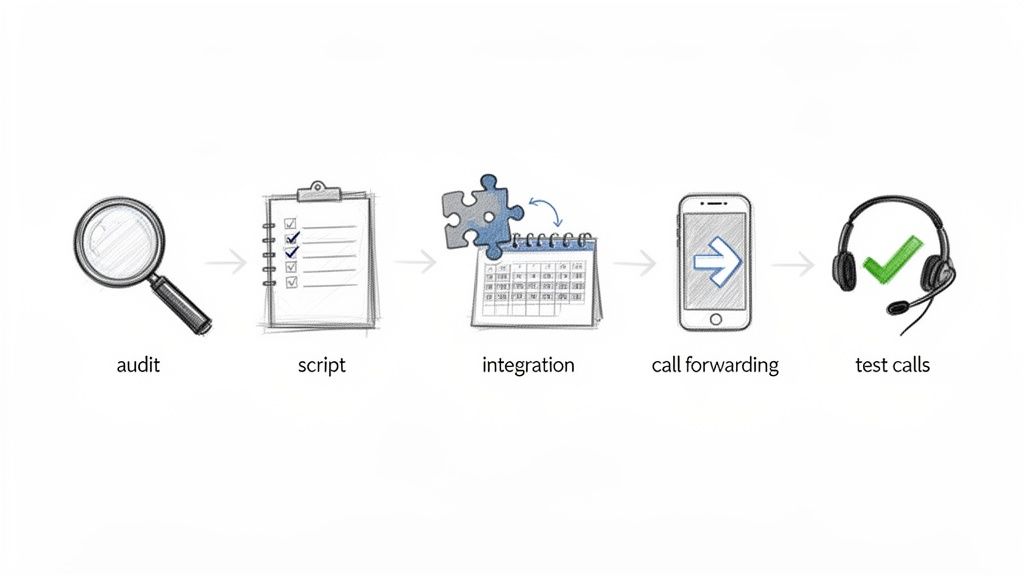
Getting a virtual receptionist up and running is way easier than most moving company owners imagine. This isn't a complex IT project that's going to eat up your week. It's a straightforward process designed for movers, not tech wizards, and you can usually get everything live in under an hour.
The whole point is to plug a major revenue leak in your business. The setup process is built around your real-world needs—capturing every lead and booking more moving jobs, plain and simple.
Step 1: Audit Your Current Call Handling
Before you can fix the problem, you need to know exactly what’s broken. Take an honest, unflinching look at how your company handles calls right now.
- When are you missing calls? Is it during peak moving hours when everyone's on-site? Is it after 5 PM? Weekends?
- Where do leads die? How many callers actually bother leaving a voicemail versus just hanging up and calling your competitor?
- What’s the real delay? How long does it take for your team to return a missed call? Be brutally honest—are we talking minutes, or is it hours?
Answering these questions gives you a clear picture of when and where you're bleeding cash. This becomes your baseline, the "before" photo you’ll use to measure success once the new system is in place.
Step 2: Define Your Ideal Lead Script
Next, map out the perfect conversation for qualifying a new moving lead. What are the absolute must-have pieces of information your team needs to give an accurate quote and get a job on the calendar?
Think through the questions you ask on every single successful booking call:
- What are the pickup and drop-off zip codes?
- Is it an apartment or a house? How many bedrooms?
- Are there any specialty items like a piano, gun safe, or hot tub?
- How many flights of stairs are we dealing with?
This script is what gives your virtual receptionist its brain. A well-designed script means every single lead gets qualified professionally and consistently, without fail.
Step 3: Choose a Service with the Right Integrations
A virtual receptionist should simplify your life, not add another piece of software to juggle. The key is picking a service that plugs right into the tools you’re already using, like your Google Calendar or your moving company CRM.
This is the secret to real automation that just works. When your systems are connected, the receptionist can see your crew’s availability in real-time and book jobs directly onto your schedule. No more double-bookings, no more mind-numbing data entry.
Some services even offer a warm transfer, which is a game-changer. It lets the AI seamlessly hand off a complex or high-value call directly to you or your lead dispatcher without dropping the ball.
Step 4: Set Up Call Forwarding and Test Everything
This is the last technical piece, and it's surprisingly simple. All you do is set up call forwarding. When a customer dials your main business number, the call gets instantly routed to the virtual receptionist service instead of your personal cell or office landline.
As soon as it’s active, run a few test calls yourself. Use a different phone, call your own number, and pretend to be a customer looking for a quote.
Does the greeting sound professional? Does it ask the right qualifying questions from the script you built? Is the experience smooth, fast, and confidence-inspiring? This final check makes sure every real customer gets a great first impression.
Don't underestimate the impact of this simple setup. For a small business like a moving company, this translates directly to less time spent playing phone tag and more booked jobs—all without adding payroll.
Why Automated Operations Are the Future for Movers
The local moving market is more crowded than ever, and the rules of the game have changed for good. Automation isn't some trendy tech idea anymore. For a moving company with 1-20 trucks, it's quickly becoming a basic requirement for survival and growth. The future belongs to the movers who respond the fastest.
Customer expectations are just plain different now. When someone needs a mover, they don't want to leave a voicemail and wait around for a callback. They expect instant answers, immediate quotes, and a simple way to book right then and there. This isn't a passing fad—it's the new standard for how people buy services.
The Widening Gap Between Movers
There’s a growing divide in the industry, and it's splitting movers into two camps:
- The Traditional Operator: Still juggling a single phone line, scribbling notes on sticky pads, and playing phone tag all day. They’re losing jobs every evening and weekend simply because they can't be in two places at once.
- The Modern Mover: Uses technology to create a professional front office that's always open. They capture leads 24/7 and book jobs while their competitors are still sifting through voicemails from last night.
This gap isn't about how well you wrap furniture or load a truck; it's about the quality of the customer experience before the move even starts. The companies delivering a faster, more professional booking experience are consistently winning the business, leaving the traditional guys fighting over what's left.
The global market for virtual receptionist services is exploding, and this market report shows a clear trend: businesses everywhere are ditching outdated reception models for smarter, more scalable ways to handle their front lines.
The real takeaway for owners is this: your biggest competitor might not be the moving company with more trucks. It’s the one with better automation. They are winning jobs simply because they answer the phone faster and more consistently.
Automation Is Your Strategic Advantage
Leaning into this change isn't about becoming a tech wizard. It’s a strategic choice to build a moving company that’s more resilient, profitable, and ready to scale. Automation, especially through an AI receptionist, takes care of the repetitive, time-sucking front-office work that costs you leads and revenue.
It works tirelessly in the background, making sure no lead ever slips through the cracks. This frees you and your team up to focus on what actually moves the needle: managing your crews, delivering amazing service on move day, and steering the direction of your business. The future of moving isn't about working harder; it’s about working smarter by letting technology handle the phones.
Got Questions? Here Are Some Straight Answers.
Bringing on any new system, especially one that talks to your customers, feels like a big deal. It’s smart to have questions. Most movers I talk to want to know how this stuff actually works in the real world of dispatching, quoting, and keeping customers happy.
Here are the most common questions—and the no-nonsense answers.
Will an AI Receptionist Sound Like a Robot?
This is the #1 concern for almost every owner, and it’s a fair one. We’ve all been tortured by those horrible automated phone menus.
The good news is, things have changed. A lot. Modern AI doesn't sound like the robotic voices from a decade ago. These systems are trained on thousands of real calls from the moving industry, so they learn to sound natural, professional, and even empathetic.
Honestly, a well-trained AI often provides a more consistent and polished first impression than a stressed-out owner trying to answer a call while directing a crew on-site. The AI’s only job is to focus on that caller, giving them a calm, helpful experience every single time.
Is This a Pain to Set Up?
Most platforms built for movers are designed for people who run moving companies, not for IT experts. The whole process is usually a "no-code" deal that you can knock out in under an hour.
It really just comes down to two simple steps:
- Forwarding your main business phone number to the service.
- Connecting your calendar (like Google Calendar or Outlook) so the system knows when you’re free and can book jobs right away.
That's it. You don't need more software; you need automation that just works.
What Happens When It Gets a Really Angry Customer?
This is a critical point. An AI receptionist has a very specific job: capture new leads, qualify them, and get them booked. It is not meant to handle complex service issues or talk someone off a ledge.
Instead, it’s programmed with clear rules. The moment it detects an angry tone, a complaint, or a really complicated question, it knows its limits. It's designed to smoothly escalate the call with a warm transfer to a human manager or your lead dispatcher. This makes sure the right person is always handling the right conversation.
Ready to see how an AI-powered front office can stop missed calls and book more jobs for your moving company? MoveJoy offers a 24/7 AI receptionist that works seamlessly in the background, so you can focus on running your business. Explore how MoveJoy can grow your revenue.