Why Your Telephone Tree System Is Costing You Moving Jobs
You know the drill. It’s a Friday afternoon and a customer needs to add a last-minute stop to their Saturday morning move. Your dispatcher starts frantically dialing. They call the first crew lead. No answer. They call the next one. Voicemail. This mad scramble, this one-by-one game of phone tag, is a telephone tree system. It’s the manual process of one person calling another, who calls the next, hoping someone picks up.
While it might seem like a small operational headache, this outdated system is a direct leak in your revenue pipeline, especially when potential customers call and get a busy signal because your team is tied up.
Why Your Manual Call System Is Costing You Jobs
If you've ever had to hunt down a crew for a rush job or tried to relay a schedule change to three different people, you've used a telephone tree. It's how things have been done for a lot of moving companies with 1–20 trucks, but it's also a massive bottleneck that just doesn't work anymore. While your team is playing phone tag internally, real, paying customers are calling your business for a quote.
And when that potential customer’s call hits a busy signal or goes to voicemail? They don't wait. They hang up and call the next mover on their Google search. In a competitive local market, the first moving company to answer the phone and provide a quote almost always wins the job. The speed of your response determines who gets the revenue.
That makes the slow, one-at-a-time nature of a telephone tree more than just annoying—it's actively costing you booked jobs.
The Real Impact on Your Moving Business
This old-school method creates a domino effect of problems that hammer your bottom line:
- Missed Booking Opportunities: Every incoming call you don't answer is a potential job—worth hundreds, sometimes thousands of dollars—that you just handed to a competitor. Movers tell us they lose 3–7 jobs per month just from missed calls.
- Delayed Operations: Time spent trying to reach your own crew is time not spent quoting new leads, managing the schedule, or handling an existing customer’s questions. Your entire front office grinds to a halt.
- Poor Customer Experience: A customer's first impression is that phone call. A busy line or a trip to voicemail sends a clear message: you're disorganized or too swamped to handle their move.
The core problem is simple: a communication system designed for internal updates is crippling your ability to capture new business. While you're managing your team, new leads are slipping through the cracks, taking their money with them.
At the end of the day, sticking with this manual process means you are actively choosing to be slower and less responsive than your competition. In an industry where speed is everything, that delay is a costly mistake that holds your moving business back from real growth.
How a Traditional Telephone Tree Cripples Daily Operations
Picture this: It's Friday afternoon, right before your busiest Saturday of the month. Your dispatcher needs to lock down the final details for three different trucks—start times, addresses, crew assignments. Simple, right? But with an old-school telephone tree, this is where everything starts to fall apart.
The dispatcher calls the first crew lead. Straight to voicemail. Now the whole process is stalled. He calls the second lead, who thankfully answers but says he needs to call his guys to confirm. So the dispatcher waits, unable to move on to other urgent tasks, like quoting the new lead who just called in.
This isn't just a minor hassle; it's a system built on failure points that breed expensive mistakes. One missed call or a garbled voicemail message triggers a domino effect. Suddenly, one crew shows up at the wrong address, another is an hour late, and a third never got the memo about the customer’s priceless antique collection.
The Domino Effect of Failed Communication
The whole idea of a telephone tree was to cascade information through a branching network of calls. The problem is, it depends entirely on a sequence of people doing the right thing at the right time, which makes it incredibly fragile. Even if each individual call has a high success rate, the system as a whole can easily fail to reach everyone on the first try. You can find more insights on the flaws of manual call chains over at AlertMedia.com.
This game of phone tag quickly spirals into busy lines and, you guessed it, lost revenue.
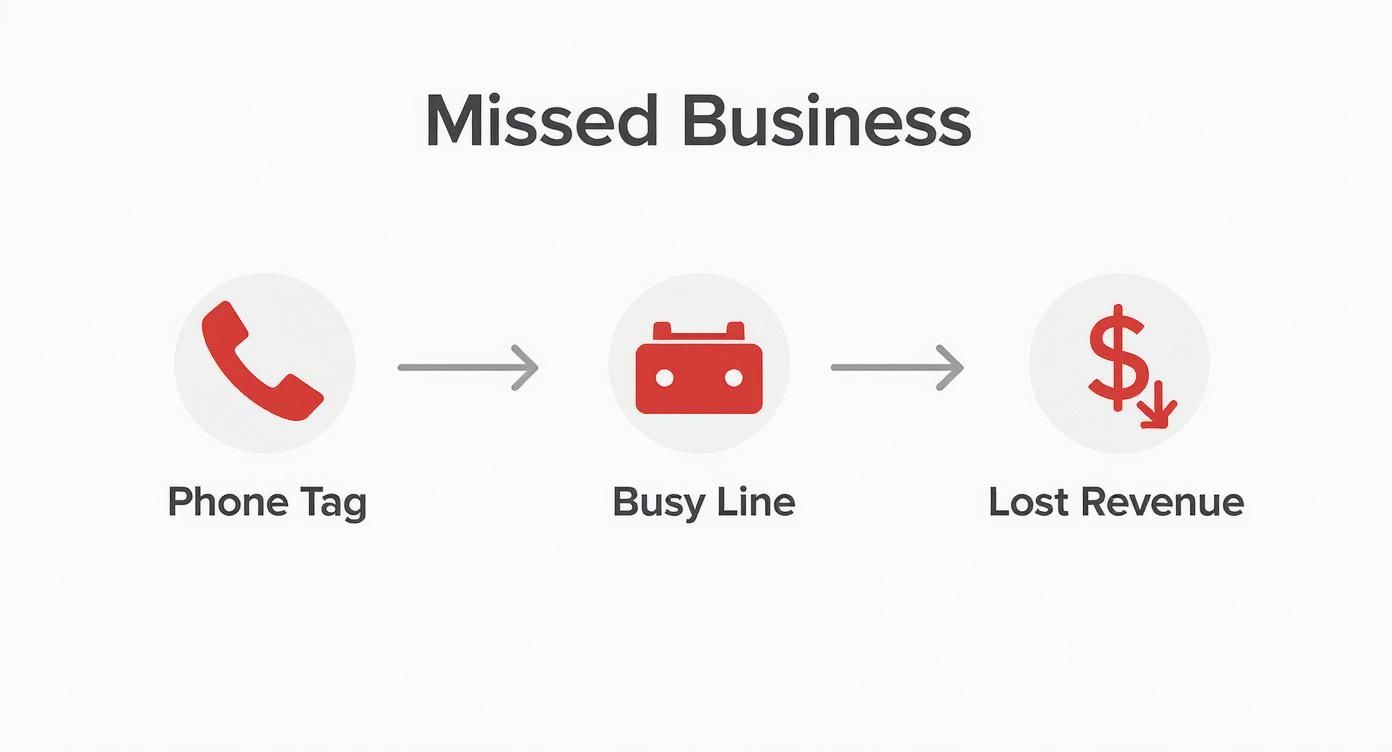
The diagram isn't just a concept; it’s the daily reality for movers still stuck with outdated communication methods. It shows a straight line from internal delays to real, tangible financial loss.
From Small Delays to Big Problems
These little communication hiccups don't stay little for long. They snowball into major operational headaches and financial hits. Every single misstep translates directly into wasted money and a black eye on your reputation.
- Wasted Fuel and Time: Sending a truck to the wrong side of town doesn't just burn fuel; it throws your entire day's schedule off, delaying every other job lined up.
- Frustrated Crews: Nothing annoys a crew more than getting last-minute changes or conflicting instructions. It tanks morale and is a fast track to high turnover.
- Angry Customers: Showing up late or unprepared is the quickest way to ruin a customer's experience. This is exactly how you end up with those brutal one-star reviews that can haunt your business for months.
The core issue with a telephone tree system is that it's built on a series of potential failures. It assumes every single person is available to answer their phone and relay information perfectly—an assumption that just doesn't hold up in the real world of a busy moving business.
The Hidden Costs of Manual Call Systems for Movers
The operational headaches that come with a manual telephone tree are one thing, but the real damage is to your bank account. Sticking with an old-school call system comes with serious costs—some obvious, some hidden—that chip away at your profits every single day.
The most direct hit is wasted payroll. Every hour your dispatcher or office manager spends playing phone tag to confirm a schedule is an hour they aren't quoting a new lead or dealing with a customer issue. That non-revenue time adds up fast, especially during peak season when every minute is money.
The True Price of a Missed Call
But the indirect costs? That's where the real bleeding happens. These are the expenses that don't show up on a payroll report but punch massive holes in your revenue pipeline.
- Lost Booking Opportunities: Every time a potential customer calls and gets a busy signal or voicemail, they don’t wait. They move on to the next mover on their list. You just lost that job—often worth $1,500 or more.
- Lower Booking Rates: Speed is everything. If a lead has to wait for you to call them back, their urgency fades, or another mover gets to them first. A slow response time is a direct hit to your booking rate.
- Wasted Marketing Dollars: You spend good money on Google Ads, local SEO, and flyers to make your phone ring. When you can't answer those calls, you're setting that marketing budget on fire.
A traditional manual phone tree can become a black hole for your team's time. For a list of just 100 contacts, you could easily burn through 200–300 calls just to get ahold of everyone, tying up your best people for hours. Modern automated systems can handle that for a tiny fraction of the cost.
The math is simple and brutal. One single lost moving job can often pay for an entire month of a front-office automation solution that provides 24/7 call answering and books jobs for you.
This financial reality makes the argument for upgrading impossible to ignore. This isn’t about adding a new expense; it's about plugging a major revenue leak.
Handling calls efficiently, especially those that come in after hours, is non-negotiable for growth. For movers looking to capture every single lead, exploring an after-hours answering service for small business can be a game-changing first step. At the end of the day, every missed call is a direct financial loss, and modern automation tools are designed to finally stop the bleeding.
Modern Alternatives That Actually Book More Jobs
Let's be honest: the old-school telephone tree just wasn't built for the speed of today's moving customer. It might have been fine for internal company announcements back in the day, but when a new customer is on the line, ready to book a move, it's a lead-killer.
The good news? The technology designed to capture those leads and book jobs has gotten incredibly powerful and simple to use. The journey from the first phone call in 1876 to today’s intelligent systems has been wild. For decades, everything was manual switchboards. It wasn't until VoIP arrived in the 1990s that the door opened for the kind of automated, smart systems we have now. If you're curious about the whole story, Ultatel.com has a great breakdown of phone history.
Auto-Attendants and IVR Systems
You’ve definitely run into an Auto-Attendant. It’s that pre-recorded voice that greets you with a simple menu: "Press 1 for Sales, Press 2 for Scheduling." For a moving company, it’s a decent first step away from a phone that just rings and rings. At least the customer knows they've reached the right place.
Interactive Voice Response (IVR) is the next step up. It's a bit smarter, capable of handling more complex routing. For example, an IVR could ask a caller if they need a residential or commercial quote, then send them to the right person. That’s a real improvement—it filters calls and saves your team from playing traffic cop.
But both of these systems share the same fatal flaw: they still need a human to be free to pick up the phone. If your sales manager is on another call or out doing an estimate, that hot lead still gets dumped into voicemail. And we all know what happens then—they call your competitor.
The AI Receptionist: A True Game-Changer
This is where you get a real competitive advantage. An AI Receptionist or AI Call Assistant does more than just forward calls—it actually handles them.
An AI Receptionist doesn't just pass a customer to your sales team; it is your sales team, available 24/7 to answer questions, capture every detail, and even book the job right then and there.
Instead of a clunky menu, a customer can just talk. They can ask, "Are you free the last weekend of the month?" or "What's a rough price for a two-bedroom apartment move?" The AI understands, provides answers, and captures all their contact info. It can even check your calendar and schedule an in-home estimate automatically, integrating call data directly into your calendar.
This isn't some far-off, futuristic idea. It's a practical tool that ensures you never miss a lead again. While your competitors are sending calls to voicemail after 5 p.m., your AI assistant is busy booking their customers for you.
To truly see the difference, let’s put the old way side-by-side with the new. The table below breaks down how a traditional phone setup stacks up against a modern AI assistant, especially for the day-to-day grind of a moving company.
Manual vs. Automated Call Systems for Moving Companies
| Feature | Traditional Telephone Tree | Modern AI Call Assistant |
|---|---|---|
| Availability | Limited to office hours; requires a human to answer. | 24/7/365. Answers every call instantly, even on nights, weekends, and holidays. |
| Lead Capture | High risk of missed calls and lost leads sent to voicemail. | Captures 100% of inbound leads, gathering all necessary details on the first call. |
| Booking Ability | Can only route calls; a salesperson must be free to book. | Can quote jobs, check availability, and book moves directly into your calendar/CRM. |
| Customer Experience | Can be frustrating with long hold times and complex menus. | Natural, conversational interaction. Answers questions instantly without hold times. |
| Scalability | Struggles during busy seasons; requires hiring more staff. | Handles unlimited simultaneous calls without extra cost or staff. |
| Cost Efficiency | High overhead (salary, benefits). Cost of missed leads is huge. | Low monthly fee. Delivers a clear ROI by recovering lost revenue and reducing labor. |
The contrast is pretty stark. One system is a relic that costs you money, while the other is a tool built specifically to make you money by ensuring no lead ever falls through the cracks again.
Making the Switch to an Automated Call System
Upgrading your phone system probably sounds like a massive technical headache. I get it. Movers are busy running their business, not managing IT projects. But moving on from an ancient telephone tree is way simpler than you think. Modern automation tools are built for busy moving company owners, not tech gurus.
The goal isn't to add another complicated piece of software to your plate. It's about finding a dead-simple tool that starts paying for itself on day one by catching all the jobs you used to miss.
Think of it as a business upgrade, plain and simple. You're plugging a revenue leak that’s likely costing you thousands of dollars every single month. The whole process really just boils down to a few practical steps.
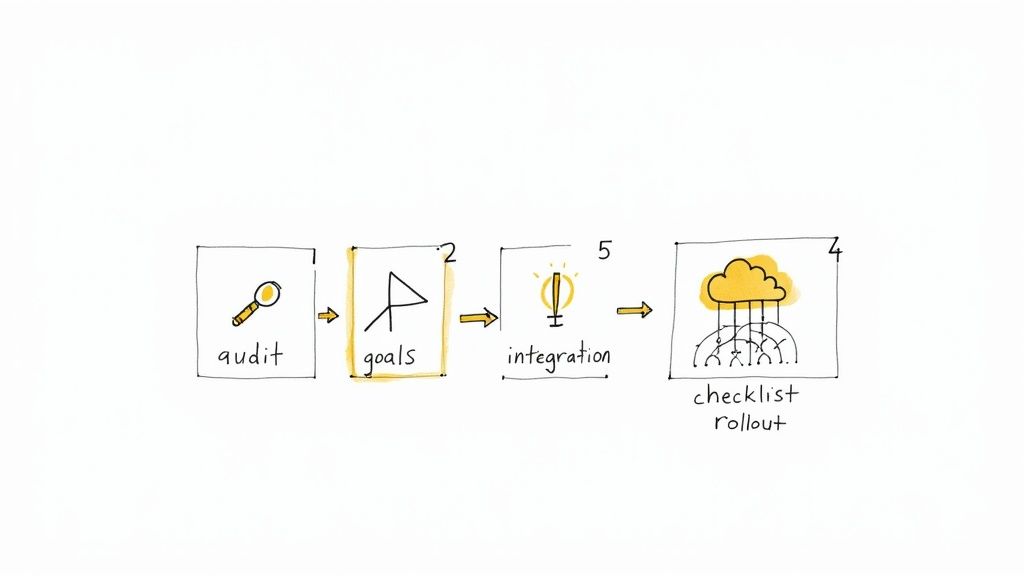
Your Four-Step Rollout Plan
This isn't about tearing down your entire operation. It's a targeted fix for your single biggest point of failure—missed calls.
-
Audit Your Current Call Process: First, figure out where the real pain is. Are most of your missed calls piling up after hours? Is it during that chaotic morning rush when dispatch is busy? Pinpoint exactly when and why leads are slipping away. Knowing this helps you find a solution that solves your specific problem.
-
Set a Clear Goal: What's the number one thing you want to accomplish? Maybe it's to "never miss another peak-season call" again. Or perhaps it's to finally capture every lead that calls on a weekend. Having a simple, clear goal keeps this transition focused on what actually matters: booking more moving jobs.
-
Prioritize Simple Integration: Your new system has to play nice with the tools you already use. Look for something that connects directly to your existing calendar (like Google Calendar) or your CRM. Automation that creates more manual work is worthless. It needs to "just work" with your current setup.
-
Follow a Simple Rollout Checklist: A good provider will give you a clear, step-by-step guide to get up and running. This usually just involves forwarding your existing business number and setting up your office hours. The entire process should take a few minutes, not days of frustration.
The key is to stop seeing this as a tech project. It's a strategic move to boost revenue. The right system should feel like flipping a switch—one that immediately stops you from losing valuable after-hours leads and starts turning those missed calls into booked jobs.
This upgrade is part of the game for modern movers who want to stay competitive. To go a bit deeper, you can learn more about how to stop losing after-hours leads without working 24/7 in our detailed guide. By focusing on automation that gets you immediate results, you can modernize your front office without skipping a beat.
Why Winning Movers Are Automating Their Front Office
In the moving business, speed is everything. The company that answers the phone first almost always wins the job. Sticking with a manual telephone tree system is like giving your competitors a head start on every single lead you pay for. It’s slow, clunky, and goes against what a modern customer expects.
Let's be blunt: automation gives you a massive competitive advantage. Switching from a manual process to an AI-powered one isn't just about looking modern. It's about grabbing every lead, giving customers instant answers, and booking more jobs without hiring more people. This gets you and your dispatchers off the phone so you can focus on running and growing the business.
Think of automation not as another expense, but as your best investment in building a more profitable, efficient moving company. The right systems don't just answer calls—they turn them into booked jobs, ensuring you never lose another dollar to voicemail.
For any moving company trying to grow, the path forward is clear. Automation is the most direct way to increase efficiency, delight customers, and secure your spot as a leader in a tough local market. Taking a look at modern moving company software is the first step toward building a front office that works for you 24/7, turning every single call into a real opportunity.
A Few Common Questions
If you're running a moving company, you've probably got some real-world questions about switching up your phone system. I get it. Here are some straight answers to what I hear most often from owners.
"Is This AI Stuff Too Complicated for My Small Company?"
Not a chance. Honestly, the new AI receptionists are built for operators who don't want to be IT experts. Getting started is usually as simple as forwarding your main business number. That’s it.
There's no hardware to install or clunky software to learn. The whole point is for it to "just work" the second you turn it on, so you can spend your time running moves, not fiddling with tech. Movers need automation that works, not another software headache.
"Will My Customers Hate Talking to a Robot?"
This is the biggest hang-up I hear, and it’s a fair one. We’ve all been stuck in those awful, robotic phone menus. But today’s AI is a completely different animal. Think of it less like a robot and more like a super-efficient assistant who never takes a day off.
Instead of hitting your voicemail and hanging up, customers get an instant, helpful response. The AI can give them a quote on the spot, answer questions about packing, and book an estimate, 24/7. It's a massive step up from the alternative—making them wait for a callback, which is exactly when you lose them to the next moving company on their list.
"How Much Money Am I Really Losing with Missed Calls?"
It's probably more than you think. You can get a rough idea with some quick back-of-the-napkin math. It really puts the financial hit of a ringing, unanswered phone into perspective.
Here’s the simple formula:
(Your Average Job Value) x (Weekly Missed Calls) = Weekly Lost Revenue
Let's say your average move is worth $1,500. If you miss just four calls a week—maybe one during a busy dispatch, a couple after hours, one on a Saturday—you're looking at $6,000 in potential revenue gone. Every. Single. Week.
That adds up to over a quarter of a million dollars a year in missed opportunities. It shows just how much every single call matters.
Ready to stop sending leads to voicemail and start booking more jobs without lifting a finger? See how MoveJoy uses AI to answer every call, provide instant quotes, and schedule moves for you 24/7. Discover how MoveJoy can transform your front office.