How to Start a Moving Company: A Guide to Your First Year
Starting a moving company is about more than just a truck and some muscle; it’s about building a rock-solid legal and operational foundation from day one. I’m talking about critical decisions like choosing an LLC over a sole proprietorship, getting your USDOT number, and securing the right insurance. Nail this stuff from the start, and you’re building a real business, not just buying yourself a job.
Building Your Legal and Operational Foundation
Before you lift a single box, the choices you make here will define your company's future. This isn't just paperwork; it’s the framework that shields you from personal liability, keeps you compliant, and sets you up for profitable growth. Too many new owners rush this stage, only to get hit with fines or, worse, personal financial ruin down the road.
The moving industry is accessible, but it's also crowded. In 2023, there were 16,851 registered moving companies in the U.S., most operating with small crews. That’s your opening. You can compete effectively as a lean, agile team if you look and act like a professional operation from the moment you launch.
Choosing Your Business Structure
Your first major decision is how to legally structure your business. For most new moving company owners, it boils down to two options: a Sole Proprietorship or a Limited Liability Company (LLC).
- Sole Proprietorship: This is the quickest route. You and the business are legally the same entity. While simple to set up, it offers zero personal liability protection. If your company gets sued or racks up debt, your personal assets—your house, car, and savings—are at risk.
- Limited Liability Company (LLC): An LLC creates a legal separation between you and your business. This is the path I recommend for 99% of new moving companies. It protects your personal assets from business debts and lawsuits, giving you the peace of mind that one bad day on a job won't threaten your family's finances.
Key Takeaway: A sole proprietorship seems easy, but forming an LLC is a critical investment in your future. The small upfront cost is nothing compared to the risk of losing your personal assets.
Navigating Licenses and Operating Authority
You can't just start hauling furniture across town. You need specific federal and state credentials. This isn't optional—getting caught without the right authority can lead to crippling fines and having your truck impounded on the spot.
First, nearly every mover needs a U.S. Department of Transportation (DOT) number. This is your unique ID with the Federal Motor Carrier Safety Administration (FMCSA), used to track your company's safety record. Even if you only plan on doing local moves, many states now require a DOT number for any commercial vehicle.
Next, you need to determine your operating authority, which depends entirely on where you plan to work.
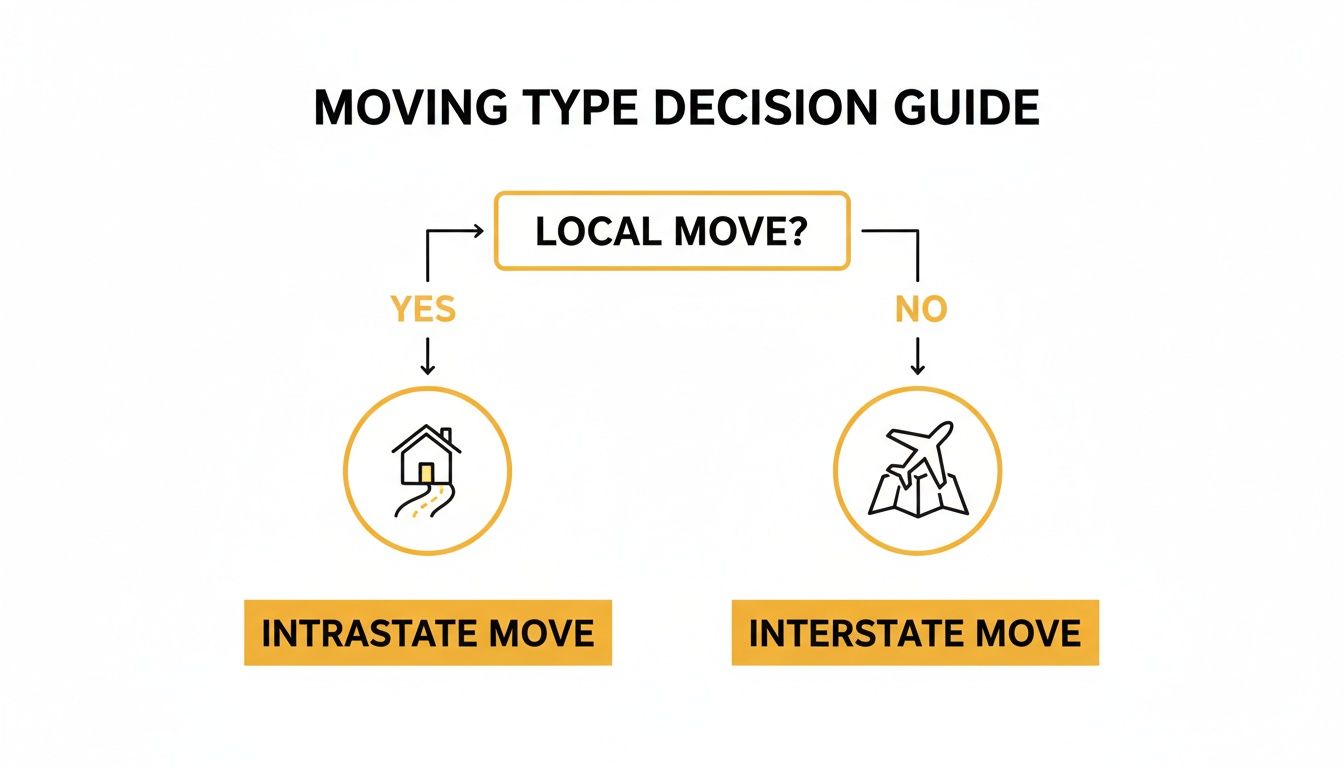
As the chart shows, your regulatory journey is shaped by whether you're staying local (intrastate) or crossing state lines (interstate).
- Intrastate Authority: For moves that start and end within a single state. These rules are managed by your state’s DOT or public utility commission.
- Interstate Authority: For any move that crosses a state line. This requires a Motor Carrier (MC) number from the FMCSA, in addition to your DOT number.
Before you file for an LLC, your first step should be to nail down how to write a comprehensive business plan. A solid plan forces you to decide if you're starting local or aiming for interstate jobs, which will guide every licensing decision you make.
Startup Legal and Compliance Checklist
Here’s a quick-reference guide to the essential legal steps for launching your moving company. Think of this as your "don't-mess-this-up" list.
| Task | Why It's Critical | Pro Tip |
|---|---|---|
| Choose Business Structure (LLC) | Protects your personal assets (home, car) from business debts and lawsuits. | Use a registered agent service to handle state filings and keep your home address private. |
| Register Your Business Name | Secures your brand and prevents others in your state from using the same name. | Check if the domain name and social media handles are available before you register the name. |
| Obtain an EIN | The IRS requires an Employer Identification Number to hire employees and open a business bank account. | You can apply for an EIN for free on the IRS website. Don't pay a service to do it. |
| Get a USDOT Number | Required by the FMCSA for interstate moves; many states now require it for intrastate moves too. | Apply online through the FMCSA's Unified Registration System (URS). It’s faster than mail. |
| Secure Operating Authority (MC Number) | If you cross state lines, you need an MC number to operate legally. Fines are steep without it. | The application includes a mandatory 21-day public vetting period. Factor this delay into your launch timeline. |
| Open a Business Bank Account | Keeps business and personal finances separate, which is crucial for liability protection and taxes. | Look for a bank with low fees and good online tools. Don't just use your personal bank for convenience. |
Checking these items off isn't the most exciting part of starting your company, but it’s the bedrock. A strong legal and compliance foundation lets you focus on what really matters: booking more moving jobs and growing your business.
Equipping Your Company for the First Move
Your reputation is built one move at a time, and it all comes down to your crew and your equipment. The right gear doesn't just make the job possible; it signals professionalism to your customers. Skimping here is a fast track to damaged furniture, injured employees, and a brand image that’s broken before you even get started.
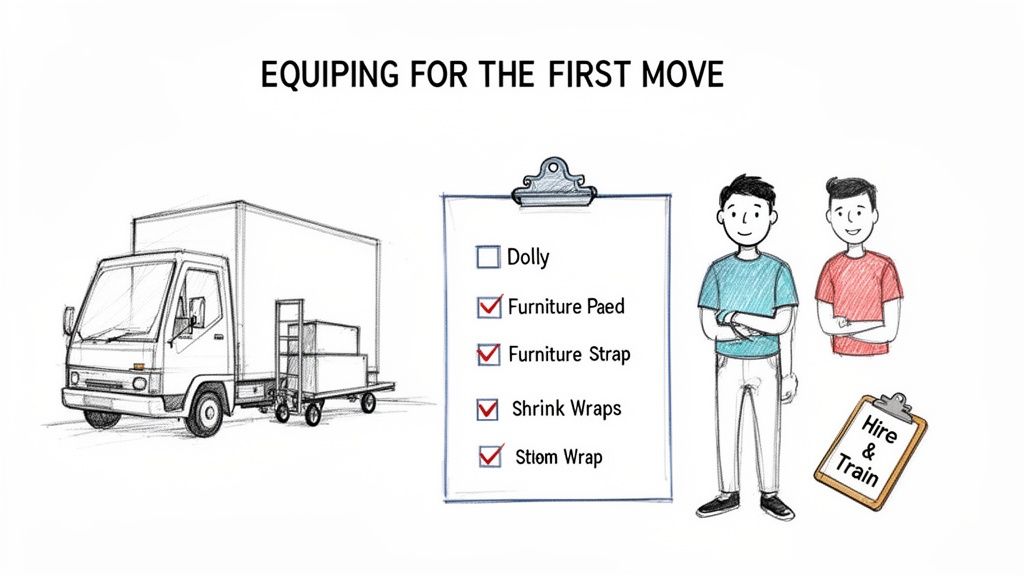
This is where your business plan meets reality. The choices you make now—from the truck you pick to the people you hire—will directly impact whether you can deliver a five-star experience and turn a profit.
Your First Truck: Buy, Lease, or Rent?
For any new moving company owner, the truck is the single biggest investment. This one decision will have a massive impact on your startup costs and monthly overhead. You have three main paths, each with serious pros and cons.
- Renting: Using U-Haul or Penske for daily rentals is the easiest way to start. It’s perfect for your first few jobs when demand is unpredictable. The problem? The daily cost is brutal, it makes you look less professional, and it will destroy your profit margins if you rely on it for too long.
- Leasing: This is the middle ground. Leasing a truck requires less cash upfront than buying and often includes maintenance, making your monthly budget predictable. The downside is you're locked into a multi-year contract without building equity. It’s a solid choice for new owners who have some steady work but need to conserve cash.
- Buying: Purchasing a new or used truck is a major financial leap, but you own a real asset. You build equity, have total control over branding, and your long-term costs will be lower. The risk is significant, though. Every maintenance and repair bill is on you, and those costs can be wildly unpredictable.
For most startups, leasing a single 16-foot or 26-foot box truck hits the sweet spot. It offers the best balance of professionalism, predictable costs, and manageable financial risk.
Assembling Your Essential Gear Kit
A truck is just a big empty box without the right tools to safely move a customer’s life. Trust me, you do not want to get caught on a job without the basics. Your starter kit is non-negotiable.
The Must-Have Equipment Checklist:
- Appliance Dolly: You absolutely need this for refrigerators, washers, and other heavy, awkward items. Don’t even think about starting without one.
- Furniture Dolly (4-Wheel): This is your workhorse for dressers, couches, and large furniture. Get at least two.
- Furniture Pads/Blankets: You can never have too many. Seriously. Start with at least two dozen. They are your first line of defense against scratches and dings.
- Ratchet Straps & Tie-Downs: These are critical for locking everything down in the truck so it doesn't shift in transit.
- Shrink Wrap & Tape: You’ll use this to protect upholstered furniture from dirt and to wrap pads tightly around items.
- Basic Tool Kit: A decent set with wrenches, screwdrivers, and Allen keys is a must for taking apart and reassembling beds and tables.
Investing in quality equipment from day one prevents costly damage claims and shows customers you take their belongings seriously. A broken dolly or a ripped moving blanket can turn a profitable job into a net loss in an instant.
Hiring Your First Movers
The people you hire are the face of your company. They are in your customers' homes, handling their most valuable possessions. Finding the right crew is about much more than just raw strength; it's about finding people who can be ambassadors for your brand.
Look for people who have:
- Problem-Solving Skills: Every move has a surprise challenge, like a sofa that won't fit through a door. You need movers who can think on their feet, not just stare at the problem.
- Customer-First Attitude: A friendly, respectful mover who communicates clearly can defuse a stressful situation and earn you a glowing review.
- Reliability and Punctuality: Showing up late is one of the fastest ways to destroy a customer's trust before you’ve even lifted a box.
Train your team not just on how to lift safely, but on how to talk to customers. A simple introduction, a quick walkthrough of the game plan, and clear communication throughout the day can turn a standard move into a premium experience. As you grow, using effective moving company software can take the headache out of scheduling and dispatch, ensuring your well-trained crews are always in the right place at the right time.
Pricing Your Services for Profitability
Profit in the moving industry isn't made on move day—it's won or lost in the quote. Your pricing strategy is the single most important lever you have for growth. Get it right, and you're building a sustainable business. Get it wrong, and you've just bought yourself a tough, low-paying job.
Many new owners fall into the same trap: they call a few local competitors, get their rates, and price themselves just a little bit lower. This is a race to the bottom. You have no idea what their truck payments, insurance costs, or labor expenses are.
Sustainable profit comes from knowing your own numbers, inside and out. You need to price your services to guarantee a healthy margin on every single job.
Calculating Your True Operational Costs
Before you can determine what to charge a customer, you need to know what it costs to run your business. This is your break-even number, and you can't afford to guess. Track every single expense, both fixed and variable.
Your Core Costs Breakdown:
- Vehicle Costs: This isn't just the truck payment. It's fuel, insurance, regular maintenance, and a separate fund for unexpected repairs. A blown transmission can happen, and it can't be what sinks your business.
- Labor Costs: Don't just look at the hourly wage. Add in payroll taxes, workers' compensation insurance (which is non-negotiable), and any benefits you offer.
- Equipment Costs: Dollies break, pads get torn, and straps disappear. You have to factor in the cost of replacing and repairing this essential gear.
- Marketing & Sales: What are you spending to make the phone ring? This includes your website, Google Ads, lead service fees, and any call management systems.
- Overhead: This is the boring stuff that adds up fast. Office rent, phone bills, business insurance, and software subscriptions all go here.
These costs are not static. From 2020 to 2024 alone, the combined costs for vehicles and drivers shot up by a staggering 37.3%. With fuel, labor, and insurance all jumping 30-80% in that same window, you can see why pricing based on old numbers is a death sentence.
Choosing the Right Pricing Model
Once you have a rock-solid understanding of your costs, you can decide how to charge for your work. In residential moving, it usually boils down to two models: hourly rates or flat-rate quotes.
- Hourly Rates: This is the standard for most local moves. It's simple for customers to understand and protects you if a job runs longer than expected. The key is to set a minimum, like a 3-hour minimum, to ensure the job is profitable enough to cover your travel time and setup.
- Flat-Rate Quotes: This is your go-to for larger moves or any long-distance job. Customers love the price certainty, which can be a huge selling point. But be warned: the risk is entirely on you. If you underestimate the time or difficulty, you eat that loss, not the customer.
Pro Tip: For any flat-rate job, build a 15-20% contingency buffer into your price. This is your margin of safety. It protects you from the inevitable surprises, like a service elevator that’s out of order or a customer who wasn't fully packed.
Whether you're quoting by the hour or giving a flat rate, your ability to estimate accurately is everything. You need a system. Ask detailed questions on every call. Our guide on creating a moving company estimate template provides a framework to build that system.
You have to account for the variables that kill profitability: the long carry from the truck to the door, five flights of stairs, an antique piano, or a ridiculously heavy gun safe. Overlook those details, and you're essentially paying to move someone's stuff.
At the end of the day, your pricing directly drives your cash flow. And it's not just about the quote. Implementing smarter client billing strategies can reduce administrative headaches and get cash in the door faster, which is just as important as the price itself.
Your Go-to-Market Sales and Marketing Playbook
You’ve got a truck, equipment, and a crew ready to work. But right now, they're just costing you money. The phone needs to ring. Your go-to-market playbook is your battle plan for landing those first critical jobs and building momentum.

Forget about expensive billboards or complex ad campaigns for now. Your focus should be on high-impact, low-cost strategies that put you directly in front of local customers who need a mover today.
Dominate Your Local Digital Footprint
Before you do anything else, claim and obsessively optimize your Google Business Profile (GBP). This is your digital storefront. For a local moving business, it’s the single most powerful free marketing tool you have.
- Fill Out Everything: Don't skip a single section. List your service areas, hours, and write a detailed business description that connects with potential customers.
- Show, Don't Tell: Get high-quality photos of your branded truck, your uniformed crew, and your equipment. Look professional from the start.
- Get Reviews Immediately: Ask your very first customers for a review the second the job is done. A profile with zero reviews is a major red flag for potential clients.
Once Google is handled, get your company name, address, and phone number listed consistently on key local directories—think Yelp, Angi, and Thumbtack. This builds your local SEO and puts you where people are actively searching for movers.
Build Your Referral Engine
Your next move is to build a network of people who are constantly talking to someone about to move. These relationships can become a pipeline of high-quality, ready-to-book leads that cost you almost nothing.
Here’s who you need to connect with:
- Real Estate Agents: They are on the front lines of every home sale. Offer a small, reliable referral fee for any booked job they send your way. Make their lives easy, and they’ll keep calling.
- Property Managers: Apartment complexes have constant turnover. Become their go-to mover for new tenants.
- Storage Facility Managers: People who need storage often need movers, and vice versa. It’s a natural partnership.
Get active in local community Facebook groups. Don't just spam your link; offer genuinely helpful advice on packing or moving logistics. When someone asks for a mover recommendation, you'll be top of mind. For a deeper dive, our guide on how to get moving leads has more strategies you can use today.
Speed to Lead Is the New Standard
In the moving business, speed wins. The customer calling you is also calling two or three of your competitors. The company that answers the phone and provides a quote first is overwhelmingly the one that books the job.
Every time your phone rings and you can't answer—because you're on a job, driving, or it's after hours—you are handing that customer to your competition. This isn't a small leak; it's a hole in your revenue bucket that can cost you 3-7 jobs every single month.
This is where automation becomes a powerful competitive advantage. Imagine a system that answers every single call, 24/7. It doesn’t need breaks, doesn't get tired, and never misses a lead. This technology exists now. An AI receptionist can answer the phone, understand what the caller needs ("I'm moving a two-bedroom apartment"), and instantly text them a link to get a professional quote. It can capture every lead without you lifting a finger. Suddenly, your one-truck operation has the responsiveness of a huge company with a full-time sales staff.
The table below breaks down just how different the game is when you automate lead capture.
Lead Capture Methods: Manual vs. Automated
| Feature | Manual Process (Owner Answering) | Automated System (AI Receptionist) |
|---|---|---|
| Availability | Limited to when you're free; misses calls on jobs & after-hours. | 24/7/365. Never misses a call, even at 10 PM on a Saturday. |
| Response Time | Minutes to hours (if you have to call back from voicemail). | Instant. Answers in under 2 seconds, every time. |
| Quoting Speed | Depends on you stopping what you're doing to calculate. | Immediate. Captures info and sends a quote link during the call. |
| Booking Process | Manual entry into calendar/CRM, requires follow-up. | Automated. Feeds lead data directly into your booking system. |
| Lost Leads | High. Any missed call is a likely lost job. | Minimal. Captures details from nearly every caller. |
| Cost | "Free" in dollars, but costs you thousands in lost revenue. | Low monthly fee, often paid for by booking one extra job. |
The difference isn't just about convenience—it's about survival and growth. Relying on yourself to answer every call is a recipe for lost revenue and burnout.
The industry is already shifting. After a tough 2024 where only 44% of movers hit their revenue goals, the focus for 2025 is squarely on growth and profitability. The best companies are using smart technology to capture every opportunity. Adopting efficient systems from day one is how new movers can compete. You can get more insights from the 2025 State of Moving report on smartmoving.com.
A system for 24/7 lead capture isn't a luxury; it's the tool that gets you there. One booked job that you otherwise would have missed often covers the system's cost for the entire month, making it one of the highest-ROI investments you can make.
Scaling Your Operations for the Long Haul
Once you’re consistently booking jobs, the game changes. The problem shifts from finding work to managing it without dropping the ball. This is where many promising moving companies hit a wall, breaking under the pressure of their own success. To grow sustainably, you need a scalable framework from the moment you consider adding a second truck.
The secret isn’t just working harder; it’s building systems that handle more volume without multiplying your chaos.
Nailing Your Day-to-Day Operations
As you grow, simple tasks get complicated. What worked with one truck will fall apart with two. You need a rock-solid system for dispatching crews, communicating with customers, and ensuring every job runs like clockwork.
Good dispatching is a strategic puzzle. You have to juggle travel times, crew skills, and the unique needs of each move. A poorly planned schedule leads to late crews, exhausted movers, and angry customers—all of which poison your online reviews.
Proactive communication is the other piece. Instead of waiting for a customer to call asking where the truck is, your system should send automatic reminders, confirmations, and "on-the-way" texts. These small touches prevent big headaches and make you look incredibly professional.
The Smart Way to Grow Your Front Office
Most owners think the next step for growth is hiring an office manager. While that day might come, adding another salary too early can cripple your profits. There’s a smarter, more cost-effective way to bridge that gap: automation.
Instead of adding another person to the payroll, use technology to handle the repetitive tasks that bog you down.
Here’s what to automate first:
- Quote Follow-Ups: How many quotes do you send that disappear into a black hole? An automated system can send perfectly timed texts and emails to nudge those clients, turning cold leads into booked jobs while you’re on a move.
- Review Requests: Manually asking every customer for a review is inconsistent. Automation can send a thank-you message with a direct link to your Google Business Profile the second a job is marked complete, striking while the positive experience is fresh.
- Appointment Reminders: Stop wasting time and fuel on last-minute cancellations. Automated reminders are a simple fix that saves you real money.
The goal is to build a front office where adding a second or third truck strengthens your business instead of breaking it. You want to grow revenue, not just overhead and stress.
Laying the Foundation to Actually Scale
Think of your business like a machine. In the beginning, you can power it yourself. But as it gets bigger, you need a more powerful engine. For your front office, automation is that engine. It creates a standardized, efficient process for every lead and every customer, no matter how busy you are.
This lets you focus your time and money on what truly drives growth—buying more trucks, training elite crews, and delivering a killer on-site experience. An AI receptionist, for example, can ensure 100% of your calls are answered and every lead gets an instant response. That alone gives you a massive edge over competitors who let calls go to voicemail.
By systemizing your operations and automating admin work, you build a company that can scale smoothly. This isn't about replacing people; it's about empowering your team to focus on high-value work while technology handles the grind. This is how you build a business that runs itself, instead of one that runs you into the ground.
Got Questions About Starting Your Moving Business? We've Got Answers.
Even with a solid plan, you'll have questions. You're not alone. Here are straight answers to what we hear most from new moving company owners.
How Much Cash Do I Actually Need to Start?
The honest answer is: it depends. The biggest variable is your first truck.
Realistically, for a single-truck operation, you should budget between $15,000 and $50,000. That covers your truck down payment (or first lease payment), insurance deposits, licensing and fees, initial equipment, and a small marketing budget to get the phone ringing.
Leasing a truck will lower that initial cash outlay, but you'll likely pay more over the long haul. Crucially, don't drain your bank account on day one. You absolutely need 3-6 months of operating expenses in reserve as a cushion to cover bills before jobs start rolling in consistently.
What’s the #1 Mistake New Moving Company Owners Make?
Easy: underpricing their services because they don't really know their numbers. New owners often just look at a competitor's rates and try to beat them, without ever calculating their own break-even point. This is a recipe for working yourself to the bone for zero profit.
You must factor in every "hidden" cost: insurance premiums, the price of fuel, vehicle maintenance, marketing dollars, software subscriptions, and your own salary. The second biggest mistake? Not having a bulletproof system to handle inbound calls, which means you're losing money before you even realize it.
Okay, So How Do I Get My First Paying Customers?
Start with the people who already know and trust you—friends, family, and former co-workers. A professional flyer shared in local Facebook groups can also work wonders.
Your most powerful free tool is your Google Business Profile. Set it up, fill out every single section, and upload quality photos. Then, network with people who are already talking to your future customers: real estate agents, apartment managers, and storage facility managers. Offer a fair referral fee for any jobs they send your way. Your mission for these first gigs is simple: deliver such an amazing experience that they can't help but leave you a glowing review.
Here's the deal: Your first ten customers aren't just about revenue. They are the foundation of your marketing. The reviews and word-of-mouth they generate will fuel your growth far more than any ad campaign you could buy at the start.
When Should I Think About Using Something Like an AI Receptionist?
You should be thinking about it from day one. This isn't futuristic tech for massive companies anymore; for a startup, it's a critical competitive advantage.
The second you miss your first call because you're driving or on a job, you've lost potential income. An AI receptionist ensures 100% of your leads get an immediate, professional response, 24/7. The profit from just one booked job that you otherwise would have missed often covers the cost of the service for an entire month. The ROI is immediate.
It lets a one-truck operation project the image and responsiveness of a much larger company. In a competitive local market, that's not just a nice-to-have—it's how you win.
Ready to build a moving company that never misses a lead? MoveJoy provides the 24/7 AI Receptionist that captures every call, sends instant quotes, and books jobs for you—so you can focus on the move, not the phone. Discover how you can automate your front office from day one at https://getmovejoy.com.