Prospect to Customer: The Moving Company’s Playbook to Turn Leads Into Booked Jobs Fast

Every time your phone rings and goes to voicemail, you're not just missing a call—you're handing a profitable job directly to your competition. In the moving business, turning a prospect into a customer comes down to two things: speed and a dead-simple process.
This is your playbook for closing the gap between the first ring and a confirmed job on your dispatch calendar. For owners of 1-20 truck operations, mastering this is the key to predictable revenue, especially when seasonal demand gets chaotic.
Your Blueprint for Higher Booking Rates
For a small moving company, a missed opportunity isn't just a lost sale. It’s a direct hit to your revenue, especially when you're slammed during peak season. Generic advice is useless here. You need a process built for the specific operational challenges of the moving industry—from quoting accurately to managing dispatch.
That means owning the first conversation, sending instant quotes that actually win the job, and following up in a way that feels helpful, not desperate.
The path from a curious caller to a booked customer has a few make-or-break moments. If you can nail these, you'll stop watching good leads disappear into thin air. Of course, a solid process only works if you have good leads coming in. You can learn more about how movers can fill their pipeline and boost revenue in our guide on getting moving leads.
Here's a quick look at the journey every prospect takes.
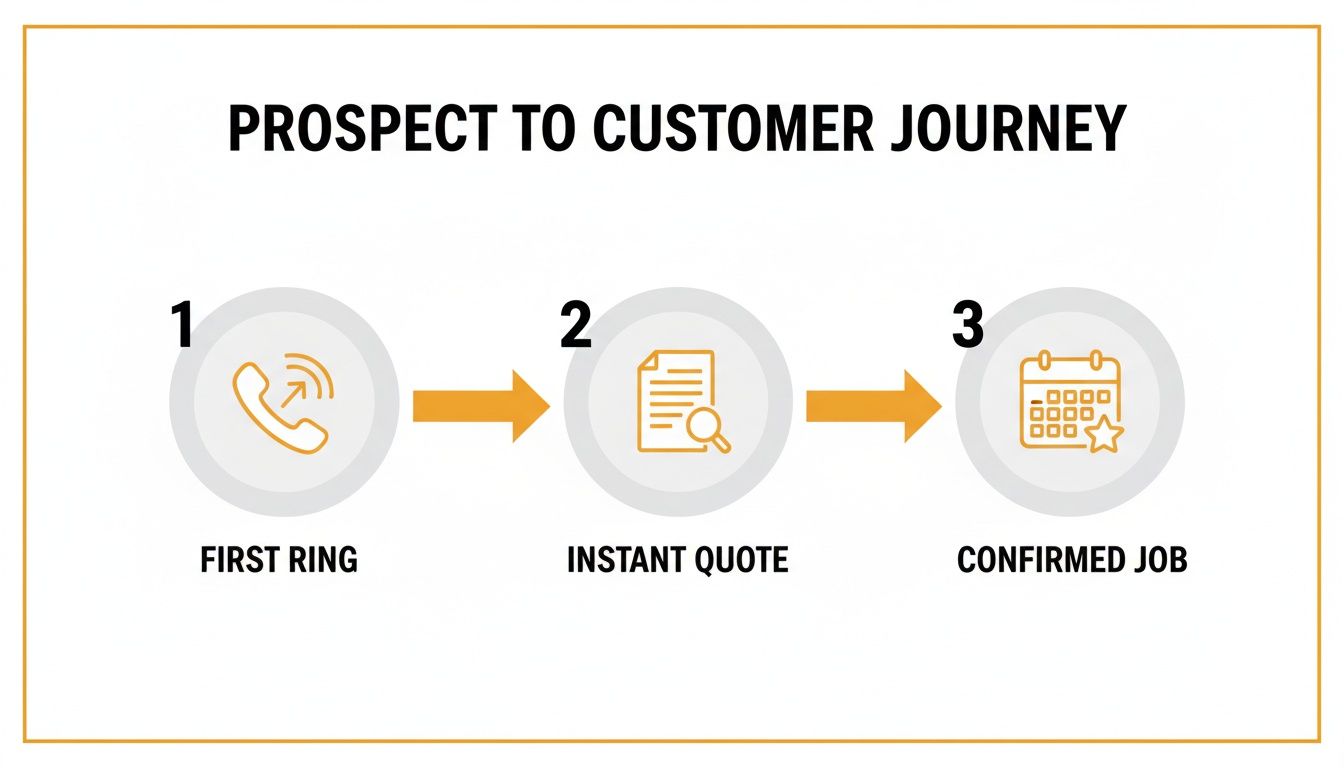
This whole process boils down to flawlessly executing three distinct phases: capturing their interest immediately, getting them a compelling quote fast, and locking in the job. Each stage is a chance for a prospect to either drop off or move one step closer to paying you.
To give you a clearer picture, here’s a breakdown of the key stages and what you need to accomplish at each one.
The Moving Prospect to Customer Journey
| Stage | Primary Goal | Key Action Item |
|---|---|---|
| Initial Contact | Capture the lead immediately. | Answer the phone live, 24/7. |
| Quote Delivery | Provide a fast, accurate estimate. | Send an instant quote via text/email. |
| Follow-Up | Stay top-of-mind without being annoying. | Use automated, timely check-ins. |
| Booking | Make it easy for them to say "yes." | Offer online booking or a calendar hold. |
| Confirmation | Lock in the details and build trust. | Send an immediate confirmation and reminder. |
As you can see, every step is designed to remove friction and keep the momentum going. Lose that momentum, and you lose the customer.
The real challenge for most moving companies isn't a lack of calls; it's the operational bottleneck that comes from trying to manage these stages. When you and your crew are out on a job or handling dispatch, calls go to voicemail. Quote requests sit in an inbox for hours. This is where smart automation provides a massive competitive advantage.
The moving company that responds the fastest almost always wins the job. Your entire process, from start to finish, has to be built for speed.
Imagine having an AI receptionist that handles this for you. It answers every call, 24/7. It gathers all the necessary job details. It can even send an instant quote via text message. Suddenly, you're not missing any leads, and every prospect gets a professional, immediate response—setting you up to book more jobs without creating more work for your team.
Mastering the First Call to Build Instant Trust
That first phone call? It’s everything. The first 30 seconds will often decide whether you book the job or that prospect hangs up and calls the next mover on their list. Speed, empathy, and a professional tone aren't just nice-to-haves; they are the foundation for turning a curious caller into a paying customer.
When someone calls you, they’re probably stressed. They’re looking for an expert—someone confident and organized who can solve their immediate problem. Your job isn't just to collect their information; it's to instantly build trust and make them feel like they’ve finally called the right place.
The Anatomy of a Perfect Intake Call
Your intake process needs to be a well-oiled machine. It should feel like a smooth, professional consultation, not a clunky interrogation. Every question should have a clear purpose, guiding the conversation toward a quote while making the customer feel understood.
Here’s a simple, effective structure for that first conversation:
- The Opener: A warm, professional greeting that clearly states who you are. Try something like, "Thanks for calling [Your Company Name], this is [Your Name]. How can I help you with your move today?"
- The Core Details: Get right to the key info you need for a quote. This means the move date, current and new addresses, and the size of the home (e.g., two-bedroom apartment, three-bedroom house).
- The Specialty Items: Always, always ask about the tricky stuff. "Are there any particularly large, heavy, or delicate items we should know about, like a piano, safe, or large artwork?" This shows you know what you’re doing and are thinking ahead.
- The Logistics: Don't forget about access. "Will our truck have easy access at both locations, or are there any long carries, stairs, or tricky driveways to consider?"
Nailing this conversation is a non-negotiable skill. To dig deeper into why getting it right the first time is such a game-changer, check out our guide on first call resolution.
Handling Common Objections with Confidence
Prospects are almost guaranteed to have questions about two things: price and availability. How you handle these conversations is key to staying in control and steering the call toward a booking.
When a caller pushes back on your price, don't get defensive. Explain the value behind the number.
Pro Tip: Instead of just saying, "That's our rate," try this: "I understand. Our rate includes a fully-equipped 26-foot truck, two professional and insured movers, padding for all your furniture, and our commitment to getting your move done efficiently and safely. We focus on providing a stress-free experience from start to finish."
This little shift reframes the discussion from cost to value, which puts you in a much stronger position.
While movers don't do much outbound cold calling, the data from that world tells us something important. Cold calling success rates are dismal, hovering around a meager 2-3%. A recent study of over 200,000 calls confirmed a conversion rate of just 2.3%—a steep drop from years past.
What does that tell us? When a prospect chooses to call you, that inbound lead is pure gold. It's incredibly valuable and deserves to be handled perfectly, every single time. A single missed call is a lost revenue opportunity you can't get back.
This is exactly where an automated system provides a massive advantage. An AI-powered receptionist ensures every single one of these high-intent calls gets answered 24/7, day or night. It can ask all the right qualifying questions, capture every critical detail, and make sure you never lose a lead to voicemail just because you were on another job or it was after hours.
Sending Quotes That Close the Deal Faster
When a prospect asks for a quote, they’ve already decided they need a mover. Now, they're just deciding which one. Their patience is thin, and in this business, speed isn't a bonus—it's the single most important factor in turning that prospect into a customer.
If you take hours to send back a price, you've likely already lost the job to a competitor who was faster. Simple as that.
This is the moment to dial in your quoting process for both speed and impact. The goal is to get a professional, easy-to-understand estimate into their hands the moment the initial call ends.
From Call to Quote in Seconds
Manually creating and emailing a PDF quote is a major operational bottleneck. By the time you get back to the office, find the right template, and fill in the details, that hot lead has gone completely cold.
The only real solution is to automate this step entirely.
Imagine a workflow where as soon as your team (or an AI receptionist) hangs up the phone, an accurate estimate is automatically sent to the prospect via text and email. This isn't just about being quick; it's about looking incredibly organized and professional, which builds immediate trust. For a deeper dive into this, you can learn more about how moving company estimate software can transform your operations.
This speed creates a powerful first impression that you are the most responsive and reliable choice.
The Power of the Soft-Booking Technique
Sending a quote quickly is half the battle. The other half is preventing the customer from continuing to shop around. A highly effective strategy here is the "soft-booking" or calendar-hold technique.
Instead of just sending a price, your automated message can include a link that says something like:
"We have a crew available for your preferred date. Click here to temporarily hold your spot on our calendar for the next 24 hours while you decide. No obligation or credit card required."
This simple action introduces a sense of urgency and scarcity. It makes the booking feel tangible and kills the prospect's motivation to call other movers. Why would they? They already have a spot tentatively secured with you.
This little trick dramatically increases your booking rate without any extra sales pressure.
While the moving industry is primarily B2C, it’s useful to see how other industries stack up. Global eCommerce averages sit around 2.58%, but B2B conversion rates are a lower 1.8% due to more complex decision-making. Here's the key part: once a lead is qualified, benchmarks show close rates can jump to 29%, but that still requires a ton of effort. This data highlights that every single qualified inbound lead is precious and must be handled with maximum efficiency.
Automating both the instant quote and the calendar-hold link means you can deliver a compelling offer and create urgency before your team even puts down the phone. This makes you the fastest, easiest, and smartest choice for the customer.
Turning Follow-Ups into Confirmed Bookings
Let's be honest, most moving jobs aren't booked on the first call. That initial conversation is just the starting line. The real money—the kind that separates thriving moving companies from the ones just scraping by—is made in the follow-up.
This is also where most movers drop the ball. Hard.
When you're out on a job or managing dispatch, remembering to text that prospect from two days ago is the last thing on your mind. But that's exactly how a high-intent lead who was ready to book with you ends up on a competitor's schedule. The difference between a prospect and a customer often comes down to simple, timely persistence.
The secret isn't working harder; it's putting a smart, automated process in place that you can set and forget. A simple, automated 3-touch sequence using a mix of text and email keeps your company top-of-mind without ever feeling desperate or annoying.
Your Automated 3-Touch Follow-Up Sequence
This sequence is designed to be helpful, not pushy. Each message has a specific job, and the timing is absolutely key.
Touch 1: The "Quote Recap" (24 hours after quote)
The first touch is a gentle reminder. The prospect has had a day to digest the info and maybe get a few other quotes. Your goal is to pop your company right back to the top of their list with a helpful, no-pressure summary.
- Template (SMS/Email): "Hi [Customer Name], just wanted to follow up on the quote we sent yesterday for your move on [Date]. Let me know if you have any questions at all. We’d be happy to help!"
Touch 2: The "Any Questions?" Check-In (48 hours after quote)
This message shifts the focus from selling to serving. You're not asking for the sale; you're offering your expertise. This simple move positions you as a helpful pro, not just another salesperson trying to close a deal.
- Template (SMS/Email): "Hi [Customer Name], just checking in. Sometimes questions come up after reviewing a moving quote. Is there anything I can clarify for you about our process or pricing?"
Touch 3: The "Final Availability" Nudge (72 hours after quote)
The final touch introduces a bit of friendly urgency. It's not a gimmick—peak season dates really do fill up fast. Reminding them of this is a legitimate, helpful nudge that prompts a decision without being aggressive.
- Template (SMS/Email): "Hi [Customer Name], hope you're having a good week. Just wanted to let you know that your preferred move date, [Date], is starting to book up. Should I hold a spot for you?"
This simple, automated sequence ensures no lead ever falls through the cracks because someone was too busy or just plain forgot to call back. It’s a safety net that consistently recovers revenue you'd otherwise lose.
Trying to run this manually is a recipe for disaster for any busy moving company. This is where automation becomes your most valuable employee. A system like MoveJoy can trigger this exact sequence the moment a quote is sent. It works tirelessly in the background, nurturing leads and turning them into booked jobs, freeing you and your team up to focus on what you do best: delivering a great move.
Tracking the Numbers That Actually Matter
You can't fix what you can't see. Forget about drowning in complicated analytics—for a busy moving company owner, success really comes down to a handful of numbers that directly impact your bank account. This isn't about building massive spreadsheets. It’s about having a simple, at-a-glance view of your sales pipeline's health.
Knowing these numbers shows you exactly where the journey from prospect to customer is breaking down. It lets you plug the leaks in your bucket so you can book more jobs from the leads you’re already getting.
Lead Source Effectiveness
First things first: where are your best customers actually coming from? Are they finding you on Google? A local referral group? Your paid ads? Tracking this tells you exactly where to put your marketing dollars and, just as importantly, where to stop wasting them.
- Why It Matters: Without this data, your marketing budget is just a guessing game. Knowing that 70% of your booked jobs come from organic search tells you to double down on your website's SEO, not your fading print ads.
- How to Track It: The simplest way is to just ask every single caller, "How did you hear about us?" An AI receptionist can be set up to ask this on every call, automatically tagging the lead source in your system without you lifting a finger.
Average Response Time
In the moving business, speed is everything. Average Response Time measures how long it takes you to reply to a new lead, whether it's a phone call or a web form. Every single minute you wait drastically lowers your chance of booking the job.
The goal should be to get this number as close to zero as possible. An immediate, automated response makes you look professional and grabs the lead before they have a chance to call your competitor.
Think about it from the customer's perspective. Someone who fills out your form at 10 PM on a Tuesday isn't expecting to wait until the next morning. An instant text that says, "Got your request! We'll have a quote over to you shortly" keeps them warm and stops them from shopping around.
Quote-to-Booking Ratio
This number is the ultimate report card for your sales process. It's the percentage of quotes you send out that actually turn into confirmed, booked jobs. If you send out 10 quotes and book 3 jobs, your quote-to-booking ratio is 30%. Simple as that.
- Why It's Crucial: A low ratio (think below 20%) is a huge red flag. It usually points to a problem with your pricing, your quoting process, or your follow-up game. It means your proposals just aren't convincing enough to get people to sign on the dotted line.
- A Good Benchmark: For a small to mid-sized moving company, a healthy quote-to-booking ratio is typically between 25% and 40%. If you're consistently falling below that, it's time to take a hard look at how quickly you're sending quotes and how you're following up.
Missed Call Rate
Finally, the most painful metric of all: how many calls are you sending straight to voicemail? Every single missed call is a direct loss of potential revenue. For most companies, this adds up to 3–7 lost jobs every single month.
Knowing your conversion rate is the key to understanding just how much this hurts. Industry data shows the average conversion rate is just 2.9%. So when you get a high-intent inbound call, it’s a golden opportunity you absolutely cannot afford to waste. You can read the full industry conversion research to see how you stack up.
A system that provides 24/7 call answering is the only surefire way to get your missed call rate to zero, capturing every single opportunity that comes your way.
Common Questions About Turning Leads into Booked Jobs
Getting this part of your business dialed in is a total game-changer, but it always brings up a few practical questions. I hear these from moving company owners all the time, so let's get right to it.
What's the Single Biggest Mistake Movers Make in the Sales Process?
Easy. Slow response time. It's the silent killer of moving company sales.
Moving customers are shopping fast. Their patience is razor-thin. If you don't answer the phone live or you take a few hours to text back a quote, they’ve already called the next three companies on their list. One of them picked up, and now they've booked the job.
Every minute you wait, your chances of winning that business plummet. This is where having an automated system to capture and respond to leads instantly gives you a massive, almost unfair, advantage. You're always the first one to the table.
How Do I Follow Up Without Sounding Pushy or Desperate?
The trick is to be helpful, not just persistent. Nobody likes being hounded. Frame every single follow-up around providing value and making their life easier.
Instead of the old, "Hey, just checking in to see if you're ready to book," try a softer, more service-oriented approach. Think like a helpful guide, not a salesperson.
- "Just wanted to see if you had any questions about the quote I sent over."
- "We still have a crew available on your preferred date—should I hold that spot for you for a bit?"
A well-timed, automated sequence can handle this for you with perfect consistency. It keeps you top-of-mind without ever coming across as needy.
How Can a Small Team Possibly Implement This Without Creating More Work?
This is the best part—it's not about adding more to your plate. The entire point of a good system is to automate the repetitive, soul-crushing work that’s bogging you and your team down right now.
The right automation doesn't create more work; it actually removes it from your team's shoulders. It handles the tedious stuff so your people can focus on high-value conversations and making sure move day goes off without a hitch.
Imagine an AI receptionist that answers every single call and captures lead details instantly. Or a system that automatically sends quotes and kicks off a follow-up sequence without anyone lifting a finger.
That's how you scale your booking capacity without having to hire more office staff. You handle more jobs with the same team, which flows directly to your bottom line.
Ready to stop losing leads to voicemail and start booking more jobs on autopilot? MoveJoy is an AI-powered assistant built specifically for movers that answers every call 24/7, sends instant quotes, and books jobs for you. See how MoveJoy can transform your front office.