How to Get Moving Leads and Fill Your Calendar
If you want a steady stream of moving leads, you have to start with a rock-solid digital foundation. This isn't about spending a fortune on ads right out of the gate. It's about owning your local search results with two key assets: a perfectly optimized Google Business Profile and a website built to convert.
These two work hand-in-hand to grab the attention of people actively looking for movers in your area, turning their Google searches into booked jobs for your company.
Build Your Digital Foundation for Consistent Leads
Before you can even think about capturing leads, you need a digital home base where potential customers can find you, see you're legitimate, and – most importantly – ask for a quote. We're not talking about a fancy, complicated website. We're talking about a simple, powerful engine that works for you 24/7.
Think of your Google Business Profile (GBP) as your company's storefront on the world's biggest street. When someone types "movers near me" into Google, the businesses that pop up in that coveted map pack at the top are the ones with dialed-in profiles. This is your absolute best shot at getting free, high-quality moving leads.
Nail Your Google Business Profile
Your GBP is so much more than a business listing. It’s an active profile that tells both Google and your future customers that you’re a relevant, trustworthy choice. A complete profile isn't just a good idea; it's non-negotiable.
Here’s where to put your energy:
-
Service Areas: Get granular. Don't just list your city. Add every single surrounding town, suburb, and even the specific zip codes you’re willing to work in.
-
Services Offered: Detail everything. Go beyond just "moving." List out "packing services," "long-distance moving," "apartment moving," and "office relocation." The more specific, the better.
-
Photos and Videos: This is huge for building trust. Regularly upload high-quality pictures of your crew in uniform, your branded trucks, and your team carefully handling a successful move. Show, don't just tell.
Design a Website That Turns Visitors into Leads
Once someone clicks from your GBP to your website, you have one job: make it ridiculously easy for them to request an estimate. Your website is not a brochure; it’s a lead-capture machine.
A mistake I see all the time is websites crammed with too much information. A visitor should land on your homepage and see a "Get a Free Quote" button within three seconds, no scrolling required.
Here's what a simple, effective quote form looks like – it gets right to the point.

This kind of setup works because it puts the call-to-action front and center, eliminating any guesswork for the user.
Optimizing your site like this is a core part of content marketing, which is a powerhouse for B2C businesses like moving companies. In fact, content marketing is responsible for over half (51.5%) of all lead generation for companies selling to consumers, easily beating out paid ads.
By creating a seamless path from someone finding you on Google to them requesting a quote on your site, you build a reliable lead system. For those who want to take it a step further, you can see how to book a demo for an automated sales assistant that can handle capturing and quoting these leads instantly.
Master Paid Ads for Immediate Job Bookings
When you've got gaps in your schedule and need the phone to ring now, paid advertising is your go-to. Unlike SEO, which is a long game, paid ads instantly put your moving company in front of people at the exact moment they’re searching for movers.
This is all about grabbing high-intent leads—people who are past the "just browsing" phase and are ready to hire. For movers, the two best platforms for this are Google's Local Services Ads and the classic Google Ads. Getting good at these is the key to turning on a firehose of quality leads whenever you need them.

Start with Local Services Ads for Quick Trust
Think of Local Services Ads (LSAs) as your fast pass to the top of Google. These ads show up even above the traditional paid search results and come with that all-important "Google Guaranteed" badge. This isn't just a shiny icon; it's a huge trust signal. It tells a potential customer that Google has already vetted your business, which instantly puts you ahead of the competition.
The catch? You have to earn it. The process involves passing background checks and showing proof of your license and insurance. But once you're in, you pay per lead, not per click. That means you only open your wallet when a real customer actually calls or messages you. For a moving company, this is about as efficient as it gets for making the phone ring with qualified prospects.
Launch Targeted Google Ads Campaigns for More Control
While LSAs are incredible for generating local calls, traditional Google Ads give you much more control and a wider reach. They're perfect for targeting specific services, like piano moving, or for going after those lucrative long-distance jobs.
Your success here boils down to picking the right keywords. You have to get inside the head of a customer who is ready to book.
Forget broad, expensive terms like "movers." Instead, zero in on high-intent phrases that scream "I'm ready to hire someone!"
-
Action-Oriented Keywords: Think phrases like "get a moving quote" or "hire movers for Saturday."
-
Specific Service Keywords: Go after niche terms like "packing services near me" or "long-distance movers cost."
-
Location-Based Keywords: Combine your service with a specific area, such as "apartment movers in downtown Phoenix."
Your ad copy needs to hit on the core anxieties of moving. A headline like, "Reliable Movers, Upfront Pricing. Book Your Stress-Free Move Today!" directly addresses a customer's biggest fears. It will always outperform a generic ad that just says "Moving Company Here."
Deciding where to put your money can be tough. Both LSA and traditional Google Ads have their place, but they serve different purposes. Here's a quick breakdown to help you choose the right tool for the job.
Choosing Your Paid Lead Generation Channel
| Feature | Google Local Services Ads (LSA) | Traditional Google Ads |
|---|---|---|
| Placement | Top of Google, above all other results | Below LSAs, above organic results |
| Cost Model | Pay-per-lead (you pay for a call/message) | Pay-per-click (you pay when someone clicks your ad) |
| Key Benefit | "Google Guaranteed" badge builds instant trust | High level of control over keywords, ad copy, and targeting |
| Best For | Driving immediate local calls from high-trust leads | Targeting specific services, long-distance moves, and niche markets |
| Setup | Requires background checks and verification | Faster setup, but requires ongoing keyword and bid management |
Ultimately, a smart strategy often involves using both. Start with LSAs to capture the low-hanging fruit and build a foundation of trust. Then, layer in traditional Google Ads to target more specific, high-value jobs that LSAs might miss.
Finally, you need a budget you can actually track. Start small—maybe $25-$50 per day—and watch your return on investment like a hawk. The goal isn't just to get clicks; it's to book jobs at a profit. By carefully tracking which keywords and ads are actually turning into paying customers, you can fine-tune your campaigns and build a predictable, scalable machine for booking moves.
Generate High-Quality Leads with Local Partnerships
As much as we focus on digital marketing, some of the absolute best moving leads you’ll ever land won't come from a Google search. They'll come from your own backyard—through smart, local partnerships. This is all about building a referral engine that sends a steady stream of warm, pre-qualified customers right to your phone.
We’re not talking about just hoping a past client mentions your name. The goal here is to build real, formal relationships with other local businesses whose clients are your future clients. These partners are your eyes and ears on the ground, interacting with people who are actively planning a move every single day.
Identify Your Key Referral Partners
First, let's think about who else is involved when someone moves. Your ideal partners are the pros whose own success depends on their client having a smooth relocation. If the move goes badly, it reflects poorly on them, so they have a real incentive to recommend someone they trust.
Start by making a target list of these key players in your area:
-
Real Estate Agents: These folks are on the front lines, helping people buy and sell homes constantly. A great mover makes their job easier and keeps their clients happy.
-
Apartment Complex Managers: When a lease is ending, the property manager is one of the first to know. They can be a fantastic source for both move-ins and move-outs.
-
Self-Storage Facility Owners: People almost always need storage at some point during a move. Building a good relationship here creates a natural, two-way street for referrals.
-
Home Service Professionals: This includes mortgage brokers, home inspectors, and even professional organizers. They're all part of that larger moving ecosystem.
The simple process below shows just how to turn these local connections into a reliable source of business.
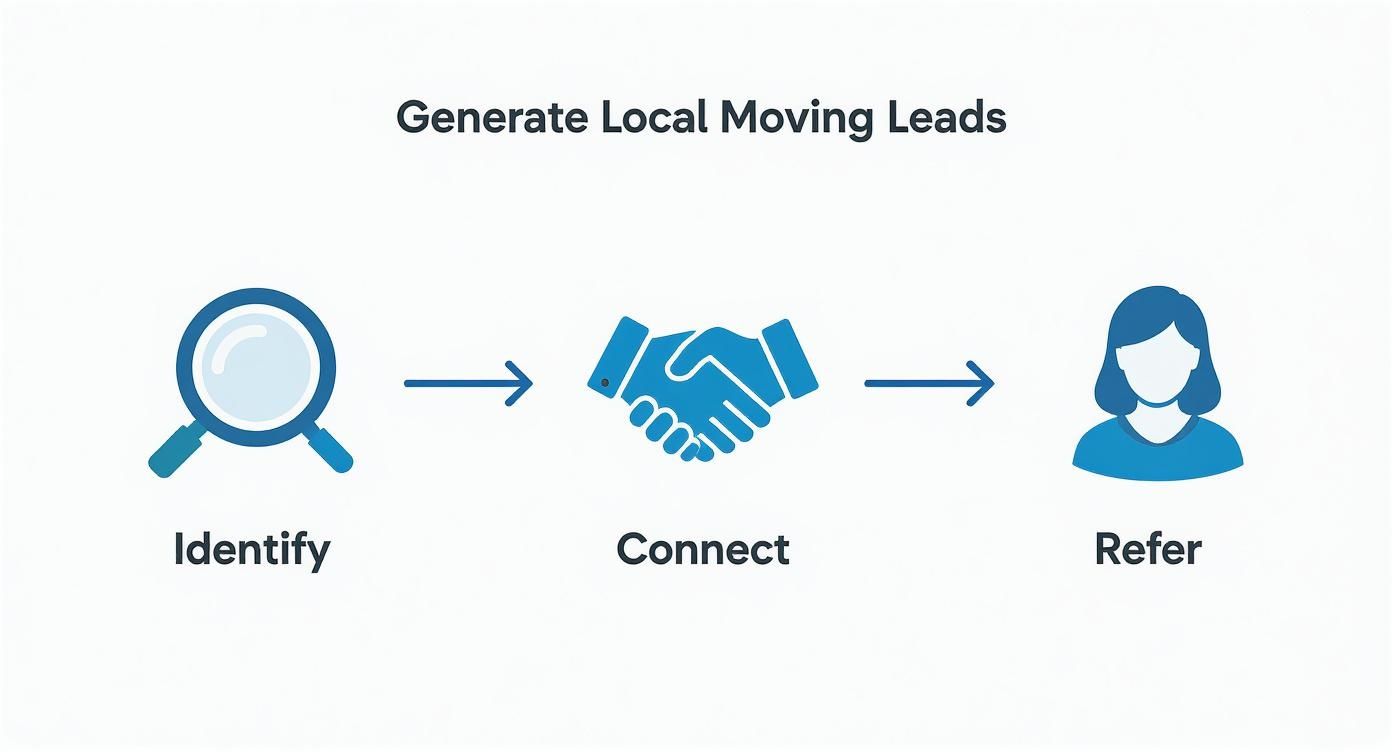
This just goes to show that a system—finding the right people, making a genuine connection, and then having an easy way for them to refer you—is what makes this strategy work.
Propose a Mutually Beneficial Relationship
Once you have your list, it's time to reach out. But don't just blast out a generic email asking for business. Your approach needs to be professional and, most importantly, show what’s in it for them. You have to frame it as a true partnership, not a one-way street where you get all the benefit.
Your pitch could include a referral fee for every booked job they send your way. Or, you could simply promise exceptional, white-glove service for their clients that makes them look like a hero for recommending you. A simple commission of 5-10% is a common and highly effective incentive.
A great way to break the ice is by offering to send your clients to them first. For instance, walk into a storage facility and tell the manager, "I have clients asking for storage recommendations all the time. I'd love to start sending them your way. Would you be open to doing the same for us?"
This whole strategy taps into the single most powerful lead source in our industry. It's not just a gut feeling; the data backs it up. A recent survey showed that a staggering 68.6% of movers see word-of-mouth as their highest-quality source of leads. That number absolutely dwarfs every other channel. You can explore the full state of moving and storage report to see just how dominant personal recommendations are.
By building a strong network of local partners, you're essentially putting word-of-mouth marketing on steroids. You’re creating a small army of advocates who will consistently promote your business, sending you high-intent leads that are far more likely to book than cold traffic from an online ad. It’s a low-cost, high-return strategy that’s key to sustainable growth.
Automate Your Follow-Up to Convert More Leads
In the moving business, speed isn't just a nice-to-have—it’s everything. The first company to respond almost always gets the job. Think about it: when someone fills out your quote form, they're in "buy mode" right then and there. Every minute they wait, their interest cools, and they start looking at your competitors.
Building an automated system ensures you're always the first to make contact. It doesn't matter if you're on a job, it's after hours, or even the middle of the night. This is where a little bit of tech can act like your most reliable employee, working 24/7 to turn inquiries into booked jobs.
Nail the Instant First Response
I can't stress this enough: speed is the single biggest factor in closing a lead. Movers who get back to prospects within minutes blow away those who wait, even by just half an hour. That rapid response is often the only thing separating you from a competitor who was just a little bit faster.
Direct leads can convert at an incredible 25% to 50%, but only if you have a solid sales follow-up. That follow-up starts the second they hit "submit."
The good news is your first automated text doesn’t need to be fancy. Its only job is to acknowledge the request and tell them what’s next.
Here’s a simple, effective template I've seen work wonders:
"Hi [Customer Name], this is [Your Name] from [Your Moving Company]. Thanks for requesting a moving quote! I'm reviewing your details now and will give you a call from this number in the next 15-20 minutes to give you an accurate price. Talk soon!"
This one little message is a powerhouse. It accomplishes three critical things instantly:
-
Confirms Receipt: It calms the customer down and lets them know their request didn't just disappear into the internet.
-
Sets Expectations: It clearly states what happens next and when, which stops them from immediately calling another mover.
-
Personalizes the Interaction: Using their name and your company name makes an automated message feel genuinely human.
Nurture Leads That Aren't Ready to Book
So what happens with the leads that don't book on the spot? This is where most moving companies leak a ton of profit. A potential customer might be waiting for their house to close or just shopping around for quotes. If you don't have a system to follow up, those leads just fall through the cracks.
A simple Customer Relationship Management (CRM) tool is the perfect fix. You can set up automated follow-up sequences that keep your company top-of-mind without you having to lift a finger.
Imagine a simple "set it and forget it" flow like this:
-
Day 2: A quick text goes out: "Hi [Customer Name], just following up on the moving quote we sent. Any questions I can answer for you?"
-
Day 5: An automated email delivers a helpful blog post, like "5 Tips for a Stress-Free Packing Day."
-
Day 10: A final text creates a little urgency: "Hi [Customer Name], our schedule for [Month] is filling up fast. Let me know if you’d like to lock in your moving date!"
This kind of gentle, consistent follow-up keeps you on their radar without being annoying. It dramatically increases your chances of winning their business when they're finally ready to pull the trigger. Many leads are lost simply because no one follows up after hours, a problem that modern tools are designed to fix. To dig deeper, check out our guide on how to stop losing after-hours leads without working 24/7.
Track Your Marketing to Maximize Profitability
Good marketing isn't about spending more money; it's about spending it smarter. Pouring cash into ads or local sponsorships without knowing what you're getting back is like driving a moving truck with the windshield blacked out. To build a business that lasts, you have to know which of your efforts are bringing in profitable jobs and which are just draining your bank account.
This all comes down to tracking your results. Once you get a handle on a few key numbers, you can confidently decide where to invest your next dollar. This turns marketing from a guessing game into a predictable growth engine.
Demystify Your Key Metrics
You don’t need some crazy-complicated spreadsheet to get started. Just focus on two critical numbers that tell the real story of your marketing performance.
-
Cost Per Lead (CPL): Think of this as the price you pay for someone to raise their hand and say, "Hey, I need a moving quote." It tells you how good a specific marketing channel is at just getting your phone to ring or your inbox to ding.
-
Customer Acquisition Cost (CAC): This is the big one. It's the total cost to actually land a new, paying customer. This is probably the most important number in your business because it tells you, point-blank, if your marketing is actually making you money.
Calculating these is way easier than it sounds. Let's say you spend $500 on Google Ads in a month, and that campaign brings in 20 quote requests. Your CPL is $25 ($500 / 20 leads). Simple enough.
Now, if 4 of those leads actually book a job with you, your CAC for that channel is $125 ($500 / 4 jobs).
Your goal is straightforward: find the channels with the lowest CAC that bring in the kind of high-value jobs you want. A channel might have a super cheap CPL, but if none of those leads ever book, its CAC is infinite—and it's completely worthless to you.
Track Every Single Channel
You need to measure every single lead source, from your paid ads all the way down to the business cards you hand out at the local coffee shop. This is the only way you can compare them apples-to-apples and see what's truly working.
Essential KPIs for Moving Lead Generation
To really get a grip on what's working, you need to be tracking the right metrics. These Key Performance Indicators (KPIs) are the vital signs of your marketing health.
| KPI (Key Performance Indicator) | What It Measures | Why It's Important |
|---|---|---|
| Cost Per Lead (CPL) | The average cost to generate a single quote request. | Tells you how efficiently your ads and content are at grabbing attention. |
| Customer Acquisition Cost (CAC) | The total marketing spend to get one new booked job. | The ultimate measure of profitability. If CAC > Job Profit, you're losing money. |
| Lead-to-Booking Rate | The percentage of leads that become paying customers. | Shows how effective your sales process is at closing the deals you generate. |
| Return on Ad Spend (ROAS) | The total revenue generated for every dollar spent on ads. | A direct line to see how much money your advertising is bringing back. |
| Average Job Value | The average revenue you earn from a single move. | Helps you understand which channels bring in the bigger, more profitable jobs. |
| Lead Source Attribution | Where your leads are coming from (e.g., Google, Facebook, referral). | Pinpoints your most valuable marketing channels so you can invest more there. |
By keeping an eye on these numbers, you move from "I think this is working" to "I know this is working."
You'll quickly gain clarity. For instance, you might find that while your Google Ads bring in a ton of leads, your partnership with a local real estate agent actually delivers a much lower CAC and much bigger jobs. That insight is gold.
It gives you the power to stop wasting money on channels that don’t perform and double down on the ones that consistently fill your calendar. Don't forget, every missed opportunity has a real price; our own research shows the real cost of missing just 4 calls per week can easily add up to thousands in lost revenue.
Got Questions About Getting Moving Leads? We've Got Answers.
When you're trying to figure out where your next job is coming from, the world of lead generation can feel like a maze. There are a dozen different channels, all promising the world and all demanding a piece of your budget. Most movers I talk to are asking the same questions. Let's cut through the noise and get you some straight answers.
How Much Should a Moving Company Actually Spend on Marketing?
There's no one-size-fits-all answer here, but a really solid rule of thumb is to set aside 5-10% of your target annual revenue for marketing.
Are you a new company trying to make a name for yourself and get trucks moving fast? You might need to be more aggressive and push that number closer to 10-12% to really grab some market share.
But honestly, the exact percentage isn't what matters most. The real key is tracking what you get for every dollar spent. Start with a budget you're comfortable with and obsessively track your Cost Per Lead (CPL) from every single source. If your Google Ads are bringing in jobs at a profit, you'll know with certainty that it's safe to pour more gas on that fire while pulling back on something else that isn't working.
Is Buying Leads from Those Big Third-Party Sites a Good Idea?
I get it. The idea of just buying a list of people who need to move is tempting. It can feel like a quick way to get the phone ringing, and for a brand-new company, it might give you that initial push to get some jobs on the books.
Here's the catch: you have to go in with your eyes wide open. Those leads are almost always sold to you and four or five of your competitors at the exact same time. This immediately turns the conversation into a race to the bottom on price. The mover who calls first and quotes cheapest usually gets the job. Conversion rates are typically abysmal, often wallowing between 2-5%.
If you decide to play this game, speed is everything. You absolutely must have a system in place to call that lead within seconds. For real, sustainable growth, you're almost always better off putting that money into building your own lead-generating assets, like a great website and a killer local SEO strategy. The leads will be yours and yours alone.
Think about this: nearly 30% of movers jump on a new lead within the first five minutes. If you can't match that speed, you're already losing before you've even dialed the number.
What's the Absolute Best Way to Get Moving Leads for Free?
This one's easy. Your single most powerful, cost-effective marketing tool is your Google Business Profile (GBP). Hands down, it's the undisputed king of free leads for any local service business.
Think of your GBP as your digital billboard right on Google Maps and at the top of local search results. A fully built-out profile – packed with glowing reviews, recent photos of your crew on the job, and a clearly defined service area – is a machine that will crank out free phone calls and website visits month after month.
After you've nailed your GBP, your next best bet is building a solid local referral network. Make friends with real estate agents, apartment complex managers, and storage facility owners. These two strategies should be the absolute foundation of your entire marketing plan before you spend a dime anywhere else.
Answering every call and firing off a quote right away is how you win jobs, but who can be on call 24/7? MoveJoy is the AI-powered sales assistant that makes sure you never miss a lead. It answers every call, any time of day, and texts an accurate estimate back in seconds. See exactly how it works at https://getmovejoy.com.