How to Estimate Moving Costs and Win More Jobs
Every moving company owner knows the gut-punch of a bad estimate.
Underquote, and you’re basically paying to do the job. Your profit margin vanishes right before your eyes on moving day as the hours pile up. Overquote, and that potential customer ghosts you, probably booking with the competitor who came in with a number that felt more realistic.
Losing that one job hurts. But the real damage from a bad quote runs way deeper. In a competitive local market where customers shop fast, the accuracy and speed of your quote often determine who wins the business.
The True Cost of an Inaccurate Moving Quote
Getting the quote wrong is one of the fastest ways to kill trust. When the final bill is way higher than the estimate, customers don't just get upset—they feel cheated. That leads to those awful end-of-job confrontations, credit card disputes, and the kind of scathing one-star reviews that can shadow your business for years.
In a local market, reputation is everything. A few bad reviews can poison the well for a long, long time.
The Operational Chaos of a Bad Estimate
Beyond angry customers, sloppy quoting throws your entire operation into chaos.
That job you quoted for four hours? It’s now pushing seven. This blows up your whole dispatch schedule for the day. Now you’ve got a choice: either show up late to your next job and tick off another customer, or pay your crew overtime, eating even further into profits that are already razor-thin.
This kind of unpredictability burns your crews out, too. They’re the ones on the front lines, dealing with the customer’s frustration and scrambling to handle a job that’s way bigger than they were told. It’s a recipe for low morale and high turnover in an industry where good help is hard to find.
Key Takeaway: Bad estimates aren't just a sales problem. They create a ripple effect of scheduling nightmares, pissed-off crews, and ultimately stop your moving business from growing efficiently.
Why Standardizing Your Process is Crucial
Here’s the thing: most quoting errors don’t happen because of inexperience. They happen because there’s no system.
When every estimate is just a ballpark guess based on a quick phone call—often a call you barely had time to answer—you’re bound to miss things. You forget to ask about the 150-foot long carry from the truck to the front door. You don’t account for the three flights of stairs at the new apartment. Or you completely overlook the priceless antique piano that needs special handling and a whole lot of extra time.
These “little details” are what turn a profitable job into a money pit.
Without a repeatable process for gathering information—whether it's a detailed checklist, a virtual survey, or an automated intake form that captures lead details 24/7—you're gambling on every single quote. Nailing your estimates isn’t just about winning the next job; it’s the foundation you build a profitable, trusted, and scalable moving business on.
Breaking Down Your Core Cost Factors
An accurate estimate isn't guesswork; it's a formula. If you want to quote jobs that are both competitive enough to win and profitable enough to be worth it, you need a repeatable system. It's the only way to move from gut-feel pricing to a data-driven approach that actually protects your margins.
Without one, you're setting yourself up for failure. Inaccurate quotes don't just cost you money on a single job; they snowball into bigger problems that can seriously damage your business.
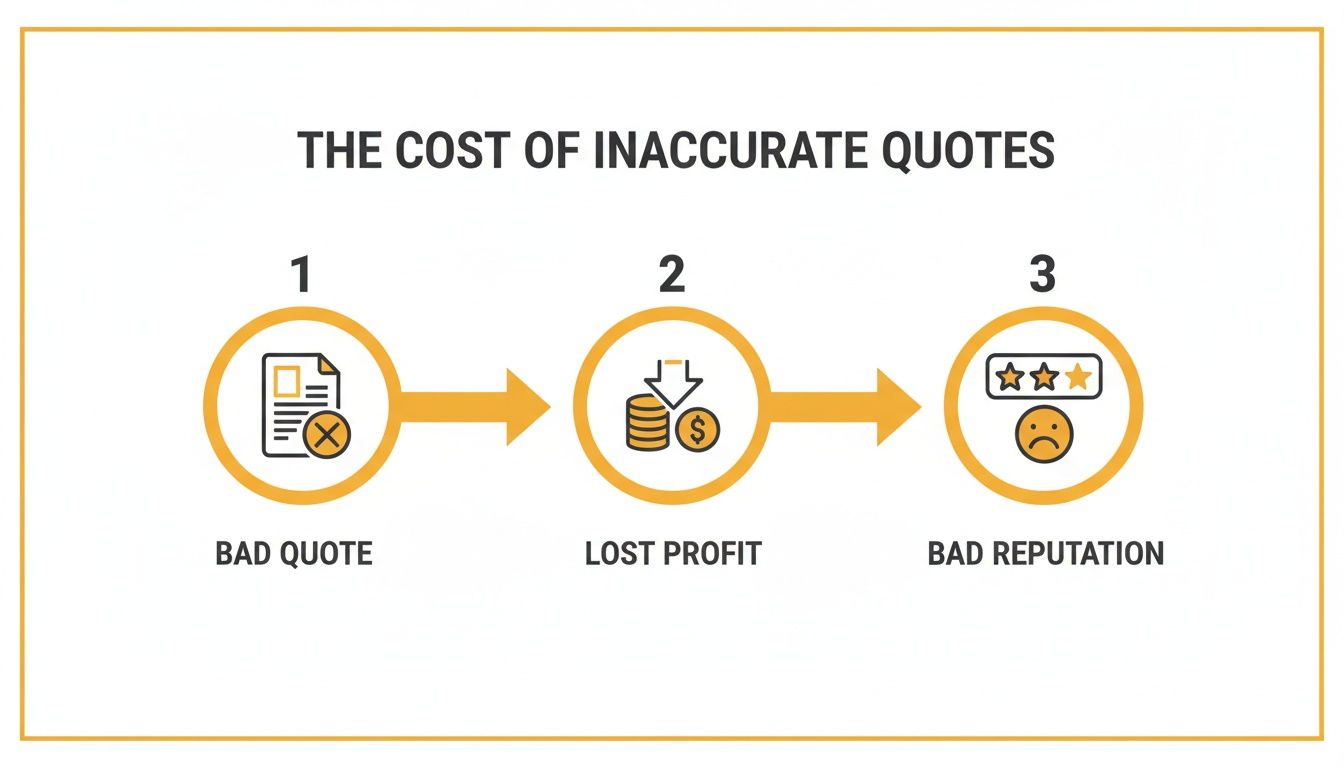
As you can see, a bad quote is the first step toward lost revenue and the kind of negative reviews that scare away future customers. Let's build a better system, starting with the essentials.
Before we dive into the nitty-gritty of each calculation, it's helpful to see all the moving parts in one place. Think of this table as your pre-flight checklist for every estimate you create. Miss one of these, and your profitability could take a serious hit.
Core Components of a Moving Estimate
| Cost Category | What to Calculate | Common Pitfall for 1-20 Truck Operations |
|---|---|---|
| Inventory & Volume | Cubic footage of all items, identifying oversized or specialty pieces. | Relying on bedroom counts from a rushed phone call instead of a detailed item list. |
| Labor Hours | Packing (if applicable), loading, transit, and unloading time. | Forgetting to add a 10-15% buffer for unexpected delays (like customer not being ready). |
| Travel & Fuel | Mileage from your depot to the job, between locations, and back to the depot. | Only charging for the drive between the customer's locations, eating the cost of getting there and back. |
| Accessorials | Fees for stairs, long carries (>75 feet), elevators, and specialty items. | Not identifying and quoting these charges upfront, leading to disputes on moving day. |
| Materials & Insurance | Cost of boxes, tape, and packing supplies; valuation coverage options. | Assuming the customer will provide all materials or skipping the valuation conversation. |
Nailing each of these components is the difference between a profitable job and a painful lesson. Now, let’s get into the details of how to calculate them properly.
Assessing Inventory and Volume
The foundation of every solid quote is a precise inventory. Just asking a customer "how many bedrooms?" is a recipe for disaster. One person's "lightly furnished" two-bedroom apartment is another's packed-to-the-gills hoard.
You need specifics. A detailed inventory list is non-negotiable. Using an essential moving inventory list template can help customers think through every single item, but you still need to verify it.
For your internal math, lean on proven industry standards as a starting point:
- A standard furnished room typically takes up 250–400 cubic feet.
- A one-bedroom apartment usually falls between 400–700 cubic feet.
- A three-bedroom house often needs 1,200–1,600 cubic feet of truck space.
These are just baselines. The real magic happens when you get eyes on the stuff. A quick virtual survey over a video call or asking the customer to send photos of each room gives you the visual proof you need. It helps you spot the problem items—like a massive sectional sofa or a double-wide refrigerator—that can blow up your estimate if you don't account for them.
Calculating Labor Hours
Once you have a real handle on the volume, you can start estimating the labor. This is where a lot of movers get tripped up, because they only think about the time spent loading and unloading the truck.
A profitable labor calculation has to include everything:
- Packing Time (If applicable): If you're selling packing services, this needs its own line item, but it's part of the total job time.
- Loading Time: A good rule of thumb is one hour of loading for every 150-200 cubic feet with a two-person crew. Adjust this up for larger crews or down for particularly complex items.
- Transit Time: The actual drive time from point A to point B.
- Unloading Time: This is usually a bit faster than loading, but it’s always safer to estimate it as being equal. Better safe than sorry.
Pro Tip: Always, always add a buffer. A 10-15% buffer on your total estimated hours can save a job's profitability from unexpected delays, like a slow service elevator or a customer who isn't quite packed when you arrive. For a structured approach, our moving company estimate template provides a great framework.
Factoring in Travel and Fuel
Your travel costs are more than just the time spent driving between the two locations. A profitable quote accounts for the entire journey your truck and crew make for that job.
This includes:
- Travel to the Job: The time and fuel it takes to get from your office to the customer's front door.
- Travel During the Job: The drive between the pickup and drop-off addresses.
- Return to Depot: The time and fuel to get your truck and crew back home after the job is done.
Forgetting the "to" and "from" travel is one of the most common ways movers quietly lose money on every single job. Bake it into your pricing with a simple mileage rate that covers fuel, vehicle wear and tear, and insurance.
Identifying Accessorial Charges
Accessorials are where the pros separate themselves from the amateurs. These aren't "hidden fees"—they're legitimate charges for additional labor, risk, and complexity, and they must be identified during the quoting process.
Key accessorials to look for include:
- Stairs: Any flights of stairs at either location. Many movers charge a per-flight, per-item, or hourly surcharge.
- Long Carries: If the truck has to park more than 75 feet from the door, that extra walking time is costing you money. Charge for it.
- Elevators: Even with an elevator, navigating tight corners and waiting for access adds time. Some movers apply a fee, especially if there's no dedicated service elevator.
- Specialty Items: Pianos, gun safes, massive artwork, or hot tubs require special equipment and extra muscle. These should always have a standalone fee.
The difference these factors make can be huge. Recent industry data shows local moves in major U.S. markets average between $850 and $1,600, while long-distance moves can easily jump to $3,200 to $6,000. Much of that difference is driven by mileage and accessorials, with urban moves in cities like Los Angeles often costing 10-20% more just because of parking hassles and elevator use. Knowing these regional cost drivers is critical to creating quotes that reflect the real world.
Choosing the Right Pricing Model for the Job
Once you've nailed down your core costs, the next big decision is how you're going to present that price to the customer. This isn't just about spitting out a number. Your pricing model is a strategic move that frames how a customer sees your company, helps you manage risk, and can be the single biggest factor in whether you win the job.
Get this part wrong, and it can cause as many headaches as a bad estimate. A customer who was expecting a fixed price will get nervous watching the clock on an hourly job. On the other hand, offering a flat rate for a messy, unpredictable local move can absolutely destroy your profit margins.
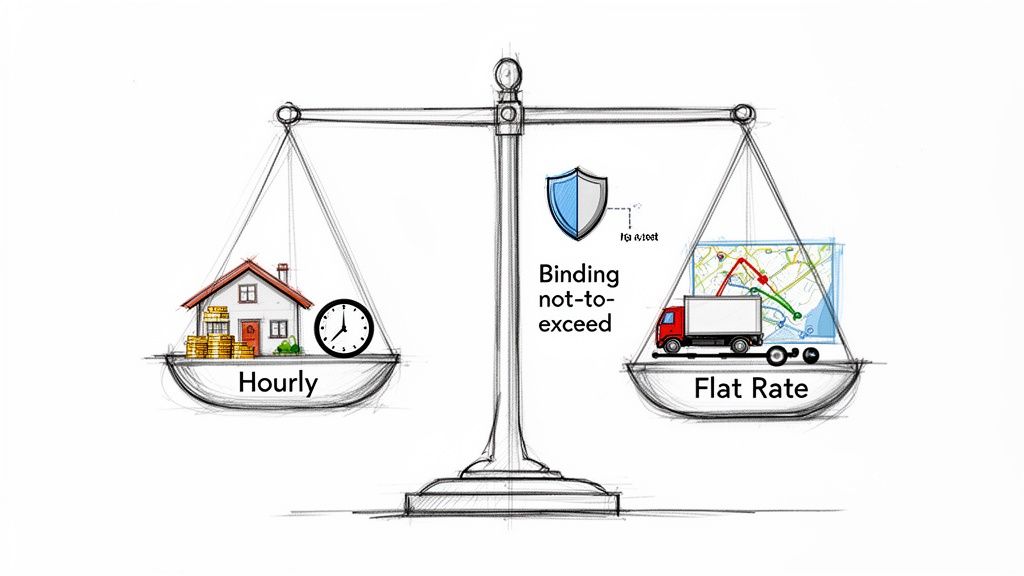
Let's walk through the three main ways to price a move so you can pick the right tool for the right job.
The Hourly Rate Model
This is the bread and butter for most local movers, and for a good reason. It's straightforward, customers get it, and most importantly, it protects you from all the little things that can go wrong on a short-distance move.
Best suited for:
- Local Moves: This is the go-to for any job inside a 50-mile radius. Traffic, elevator delays, a customer who isn't quite packed yet—the hourly rate covers you when things get unpredictable.
- Smaller Jobs: Perfect for one-bedroom apartments or straightforward moves where spending hours on a detailed flat-rate calculation just doesn't make sense.
The biggest downside? The customer's anxiety. They're constantly watching the clock, and you can feel them worrying as every minute ticks by. This is why you always give them a time range or a "not-to-exceed" estimate. It gives them a ceiling and a sense of control.
The Flat-Rate Model
Customers crave certainty. A flat-rate, or binding, estimate gives them exactly that. They know the final cost before the truck even shows up, which is a massive selling point for anyone on a tight budget.
Best suited for:
- Long-Distance Moves: This is the industry standard for interstate jobs. Customers expect a price based on weight and mileage, and a flat rate is the only way to compete here.
- Large, Well-Defined Local Moves: If you’ve done a thorough in-home survey for a big four-bedroom house, offering a flat rate can be a powerful way to stand out. It shows confidence and can lock in a high-value job that your hourly-only competitors might lose.
But make no mistake, the risk here is 100% on you. If you misjudge the inventory or underestimate the time needed, that's your profit vanishing into thin air. This model demands that your initial estimate is rock-solid.
A flat-rate quote is a classic high-risk, high-reward play. It can win you bigger, more profitable jobs, but only if your quoting process is sharp enough to protect your margins.
The Hybrid "Binding Not-to-Exceed" Model
This is the killer app of moving estimates. It’s the most powerful, trust-building model you can offer, combining the best of both worlds and immediately putting the customer at ease.
Here’s the pitch: You give them a binding quote based on your detailed assessment. But, you also tell them that if the move takes less time than you planned, the final price will actually be lower. The price can go down, but it can never go up (unless they add a bunch of stuff last minute).
This simple tweak flips the entire script. It kills the customer's biggest fear: getting ripped off. It screams fairness and transparency. When a potential customer is staring at three different quotes, the one offering a "binding not-to-exceed" price almost always wins. It turns your estimate from a simple number into your best closing tool.
Think Beyond the Boxes: Turning Your Quote into a Revenue Machine
The basic moving estimate gets the truck and the crew there. Labor, time, transport—that’s the core of it. But the movers who really crush it know that a quote is more than just a price list; it's your single best sales tool. This is your chance to go from "guys who haul boxes" to a full-service partner, and that shift can dramatically boost the revenue from every single job you book.
Put yourself in your customer’s shoes for a second. Moving is a nightmare. They aren’t just looking for muscle; they're desperate for solutions. When you offer services like packing, selling materials, or handling specialty items, you're not nickel-and-diming them. You’re solving their biggest headaches.
Don't Just Offer "Packing," Sell a Solution
Packing is easily the most common and profitable add-on you can offer. But a lot of movers make the mistake of just listing "Packing" as a single, all-or-nothing line item. That’s intimidating. You need to break it down and make it easy for a stressed-out customer to say "yes."
- The Full Pack: This is your premium, hands-off option. Your crew packs everything in the house. Price this based on the estimated labor hours, and don't forget a healthy markup on the materials you'll use.
- The Partial Pack: This is the sweet spot for most people. They want to save a little cash but absolutely dread packing certain rooms. Offer a "Kitchen Pack" or a "Fragiles-Only Pack." It's an incredibly easy upsell because no one wants to wrap a hundred dishes.
- Unpacking Services: This is the ultimate white-glove service. Even bringing it up shows you’re thinking about the entire move, not just the hard part in the middle.
Here’s a pro tip: always separate the labor cost from the materials cost on your quote. It builds trust and shows them exactly what they’re paying for. A "Kitchen Pack" might be quoted as 3-4 hours of labor plus a fixed price for the dish packs, paper, and boxes needed. It just makes more sense to the customer.
Your Moving Boxes Should Be a Profit Center
If you're not selling boxes, tape, and paper, you're leaving easy money on the table. It’s a massive convenience for your customer and a simple, high-margin revenue stream for you. Your estimate is the perfect place to introduce it.
Don't just ask, "Do you need any boxes?" That's a yes/no question. Instead, present them with pre-bundled packages that solve a problem.
- The Studio Kit: Perfect for a small apartment, maybe 10 small boxes, 5 medium, 3 large, and a roll of tape.
- The 3-Bedroom Home Kit: A comprehensive bundle with a wide variety of box sizes, packing paper, and bubble wrap for a family.
Frame it as a time-saver. Let them know your professional-grade materials are way better than the flimsy stuff from the big-box store, and you'll deliver it right to their door. Suddenly, you’ve turned a simple sale into a valuable service they're happy to pay for.
Key Insight: Stop presenting these services as a list of fees. Frame them as "convenience packages" or "stress-free upgrades." The language you use in your quote completely changes whether a customer sees another charge or a helpful solution.
Quoting Pianos, Safes, and Other Headaches
This is where rookies lose their shirts. Properly quoting specialty items is non-negotiable for protecting your profit and your crew. These things demand extra time, special equipment, and a whole lot more risk—and your price has to reflect that.
- Pianos: An upright piano should be a flat fee, often $150-$300. Baby grands? That's a different beast. Expect $400-$600 or even more, especially if stairs or tight corners are involved.
- Gun Safes & Heavy Equipment: Price these by weight and difficulty. A 500 lb. safe could easily add $200-$400 to the bill, and that number climbs quickly with every stair.
- Antiques & Fine Art: This isn't just a move; it's a project. You'll likely need custom crating. Your fee needs to cover both the crate materials and the skilled labor to build it properly.
Ignoring these items or just winging it is a classic mistake that costs you money and puts your business at risk. When you call these items out on your quote, you’re not just padding the bill. You’re positioning yourself as a true professional who can handle anything, and that’s the kind of confidence that wins bigger jobs at better prices.
Using Technology to Quote Faster and Smarter
In the moving industry, speed is everything. The first professional, detailed quote that lands in a customer’s inbox is usually the one that wins the job. Simple as that.
If you’re still jotting down notes to create an estimate when you get back to the office, you’re already behind. For owners of 1-20 truck operations, technology isn't some fancy add-on anymore; it’s your single biggest advantage for quoting faster than the competition.
Let's be real, relying on old methods is a losing battle against rising costs. Between 2020 and 2025, everything from fuel and labor to insurance shot up by 30-80%. Your rate hikes barely made a dent. To stay profitable, you have to get ruthlessly efficient.
From In-Home Visits to Virtual Surveys
For years, the in-home visit was the gold standard. It was accurate, sure, but also a massive time sink. Driving across town for a 30-minute walkthrough burns hours you could be spending on booked jobs or managing your crews.
Modern tools completely flip this script.
- Virtual Survey Apps: These let you walk through a customer’s home using their smartphone camera. You see everything, ask questions in real time, and can spot potential headaches like a narrow staircase or that ridiculously heavy armoire they forgot to mention.
- Photo-Based Inventory: Plenty of customers are happy to just snap photos of each room and text them over. This gives you a quick, visual checklist to build your estimate from, often eliminating the need for a site visit entirely.
Adopting these tools means you can pump out a solid, accurate quote in a fraction of the time. You’re not just saving gas; you’re cutting your sales cycle down from days to minutes.
Automating the First Touchpoint
The biggest bottleneck for most small moving companies isn’t the move itself—it’s the initial phone call. Every single call that goes to voicemail while you're on a job or driving is a potential $1,500+ job walking out the door. This is where automation changes the entire game.

Imagine a system that works for you 24/7, even when you can't get to the phone. An AI receptionist can instantly handle every call, grabbing the essential details you need for a quote:
- Customer name and contact info
- Pickup and drop-off addresses
- Type of home (apartment, house, etc.)
- Number of bedrooms
- Any specialty items like pianos or gun safes
The Power of Instant Engagement: This automated intake ensures you never miss a lead. While your competitor’s potential customer is leaving a voicemail they may never check, yours is already giving you the info needed for a quote. That speed is your competitive advantage.
This tech doesn't replace you; it empowers you. It takes the repetitive, time-sucking task of gathering basic info off your plate. All the critical data is captured and sent right to you, ready for a quick review and final quote. You can deliver a precise estimate in minutes, not hours—from your truck, from home, from anywhere. This is how you book more jobs without hiring more office staff.
Tough Questions and Honest Answers About Moving Estimates
Even the smoothest quoting process hits a snag now and then. You’ll always run into tricky situations and tough questions from customers. Here’s my straight-talk advice for handling some of the most common issues that pop up.
How Do I Handle a Customer Who Disputes the Final Cost?
Here’s the hard truth: if a customer is arguing about the bill on moving day, you’ve already messed up. The time to prevent a dispute is long before the truck even shows up. Your best defense is a rock-solid, crystal-clear estimate from the very beginning.
Your quote needs to spell out everything. Every service included, and more importantly, every potential extra charge. Think stairs, long carries, shuttle services—if it might cost them more, it needs to be on that paper. Don’t just list it; when you walk them through the quote, point to that section and say, "Just so you know, if we run into X, there’s an additional charge as we discussed." No surprises.
But if a dispute happens anyway? Stay calm. Don't get defensive. Pull out the signed agreement and the final bill of lading. Go through it with them, line by line, showing them how the work performed matches the charges they agreed to upfront. Honestly, this is why the "binding not-to-exceed" model is so powerful. It pretty much kills these stressful arguments before they can even start.
What Is the Best Way to Quote Long Distance Moves Remotely?
Forget driving across town for an in-home estimate on a long-distance job. That’s an old-school move, and it’s a massive waste of time for both you and the customer. Virtual surveys are the standard now, and when done right, they're just as accurate.
The easiest way is a simple video call. Have the customer walk you through their house on their smartphone. Tell them to open closets, show you the garage, and point out anything in the attic or storage unit. This is your chance to see what they might forget to mention, like that antique armoire or the packed-to-the-gills storage shed.
Another solid option is to ask for photos. Have them send pictures of every single room. You can build a surprisingly detailed inventory list this way. Just make sure your quote includes a clear statement that the price is based on the specific inventory provided and will change if they add a bunch of stuff later.
These jobs can get complicated, fast. International moves are a whole different beast. A U.S. outbound move can swing wildly from $6,300 to nearly $16,000, all depending on where it's going and the size of the home. A one-bedroom might be $3,500, but a four-bedroom could easily top $10,000. Getting that remote assessment right is everything.
How Often Should I Update My Company's Base Rates?
If you’re using a "set it and forget it" approach to your pricing, you're bleeding money. Simple as that. The cost of fuel, labor, insurance—it's always moving. You absolutely have to review your entire pricing structure at least twice a year to protect your margins.
Here’s a good rhythm to get into:
- Before the busy season: Around February or March, dig into your numbers. Your costs are about to go up and demand is about to spike, so your rates should, too.
- After the busy season: In September or October, do it again. You might not lower your rates, but it’s the perfect time to see if your summer pricing actually made you the money you thought it would.
Keep an eye on what your competitors are doing, but for God's sake, don't just copy them. Your rates are a reflection of your company's value. If you have the best crews, the best reputation, and provide flawless service, you should be charging more. That confidence is how you win the jobs you actually want.
Tired of quotes falling through the cracks or losing leads to voicemail? The most profitable moving companies use automation to respond instantly and quote faster. MoveJoy provides a 24/7 AI receptionist that captures every lead, gathers all the necessary details, and lets you send accurate quotes in minutes—not hours.