The Ultimate Guide to Home Service Business Software for Movers

It’s Saturday morning, peak season. The phone’s ringing off the hook, but your crew is out on a job and the office is swamped. Every one of those calls that hits voicemail isn't just a missed call. It's a lost job—and thousands in revenue walking out the door.
Your Moving Company Is Leaking Revenue From Missed Calls

This scene is painfully familiar for movers still relying on spreadsheets and manual callbacks. You’re stuck in a frantic game of phone tag with a customer who called hours ago, and it almost never ends well. In the time it took you to call back, that customer has already booked with a competitor who actually picked up the phone.
The modern moving customer moves fast. They expect instant answers and immediate quotes. When they reach your voicemail, they don’t wait around—they just dial the next mover on the list. For a small or mid-sized moving business with 1-20 trucks, this quiet leak of missed opportunities is what's holding you back from real growth.
The True Cost of Voicemail
Every unanswered ring is more than just a missed conversation. It's a direct hit to your bottom line and your local reputation.
Think about the math for a second. If an average local move is worth $1,500, losing just four or five jobs a month to voicemail costs your business tens of thousands of dollars over the year. This is the difference between having a good season and a great one.
This is where home service business software stops being just another tool and becomes the most valuable player on your team. It’s not about adding complexity; it’s about installing an automated system that plugs these critical revenue leaks for good.
For many moving company owners, the idea of automation feels complicated. But the reality is simple: the right software acts as your 24/7 receptionist and sales assistant, making sure you capture every single lead, even when you're on a job or after hours. One booked job can pay for the entire system.
Turning Missed Calls into Booked Jobs
Imagine a system that not only answers every call but also qualifies the lead, collects all the job details, and sends an accurate quote via text—all within seconds. This is the power of automation built specifically for movers. It solves the core problems that kill growth:
- Capturing Every Lead: An automated system with an AI receptionist works around the clock. It guarantees you never miss an inquiry from a potential customer, ever again.
- Winning on Speed: It gives you the instant response today's customers demand, getting a quote into their hands before competitors can even check their voicemail.
- Streamlining Your Day: It automates the tedious front-office tasks that eat up your time, from follow-ups to scheduling, freeing you up to actually run your business.
Beyond just answering the phone, solid call logging software is essential to stop leads from falling through the cracks. It gives you the data you need to see what's really happening with your call volume and conversion rates.
To see exactly how this hits your bank account, you can explore the real cost of missing just 4 calls per week. It’s time to stop losing jobs you never even knew you had.
What Is Home Service Business Software, Really?
Let’s be honest, “software” is a vague term. At its core, home service business software is the command center for your entire moving company. It’s the single digital hub that handles everything from the moment a customer calls for a quote to the minute you send the final invoice.
Forget the chaotic mess of spreadsheets, sticky notes, and overflowing inboxes. This is about moving from a system held together with duct tape to one organized platform.
Think of it as the perfect employee. It’s your best office manager, your most persistent salesperson, and your sharpest dispatcher, all rolled into one. It works 24/7, never calls in sick, and never, ever forgets to follow up on a lead.
It’s Not Just a Fancy Calendar
Look, you could try to run your moving business on Google Calendar and a generic CRM. But those tools can’t tell the difference between a simple service call and a complex three-bedroom move with full packing services. They have no idea how to factor in travel time between jobs, crew availability, or which truck is needed for a specific move.
That’s where software built specifically for movers gives you a competitive edge. It’s designed from the ground up to solve the headaches that only moving company owners understand.
Its main job is to take all the repetitive, time-sucking tasks off your plate:
- Answering every single call, even the one that comes in at 10 PM on a Friday.
- Firing off accurate quotes via text and email the second a lead comes in.
- Following up with potential customers who haven't booked yet.
- Scheduling crews and assigning trucks without accidentally double-booking anyone.
- Sending out appointment reminders so customers don't forget you're coming.
Moving from Manual Chaos to Automated Control
For a small moving company with 1-5 trucks, your day is probably spent putting out fires. A missed call while your crew is on a job, a quote that gets delayed because you were stuck in traffic, or a scheduling mix-up—any one of these can throw off your entire week and cost you thousands.
The point of this software isn’t to give you another piece of tech to manage. It's to eliminate the manual grind that keeps you from focusing on what actually grows your business: landing bigger jobs and making sure your crews deliver incredible service.
By automating your front office, you go from reacting to problems to running a smooth, predictable operation. This is how you free yourself up to think about marketing, training your team, or planning your next truck purchase. It gives you back the headspace to actually run your company, instead of letting your company run you.
This is exactly how smaller movers start competing with—and beating—the bigger, more established players in their city.
What Features Actually Matter in Moving Company Software?
Picking the right software isn't about finding the platform with the longest, most confusing feature list. It’s about zeroing in on the tools that fix your biggest daily headaches and put more money in your pocket. Plenty of generic platforms will try to sell you on dozens of features, but for a moving company, only a handful truly move the needle.
Instead of getting lost in a sea of tech jargon, let’s talk about the non-negotiables. These are the features that will start paying for themselves from day one.
Essential Software Features and Their Impact on Your Moving Business
To cut through the noise, this table breaks down the core features you should be looking for. It explains what each one actually does and, more importantly, what it means for your bottom line.
| Feature | What It Does | Why It Matters for Movers |
|---|---|---|
| 24/7 AI Call Answering | An AI-powered system answers every phone call instantly, qualifies leads with key questions, and captures their information day or night. | You stop losing high-intent leads who call after hours. Captures revenue you're currently sending to your competitors' voicemails. |
| Automated Quoting | Instantly generates an accurate, professional quote based on lead details and sends it automatically via text and email. | Speed wins jobs. Getting a quote to a customer first dramatically increases your booking rate without any manual effort. |
| Centralized Calendar | Provides a single, clear view of all booked jobs, crew assignments, and truck availability for your entire team. | Eliminates costly double-bookings and scheduling chaos. Makes dispatching simple and protects your company's reputation. |
| Performance Reporting | Tracks and displays key business metrics like lead sources, booking rates, revenue per job, and missed call volume in easy-to-read reports. | You can't improve what you don't measure. This gives you the hard data you need to make smarter decisions and grow profitably. |
These aren't just "nice-to-haves." In today's market, they're the engine that drives a modern, profitable moving company.
24/7 AI Call Answering and Lead Capture
Your phone line is your most valuable asset. Period. When a potential customer calls at 8 PM on a Tuesday, they aren't going to leave a voicemail and wait patiently. They're going to hang up and call the next mover on their list. This is where an AI receptionist becomes a total game-changer, ensuring you never miss a lead again.
An AI-powered system picks up every single call, day or night. It can qualify leads by asking the right questions—like move size and preferred dates—and instantly save that information. This one feature plugs the revenue leaks from missed calls, a silent killer that costs the average mover thousands of dollars every single month.
Automated Quoting and Instant Follow-Up
In the moving industry, speed wins. The company that gets an accurate quote into a customer's hands first almost always gets the job. If you're still relying on manual emails and playing phone tag, you're starting every race ten steps behind.
This is why automated quoting is an absolute must-have. When a lead comes in, the system should be able to generate a professional, accurate quote based on the details provided and fire it off via text and email immediately. Just as important, it should kick off an automated follow-up sequence to keep your company top-of-mind without you lifting a finger.
Picture this: A customer fills out your website form at midnight. By the time you wake up, an automated system has already answered their questions, sent them a detailed quote, and confirmed their interest—turning a cold lead into a booked job while you were asleep.
Centralized Job Calendar and Dispatching
Nothing kills profits and your reputation faster than double-bookings and scheduling mix-ups. They create chaos, tick off customers, and waste your crew's valuable time. A centralized job calendar is the antidote, giving you a single source of truth for your entire operation.
This isn't just a simple calendar; it's your command center. It gives you a clear, visual overview of all booked jobs, which crews are assigned, and which trucks are available. Dispatching becomes dead simple. You can see at a glance who’s free, assign the right team to the right job, and finally put an end to those costly overlaps. To get this part of your operation humming, it's worth exploring dedicated crew schedule software that plugs right into your main platform.
The demand for this kind of efficiency is exploding. Industry reports value the home services management software market in the hundreds of millions, projecting it to hit $1,287.9 million by 2035. That growth is being driven by movers and other service pros who know that automation is no longer optional. You can learn more about the growth of the home service software market and why your competitors are already investing in it.
Reporting and Performance Analytics
You can't run a business on gut feelings. You need hard data to know what's working and what's not. Your software should give you clean, easy-to-understand reports that offer real insights into how your company is performing.
Look for a system that puts these essential metrics right at your fingertips:
- Lead Sources: See which of your marketing channels are actually making the phone ring.
- Booking Conversion Rates: Finally understand how many leads are turning into paying customers.
- Revenue Per Job: Track your average job value and spot opportunities to increase it.
- Missed Call Volume: Quantify exactly how much money you were leaving on the table before you automated.
These numbers empower you to make data-driven decisions that actually grow the business. It’s how your software stops being a simple tool and becomes your most valuable strategic partner.
Choosing the Right Software for Your Fleet Size
The perfect software for a 15-truck moving operation will absolutely crush a two-truck team. It’s too complex, too expensive, and just… too much. On the flip side, the simple app that a small crew loves will lack the horsepower a larger business needs to keep things from falling apart.
Choosing the right home service business software isn’t about finding the “best” platform out there. It’s about finding the right fit for your fleet right now, with a clear path to grow when you’re ready.
A classic mistake is buying software for the business you hope to have in five years. You end up paying for a bunch of features you never touch and bogging down your team with a system that’s way too complicated. The goal is to find automation that pays for itself on day one, not another piece of tech that creates more work than it saves.
This chart cuts through the noise and helps you zero in on the features that will solve your most painful operational bottlenecks.
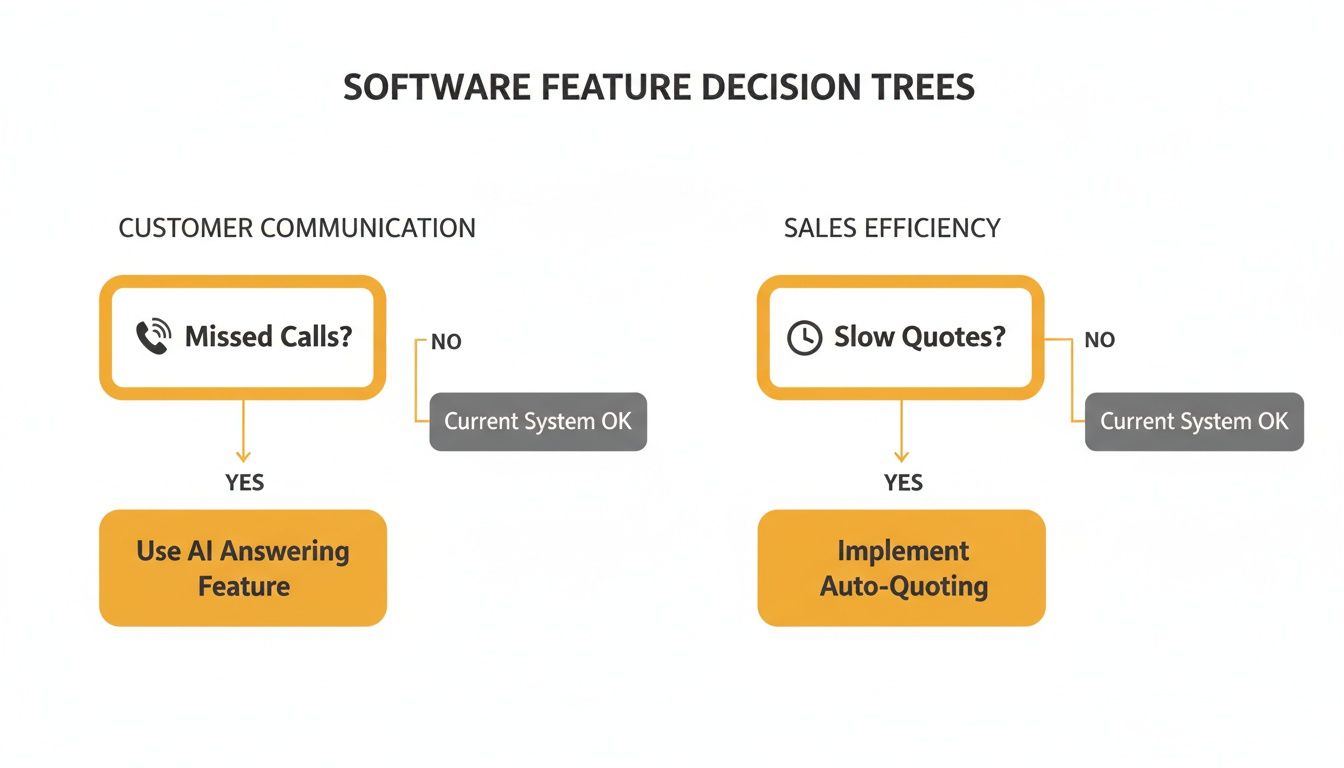
As you can see, the idea is to match the problem to the solution. Missed calls and slow quotes are killing your revenue? You need AI call answering and automated quoting—direct fixes for specific leaks in your sales funnel.
For Owners With 1 to 5 Trucks
When you're running a smaller operation, your world revolves around three things: simplicity, affordability, and solving your biggest money-loser—missed calls. You need a lean, powerful system that automates the front office without needing a Ph.D. to run it.
Your software priorities should be laser-focused:
- 24/7 AI Call Answering: This is non-negotiable. You're out on a truck or managing a job, which means you can't possibly answer every call. An AI receptionist makes sure you capture every single lead, turning those after-hours calls into booked jobs while you sleep.
- Automated Quoting & Follow-Up: Speed is everything. You need a system that can fire off a professional quote via text seconds after a customer calls or fills out your web form. The first to quote is often the first to book.
- Simple Job Calendar: A clean, easy-to-read calendar is critical. You need to see your schedule at a glance, avoid double-bookings, and keep things organized without a ton of clutter.
The name of the game for a 1-5 truck operation is efficiency. Your software should feel like a clone of you—a tool that books jobs and talks to customers so you can focus on the actual move. Anything more complicated is just a distraction.
For Businesses With 6 to 20 Trucks
As your business grows, so does the chaos. Juggling more crews, more trucks, and a flood of job requests requires a much more robust platform. You still need the core features from your early days, but now the focus shifts to deeper operational control and knowing your numbers.
Your software shopping list gets a bit longer:
- Advanced Dispatching & Crew Management: Now you need the ability to assign specific crews and trucks to jobs, track their progress in real-time, and manage a tangled web of schedules across your entire fleet.
- Deeper Performance Reporting: It’s time to move beyond gut feelings. Look for dashboards that track key metrics like booking rates by lead source, crew efficiency, and revenue trends. This is how you make smart, data-driven decisions.
- Customer Communication Tools: Things like automated appointment reminders, "we're on the way" texts, and post-job review requests become essential. They’re what allow you to maintain top-notch service even when you're managing dozens of jobs a week.
To get the most out of your trucks and teams, it’s also smart to see how your software choice stacks up against established fleet management best practices. Getting this right ensures your entire moving operation runs like a well-oiled machine as you continue to scale.
Calculating the Real ROI of Your Software Investment
Dropping money on new tech can feel like a big leap of faith, especially when you're watching every single dollar. A lot of moving company owners I talk to see home service business software as just another monthly bill to pay.
That’s the wrong way to look at it. The right platform isn’t a cost center; it’s a machine that generates profit.
Calculating the return on your investment (ROI) doesn't require a complicated spreadsheet or a finance degree. For a moving company, it comes down to answering a few simple, powerful questions that tie the software directly to your bank account. The most important truth is this: booking just one or two extra moves a month often pays for the entire system.
From Missed Calls to Booked Jobs
The easiest way to see the ROI is to look at the money you're no longer leaving on the table. Before you had an automated system, how many calls went to voicemail each week? Be honest. For most movers, it’s more than they’d like to admit.
Every one of those missed calls was a potential job that went straight to a competitor who picked up the phone. With a 24/7 AI receptionist, those calls are now captured leads.
Let's do some quick math:
- Benchmark: Let's say you were losing 5 jobs a month to voicemail. That’s just over one per week.
- Average Job Value: Your average local move is worth $1,500.
- Recovered Revenue: 5 jobs x $1,500 = $7,500 in new monthly revenue.
This isn't some imaginary number. It's real cash that was leaking out of your business, now captured by automation. The ROI here is massive and almost immediate.
The goal is to reframe your thinking. Stop asking, "What does this software cost?" and start asking, "How many missed jobs will it book for me this month?" The answer makes the investment decision incredibly clear.
Quantifying Your Boost in Efficiency
The second piece of the ROI puzzle comes from getting your time back. How many hours do you or your office manager spend each week on busywork? I’m talking about manually typing up quotes, playing phone tag to follow up, and sending out appointment reminders. It all adds up.
Automation handles these repetitive tasks instantly. This frees up your team for the stuff that actually grows the business—customer service, marketing, or training up your crew leads.
- Admin Time Saved: If software saves just 10 hours of administrative work per week, that’s 40 hours a month.
- Value of Your Time: At a conservative rate of $50/hour, that’s $2,000 per month in reclaimed productivity.
When you add the revenue from newly captured jobs to the value of your saved time, the software pays for itself several times over. To see how these numbers stack up for your own business, you can plug your figures into this handy moving company ROI calculator.
Key Performance Indicators to Watch
Once you're up and running, you don't have to guess if it's working. Keep an eye on these key performance indicators (KPIs) to track the direct impact on your bottom line:
- Lead-to-Booking Conversion Rate: This is the big one. You should see a clear jump in the percentage of leads that turn into confirmed jobs, especially from those after-hours and weekend calls you used to miss.
- Average Response Time: Your software should take your response time from hours (or even days) down to seconds. In this business, speed is what wins jobs.
- Revenue Per Lead: As your booking rate goes up, the value of every single lead that comes into your business increases. You're getting more out of the marketing dollars you're already spending.
By tracking these simple metrics, you can easily prove that your investment in home service business software is one of the smartest financial decisions you can make for your company’s growth.
Getting Started Without Disrupting Your Business

For a busy moving company, the thought of rolling out new software is enough to give you a headache. The fear of blowing up your already packed schedule is a huge reason owners stick with spreadsheets and sticky notes—even when they know that old system is costing them money.
But here’s the good news: modern home service business software is built for a fast, painless setup. You shouldn't need weeks of training or an IT guy on speed dial. The right platform starts capturing leads and automating your grunt work within days, delivering quick wins that get your whole team on board.
The 30-Day Quick Start Plan
Forget about trying to launch everything at once. That’s a recipe for disaster. Instead, focus on a phased approach that tackles your biggest money-wasters first. This strategy delivers immediate value, builds momentum, and lets your team adapt without feeling buried.
The goal is simple: get the new system paying for itself as fast as humanly possible. If you prioritize the right things, you can see a return on your investment in the very first week.
A smart software rollout isn’t about flipping a switch and changing everything overnight. It’s about strategically plugging the biggest leaks in your revenue bucket first, proving the system’s value to yourself and your team from day one.
Your Quick Start Implementation Checklist
Use this simple checklist to guide your first month. We’re focusing on the features that directly impact how many leads you capture and how many jobs you book.
Week 1: Capture Every Single Lead
- Set Up Your AI Receptionist: This is priority number one. Forward your main business number to the new system so it can start answering every call, 24/7. This one step immediately stops you from losing money to missed calls.
- Get Your Customer Data Ready: Export your existing customer list from your old CRM, spreadsheets, or even your phone contacts. A simple CSV file is usually all it takes to get your history loaded into the new platform.
- Connect Your Website Form: Hook up the contact form on your website to the software. This makes sure every online inquiry instantly lands in your system as a hot lead, ready for an automated quote.
Week 2: Put Your Quoting on Autopilot
- Build Your First Quote Template: Customize your standard quote. Add your logo, pricing for your most common jobs (like a two-bedroom apartment local move), and any standard terms and conditions.
- Turn On Automated Follow-Ups: Activate the pre-built text and email follow-up sequence. This is your safety net—it ensures no lead ever falls through the cracks just because you got slammed and forgot to call them back.
Week 3: Get Your Operations Organized
- Set Up Your Master Calendar: Block out any jobs you already have booked and any personal appointments. Connect your team’s calendars so you have one clean view of who is available and when.
- Train Your Team (1 Hour Max): Your crew doesn’t need to know every single feature. Just show them the basics: how to check the job calendar and how to pull up customer details for their assigned moves. Keep it simple and focused.
By following this roadmap, you can get powerful automation up and running without wrecking your daily operations. You’ll be booking more jobs and running a tighter ship before the first month is even over.
A Few Questions Movers Always Ask
When you're running a moving company, every dollar and every minute is already spoken for. It makes sense to be skeptical about new tech. Here are some straight, no-nonsense answers to the questions we hear from movers just like you.
"Isn't This Stuff Too Expensive for a Small Mover?"
This is always the first question, and it's a fair one. But it's the wrong way to look at it. You have to stop thinking of home service business software as a cost and start seeing it for what it is: a revenue-generating tool.
Let’s be real. If you miss just three calls a month during your busy season, and your average move is worth $1,500, that’s $4,500 in jobs you just handed to a competitor. A good automation platform often costs less than booking a single one of those lost moves.
The right software doesn’t cost you money—it makes you money. It captures the jobs you’re currently sending to your competitors’ voicemails. One booked job a month usually pays for the whole thing.
"My Team Isn't Tech-Savvy. Can They Actually Use This?"
Absolutely. Modern moving software is built for movers and dispatchers, not IT nerds. The good stuff has clean, simple interfaces designed for people who spend their days on a truck or on the phone, not buried in complicated dashboards.
The core functions—checking the day’s schedule, pulling up job details, or marking a move as complete—are usually as easy as using any other app on your smartphone. Most platforms need very little training, and the most powerful features, like a 24/7 AI receptionist, just run in the background. You don't have to manage them at all.
"How Is This Better Than My Calendar or CRM?"
Look, generic tools like Google Calendar or a basic CRM are fine for keeping track of appointments. But they don't understand the moving business. Using them is like trying to build a house with just a hammer—it might get you started, but it’s slow, clumsy, and you’re missing the right tools for the job.
Software built specifically for movers gives you critical features that generic tools just can't touch:
- Mover-Specific Quoting: It can instantly generate quotes based on move size, inventory lists, and travel time. A generic CRM has no clue how to do that.
- 24/7 AI Call Answering: It answers the phone with actual moving knowledge, qualifies leads on the spot, and captures all the job details automatically.
- Smart Crew Dispatching: It helps you manage crew assignments and truck availability to kill the double-bookings that a simple calendar can’t prevent.
A basic calendar tells you when a job is. Mover-specific software runs the entire job from the first call to the final payment, automating the grunt work so you can actually focus on growing the business.
Ready to stop leaking revenue and start booking more jobs on autopilot? MoveJoy is your 24/7 sales and scheduling assistant, making sure you never miss another lead.