Business Telephone Answering Services for Movers: A Guide to Booking More Jobs
At its core, a business telephone answering service is an external partner that handles your moving company's incoming calls. Instead of dumping a potential customer into a voicemail box, your calls are answered right away by a live agent or a smart AI receptionist.
Every call, day or night, gets a real, immediate response, ensuring you never miss a chance to book another job.
Why Your Voicemail Is Costing You Thousands in Lost Moves
For a moving company owner, the sound of a ringing phone is the sound of opportunity. But what happens when you’re out on a job, giving an estimate, or it’s 8 PM on a Friday? That opportunity often goes straight to voicemail—and then right into the hands of your competitor.
Every missed call isn't just a lost lead. It's real, tangible revenue you're handing to another mover who was ready to pick up the phone. Speed determines who wins the job, and voicemail is the slowest response possible.

The All-Too-Common Scenario for Movers
Picture this: a customer in your area needs to book a three-bedroom move for next weekend. They hit Google and call three local movers. You're first on their list, but at that exact moment, you’re helping your crew muscle a sofa down a tricky staircase. The call rolls to voicemail.
They don't wait. They immediately dial the next mover on the list. That company answers, gives them a quick quote, and books the job in under ten minutes. By the time you finally check your voicemail an hour later, that $1,500 job is long gone.
This isn’t some rare, unlucky event; it happens every single day in the moving industry. Modern customers demand immediate answers. A study even found that 80% of callers who get sent to voicemail just hang up without leaving a message. They don't have time to wait for a callback—they just move on to the next company.
For a moving business, that easily translates to 3-7 lost jobs every month, especially during the chaos of peak season.
The True Cost of an Unanswered Call
The financial bleed from missed calls is way bigger than most moving company owners realize. It’s not just about the value of that single lost job. It's the ripple effect—the loss of potential repeat business, the referrals that never happen, and the positive reviews that could have built your local reputation.
The core issue isn't a lack of customer interest; it's an operational bottleneck. Your phone line is your main sales channel, and letting calls go unanswered is like locking the doors to paying customers.
This is exactly where a business telephone answering service becomes a strategic weapon, not just a simple convenience. It acts as your frontline defense against lost revenue. Whether it’s a dedicated human agent or a sophisticated AI receptionist, the goal is the same: capture every lead, provide instant service, and turn curious callers into booked jobs. Knowing how to handle these inquiries, especially with a solid after-hours answering service for small business, can be the difference between stagnating and scaling your operations.
It stops the financial leak and turns your phone into a reliable, 24/7 booking engine.
Understanding Business Telephone Answering Services
At its heart, a business telephone answering service is pretty simple: it’s an outside partner that handles your moving company’s incoming calls. So instead of a potential customer landing in a voicemail box—where they’ll just hang up and call your competitor—their call gets picked up right away by a real person or a smart AI assistant.
This isn't your average call center just taking messages. Think of it more like a perfectly trained, dedicated receptionist who works 24/7 without needing breaks, benefits, or sick days. Whether a call comes in at 9 PM on a Tuesday or during the chaos of a Saturday morning move, it gets an immediate, professional answer.
More Than Just Answering the Phone
For a moving business, a good answering service is a seamless extension of your front office. It's built to handle the specific tasks that turn a random caller into a booked job. This means they’re ready to jump on the core functions that directly grow your revenue and keep your operations running smoothly.
A top-notch service for movers will do things like:
- Capture Critical Lead Details: They know to ask for the caller's name, phone number, current address, and where they're moving to. No fumbling around.
- Qualify the Caller: They use a script you approve to ask the right questions, like the size of the home (e.g., "is it a two-bedroom apartment?") and if there are any special items like pianos or gun safes.
- Schedule In-Home or Virtual Estimates: If a lead needs a more detailed quote, the service can book an estimate directly into your calendar. That saves you from the endless back-and-forth of scheduling.
- Book Jobs Directly: For straightforward local moves, they can give basic pricing info and book the job right there on the spot, syncing it with your dispatch schedule.
This kind of service turns your phone line from just a point of contact into a reliable, around-the-clock booking machine.
How It Works in a Real-World Moving Scenario
Let’s paint a picture. A customer needs a last-minute move and calls your number at 7 PM. You’re at home with your family, and the office has been closed for hours.
Without an answering service, that call goes straight to voicemail, and that job is gone forever. You paid for the ad, but the lead just vanished.
With a business telephone answering service, the call is picked up instantly. The agent follows your script, confirms the caller is in your service area, and gathers the key details of the move. They see an open slot on your calendar for the next morning, book the job, collect a deposit, and the customer gets an automated confirmation email.
You wake up the next day not with a missed call to chase down, but with a new, profitable job already locked in on the schedule. This is the fundamental difference—proactive booking versus reactive voicemail chasing.
The service makes sure no lead ever slips through the cracks. It captures every single opportunity, giving customers the fast, professional response they expect these days. Ultimately, it gives you an operational edge, letting you focus on running the move itself, confident that your sales pipeline is being filled in the background.
Comparing Your Options: In-House vs. Answering Service vs. AI
When you're running a moving company with 1-20 trucks, every decision you make hits the bottom line. And how you handle your phones? That’s one of the biggest. Do you hire someone to sit in the office, outsource to a generic service, or is it time to look at newer tech?
Each path has real-world consequences for your operations and your bank account. Let’s break down what these choices actually look like for a mover on the ground.
The In-House Receptionist: The Traditional Route
Hiring a full-time receptionist feels like the most direct fix. You get a dedicated person who learns your business inside and out, becoming a core part of your team. They can handle quotes, scheduling, and customer follow-ups with a personal touch that builds trust.
But the costs pile up fast, and they go way beyond an hourly wage. You're also on the hook for benefits, payroll taxes, paid time off, and training. And the biggest question: what happens when they call in sick, go on vacation, or take a lunch break right when a hot lead calls? Those calls go straight to voicemail—the very problem you were trying to solve in the first place.
Real-World Costs of an In-House Employee:
- Salary and Benefits: The true cost is often 30-40% higher than their base salary once you factor everything in.
- Downtime: Breaks, sick days, and vacations create gaps where your phone line is completely uncovered.
- Limited Hours: Most receptionists work a standard 9-to-5, leaving all your after-hours and weekend leads to die on the vine.
This model gives you high-quality, personalized service but completely lacks the 24/7 coverage and flexibility modern customers expect.
The Traditional Answering Service: A Step Toward Scalability
A traditional business telephone answering service offers one massive advantage: 24/7 availability. They guarantee a live person always answers the phone, which stops leads from hitting voicemail. This instantly expands your reach, letting you capture opportunities that come in after 5 PM and over the weekend.
The catch is that most of these services are generalists. Their agents are juggling calls for a dozen different industries, from plumbers to law firms. They likely won't understand the nuances of the moving business, like the difference between a binding and non-binding estimate or how to properly qualify a lead based on home size and access. It’s better than voicemail, sure, but it often results in a generic customer experience that doesn't close the deal.
The AI Receptionist: The Modern Advantage
The newest player in the game is the AI-powered receptionist. It's designed to combine the best of both worlds: the round-the-clock availability of an answering service with the deep industry knowledge you'd expect from a seasoned in-house pro. These systems are specifically trained on moving industry language and common customer scenarios.
An AI assistant can answer calls instantly, qualify leads with the right questions, provide accurate quotes based on your pricing, and book jobs directly into your calendar—all without a human touching it. It never gets tired, never has a bad day, and can handle a dozen calls at once during your spring busy season.
For a moving company owner, this means your sales and booking engine runs on autopilot. It’s capturing and converting leads around the clock while you’re out running the actual business. It’s not about replacing your team; it’s about automating the repetitive grind so your people can focus on high-value customer relationships and complex jobs.
This decision tree shows just how simple the path to a booked job becomes when you have reliable coverage.
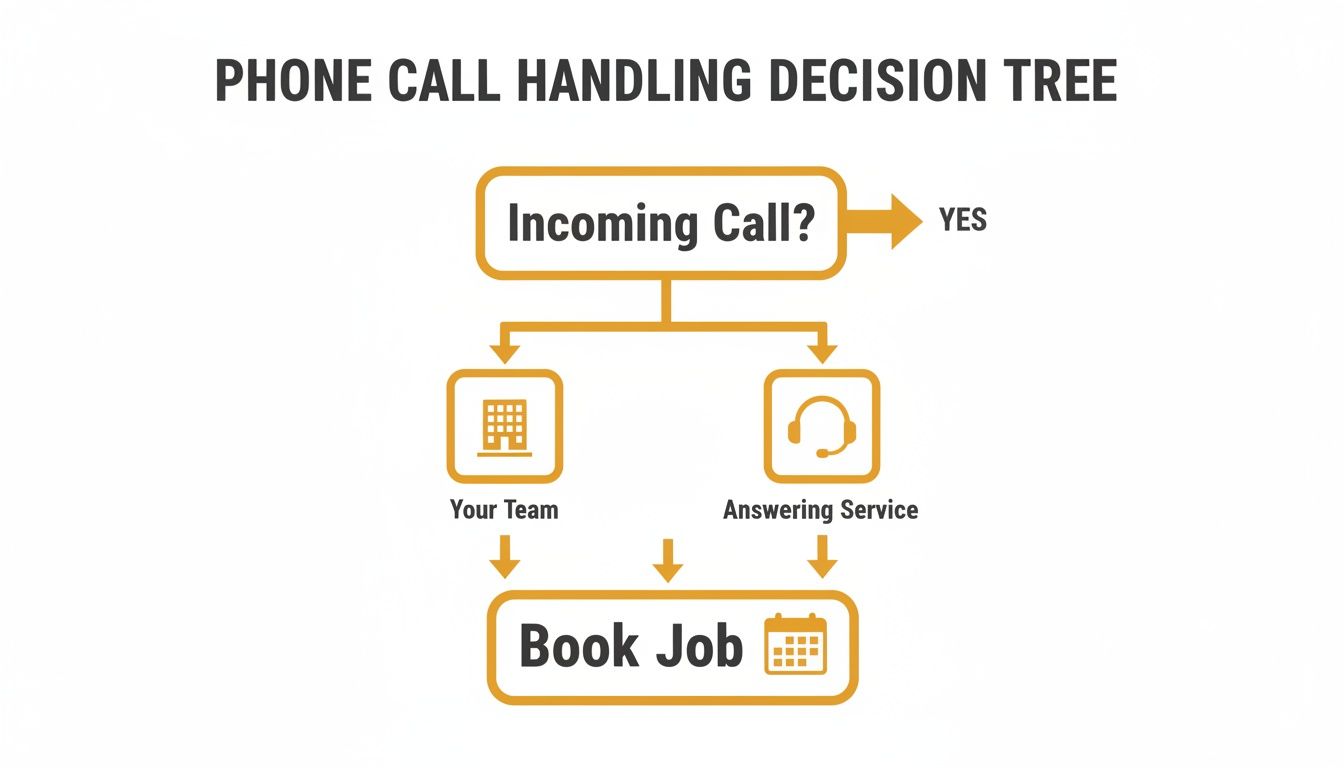
Ultimately, whether it's your team or a service, the goal is the same: a booked job and a happy customer.
To see how these options stack up side-by-side, let's put them in a table.
Call Handling Solutions: A Mover's Comparison
| Feature | In-House Receptionist | Answering Service | AI Receptionist |
|---|---|---|---|
| Availability | 8-10 hours/day, weekdays only | 24/7/365 | 24/7/365 |
| Cost | $3,500 – $5,000+ per month | $500 – $2,000+ per month | $149 – $499+ per month |
| Moving Expertise | High (after training) | Low (generalist agents) | High (trained on industry data) |
| Lead Qualification | Yes, but only when available | Basic message taking only | Yes, asks detailed, relevant questions |
| Live Quoting | Yes | No | Yes, based on your rate card |
| Direct Booking | Yes, into your calendar/CRM | No | Yes, syncs directly with your software |
| Scalability | Low (can only handle one call) | High | Very High (handles unlimited calls) |
Each solution has its place, but the numbers show a clear trend toward more efficient, specialized options that deliver better results for less money.
The demand for better call handling is exploding. The global call center market, which includes these services, hit $352.4 billion in 2024 and is projected to climb over $500 billion by 2030. This isn't just corporate jargon; it reflects the intense pressure businesses are under to handle more calls without dropping the ball. In fact, 61% of call center leaders have seen call volumes spike since the pandemic. You can find more insights about support call marketing statistics and see how they're impacting businesses like yours.
Choosing the right path comes down to your company’s size, call volume, and how fast you want to grow. The key is to find a system that doesn’t just answer the phone, but actively helps you book more moves.
The Non-Negotiables: What to Look for in a Mover's Answering Service
Look, not all answering services are built the same. A generic, one-size-fits-all solution is going to fall flat the second a customer asks about a "long carry" or a "bill of lading." They just don't get it.
When a customer calls your moving company, they need to talk to someone who understands the difference between a studio apartment move and a full pack-and-move for a three-bedroom house. Choosing the right service is like hiring a seasoned dispatcher instead of a temp who's just taking messages. The results are night and day.
To make sure your answering service is actually making you money—not just costing you—there are a few features that are absolutely non-negotiable. These are what separate a basic message-taker from a true extension of your moving business.
24/7 Live Answering and Instant Response
First thing's first: it has to be 24/7. A customer's moving panic doesn't stick to a 9-to-5 schedule. Calls pour in on Saturday mornings, late on a Tuesday night, and all through holiday weekends. If you're not there to pick up, you can bet your competitor will be.
A solid service guarantees every single call gets answered by a real person or a smart AI assistant, no matter when it comes in. That immediate response is everything. It meets the customer's need for a quick answer and gets the ball rolling before they have a chance to dial the next mover on their list.
Industry-Specific Training and Scripting
A generic operator reading from a script is going to sound clueless to someone planning a move. Your answering service needs agents or an AI trained specifically for the moving industry. It's a deal-breaker.
This means they need to:
- Speak Your Language: They have to be comfortable with terms like "binding vs. non-binding estimates," "accessorial charges," and "COI."
- Ask the Right Questions: They need to follow a script you approve to pull out the critical details—home size, tricky inventory like pianos or safes, and any access issues.
- Sound Like You: The service has to represent your company with the same professional tone as your best in-office employee.
This kind of industry-specific knowledge builds trust right out of the gate. It tells the caller they've reached a real moving company, not just a call center in another country.
Direct Calendar and CRM Integration
Just answering the call is only half the job. The real goal is to get a booked move or a scheduled estimate on your calendar. Any top-tier answering service has to plug directly into the tools you already use.
This call-to-calendar integration is a total game-changer. It lets the service see your team's real-time availability and book in-home estimates or even lock in moving jobs right on your dispatch schedule. No more playing phone tag or swapping emails for days. It shrinks the sales cycle from a week to a few minutes. And with CRM integration, every new lead's info gets logged automatically, so nothing falls through the cracks.
Advanced Automation and Follow-Up Capabilities
The best services do more than just answer the phone; they actively help you book more jobs. You should look for a solution that automates the little tasks that always get missed when you're slammed.
A truly effective service doesn't just pass along a message—it moves the lead forward. By automating quotes and follow-ups, it ensures no opportunity is left behind, turning a simple phone call into a confirmed job.
This includes things like automated quote follow-up. Imagine the system sending a text or email to a lead who didn't book on the first call. That one simple touch can boost your booking rate without you or your team lifting a finger. The technology behind this is getting smarter every year. The call center software market is now worth over $33 billion, fueled by the demand for automated solutions that keep up with customers. You can read more about the growth of the call center software market on givainc.com. Giving your moving company these tools isn't just a nice-to-have; it's a massive competitive edge.
Putting a Price Tag on a Ringing Phone
It’s easy to look at a telephone answering service as just another line item on your monthly expenses. But that’s the wrong way to think about it. This isn't a cost—it’s an investment that generates revenue. And figuring out the return is simpler than you might expect.
It all starts by putting a real dollar value on the calls you're currently sending to voicemail.
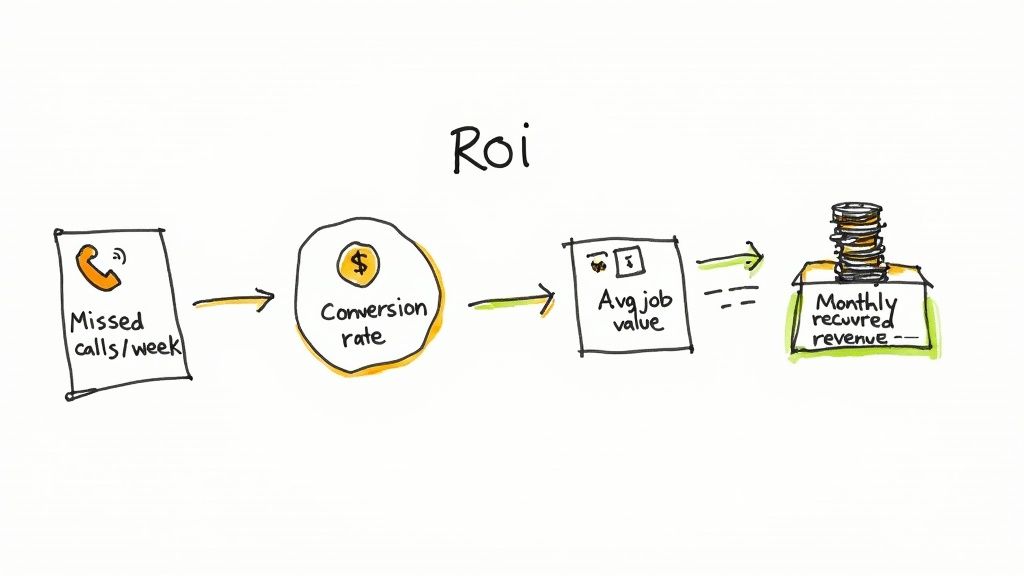
Think about it honestly. How many calls really go unanswered each week? During the peak of busy season, after 5 PM, or when you’re out on a job? For most movers, a conservative guess is four to five calls per week. When your average move is worth around $1,200, the missed opportunity starts to sting.
A Simple Framework for Finding Your ROI
You don’t need a complicated spreadsheet for this. Just a few honest numbers based on what you already know about your moving business.
Let's break it down:
- Estimate Your Weekly Missed Calls: Be realistic, even conservative. Let’s stick with 4 missed calls a week. These are the calls that ring while your hands are full, when you're talking to a client, or long after you’ve closed up for the day.
- Determine Your Booking Rate: Look, you're not going to book every single person who calls. But a booking rate of 25% from a qualified lead who gets a live answer is pretty standard. That means you'd land one out of those four missed calls.
- Calculate Your Average Job Value: What’s a typical local move worth to you? We'll use $1,200 as a solid baseline.
- Do the Math:
- 4 missed calls/week x 25% booking rate = 1 new job booked per week.
- 1 new job/week x $1,200/job = $1,200 in new weekly revenue.
- $1,200/week x 4 weeks = $4,800 in new monthly revenue.
That’s nearly $5,000 a month in your pocket, recovered from just four weekly calls that used to go nowhere. This isn't some fantasy number; it's the direct result of making sure every single caller gets an immediate, professional answer.
One Booked Job Can Pay for the Whole Month
When you frame it like that, the cost of an answering service, whether live or AI-driven, suddenly looks tiny. A modern AI receptionist often costs less than what you make from a single booking.
This means capturing just one extra move a month—the lowest-hanging fruit imaginable—usually covers the entire service cost.
Every job you book beyond that first one is pure profit. Profit you were previously handing directly to the competitor who bothered to pick up their phone. You can see a deeper breakdown by exploring the real cost of missing 4 calls per week—the numbers often surprise even the most seasoned owners.
This simple calculation proves that the right phone solution isn’t an expense at all. It’s a self-funding growth engine that pays for itself almost instantly by turning lost calls into booked jobs on your calendar.
How to Flip the Switch on an Answering Service—Without Messing Up Your Day
Bringing on new help shouldn't mean grinding your business to a halt. The thought of changing how you handle calls can be nerve-wracking, especially when it’s peak season and every single booking matters. But getting set up is way easier than you think. A good provider will make the whole process painless.
The trick is a gradual rollout that doesn’t throw a wrench in your dispatch or daily moves. A professional business telephone answering service worth its salt will walk you through a simple, structured process, turning what feels like a huge project into a few easy steps.
Your Quick-Start Checklist
Getting this off the ground is far less complicated than it sounds. The whole point is to get your service up and running fast, so it feels like a new, highly effective team member from day one. Here’s a simple checklist of what to expect.
1. Set Up Call Forwarding
This is the only "technical" part, and it's surprisingly straightforward. Your provider gives you a unique phone number. From there, you just tell your current phone carrier when to send calls to that number.
You’ve got a few options:
- Conditional Forwarding: Only send calls over when your line is busy or you don’t pick up after a few rings. This is perfect for backup when your dispatcher is swamped.
- Time-Based Forwarding: Automatically forward every call after hours, on weekends, or during holidays. Set it and forget it.
- Full Forwarding: Send all your incoming calls straight to the service, 24/7. This completely frees up your team from the phone.
2. Nail Down Your Custom Script
This is where you teach the service to be an extension of your company. You'll work together to build a script that sounds like you and gets the exact information you need from every caller, every time.
A solid script for a moving company has to cover the basics:
- Move size (e.g., number of bedrooms)
- Origin and destination addresses
- Any specialty items (pianos, gun safes, antiques)
- Access issues (flights of stairs, long carries, service elevators)
This makes sure every lead is properly qualified before you even see it.
3. Plug Into Your Calendar and CRM
To get real value, the service needs to talk to the tools you already use. The provider will help you connect your dispatch calendar (like Google Calendar) and your CRM. This integration is the magic that lets them book estimates and jobs directly into your schedule, killing off manual data entry and double bookings. It’s what turns a simple phone call into a confirmed job on the books.
The goal here is a seamless flow of information. A call comes in, the lead gets qualified, and the appointment just appears on your calendar automatically. This is how you stop chasing leads and start managing a steady pipeline of booked moves.
This kind of automation and 24/7 coverage is fast becoming a major competitive edge. The boom in VoIP technology, part of a market expected to hit $236.25 billion by 2028, is giving even the smallest moving companies access to these powerful cloud-based tools. It’s the same tech powering the global telephone call center market, which is on track to reach $150.51 billion by 2029, all because customers demand an instant, reliable answer when they call. You can discover more insights about these telephone answering services trends and see how they’re helping small operators punch above their weight.
Ultimately, a smooth setup comes down to partnership. A good provider makes this feel effortless, handling the techy details so you can stay focused on running your moves. To learn more about how to capture every single opportunity, check out our guide on how to stop losing after-hours leads without working 24/7.
Got Questions? We’ve Got Answers.
Switching up how you handle calls always brings up a few questions. I get it. Here are some straight answers to the most common things moving company owners ask about using an answering service.
How Much Say Do I Have in the Scripts?
You have 100% control. A good service doesn’t hand you a generic script; they build one with you.
We'll work together to map out the exact questions you need answered—from the size of the move and tricky items like pianos, to building access and COI requirements. The whole point is to make the service sound like a perfectly trained member of your own team, using your company's voice and process.
Will My Customers Know They’re Talking to a Service?
Honestly? They shouldn't. When it's set up right, it feels completely seamless.
The best services, especially modern AI receptionists, are designed to be an invisible extension of your business. They answer with your company name, follow your specific script, and provide a professional experience that builds trust. The caller just thinks they’ve reached your front desk, not some third-party call center.
Is This Going to Be a Pain to Set Up?
Not at all. The setup is surprisingly quick and designed so you don't miss a single call in the transition. It really just comes down to three simple steps:
- Forward your calls. This literally takes a few minutes to do.
- Lock in your script. We'll finalize the custom script we built together.
- Connect your calendar. We integrate with your CRM or calendar for direct booking.
A solid partner handles all the technical heavy lifting for you. The goal is to get you live fast so you can stop losing leads and start booking jobs right away. It's built to be painless.
Ready to stop losing jobs to voicemail and start automating your booking process? MoveJoy acts as your AI-powered receptionist, answering every call 24/7, providing instant quotes, and booking jobs directly into your calendar. See how it works at https://getmovejoy.com.