You know the moment. You’re on a jobsite, a crew lead is asking about access, a customer wants to change the unload window, and your business line starts ringing. You glance at it, can’t pick up, and tell yourself you’ll call back in ten minutes.
That call often doesn’t wait ten minutes.
In the moving industry, 67% of customers book with the first company that picks up the call (moving customer first-to-answer behavior). For a moving company owner, that means a missed ring usually isn’t a delayed opportunity. It’s a booked job for the mover down the street.
That’s why the question isn’t just why do moving companies miss calls. The better question is why so many moving companies still rely on a front-office process that breaks the moment the owner leaves the desk. If your sales process depends on one busy person, one office admin, or one callback list for daily attention, your phone becomes a liability.
Most owners already feel this. The long hours. The constant switching between dispatch, estimates, customer service, hiring, and collections. The missed family time because the phone never really shuts off. What many don’t see clearly is how often the most significant loss happens in the first interaction, when no one answers, no one qualifies the lead properly, or no one gives the caller enough clarity to book.
Introduction The Real Reason Your Phone Is Your Biggest Liability
For most moving companies, the phone looks like a sales asset. In practice, it often acts like a leak in the bucket.
If you run a 5 to 20 truck operation, your best people are rarely sitting still. The owner is out doing estimates or solving problems. The operations manager is dealing with trucks, labor, and route changes. The office is trying to keep up with confirmations, reschedules, paperwork, and dispatch. New leads come in right in the middle of all of that.
The result is predictable. Calls come in during the exact moments your team is least available to stop and sell.
Practical rule: If your growth depends on someone “calling them back later,” your growth depends on a process that fails during your busiest hours.
The bigger issue is what happens after the ring. Most moving customers aren’t calling to chat. They want to know if you service their route, whether you have availability, what the move might cost, and how quickly they can lock it in. If they don’t get movement on those questions, they keep calling.
Owners often treat missed calls as a staffing problem. Sometimes it is. But more often, it’s an operating model problem. You built a field business with moving crews, estimates, dispatch pressure, and seasonal swings. Then you attached a desk-bound sales process to it and hoped the phone would somehow keep up.
That mismatch is why missed calls hurt so much in moving. They don’t just create extra admin work. They create lost bookings, colder leads, and a front office that always feels behind.
The Anatomy of a Missed Call and Why It Happens
The reasons moving companies miss calls are usually boring, structural, and repeated every day. That’s good news. It means the problem can be fixed once you stop treating it like random chaos.
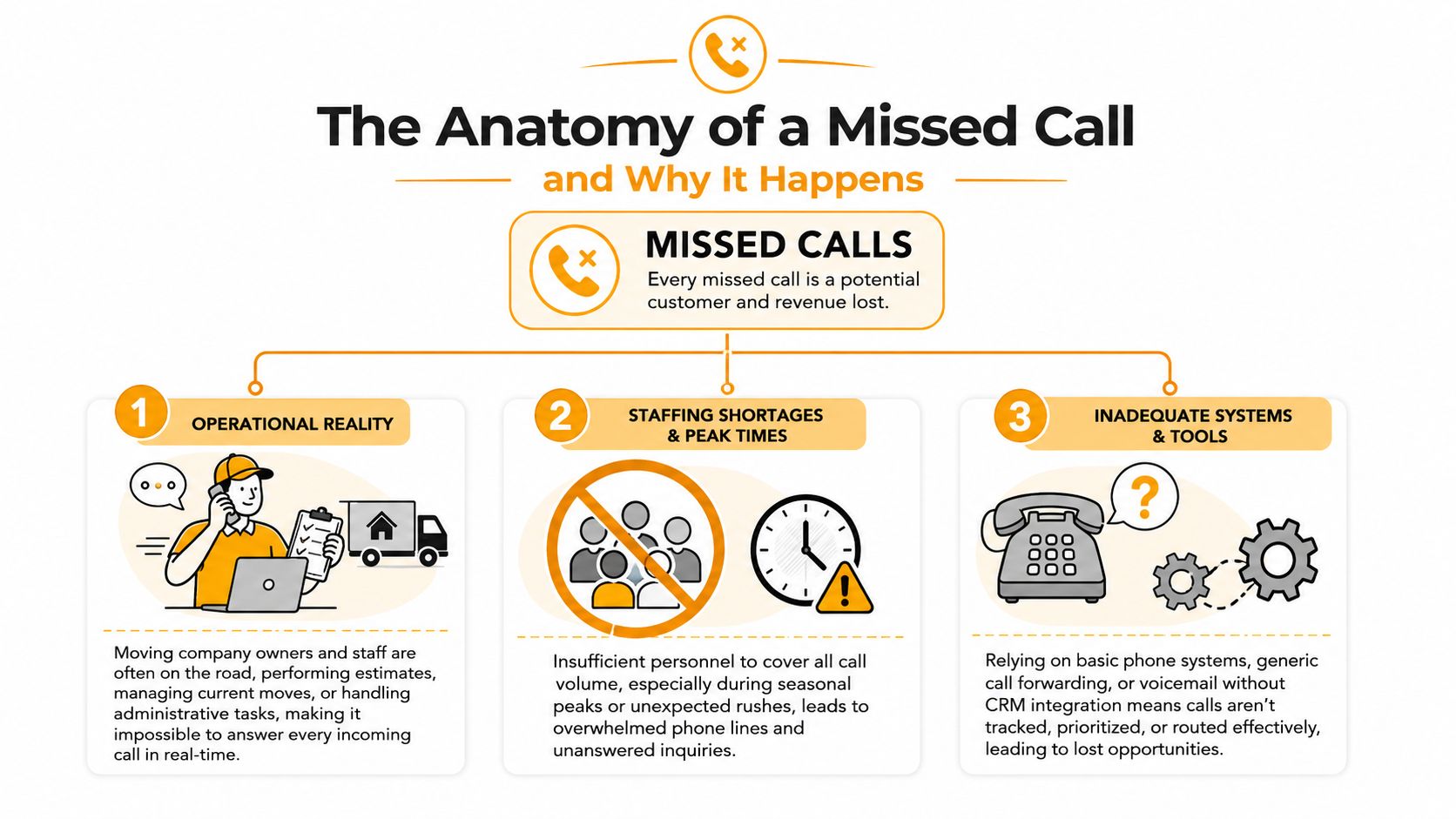
People are mobile and the phone is not
A moving company is a mobile business. The people with the best knowledge are rarely the people sitting at the front desk all day.
Owners are on estimates, in trucks, and handling escalations. Dispatchers are juggling schedule changes. Sales managers get pulled into problem-solving. Even when someone technically “can” answer, they often can’t stop long enough to give a prospect the attention needed to qualify and quote the move properly.
That’s why so many companies have the same symptom. The phone rings. Everyone sees it. Nobody can take it.
The missed call usually isn’t caused by laziness. It’s caused by a business that needs its key people in motion while the sales process still expects someone static at a desk.
Office hours don’t match buying behavior
The primary reason movers miss calls is a misalignment between customer calling habits and traditional office hours, and that problem gets worse in busy season when call volume can spike by 200% to 425% between May and September (moving company call timing and seasonal spike data).
That point matters because most customers don’t shop for movers at the most convenient time for your office. They call during lunch breaks, after work, and on weekends. Those are exactly the hours when many moving offices are closed, lightly staffed, or trying to cover too much with too few people.
A standard 9-to-5 setup might feel reasonable internally. It doesn’t match how demand shows up.
Peak season exposes every weak process
During March through September, the same company that feels manageable in the winter starts dropping balls. Not because the owner forgot how to run a business. Because volume reveals every weak handoff.
Here’s what usually breaks first:
- Inbound coverage: Calls stack up while the office is helping current customers.
- Lead qualification: Staff rushes through intake and misses key pricing details.
- Callback discipline: New leads sit until the afternoon, then until tomorrow.
- Quote consistency: Different team members collect different information.
- Booking handoff: The lead gets captured but doesn’t move cleanly into scheduling.
A lot of owners assume they need more leads. Many need to stop wasting the leads they already paid for.
Here’s a quick diagnostic table for a typical local mover:
| Failure point | What it looks like | What it causes |
|---|---|---|
| Owner dependence | Calls route to one person first | Delays when that person is on-site |
| Thin office coverage | One admin handles phones and dispatch | Calls abandoned during rush periods |
| Loose intake process | No consistent quote checklist | Bad follow-up and inaccurate estimates |
| After-hours gap | Evenings and weekends roll to voicemail | High-intent shoppers call competitors |
| Seasonal overload | Busy season volume hits all at once | Team reacts instead of selling |
If you recognize your company in that table, that’s normal. It also means the fix isn’t motivational. It’s operational.
Calculating the True Cost of an Unanswered Phone
Many owners know missed calls are bad. Fewer have completed the math. Once you do, the problem stops looking like an annoyance and starts looking like a revenue line item.

A simple way to think about the loss
The average moving company fails to answer nearly one in four calls. Each missed call represents about $1,200 in lost potential revenue, and that can add up to an average of $126,000 per year for a small business (moving company missed call revenue impact).
You don’t need a complex spreadsheet to understand the damage. Use conservative math.
If your office misses just a handful of good inbound opportunities each week, and each missed opportunity carries real booking value, the annual loss gets large very quickly. That’s why missed call recovery deserves the same attention as truck utilization, crew productivity, or ad spend. If you want a deeper breakdown, this guide on missed call revenue for moving companies lays out the leak in practical terms.
Owner mindset shift: A missed call is not just a missed conversation. It’s an uncollected deposit, an empty truck slot, and a marketing dollar that never got a fair chance to convert.
Why voicemail is usually the end of the lead
The financial hit gets worse because voicemail feels safer than it is. Many teams assume the lead is still alive if the caller heard a message and had the option to leave one.
That’s not how most moving shoppers behave.
They’re comparing availability, speed, professionalism, and price confidence. If they reach voicemail, many won’t wait around for a callback cycle. They’ll move to the next mover on the search results page or referral list.
That creates three separate losses at once:
- You lose the immediate booking chance
- You lose quote momentum
- You force your team into reactive follow-up instead of live selling
This is why moving company missed calls are so expensive. The loss doesn’t come from one dramatic failure. It comes from repeated small moments where nobody captured the customer while intent was highest.
Immediate Process Fixes to Capture More Leads Today
You don’t need new software to improve this week. You do need tighter habits. Most 5 to 20 truck operators can recover a meaningful amount of lost opportunity by cleaning up basic phone coverage and intake discipline.
Build a real phone coverage plan
Most companies don’t have a phone coverage plan. They have assumptions.
Write down exactly who owns inbound calls during these windows: morning open, lunch, late afternoon, after-hours, and Saturday. If your answer is “whoever’s free,” you don’t have coverage.
Use a simple rotating structure:
- Primary answerer: One person owns first pickup for a defined block.
- Backup answerer: A second person steps in when the primary is tied up.
- Escalation owner: One person handles quote exceptions and special cases.
- End-of-day sweep: Someone clears every open lead before close.
This sounds basic because it is. Basic works when it’s written down and followed.
Use a basic intake script and tighter follow-up
A good first-call script should collect enough information to move the lead forward without turning the conversation into an interrogation.
At minimum, every answerer should capture:
- Move date or date range
- Origin and destination
- Home type and access issues
- Inventory size
- Special items
- Best callback number and email
- Whether the caller wants a quote now or later
If your team needs inspiration on how structured lead capture improves conversion in other industries, this archive on lead generation for SaaS and ecommerce is useful because it shows how better qualification reduces wasted follow-up.
Then set a hard rule for callbacks. Don’t leave new inquiries sitting in a general inbox or sticky-note pile. Block time in the morning, early afternoon, and before close to work every unquoted lead.
A callback process fails when it depends on memory. It works when it lives on the calendar.
Fix the voicemail and handoff experience
If you’re still using voicemail, make it useful.
Bad voicemail says, “Leave a message and we’ll get back to you.” That sounds passive and crowded. A better message tells the caller what to send, what happens next, and gives an alternate path to reach you.
Use these do’s and don’ts:
- Do state business hours clearly: Don’t make callers guess when they’ll hear back.
- Do ask for specific details: Name, move date, zip codes, and inventory size.
- Do route web leads cleanly: Make sure your form notifications reach the right person.
- Don’t promise instant callbacks if you can’t deliver them: That creates distrust.
- Don’t let every line ring endlessly: Shorten the path to a human or a fallback process.
One more fix matters. Train dispatch and office staff on when to stop “taking a message” and start actively qualifying. The first person who answers doesn’t need to close every job. But they do need to keep the lead from going cold.
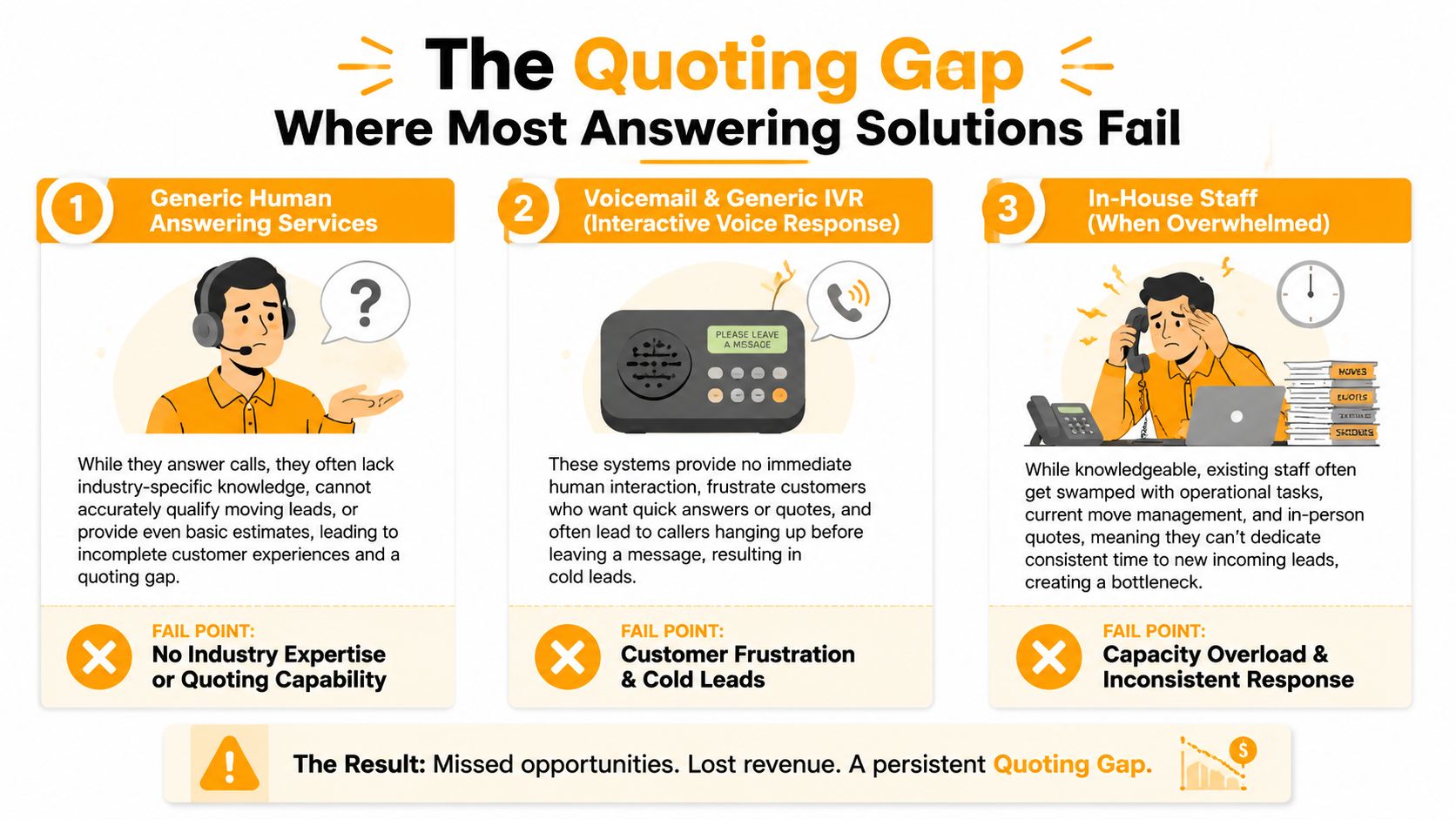
The Quoting Gap Where Most Answering Solutions Fail
Many owners think the problem ends once someone picks up the phone. It doesn’t. A lot of moving companies are not really losing leads because nobody answered. They’re losing them because nobody gave the caller a usable next step.
Answering is not the same as selling
The core issue is often not call availability but the Quote Complexity Gap. Generic solutions fail because they can’t handle the structured intake required for an accurate moving quote, and they miss details like long carries, stair charges, or hourly versus flat-rate pricing that directly affect conversion (moving quote complexity in first-call intake).
That’s the difference between capturing a lead and closing a job.
A human answering service might be polite and reliable, but if they can only say, “Someone will call you back,” they haven’t solved the core sales problem. They’ve just created a cleaner version of voicemail.
A generic voice tool has a similar weakness. It may collect contact information. It may even ask a few basic questions. But moving isn’t a generic retail transaction. Pricing depends on access, item complexity, service level, distance, timing, and your own rate structure. If the first interaction can’t handle that reality, the lead often leaves without confidence.
Why generic tools break on moving details
Moving quotes fall apart when the intake misses operational details. You already know the common ones:
| Missed detail | Why it matters |
|---|---|
| Long carry | Labor time changes |
| Stair charges or walkups | Crew load changes |
| Specialty items | Equipment and pricing change |
| Hourly vs flat-rate fit | Quote logic changes |
| Packing needs | Scope increases |
| Building restrictions | Schedule and labor planning change |
This is why I’m skeptical when owners say, “We just need something to answer the phones.” No. You need something that can move the lead forward with enough precision that the customer feels informed and your team doesn’t have to restart the sale later.
For movers exploring what a purpose-built system looks like, this page on an AI quoting tool for movers is useful because it focuses on quote generation rather than generic call handling.
What a useful first call needs to accomplish
A strong first interaction should do four things well:
- Confirm fit: Is this a job you want?
- Collect quote-critical details: Enough to price or route correctly
- Set expectations clearly: Next step, timeline, and availability
- Create booking momentum: Don’t force the customer to start over later
Field observation: The lead usually goes cold when the caller has to repeat the same move details to three different people.
CRMs help after the lead is in the system. They don’t solve the front-end failure. Answering services reduce ring time but often stop short of quoting. Generic AI tools can sound impressive in a demo and still break when a caller asks about a two-bedroom walkup with a long carry and a piano.
That’s the quoting gap. And it’s where many moving companies keep losing jobs they thought they had “covered.”
How Automation Can Capture and Close Every Lead
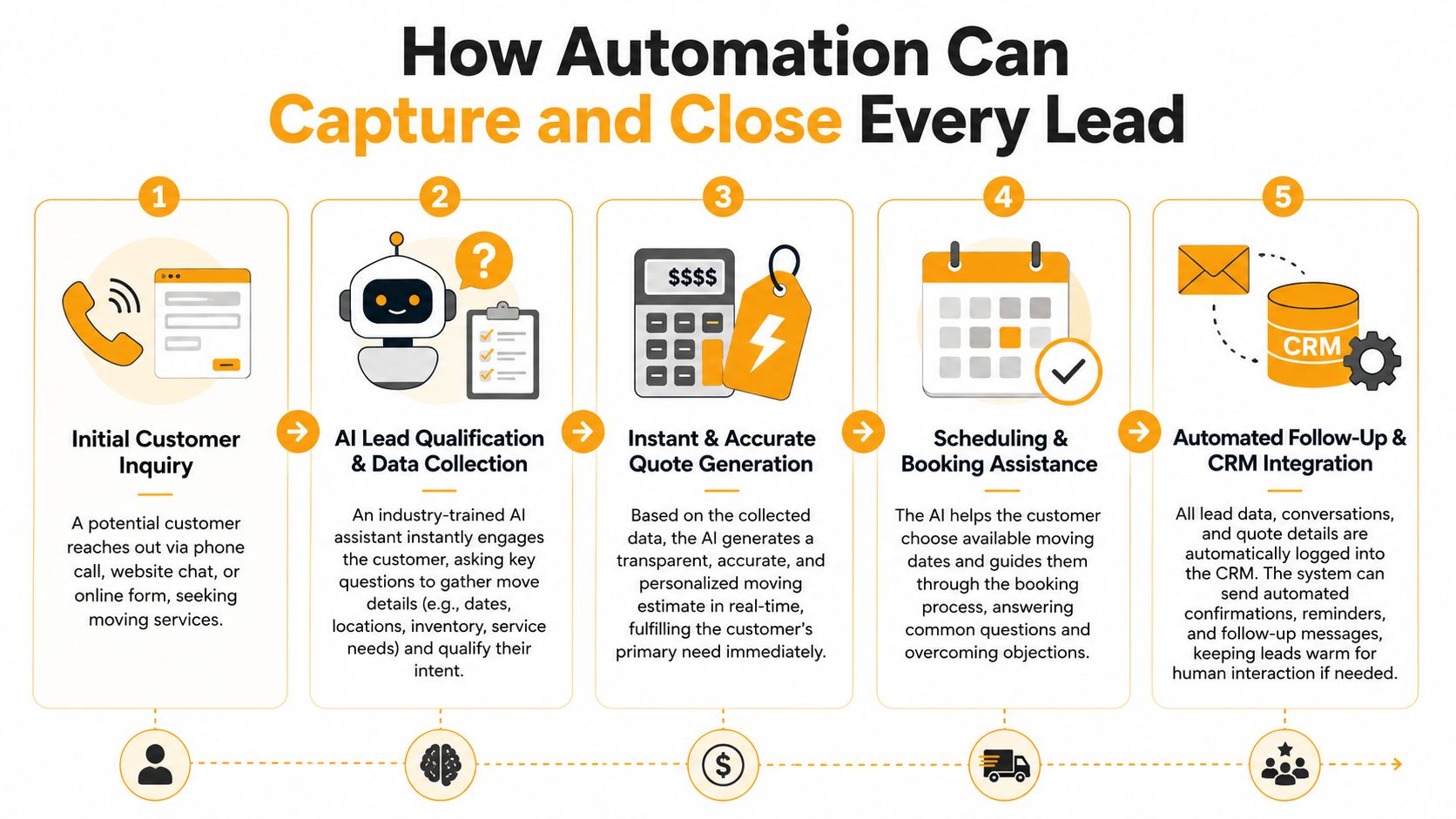
The best front-office systems remove dependency on one busy person, one shift, or one callback list. They don’t just answer. They qualify, quote, route, and create booking momentum while your team handles the work already on the board.
The right workflow removes the front-office bottleneck
Moving companies miss approximately 24% of inbound calls, leading to annualized revenue leakage of $50K to $150K for independent operators. The main reason is the conflict between mobile operations and the need for desk coverage during peak calling hours (missed call losses for independent movers).
The practical answer is automation built for moving workflows, not generic phone coverage.
The right setup can:
- Answer every inbound inquiry around the clock
- Collect structured move details consistently
- Generate an accurate quote using your own rate card
- Book directly into SmartMoving, Supermove, MoveitPro, or Google Calendar
- Trigger automated quote follow-up when the customer doesn’t book immediately
That’s a different outcome from “we took the message.” It turns the phone into a booking channel instead of a triage channel.
If you’re thinking about intake outside voice calls too, this piece on conversion forms and multi-step flows is a good reminder that structured questions usually outperform one big generic form. The same principle applies to moving quotes. Better sequencing gets better information.
What to automate first
Don’t automate everything at once. Start where your current process breaks most often.
For most moving companies, the best first automations are:
After-hours and weekend coverage
High-intent shoppers frequently encounter a dead end today regarding after-hours and weekend coverage.Quote intake standardization
Every lead should be qualified the same way, not based on who happened to answer.Calendar and CRM booking handoff
If a quote is ready, the next step should be immediate.Follow-up on unbooked estimates
A lot of revenue sits in estimates that were sent but never actively worked.
A strong automated workflow shouldn’t create more admin. It should remove it. The office shouldn’t need to re-enter every lead, chase scattered notes, or reconstruct what happened on the first call. Here, a system that can stop moving companies from losing jobs becomes less about phone coverage and more about operational control.
Bottom line: Movers don’t need more software tabs. They need a front-end booking process that works when crews are busy, the office is slammed, and customers are shopping right now.
If you’ve been asking why do moving companies miss calls, the honest answer is that most are still using a front-office model built for a quieter, simpler business. The operators who grow are the ones who stop treating missed calls as a nuisance and start treating quoting and booking as a system.
If your team is tired of watching calls turn into voicemail, callbacks, and lost jobs, take a look at MoveJoy. It’s built for movers that need more than answered calls. It helps generate accurate quotes using your rate card, book jobs into your CRM or calendar, and recover revenue that usually slips away after hours, on weekends, and during peak season.