Your crew is on a job. The dispatcher is juggling arrivals, the office line rings, and nobody can grab it. If that caller needs a same-week local move, a labor-only unload, or a long-distance estimate, they won’t wait long. They’ll call the next mover.
That’s why so many owners start searching for smith ai reviews. They’re not really shopping for a receptionist. They’re trying to stop the leak between inbound demand and booked work.
For moving companies, that leak usually starts in the front office. Calls come in during load-outs, after hours, on weekends, and in the middle of peak-season chaos. A generic answering solution can help, but moving is one of those categories where taking a message and effectively advancing the sale are two very different things.
| Evaluation area | Smith.ai | What a mover should care about |
|---|---|---|
| Core model | Hybrid AI-human receptionist | Whether calls get answered when your team is on jobs |
| Best use case | Lead capture, intake, scheduling, overflow | Whether your office can follow up fast enough to win the job |
| Conversation handling | Strong for general business conversations | Whether the system understands moving-specific pricing logic |
| Moving quote ability | Limited for detailed quoting | Whether callers can get a confident quote on the first interaction |
| CRM workflow | Can log leads and support follow-up workflows | Whether it creates a booked job or just hands your team another task |
| ROI lens | Value from fewer missed calls and more captured leads | Value from jobs actually quoted, scheduled, and closed |
The Unanswered Call That Costs Thousands
The missed call problem looks small when you hear the phone ring once and it goes to voicemail. It looks expensive when you realize that call happened while your estimator was driving, your office manager was handling a reschedule, and your dispatcher was confirming tomorrow’s route.
For a small moving company, this isn’t a customer service annoyance. It’s a front-end sales problem. A caller who’s pricing a move today usually wants answers today. If your company replies tomorrow, you’re often already behind.
I see this pattern constantly with owner-led movers. The owner still answers phones, sells jobs, handles escalations, and checks route profitability. That setup can work in slower periods. It breaks down when volume spikes and every inbound call turns into a race.
What a missed call actually means
One missed call can be any of these:
- A local move shopper who wants a quick hourly ballpark and books with the first company that sounds organized
- A higher-value household move that needs inventory intake, timing, and access details before the caller trusts your quote
- A repeat customer who doesn’t want to leave a voicemail because they need help now
- A referral lead from a property manager or agent who expects a live answer
Smith.ai and similar services get attention because they solve the first visible problem. They make sure the phone gets answered.
That matters. It protects your brand, keeps prospects from hearing voicemail, and gives your company a more professional first impression. It also pairs well with other reputation levers, including leveraging Google Maps reviews so your listing converts better when a caller checks you before calling back.
Practical rule: If your best marketing channel sends calls to voicemail, your marketing is doing work your front office isn't finishing.
Why movers feel this pain more than other service businesses
A plumber can often book a diagnostic visit. A law office can schedule a consult. Moving is harder. The caller wants to know whether you handle their move type, what it may cost, and whether you have availability.
That means speed matters, but informed speed matters more.
If you want a clear breakdown of how quickly a few missed calls can turn into a meaningful revenue problem, this write-up on the real cost of missing four calls per week is worth reviewing. The main point is simple. Owners often measure missed calls as an admin issue when they should measure them as lost booking opportunities.
An Objective Look at Smith.ai
Smith.ai is one of the better-known names in the virtual receptionist category because it combines automation with live human support instead of relying on only one or the other.

That hybrid model is the important part. The AI layer handles the front end of the interaction, including initial answering and filtering, while human agents step in when the conversation needs more judgment or when overflow needs coverage. For many service businesses, that’s a practical middle ground between a basic bot and a traditional receptionist team.
What the service is built to do well
According to its Clutch profile, Smith.ai was founded in 2015 and has 77 verified client reviews, with reviewers reflecting strong satisfaction around its AI-human hybrid virtual receptionist service, 24/7 call coverage, and some plans costing under $10,000 annually.
That general market feedback lines up with what operators usually want from this category:
- Always-on answering so callers reach a live workflow instead of voicemail
- Lead intake so name, contact details, and basic service need are captured
- Scheduling help when the business wants appointments pushed into a calendar flow
- Bilingual support for teams serving both English- and Spanish-speaking callers
- Overflow handling when the in-house office gets slammed
The service also has a reputation for professionalism and responsiveness in review coverage tied to the same Clutch listing. That matters for movers because a calm, competent first interaction can prevent a lead from bouncing to the next company.
Where the model fits best
Smith.ai makes the most sense if your business needs coverage first.
Coverage means:
- Somebody answers.
- The caller gets guided through intake.
- Your team receives a usable record of the conversation.
- Follow-up happens inside your existing sales process.
The value of a hybrid receptionist rises fast when your current alternative is voicemail, chaos, or a crew lead answering from the cab of a truck.
That’s an important distinction. Smith.ai is not positioned as moving quote software. It is positioned as a capable reception and lead-handling layer for businesses that need reliability, consistency, and after-hours responsiveness.
For many industries, that’s enough. For movers, it’s often only the first half of the job.
How Smith.ai Performs for Moving Companies
For movers, Smith.ai’s strengths are real. So are its limits.
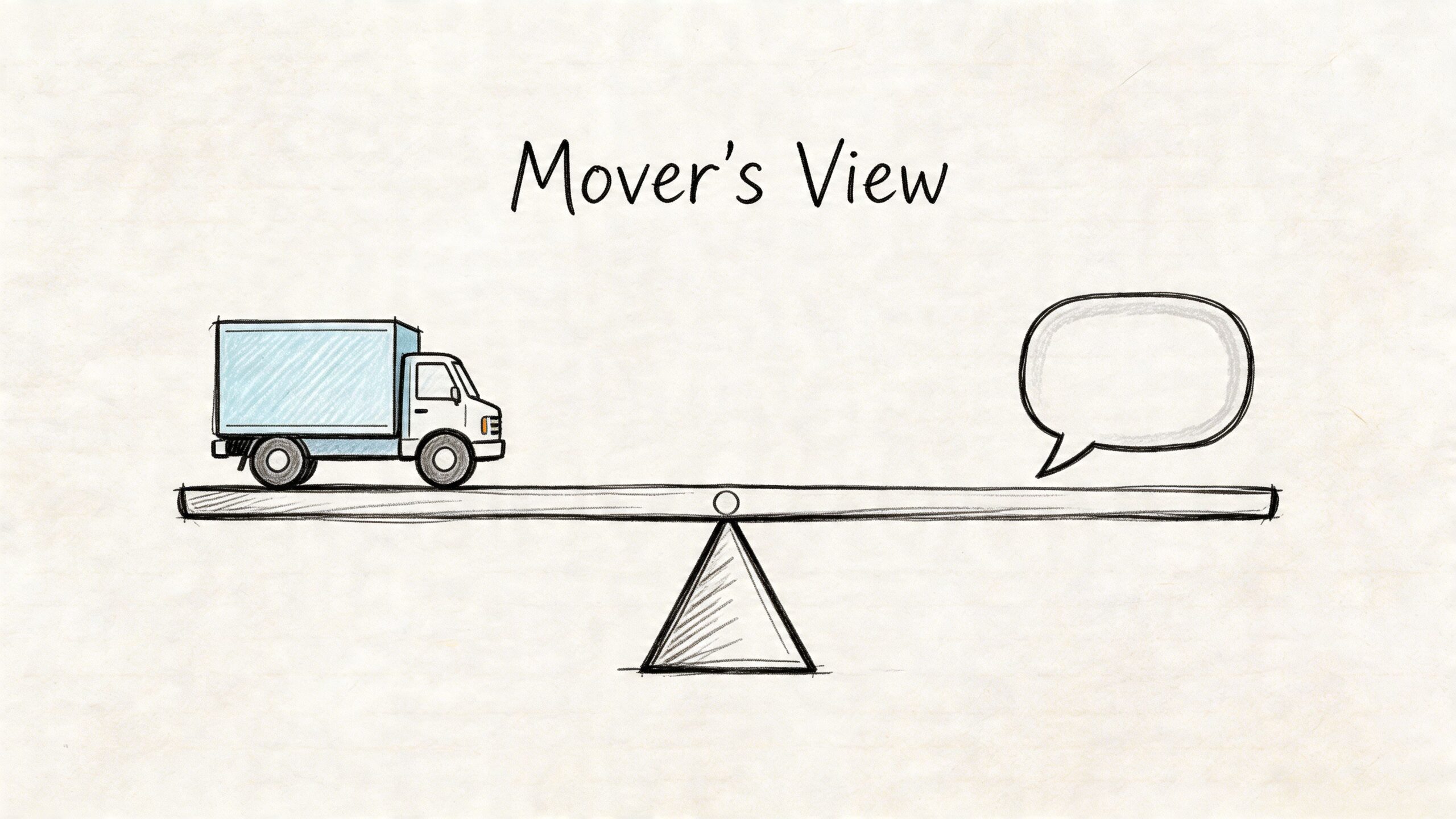
The biggest upside is simple. It helps make sure a caller reaches a professional conversation instead of dead air, voicemail, or a rushed owner trying to answer during a carry. For a moving company with inconsistent phone coverage, that alone can improve the customer experience.
Where Smith.ai helps a mover
A moving customer usually judges your company fast. If the call gets picked up, the tone is organized, and the caller feels heard, you’ve already cleared a hurdle many small operators still fail.
That’s where Smith.ai earns credit. The hybrid setup is designed for conversation quality, and in 2026 benchmark coverage, Smith.ai scored 4/5 overall for conversation quality. The same benchmark also notes features that matter operationally, such as outbound calling for follow-ups.
That can help in common moving scenarios like these:
- After-hours inquiries that need a callback queue built before the office opens
- Weekend spikes when your coordinator can’t keep pace with inbound demand
- Busy-season overflow when your team is quoting, dispatching, and fixing schedule changes at the same time
- Bilingual inbound calls where language coverage prevents a lead from dropping
If your current phone process is weak, Smith.ai is a meaningful upgrade.
Where the gap shows up
The limitation is also clear in the same benchmark review. Smith.ai relies on human judgment for lead qualification, but that still doesn’t replace industry-specific quoting knowledge for things like stair charges or hourly pricing.
That sentence matters more than most smith ai reviews admit.
A moving lead often asks questions that sit in the gray area between customer service and quoting:
- Is this billed hourly or flat rate?
- Do stairs change the price?
- What about a long carry?
- Can you do a small walk-up without overcharging me?
- Do I need a shuttle or a certificate?
- What if we’re packing only part of the home?
A general receptionist can gather details. They usually can’t price that call with confidence using your actual rate card logic.
If the caller leaves the interaction with “someone will get back to you,” your company answered the phone but may still lose the sale.
Why timing matters so much in moving
Moving buyers don’t love waiting around for a sales loop. Many are comparing a few companies in a short window. The first mover that sounds competent and gives a useful next step often gets the advantage.
This is the trade-off with receptionist-style services. They improve lead capture, but they don’t automatically improve quote completion.
That’s why owners comparing options should study the difference between receptionist workflows and systems built for AI answering service use cases in moving. The key question isn’t whether the phone gets answered. It’s whether the call moves all the way toward a usable quote and a booked slot.
My practical read
If your office misses calls, Smith.ai can stop obvious waste.
If your bigger problem is quote delay, it won’t solve enough of the funnel on its own.
For most movers, that distinction determines whether a tool feels like relief or just another inbox of leads to chase.
Lead Capture vs Job Closing A Direct Comparison
The cleanest way to evaluate smith ai reviews is to stop asking whether Smith.ai is “good” and start asking what job it actually performs.
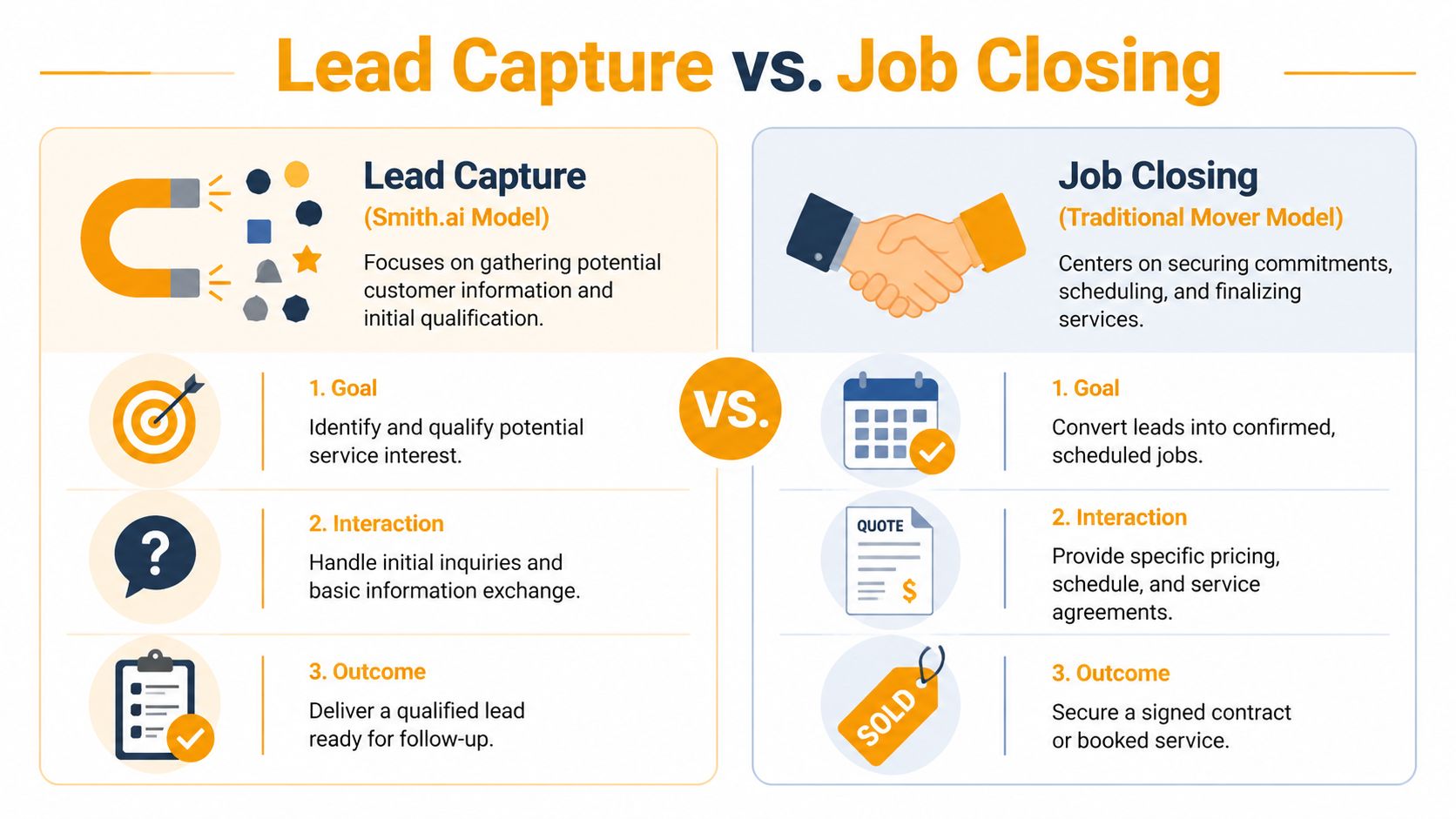
It performs lead capture well. That’s different from job closing.
The business model difference
In moving, the front office can operate under two very different philosophies:
| Criteria | Lead capture model | Job closing model |
|---|---|---|
| Main objective | Catch the inquiry and log it | Turn the inquiry into a quoted, scheduled move |
| Call outcome | Name, number, notes, maybe an appointment | Pricing, availability, next step, booking progress |
| Work left for staff | Follow-up, quote prep, sales callback | Exception handling and operational review |
| Speed to value | Better than voicemail | Better than voicemail plus faster conversion path |
| ROI measurement | Leads captured | Jobs booked |
That distinction becomes critical when evaluating a service that sits between your marketing and your operations.
According to a review analysis focused on Smith.ai, it is a cost-effective alternative to full-time receptionists at $240 to $900 per month, and it can handle simultaneous calls with AI-first routing and human escalation. The same analysis makes the most important point for movers. Its value is measured in captured leads, not the total revenue of jobs booked autonomously on the first call.
Why captured leads aren't the same as recovered revenue
Many owners overrate intake and underrate completion.
A captured lead still needs:
- Fast follow-up
- Correct quote logic
- Clear availability
- A booking push before the shopper drifts away
If your sales process is tight, lead capture can work fine. If your office is already overloaded, more captured leads can just mean more unfinished work.
Here’s how that difference shows up in real moving operations.
Scenario one with a small owner-led company
The owner is on-site, the spouse or office admin is part-time, and nobody is dedicated to sales. A receptionist service catches the call and logs the inquiry. That’s better than voicemail.
But now someone still has to call back, collect inventory, work through access issues, quote accurately, and ask for the booking. If that callback slips, the lead value drops fast.
Scenario two with a stronger office team
A larger local mover has dedicated sales coverage in the morning and dispatch support in the afternoon. In that setup, lead capture works better because the handoff is staffed. The receptionist layer acts like a filter and traffic controller.
Same tool. Different result.
Operator insight: A lead capture system only performs as well as the follow-up discipline behind it.
The four comparison points that matter most
Quoting ability
Smith.ai can support intake and qualification. That is not the same as quoting moving jobs with company-specific pricing logic.
A moving company needs a system, or a person, that can handle variables like building access, service level, minimums, travel time, and add-ons without sounding uncertain.
Booking speed
Lead capture creates a delay by design. The caller is collected first, then your team closes later.
That’s fine when the buyer is patient and your office is sharp. It’s risky when the buyer is shopping fast.
CRM outcome
A receptionist workflow usually logs a lead. A mover-focused booking workflow should push the result closer to a scheduled job inside SmartMoving, Supermove, MoveitPro, or your calendar process.
Logging is administrative progress. Booking is revenue progress.
ROI calculation
Owners often ask, “Will this help us answer more calls?” That’s the wrong end of the math.
The better question is, “Will this increase booked work from calls we currently mishandle?”
A receptionist service can absolutely create value. But if you only count answered calls, you’ll miss the bigger issue. The sales bottleneck may still sit between intake and quote delivery.
The practical takeaway
If your company needs a safety net, lead capture is useful.
If your company needs a front-end sales engine, lead capture is only partial coverage.
That’s the big lesson hidden inside many smith ai reviews. They evaluate call handling quality. Movers need to evaluate whether the system advances the booking.
When Does Smith.ai Make Sense for a Mover
There are moving companies where Smith.ai is a logical fit. Just not all of them.
The best fit is a mover that already has a reliable internal sales process and mainly needs help with coverage, overflow, and after-hours intake.
It makes sense when your team can act on leads quickly
If you have staff who can call back fast, intake capture becomes much more valuable.
That usually looks like:
- A dedicated office team that treats new leads as priority work, not side work
- Clear follow-up ownership so no estimate request sits untouched
- A stable quoting process where staff can turn intake into a quote without back-and-forth confusion
- Consistent calendar discipline so appointments and callbacks don't disappear during busy days
In those environments, Smith.ai can act as a strong front-door buffer.
It makes sense when your main problem is phone coverage
Some movers don’t need full booking automation. They need to stop calls from falling into a black hole.
For example:
| Mover type | Why Smith.ai can fit |
|---|---|
| Established local mover | Has office staff, but needs after-hours and overflow support |
| Multi-location operator | Needs consistent first-response handling across markets |
| Sales-led company | Wants every lead captured for next-step follow-up |
| Bilingual-heavy market | Benefits from broader language coverage on inbound calls |
Where smaller movers should be careful
A lot of owner-operated companies assume any answered call equals a solved problem. It doesn’t.
One of the clearest gaps noted in a review discussing Smith.ai for smaller operators is its limited native integration with moving-specific CRMs like SmartMoving or Supermove. That same review also points out the bigger issue for small firms. It can log calls, but it does not perform fully autonomous booking that eliminates manual follow-up.
That’s the dividing line.
If you run a lean operation with 1 to 20 trucks, manual follow-up is often the exact bottleneck hurting conversion. Your office doesn’t need another queue of “qualified leads.” It needs fewer handoffs.
A receptionist layer works best when your company already has enough internal muscle to finish the sale immediately after intake.
My recommendation by company stage
If you’re a smaller mover still answering phones from the field, I’d be cautious about assuming a receptionist tool fixes your revenue problem.
If you’ve already built a dependable sales desk and you need reliable call coverage, Smith.ai is easier to justify.
The product is strongest when used as an intake and overflow system, not when asked to carry the full burden of quoting and booking for a moving company.
Moving Beyond Answering Calls to Automating Revenue
The most useful conclusion from smith ai reviews is this. Smith.ai is a real upgrade over voicemail. For many businesses, that’s enough.
For moving companies, it often isn’t.
The pressure point in this industry sits between the first hello and the booked job. That pressure gets worse during busy season, on nights and weekends, and whenever the office team is stretched thin. A tool that answers calls can reduce obvious waste. A system that handles quoting and booking reduces deeper waste.
What owners should ask instead
Don’t just ask:
- Can this answer the phone?
- Can this take a message?
- Can this log the lead?
Ask:
- Can this move the caller toward a real quote?
- Can this reduce handoffs?
- Can this fit the way movers price jobs?
- Can this help the office team finish more sales, not just collect more work?
That shift matters because the moving market rewards fast clarity. Customers compare companies quickly. The mover who responds with confidence usually gets the best chance to close.
The broader trend operators should watch
More service businesses are moving from “coverage tools” to “completion tools.” That applies to communications infrastructure too. If you're tracking how AI is being deployed more seriously in customer-facing workflows, this overview of Snapdials compliant frontline AI is a useful example of how the conversation is shifting beyond simple call pickup.
For movers, the same strategic idea applies. The future isn’t just answering more calls. It’s building front-office automation that supports revenue execution.
A lot of teams are already exploring broader customer service automation software because they’re tired of stacking disconnected tools that create one more follow-up task instead of removing one.
The strongest front office is the one that shortens the gap between inquiry, quote, and booked work.
If you’re evaluating Smith.ai, be honest about your core problem in your business. If the problem is missed calls, it can help. If the problem is missed bookings, you need to think one step further.
If your moving company needs more than answered calls, take a look at MoveJoy. It’s built for movers that want to recover missed-call revenue by turning inbound inquiries into accurate quotes and booked jobs, not just captured leads.