Think of a phone answering service as your remote front desk, but smarter. It's a system that ensures every single customer call gets answered professionally. This is a game-changer when your crew is out on a job, it's after hours, or your dispatcher is just plain swamped. For moving companies, this means capturing high-value leads that would otherwise hit voicemail and call your competitor.
The Real Cost of a Missed Call for Your Moving Business
Picture this: It's peak season. A busy Saturday morning in May. Your best crew is handling a huge job across town, your dispatcher is juggling three things at once, and the phone rings. It’s a desperate customer with a high-value, last-minute move. But nobody picks up.
It rings, and rings, and finally goes to voicemail. That’s not just a missed call. That’s a lost job, easily worth a few thousand dollars, gone in an instant.

This scene plays out every single day for moving company owners. Every unanswered call is a direct hit to your bottom line because potential customers don't wait around. They just hang up and call the next mover on their list. In this business, speed determines who wins the job.
The Hidden Financial Drain
The problem is way bigger than most owners realize. A jaw-dropping 62% of calls to small businesses go completely unanswered. They go straight to voicemail, which is where moving leads go to die. For service businesses like moving, impatient customers just dial the next company.
This isn’t about blaming your team; they're probably already stretched thin. It’s about plugging a massive revenue leak in your operations. When you miss that call, you don't just lose that one job. You also lose out on:
- Future Referrals: A happy customer could have sent their friends and family your way for years.
- Repeat Business: That person might have called you for their next move.
- Marketing ROI: All the money you spent on ads to make that phone ring? Wasted.
To really grasp the damage, it's worth looking into how much moving leads cost. Every missed call means you just paid for a lead and then handed it directly to your competitor.
Key Takeaway: Booking just one job from a call you would have otherwise missed often pays for an entire month of an automated answering solution. This isn't an expense; it’s a revenue recovery tool.
The goal isn't just to answer more calls. It's to build a system that captures these opportunities 24/7, turning calls you used to miss into jobs on your calendar.
Understanding Your Answering Service Options
When you hear "phone answering service," what comes to mind? Probably a huge call center with rows of agents in headsets. That’s one way to do it, but for a modern moving company, it’s far from the most efficient option.
For a moving business, an answering service is your remote front desk. It's the operational tool that ensures every single lead gets captured, whether it’s 10 PM on a Friday or the middle of a chaotic Tuesday morning move.
Let's break down the two main paths you can take.
The Traditional Human-Powered Call Center
This is the classic model. You hire a company with live agents who answer your calls. They follow a script, take down a name and number, and shoot the details over to you in an email or text.
Think of it like hiring a team of off-site receptionists. They can sound professional and provide that "human touch," but they have serious operational limitations. Most of the time, a traditional service just gathers basic contact info. The real work of quoting the job and actually getting it on the schedule is still on you—and usually hours after the potential customer called. This delay is where you lose business.
The Modern AI-Powered Receptionist
This is the smarter approach for lean moving operations. An AI receptionist is an automated system that answers your phone 24/7/365 with a voice that sounds completely natural. The big difference? It doesn't just take a message. It actually engages the customer, qualifies the lead, and moves them to the next step on the spot.
This isn't a message-taker; it's a booking assistant. An AI-powered system can:
- Qualify Leads Instantly: It asks the important questions right away—move size (e.g., a two-bedroom apartment), preferred dates, and where they're moving from and to.
- Provide Immediate Information: It can answer common questions about your services or availability based on the rules you set, so customers aren't left hanging.
- Integrate with Your Calendar: This is the game-changer. The system can schedule on-site estimates or even book jobs directly onto your calendar without you lifting a finger.
The core difference is simple: a traditional service tells you that someone called. An AI receptionist tells you who called, what they need, and when they're available—often putting the confirmed job right on your schedule.
When you're looking at your options, think about how a dedicated appointment setting answering service can change how you operate. The ability to take a caller from a simple question to a booked appointment in one automated conversation is a massive competitive advantage.
It means that by the time you even see the lead, it’s not just another name on a callback list. It’s a warm, scheduled opportunity waiting for you. That’s the kind of efficiency that lets smaller moving businesses punch way above their weight class.
Comparing Traditional Call Centers and AI Receptionists
When you're looking to stop missing calls, you have two paths: the old way and the new way. This isn't just a pros and cons list; it's about looking at both options through the lens of a mover's chaotic daily schedule. Let's break down where each one shines and where they fall flat for a business with 1-20 trucks.
Traditional call centers have been around forever. They offer a "human touch," which sounds great on paper. A live agent answers your calls, follows a script (mostly), and takes a message. While that feels reassuring, the reality for a busy moving business often exposes the cracks in the system.
That human touch is also a human liability. Agents have bad days, get distracted, or go off-script, which leads to inconsistent calls and a poor first impression for your company.
More importantly, they create an operational bottleneck. The agent takes a message and sends you an email. You see it hours later between jobs. By the time you call that lead back, they've already gotten two quotes from your competitors. Game over.
The Limitations of Traditional Services
A traditional call center almost always operates as a separate island from your actual business, creating friction and manual work. Think about these all-too-common headaches:
- Inconsistent Lead Capture: Did the agent remember to ask for the destination zip code? Did they get the number of bedrooms or just write "house move"? When you're relying on a human to stick to a script, you end up with incomplete info that makes quoting a job impossible without another call.
- Lack of Integration: The agent answering the phone has no idea if your crew is booked on Tuesday. They can't schedule an estimate directly into your Google Calendar or dispatch software. It’s a disconnected process that just creates more manual work for you.
- Slow Response Times: The time it takes for a message to get from the call center agent to you is a golden window for your competitor to swoop in. Speed is everything in the moving game, and this model is designed to be slow.
The Advantages of an AI Receptionist
An AI-powered receptionist, on the other hand, is built from the ground up to fix these exact problems. It’s not just an answering machine; it’s a direct extension of your operations that works instantly and perfectly every single time.
For a moving company, the key advantage of AI is shrinking the time between a customer’s first call and a booked job from hours down to minutes. It automates the entire front-end of your sales process.
This system is always on, ready to grab that call at 9 PM from a motivated customer who just found out they have to move. It never gets tired, never has a bad day, and follows your custom qualification script with 100% accuracy. Every single time.
Comparing Answering Service Options for Your Moving Business
This table breaks down the key differences between traditional human call centers and modern AI-powered receptionists to help you decide which is the right fit for your operations.
| Feature | Traditional Call Center | AI-Powered Receptionist |
|---|---|---|
| Availability | Usually 24/7, but quality can vary wildly by shift. | Always on, 24/7/365, with perfect consistency. |
| Lead Qualification | Relies on agent's script adherence. Often basic info only. | Instantly gathers all key details (move size, dates, locations). |
| Booking Process | Takes a message for you to handle later. | Integrates with your calendar to book estimates or jobs in real-time. |
| Response Speed | Introduces a delay between call and action. | Instantaneous. The system acts on information immediately. |
| Cost Structure | Typically per-minute, which can be unpredictable. | Often a flat, predictable monthly fee for a set number of calls. |
So, what's the bottom line here?
A traditional service acts as a simple (and slow) message-taker. But an AI receptionist for small businesses functions as an automated booking engine. It closes the loop, turning a missed call into a confirmed job on your calendar without you ever having to lift a finger.
This isn’t just about answering calls; it’s about automating the capture of revenue you're already paying to generate.
How Answering Services Boost Your Revenue and Efficiency
A phone answering service isn't just about catching more calls. It's about turning those calls into booked jobs and bringing some sanity to your operational chaos. For a moving business, the benefits are immediate and hit your bottom line directly.
When you get the right service in place, you stop playing defense—scrambling to call people back—and start playing offense. You build a system that grabs every single opportunity.
Capture Every Single Lead
Picture this: It's 8 PM on a Sunday. A potential customer just got an urgent notice they need to be out of their apartment by the end of the month. They start frantically calling movers. When they call you, they don't get a voicemail promising a callback tomorrow. They get a professional, immediate response.
That’s the power of being available 24/7. An answering service makes sure every call gets picked up, whether it's after hours, on a holiday, or during a crazy morning in the middle of peak season. You immediately stop leaking high-intent leads to competitors who just happen to answer the phone first.
The flowchart below shows how an answering service, whether traditional or AI-powered, is designed to help you capture these leads.
As you can see, both paths lead to the same goal—preventing missed calls—but they get there using very different operational models.
Enhance Your Customer Experience
In the moving industry, the first impression is often the only one you get. When a customer calls, they're stressed. They're looking for confidence and reliability.
Just compare these two scenarios:
- The Voicemail Callback: A customer leaves a message. Hours later, you or your dispatcher call back, maybe from a noisy truck cab, sounding rushed and disorganized.
- The Instant Professional Greeting: The phone is answered on the first ring with a friendly, professional greeting. Key information is gathered smoothly, and the customer feels heard and valued from the very first second.
That professional first touch builds instant trust. It sends a clear message: you're an organized, reliable company that’s ready to handle their move.
Win the Race with Speed-to-Lead
When someone needs a mover, they shop fast. They typically call two or three companies, and research shows the first one to provide a confident answer often wins the job. Answering services, especially the AI-powered ones, give you a massive advantage by closing that gap between a customer's question and your answer from hours down to seconds.
By the time your competitor is listening to their voicemails the next morning, you can already have that job confirmed and scheduled on your calendar.
Free Up Your Team for High-Value Tasks
Finally, think about what you or your operations manager could actually accomplish if you weren't constantly chained to the phone. Offloading that front-line communication frees up an incredible amount of time for the work that really matters.
Instead of answering the same questions over and over, your team can finally focus on:
- Managing crews and ensuring five-star service on current jobs.
- Coordinating the complex logistics for multi-day or commercial moves.
- Making strategic follow-up calls to close high-value quotes that need a personal touch.
This isn't just about being more efficient. It's about reallocating your most valuable resource—your team's attention—to the tasks that actually grow your moving business.
How to Choose the Right Answering Service for Your Moving Company
Picking an answering service for your moving company isn't like ordering office supplies. You’re not just finding someone to pick up the phone; you’re choosing a partner that will either make you money or cost you a fortune. Get it right, and it’s like adding a top-performing dispatcher to your team. Get it wrong, and you’ll create more headaches than you solve.
So, where do you start? Pinpoint your single biggest pain point. Is it the flood of calls that go to voicemail over the weekend, costing you thousands in lost jobs? Or is it your office team getting swamped with back-to-back calls during the mid-week rush, letting qualified leads slip through the cracks?
Knowing your primary problem helps you cut through the noise and focus on what actually matters.
What to Look for in a Service for Movers
Before you even think about signing a contract, you need to ask the right questions. The answers will tell you whether a service truly understands the moving business or if they’re just a generic message-taker who will frustrate your customers.
Use this checklist:
- Do they speak “moving”? An agent or system that doesn't know the difference between a binding estimate and a long-carry fee is going to be useless. They need to understand the lingo to qualify leads and sound like they're actually part of your team.
- Does it connect to your tools? The real magic happens when an answering service can talk to your other software. Can it sync with your Google Calendar to book estimates? Can it log new leads directly into your CRM? If not, you're just trading one manual task for another.
- Can it handle your busy season? How will the service hold up when your call volume triples in May? You need a partner that can scale up instantly for those seasonal spikes without dropping calls or letting service quality slip. Automation excels here where human teams struggle.
- What’s the real cost? Pay-per-minute plans can look cheap, but they often lead to shockingly high bills during peak season. A flat-fee model gives you predictable costs, which is a lifesaver for managing your cash flow. If you want to dive deeper into this, check out this guide on how call center costs are structured.
Pro Tip: Your goal is to find a service that feels like a true extension of your office, not a disconnected call center. A system that integrates with your calendar and captures lead details automatically isn't just an answering service; it’s an automated booking engine.
Match the Solution to Your Problem
Once you've got your criteria straight, it's time to match the service to your specific need.
If your only problem is missed calls after 5 PM, a basic 24/7 service might seem like enough. But if your real bottleneck is the time your team wastes qualifying leads, chasing down details, and manually scheduling estimates, then a simple message-taker won't move the needle. You need a more advanced, integrated system.
This is exactly where AI-powered receptionists shine. They aren’t designed to just answer calls—they’re built to perform the critical front-office work that actually drives revenue. They qualify leads, schedule jobs, and integrate with your calendar, freeing up your team to focus on operations.
They offer the instant scalability to handle peak season without a hiccup and the consistency to make sure every single lead is captured and qualified perfectly, every time.
Your Simple Guide to Getting Started
Let's be honest, setting up any new system can feel like a headache. But this isn't like installing new dispatch software. Getting a modern answering service up and running can be done in an afternoon, no coding or IT degree required.
The whole point is to flip the switch from chasing down missed calls to automatically capturing and booking jobs. It’s about putting your front office on autopilot so you can actually focus on running your moving company.
A Simple Four-Step Plan
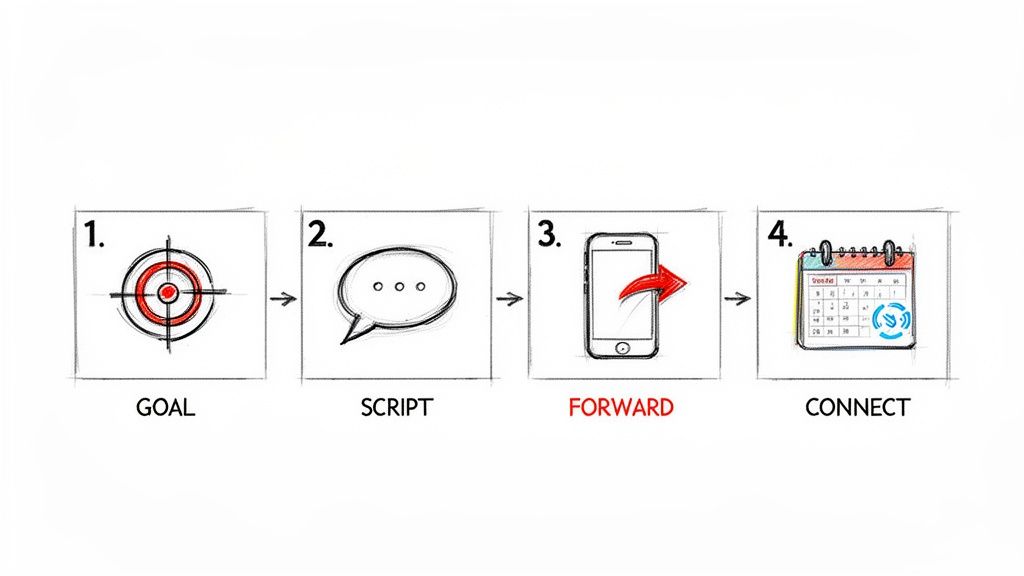
Getting set up is surprisingly simple. It really just comes down to four practical steps. This plan works for any mover, no matter what your current tech setup looks like.
Define Your #1 Goal: What's the one thing you absolutely need this to solve? Is it grabbing every single lead that calls after 5 PM? Is it handling the flood of calls during your midday rush? Get specific. A clear goal makes everything else fall into place.
Outline Your Call Script: What's the critical info you need to qualify a lead and give a decent quote? Think about the questions you already ask on every call: move size ("a two-bedroom apartment"), where they're moving from and to (zip codes), and when they want to move.
Forward Your Calls: This is the only "technical" part, and it's easy. You just tell your business line to automatically send calls to your new service. You can forward all calls, only the ones that ring more than three times, or just your after-hours answering service calls.
Connect Your Calendar: This is where the magic happens. Link your Google Calendar or scheduling software, and the system can see your real-time availability. It can then book qualified estimates or actual jobs right onto your schedule, completely hands-free.
Today's best tools, especially AI assistants, are built to "just work." You don't need to be a tech wizard; you just need to know what you want the system to do for your business.
Straight Talk for Moving Company Owners
As a moving company owner, you have to be damn sure any new tool is going to pull its weight. Here are the straight-up answers to the questions we hear every day from movers thinking about bringing on a phone answering service.
Will My Customers Know They’re Talking to an AI?
This is the biggest one, right? The honest answer is: probably not.
Modern conversational AI is designed to sound natural, not like a clunky automated menu. It uses a friendly, professional tone and actually understands the back-and-forth of a real conversation. We’re not talking about the annoying AI from your bank.
Think of it this way: the system is trained to follow your exact script, every single time. It never has a bad day, never gets flustered, and never forgets to ask for the destination zip code. Customers get their questions answered fast, and most of them will hang up thinking they just talked to your sharpest office manager.
How Much Is This Going to Cost Me?
Unlike old-school call centers that nickel and dime you by the minute—making your bills a total crapshoot during peak season—most modern services have a simple flat monthly fee. You know exactly what you’re paying, no surprises.
But the real question isn't about cost. It's about return on investment.
The only number that matters is your ROI. If an answering service snags you just one extra moving job a month that you would have otherwise missed, it has almost always paid for itself. Everything after that is pure profit.
Seriously, How Long Does It Take to Get This Running?
Look, you don't have time for a complicated tech project. You're running a moving company. Getting this set up is faster than you think, and you don't need to be a computer whiz. Honestly, you can get it done in an afternoon.
It’s a simple, three-step process:
- Tell the system what info you need from callers (move size, zip codes, stairs, etc.).
- Forward your main business line to the new service number.
- Connect your calendar so it can book jobs for you automatically.
These systems are built for busy owners who need something that just works out of the box. You can start turning missed calls into booked jobs almost immediately.
Ready to stop hearing that your voicemail is full and start seeing more jobs on your calendar? See how an AI Receptionist can capture and book every call, 24/7, turning missed opportunities into revenue. Learn more about how it works.