
If you run a 5 to 20 truck moving company, you’ve probably lived this scenario already. A lead calls during a busy afternoon and wants a quick number for a “standard two-bedroom apartment.” Your coordinator gives a rough quote to keep the conversation moving. Then one of two things happens. You lose the job because another mover sounded more confident, or you win it and find out on moving day that the third-floor walkup, long carry, and extra packing needs were never priced correctly.
That’s not a customer service issue. That’s a revenue leak.
For independent moving companies, the revenue exposure per single missed call or mishandled quote ranges from $285 to $1,200, based on average job value and typical first-call conversion rates of 20 to 30%, according to GetAira’s missed business calls analysis. Multiply that by rushed estimates, after-hours voicemails, and peak-season call spikes, and quote accuracy stops being a back-office detail. It becomes one of the clearest drivers of booking rate, gross margin, and review quality.
Why Your Good Enough Quotes Are Costing You Thousands
Friday at 4:47 p.m., the phone rings. A prospect wants a price for a Saturday move, says they are calling a few companies, and needs an answer fast. Your rep glances at the notes, makes a reasonable guess, and sends a number before the lead moves on.
That is how revenue leaks start.

I have seen this pattern in small owner-operator shops and multi-branch movers alike. The quote is close enough to feel safe, but not solid enough to protect margin or win with confidence. One lead gets overpriced and disappears. Another gets underpriced and lands on the schedule with the wrong crew size, wrong time budget, or missing services. Both quotes hurt the business.
The industry often treats quote accuracy like a customer service problem. It is also a sales conversion problem and a margin problem. If your pricing is loose, your close rate drops because shoppers sense uncertainty. If your pricing is low to avoid losing the job, booked revenue looks good until the work hits the field and the profit evaporates.
The leak shows up in two places
The first loss happens before move day. Prospects compare responsiveness, clarity, and confidence in the first few minutes. A vague range, a lot of backtracking, or a quote that changes after basic questions makes the buyer wonder what else will go wrong. Teams that want to improve intake speed can learn something from measuring speech to text accuracy. Small errors early in the process create bigger errors downstream.
The second loss shows up after the job is booked. A quote that misses stairs, packing volume, shuttle needs, elevator rules, or long carry does not stay a quoting problem. It becomes overtime, claims, discount requests, dispatcher cleanup, and bad reviews.
Here is the math owners feel fast:
- Miss 3 jobs a week because your quote comes in too high or too shaky.
- Underbid 2 booked jobs a week by a few crew hours and some materials.
- Spend office time reworking estimates and handling billing disputes.
That is not a rounding error. It is a steady drain on revenue and booking rate.
Good enough quoting creates expensive trade-offs
Many reps quote light because speed wins leads. Sometimes that is true. But speed without structure creates rework. Other teams quote cautiously and pad the number to protect margin. That protects the downside on paper, but it can push high-intent shoppers to a competitor who asked better questions and sounded more certain.
The better approach is simple. Build a quoting process that is fast enough to compete and consistent enough to hold up in operations.
Customers read quote quality as a sign of company quality.
That is why inaccurate quotes create four business problems at once:
- Lower booking rates: prospects hesitate when the estimate feels generic or keeps shifting
- Weaker margins: underquoted jobs eat labor hours, truck time, and materials
- More admin time: staff have to revise quotes, explain overages, and calm frustrated customers
- More operational friction: dispatch and crews start the job with bad assumptions
A mover can survive an occasional bad estimate. A company that runs on good enough quotes builds a hidden tax into every week.
How to Measure and Benchmark Your Quote Accuracy
Most owners judge quote quality by feel. They remember the ugly jobs, the angry customers, and the weeks where close rate felt soft. That’s useful, but it isn’t enough. If you want to improve moving quote accuracy, you need a scoreboard your sales team, dispatcher, and owner can all understand.
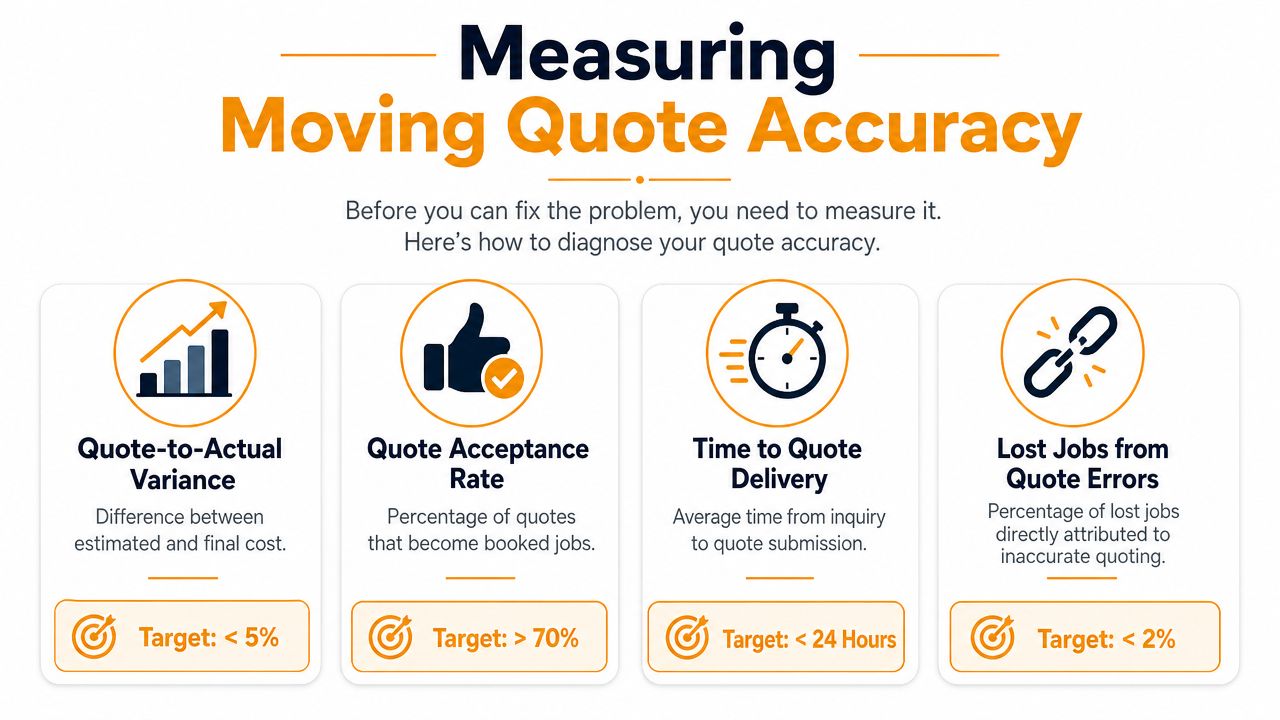
According to a Move.org survey, 52% of customers paid within $100 of their initial quote, but that breaks down when virtual or phone estimates miss physical details like stair flights or long-carry distance, as explained in Move.org’s guide to online moving quotes. That’s the key point. Accuracy isn’t just about whether the invoice was close. It’s whether the quote matched the actual job.
Define accuracy the right way
A quote is accurate when four things line up:
- The customer understands what’s included.
- Your crew walks into the job you priced.
- Your final invoice matches the estimate logic.
- The quote was fast enough to help you win.
If one of those breaks, you don’t really have quote accuracy.
Accurate quoting means expectation accuracy, not just arithmetic accuracy.
There’s a useful parallel in other parts of operations. Teams that care about voice intake quality don’t just ask whether a transcript exists. They ask whether the words were captured correctly enough to act on them. The same discipline applies here. If you want a good framework for that mindset, measuring speech to text accuracy is a solid example of how operators turn a vague quality problem into measurable performance standards.
Build a simple accuracy scorecard
Track these three KPIs every week.
| KPI | Formula | What it tells you |
|---|---|---|
| Quote-to-booking conversion rate | Booked jobs ÷ quotes sent | Whether your estimates are competitive and credible |
| Quote variance percentage | (Final invoice – quoted amount) ÷ quoted amount | Whether your pricing matched operational reality |
| Requote rate | Requotes ÷ total quotes | Whether your intake process is missing details early |
Keep the math simple. A sales manager should be able to calculate this in a spreadsheet in minutes.
Example
- You send 40 quotes and book 18 jobs.
- Your quote-to-booking conversion rate is 18 ÷ 40 = 45%.
- One job was quoted at $1,000 and invoiced at $1,150.
- Quote variance is ($1,150 – $1,000) ÷ $1,000 = 15%.
That second number matters more than most movers realize. If your variance keeps drifting up, you’re not just underpricing. You’re training your team to sell jobs the operation can’t deliver cleanly.
Use a weekly review with these questions:
- Which quotes changed after a survey or follow-up?
- Which jobs had customer pushback on move day?
- Which reps produce the most requotes?
- Which service types create the biggest variance?
You don’t need fancy reporting to start. You need consistency. Once you can see the pattern, you can fix the process causing it.
The Common Causes of Inaccurate Moving Quotes
Bad quotes usually don’t come from one dramatic mistake. They come from a chain of small misses. One rep forgets to ask about elevator access. Another doesn’t catch that the customer needs packing. A third applies the wrong minimums because they’re quoting fast during a lunch rush.
That’s how revenue leaks happen in real life.
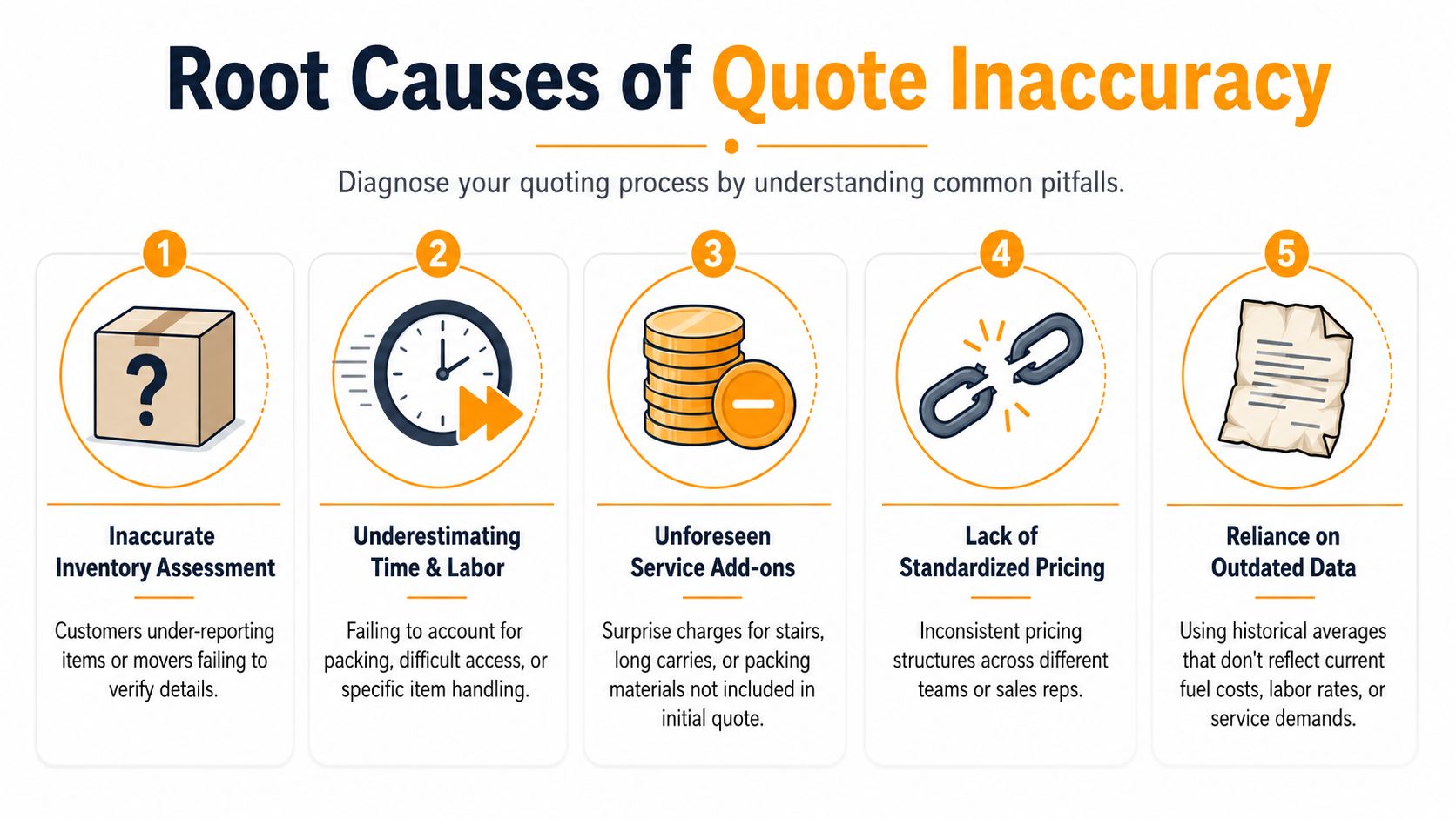
An industry analysis highlighted by FreightWaves found that over 60% of moving quote disputes start with differences between the items listed on the estimate and the items moved, and final costs rise by an average of 22% on moving day in those cases, according to FreightWaves’ analysis of moving quote disputes.
The hidden inventory gap
The biggest quoting problem for most local movers isn’t price math. It’s inventory assumptions.
Customers often describe moves in shortcuts. They say “just a couch, a bed, and some boxes” when the actual shipment includes overflow storage bins, garage items, patio furniture, disassembly, and fragile pieces they didn’t think to mention. Phone reps often accept that summary because they’re trying to keep the call moving.
That shortcut poisons the quote.
What this looks like in practice
- The customer undercounts boxes: Your crew arrives to an extra room of packed items.
- The rep hears “apartment” and assumes easy access: It is a walkup with a long hallway and no loading zone.
- The office hears “small office move” or “junk removal add-on” and misses specialty handling: Suddenly there’s equipment, monitors, or heavy disposal labor involved.
The estimate breaks the moment your team prices assumptions instead of verified inventory.
This is a data quality problem before it becomes a pricing problem. If your intake data is messy, your quote will be messy too. Teams working on process discipline in other industries use frameworks like monitoring startup data quality to spot missing fields, inconsistent inputs, and handoff errors. Moving companies should think the same way about lead intake.
Where operations break the quote
Inventory isn’t the only culprit. Internal inconsistency causes plenty of quote drift.
Inconsistent call intake
If each coordinator asks different questions, your business has no true quoting process. It has individual habits. One rep asks about stairs. Another asks about dates and move size only. A third forgets storage, shuttle needs, or whether the customer needs packing labor.
Rate card confusion under pressure
This happens a lot in growing operations. The owner knows the pricing logic cold. The staff knows parts of it. During peak season, they quote fast and start skipping rules. Travel time, specialty items, valuation, fuel, and accessorials get applied unevenly.
Scheduling and logistics blind spots
A quote can look accurate and still lose money if it ignores traffic patterns, building restrictions, crew availability, or seasonal compression. March through September compresses your margin for error because crews are already tight and the phone is ringing all day.
Here’s a useful diagnostic list to review with your team:
- Ask where details get lost: Initial call, follow-up, survey, or handoff to dispatch.
- Check where rate card logic changes: Different reps, different branches, or different service types.
- Review where field conditions surprise crews: Stairs, parking, elevators, long carries, specialty items.
If you can identify which of those three buckets causes most of your quote misses, you’ll know exactly where to tighten the operation.
A Practical Playbook to Improve Quoting Manually
You don’t need new software to make quote quality better this week. Most movers can improve accuracy with tighter intake, better verification, and basic review discipline. That’s the fastest way to stop the bleeding while you decide what to automate later.
Moving companies that use formal inventory gathering protocols and require client sign-off on every item keep quote variance under 5%, while companies relying on labels like “2-bedroom apartment” often see variance over 25%, based on Louis Massaro’s guidance on accurate moving estimates.
Standardize intake before you touch pricing
The first fix is boring. It also works.
Build one intake script for every inbound estimate call. Not three versions. Not “whatever your best rep asks.” One script. It should force your team to capture the details that move the price.
Include questions like:
- Origin and destination access: Stairs, elevator, walk distance, parking restrictions.
- Inventory specifics: Major furniture, appliance count, fragile items, gym equipment, office equipment, garage or patio items.
- Service scope: Packing, unpacking, disassembly, storage, junk removal, specialty protection.
- Scheduling details: Preferred date, flexibility, time windows, building reservation requirements.
Then make the customer confirm the inventory list. If you want a starting point, use a structured free moving estimate template and adapt it to your rate card and service area.
Add verification and review
Once the script is in place, tighten the process with lightweight checks.
Use photo and video verification
Ask customers to send a quick smartphone walkthrough for jobs that sound borderline, high-value, or unusually vague. You don’t need studio-quality footage. You need enough detail to spot what a rushed phone description missed.
Tell your team what to look for:
- Bulky items hiding in corners
- Packing complexity in kitchens, garages, and storage closets
- Access conditions at both ends
- Anything that needs disassembly or extra protection
Review a sample of quotes every week
Pick a set of recent quotes and compare them against actual job notes, survey details, and final invoices. You’re looking for patterns, not blame.
A manager review should ask:
- Was the inventory complete?
- Was the correct pricing logic applied?
- Did the quote explain included and excluded services clearly?
- Did dispatch inherit any surprises?
Owner checklist: If your crew says “we had no idea this was here” more than occasionally, the issue started in sales.
Train on mistakes, not theory
Most estimate training fails because it stays generic. Use real examples from your own jobs. Pull up the quotes that went wrong and ask where the breakdown happened. Intake? Inventory? Rate application? Customer communication?
That type of review is what gets reps better fast. It also creates consistency between sales, dispatch, and field operations, which is where most moving businesses either sharpen up or stay stuck.
Using Technology to Automate Accuracy and Win Jobs Faster
Manual process fixes matter. But once your call volume climbs, especially in busy season, manual discipline alone starts to crack. Staff get rushed. Follow-ups lag. Rate rules get applied inconsistently. That’s where technology earns its keep.
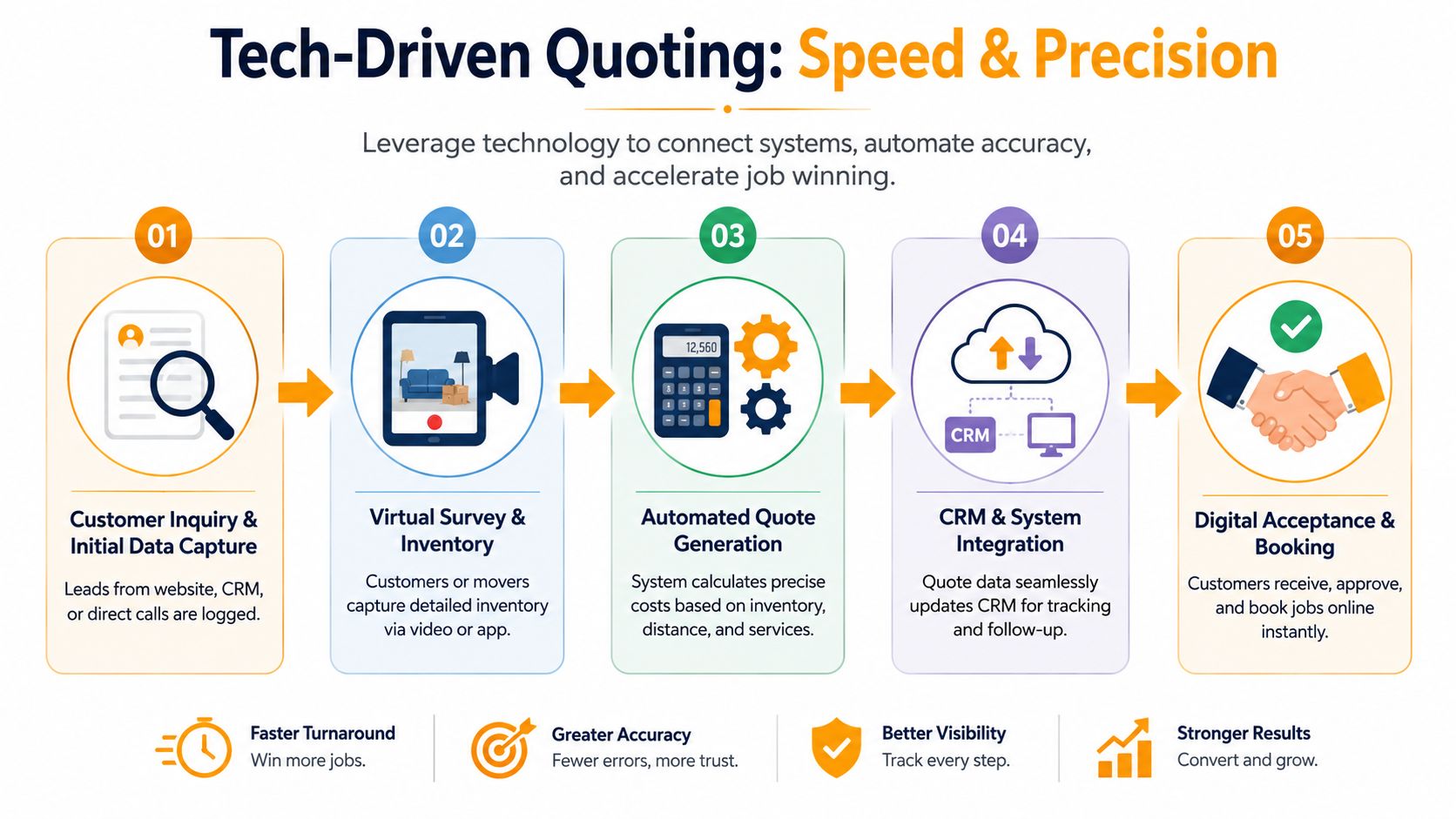
AI tools using computer vision in virtual walkthroughs can reduce human error in volume estimation by up to 45% and lead to a 30% reduction in post-quote discrepancies, according to ATL Peach Movers’ overview of technology in moving operations.
What good automation actually fixes
The value of automation isn’t “AI” by itself. It’s consistency.
A good quoting workflow should pull from the same pricing logic every time, whether the lead comes in through a website form, a phone call, or a virtual survey. That means your own rate card, your own service rules, and your own scheduling reality. If you use SmartMoving, Supermove, MoveitPro, or Google Calendar in the operation already, quote data should flow into those systems cleanly instead of getting copied by hand.
That removes three common failure points:
- Human math errors
- Skipped accessorial charges
- Slow handoffs between intake, quoting, and booking
If you’re sorting through what automation should do in a sales workflow, this practical guide to sales AI agents is useful because it focuses on workflow logic rather than hype.
Lead capture is not job conversion
A lot of movers waste money. They buy tools that answer calls, collect a name and number, and send a message to the office. That’s lead capture. It is not booked revenue.
A human answering service has the same limitation. It can take a message. It usually can’t quote from your rate card, qualify move complexity properly, or book directly into your workflow. Generic voice tools have a similar problem. They may sound impressive, but if they can’t handle moving-specific logic, they still create admin work for your team.
The operational standard should be higher:
- Capture the lead
- Collect the right inventory and access details
- Generate the quote using your pricing rules
- Book the job into your system
- Trigger follow-up automatically if the customer doesn’t commit right away
That’s the difference between software that answers the phone and software that helps close jobs. If you want to see what purpose-built quoting automation looks like in a moving context, this AI quoting tool for movers is a practical example of how operators are trying to connect quoting, booking, and follow-up into one front-end workflow.
Solving the After-Hours and Peak Season Quoting Bottleneck
The most valuable moving lead of the week might come in after your office is done for the day. Friday night. Sunday morning. A holiday weekend. That’s when customers are comparing options quickly and trying to lock in a mover before someone else does.
Those calls are high intent, but they’re also high risk.
Why these calls matter more
Home service businesses miss a huge share of inbound calls, and after-hours demand is a major reason. During peak season, 40 to 60% of revenue-generating calls for small service businesses happen outside standard business hours, yet only 12% of those after-hours calls are captured, according to this industry discussion of after-hours call loss. For movers, that problem gets worse from March through September, when crews are in the field and office staff are stretched thin.
If you miss the call, you probably lose the booking window.
If you answer it on a cell phone without the full pricing structure in front of you, you risk giving a rushed quote that creates problems later.
The busiest season exposes every weak quoting habit you’ve been able to hide during slower months.
What your system needs to do at night and on weekends
After-hours coverage only helps if it can maintain the same quote quality as your daytime staff. Otherwise, you’re just trading missed calls for bad estimates.
For moving company owners, the standard should be simple:
- Capture every inbound inquiry
- Ask the same intake questions every time
- Use the same rate logic after hours as during business hours
- Create a bookable next step immediately
- Push the job into the calendar or CRM without manual re-entry
That matters for junk removal operators too. The same issues show up there. Customers call after work, describe the job loosely, and expect a quick answer. Without a structured system, speed and accuracy fall apart together.
If your office still relies on voicemail, handwritten callbacks, or “we’ll quote it tomorrow,” you’re forcing your team into a peak-season bottleneck. A dedicated after-hours answering workflow for movers should do more than answer. It should preserve quoting quality when nobody is at the desk.
Turn Accurate Quotes into Your Competitive Advantage
The movers who win more jobs aren’t always the cheapest. They’re the ones who sound organized, quote clearly, and remove uncertainty fast. That’s why moving quote accuracy has to be treated as a growth lever, not just a sales admin task.
When your quotes are tight, a few good things happen at once. Booking rates improve because customers trust the number. Dispatch gets cleaner handoffs. Crews walk into jobs they were prepared for. Review risk drops because pricing disputes don’t hijack the customer experience before the move even starts.
The opposite is also true. Inaccurate quotes create a chain reaction of wasted follow-up, lower close rates, stressed crews, and thinner margins.
For most 5 to 20 truck operators, the path is straightforward. First, standardize intake. Second, verify inventory better. Third, audit estimate versus actual. Then automate the parts of the workflow that break under speed, volume, and after-hours pressure.
That’s how you recover lost moving revenue. Not by answering more calls alone, but by turning more inquiries into accurately priced, bookable jobs.
If inaccurate quotes, missed calls, and slow follow-up are leaking revenue from your front office, it’s worth looking at a system built to close the gap. MoveJoy helps independent movers turn inbound calls into accurate quotes and booked jobs using the company’s own rate card, with direct booking into tools like SmartMoving, Supermove, MoveitPro, or Google Calendar.