
A solid moving company estimate template isn’t just a piece of paper. It’s the firewall between a profitable job and a money-losing headache. For a growing company like yours, it’s the tool that stops misunderstandings, builds customer trust, and plugs the revenue leaks that are quietly killing your bottom line.
Why Inconsistent Estimates Cost You Thousands
Let’s be real—scribbling notes on a legal pad and pulling a price out of thin air feels fast, but it’s a silent killer for your moving business. We’ve all been there, trying to quote a job over the phone while yelling instructions to a crew on-site. This ‘best guess’ approach is where profit leaks happen, and they add up faster than you can say “long carry.”

We’re talking about underpriced jobs that barely cover fuel, surprise fees that infuriate customers, and hours of your life wasted on follow-up calls trying to explain what was included. It’s a vicious cycle that wears you down and chips away at your reputation.
The Real Cost of Guesswork
Inconsistency isn’t just a minor headache; it’s a direct shot to your bottom line. When every salesperson or crew leader quotes a little differently, you’re basically inviting chaos into your business.
Here’s where it really hurts:
- Revenue Leakage: Forget to add stair fees, long-carry charges, or the right material costs on just a few jobs a month? That can easily mean leaving $50K-$150K on the table every single year.
- Lost Credibility: A customer who gets a vague, unprofessional quote will almost always choose the competitor with a detailed, clear estimate. It just screams organization and reliability.
- Painful Disputes: When things go south, a written, standardized estimate is your best defense. Without it, disagreements over what was or wasn’t included become a “he said, she said” nightmare that you almost always lose.
We see it all the time. A small company misses just a few billable items a week or sends out inconsistent quotes. That small leak quickly turns into a flood of lost revenue, often representing the entire profit margin for the month.
This isn’t just theory. A weak estimate process directly cripples your ability to book profitable work. Every time a potential customer gets a confusing quote, they question your professionalism. A standardized moving company estimate template is your first step toward building a system that protects your profits and builds unshakable customer trust.
It’s about operating like the serious business owner you are.
Anatomy Of A Professional Moving Estimate
This isn’t just another form. It’s the backbone of a predictable, profitable sales process.
Think of this template as more than a price list. It’s the communication tool that stops arguments before they even start. A professional estimate instantly tells a customer you’re a serious operator, not just a couple of guys with a truck.
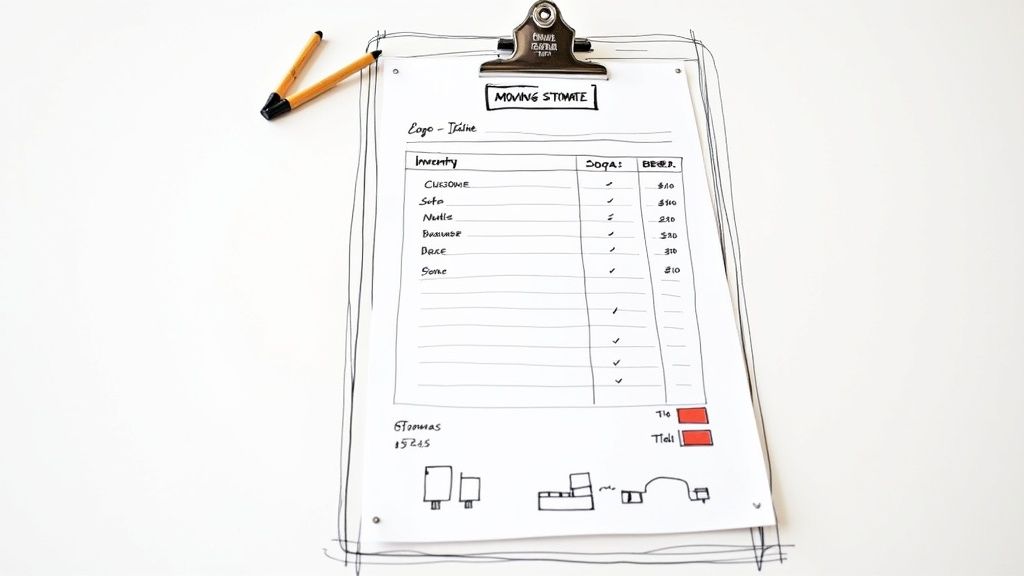
This is your first real step toward a standardized sales process—one that wins you more profitable jobs. It’s the single document that protects both you and your customer, making sure everyone is on the same page from day one.
Let’s break down what turns a simple quote into a job-winning machine.
Your moving estimate has to be more than just a number at the bottom of a page. It needs to be a clear, comprehensive document that builds trust and protects your business. Get these components right, and you’ll stand out from the competition immediately.
Key Components of a Winning Moving Estimate
| Component | Why It’s Critical | Example Detail |
|---|---|---|
| Customer & Logistics | This is ground zero. Get it wrong, and your crew shows up to the wrong place or on the wrong day. Kills your reputation and your schedule. | Full names, numbers, complete origin/destination addresses (including unit #s), move date, and arrival window. |
| Detailed Inventory | Vague descriptions like “3-bedroom house” invite scope creep. A detailed list justifies your price and manages expectations. | List specific items: “1x King Bed Frame,” “8x Large Boxes (Owner Packed),” “1x Peloton Bike.” |
| Service Breakdown | Transparency builds trust. This is where you show the customer exactly what they are paying for, line by line. | Itemize labor (3 movers @ $150/hr), travel time, packing materials, and any special handling fees. |
| Access Details | This prevents day-of surprises that kill your profits. Long carries, stairs, and tricky parking all add time and effort. | “3rd-floor walkup at destination (no elevator),” “150-foot long carry from truck to front door.” |
| Terms & Conditions | This is your legal protection. It covers liability, payment terms, and what happens if things go wrong. Non-negotiable. | Clauses for valuation coverage, cancellation policy (e.g., 48-hour notice required), and payment due upon completion. |
Nailing these sections isn’t just about looking professional; it’s about running a smarter, more profitable moving company where everyone knows what to expect.
Customer And Move Logistics
This section is ground zero for every single move. It’s where you capture the basic information that dictates the entire job. Mess this up, and you’re already starting from behind.
Every single estimate must have these details, no exceptions:
- Customer Information: Full name, phone number, and email. You need this for communication before, during, and after the move.
- Move Addresses: The full origin and destination addresses. Don’t be the guy who forgets to ask for the apartment number.
- Move Date and Time: The scheduled date and your crew’s arrival window (e.g., 8-10 AM).
- Access Details: This is where you sniff out the day-of nightmares. Note any long carries, tight stairwells, elevator reservations, or parking nightmares. These details directly hit your labor time and, therefore, your price.
Forgetting to ask about the third-floor walk-up at the new apartment is a classic rookie mistake. It can turn a profitable job into a money pit in a hurry. This section ensures you ask the right questions every single time.
A detailed estimate is your best defense against miscommunication. It provides clear, written documentation of every agreed-upon service, protecting you from disputes over costs and preventing customers from feeling like they were hit with surprise charges.
Detailed Inventory And Service Breakdown
This is where the rubber meets the road. It’s where you justify your price and build rock-solid trust with the customer.
A vague “3-bedroom house move” is an open invitation for scope creep. Suddenly, they’re asking you to move the patio set and the garage full of junk they “forgot” to mention. A detailed inventory list puts a stop to that and manages their expectations from the start.
Your moving company estimate template has to itemize everything. This is what separates the pros from the amateurs.
Your cost breakdown should be painfully clear. List out each line item so there’s no room for confusion:
- Labor Costs: Your hourly rate multiplied by the estimated hours (e.g., 3 movers @ $150/hr for 4 hours).
- Travel Time/Fuel Surcharge: The fee for getting your truck and crew from your office to their door, and back again.
- Packing Materials: List every box, roll of tape, and sheet of bubble wrap with its price. No surprises.
- Specialty Items: Pianos, gun safes, or that ridiculously heavy marble statue need their own line item. They require more work, and you should be paid for it.
- Accessorial Charges: Be upfront about fees for stairs, long carries, or disconnecting appliances.
When you break down the costs like this, you’re not just throwing a number at them—you’re showing them the value behind it. This builds instant confidence and makes it much harder for anyone to argue the final bill. It’s the difference between a smooth, profitable move and a day full of headaches.
How To Price Your Services For Profit
A great template is only half the battle. Filling it with the right numbers—the ones that actually cover your costs and leave you with a healthy profit—is where the real work begins.
Let’s be honest, pricing can feel like a guessing game, especially when you’re trying to stay competitive. But “guesstimating” is a surefire way to run yourself ragged on jobs that don’t pay the bills.
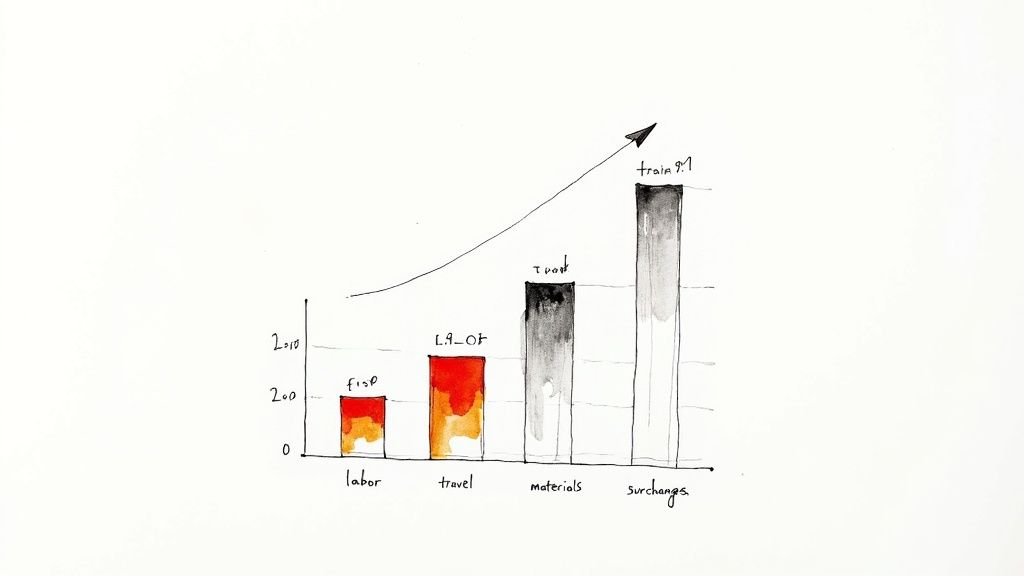
This isn’t just about picking an hourly rate out of thin air. It’s about understanding your true costs so that every single job you book actually makes you money. Think of this as a mini-masterclass in moving company finances, designed to ensure you’re pricing for profit, not just for volume.
Calculating Your True Labor Rate
Your hourly rate is the engine of your business, but too many owners set it based on what competitors charge without knowing their own numbers. This is a huge mistake. Your rate has to cover way more than just paying your crew.
It needs to account for:
- Wages and Payroll Taxes: This is the obvious part—what you pay your team per hour, plus all the fun stuff like taxes and workers’ comp.
- Overhead Costs: Think truck payments, insurance, fuel, marketing, and office rent. Add all these up for the month and divide by your average billable hours. That gives you your overhead cost per hour.
- Profit Margin: After every single cost is covered, what do you need to make to reinvest and grow the business? A 15-20% margin is a healthy target for most moving companies.
Add these three numbers together, and you have your true billable hourly rate. Pricing below this means you’re literally paying to do the job for someone else.
Your template is a tool for profitability, not just a quote generator. If your numbers don’t reflect surging operational costs, you’re working harder for less. It’s that simple.
Rising costs have made this more critical than ever. Between 2020 and 2025, the industry got slammed with massive price hikes on everything from equipment to insurance. For instance, the price of a new trailer shot up by about 44.5%, while fuel and labor costs surged anywhere from 30% to 80%. Margins got squeezed tighter than ever. You can dig into more insights about these industry-wide cost pressures.
Nailing The “Other” Fees
The real money is often lost in the details—the small but crucial charges that many owners forget to include. These aren’t “extra” fees; they are legitimate costs for services you’re providing.
Don’t leave this money on the table:
- Travel Time and Fuel Surcharge: You need to charge for the time it takes your crew to get from your shop to the customer’s origin, and from the destination back to the shop. This covers non-billable drive time and today’s brutal fuel costs. Bill it as a flat fee or at your hourly rate.
- Packing Materials: Price your materials correctly. Don’t just give boxes away. Figure out your cost per box, per roll of tape, and per bundle of packing paper, then add your markup. 50-100% is standard.
- Specialty Items: A piano, a gun safe, or a hot tub isn’t just another piece of furniture. These things require special equipment, extra manpower, and increased risk. Price them as separate line items, and price them well.
- Accessorial Charges: These cover anything that makes the job harder and take longer. You absolutely have to charge for them.
- Stair Fee: A flat fee per flight of stairs. Simple.
- Long Carry Fee: A charge for distances over 75 feet from the truck to the door.
- Elevator Fee: For the time spent waiting for and loading/unloading a slow elevator.
Failing to account for these variables is one of the biggest sources of revenue leakage we see. A job that looks like $1,000+ on paper can quickly become a break-even project—or worse—if you miss just two or three of these items. Build them directly into your moving company estimate template so you never forget to add them again.
Protecting Your Business With The Right Terms
Your moving estimate is more than just a price quote; it’s the first step toward a legal contract. That fine print at the bottom? It’s your best defense against the headaches and “he said, she said” arguments that can turn a good job sour.
A customer might not read every single word, but you can bet they will if a dispute pops up. These clauses are the legal armor that protects your business from costly fights and misunderstood expectations. Think of your terms as the rulebook for the job. Without them, you’re playing a game with no rules, and that’s a terrible way to run a business.
Must-Have Clauses For Your Estimate
Every professional moving estimate needs a rock-solid terms section. These aren’t just suggestions—they are absolutely essential for operating with confidence and avoiding financial hits from things that are completely out of your control.
- Valuation Coverage: You need to clearly explain the difference between Released Value Protection (the federally mandated minimum of $0.60 per pound) and Full Value Protection. This simple clause prevents a customer from assuming you’ll buy them a new $3,000 TV when a mishap occurs under the basic coverage.
- Cancellation & Rescheduling Policy: Spell it out in plain English. For example: “A fee of $150 will be charged for any cancellation or reschedule made within 48 hours of the scheduled move date.” This protects you from last-minute changes that blow up your schedule and cost you real money.
- Items We Don’t Move: Get specific about what you won’t transport. List things like hazardous materials, plants, pets, or high-value jewelry. This disclaimer ensures you aren’t held responsible for something you never agreed to touch in the first place.
- Building & Access Issues: This one is huge. Include a clause stating you are not responsible for delays or damages caused by things you can’t control, like a broken elevator, pre-existing damage to the property, or a blocked driveway.
Your terms and conditions aren’t about being difficult; they’re about being clear. Clarity is the foundation of a good customer relationship and the best way to prevent a small misunderstanding from becoming a big, expensive problem.
Binding vs. Non-Binding Estimates
The type of estimate you offer directly impacts your cash flow and what the customer expects to pay on move day. Your template needs to state, without a doubt, which one you’re providing.
A non-binding estimate is basically an educated guess. It’s common for local, hourly moves where the final bill is based on the actual time and materials used. This gives you flexibility, but it can lead to sticker shock if the job runs longer than expected.
A binding estimate, on the other hand, is a fixed price based on a detailed inventory list. The customer gets price certainty, which they love, but it can burn you badly if you underestimate the scope of the work. If you offer binding quotes, your inventory assessment has to be meticulous.
Defining these terms right on the estimate manages expectations from the very first interaction. For a much deeper dive into crafting airtight policies, our guide on moving company terms and conditions offers more detailed templates and advice. It’s all about protecting your business, one clause at a time.
Turning Your Estimate Into a Booked Job
Sending the quote is the easy part. Getting the customer to actually say “yes” is where the real work begins.
You can have the most beautiful, detailed moving estimate template in the world, but how you present it and—more importantly—how you follow up makes all the difference. It’s the gap between a booked job and a dead lead.
This isn’t about being a pushy salesperson. It’s about being a helpful expert who guides the customer to the right decision. Your process for delivering the quote and staying top-of-mind is what will set you apart from the guys who just fire off a price and hope for the best.
Simple Scripts That Get a Response
Your first message after sending the quote should be short, helpful, and position you as a guide. Whether it’s an email or a text, the goal is just to confirm they got it and open the door for questions.
Try this simple text message:
“Hi [Customer Name], this is [Your Name] from [Your Company]. I just sent over the detailed estimate for your move on [Date]. Take a look when you have a moment and let me know if you have any questions at all. We’re here to help make this as smooth as possible for you.”
This script works because it’s professional but not pushy. It frames the entire conversation around helping them, not just closing a sale. It’s a low-pressure way to start the conversation and keep things moving.
The Follow-Up Cadence That Actually Works
Persistence is everything. Especially when you realize that 35-40% of your leads probably came in after hours. They filled out a form at 10 PM and sent it to three other companies, too. The first one to follow up effectively often wins the job.
Without a system, you’re just guessing. Here’s a simple, proven follow-up cadence that prevents leads from going cold:
- 24 Hours Later (Text): “Hey [Customer Name], just wanted to follow up and see if you had any questions about the estimate I sent yesterday. Anything unclear? Happy to chat for a few minutes if it’s easier.”
- 48 Hours Later (Call): If you still haven’t heard back, a quick, friendly phone call can make a huge impact. It shows you’re serious about earning their business and you’re not just another faceless company.
- 72 Hours Later (Final Text/Email): “Hi [Customer Name], just checking in one last time. We’d love to help with your move. Let me know if you decide to move forward. Thanks!”
This simple process ensures no lead slips through the cracks. Missing just a handful of calls or follow-ups each week can quietly drain your revenue. As we’ve detailed before, the real cost of missed calls is often thousands of dollars in lost jobs—this structured follow-up helps you reclaim that income.
Automating Your Quoting To Book More Moves
Knocking out estimates by hand is fine when you’re slow. But once busy season hits, it’s a completely different ballgame. You know the feeling. You’re on a job, your phone rings, and you can’t pick it up. Or a lead comes in at 10 PM while you’re dead asleep.
Every single one of those missed calls is a lost opportunity—and often a job worth over $1,000. We’ve seen it firsthand: missing 15-25% of your calls is standard, and it’s where your business is quietly bleeding revenue.
A standard process for quoting is good, but an automated one can completely change the game for a small operation. You need a system that acts like your best salesperson, one that never sleeps or takes a day off.
Stop Chasing Leads And Start Booking Jobs
Imagine this: a new lead lands on your website after hours. Instead of hitting a wall, they get an instant, accurate quote based on your exact pricing. They can look it over, get their questions answered, and book the job right then and there. You haven’t lifted a finger.
That’s how you go head-to-head with the bigger guys without having to hire a full-time office manager you can’t afford yet. This isn’t about some overly complicated tech—it’s a practical fix that takes the grunt work off your plate.
The path from a quote request to a confirmed booking needs to be dead simple for both you and your customer.
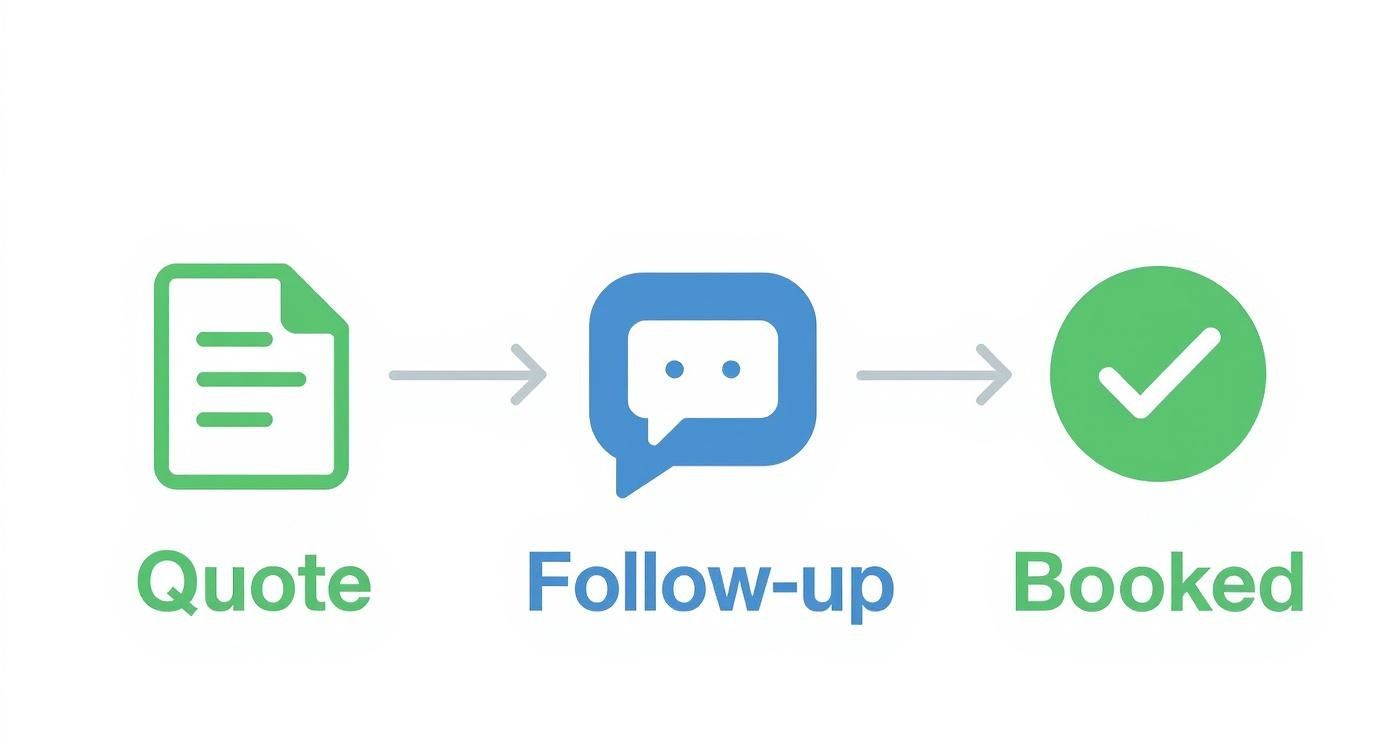
Automating these steps guarantees every lead gets an immediate, professional response. That simple act alone will dramatically increase your chances of winning the job.
Reclaim Your Time And Your Revenue
For any company running 1-20 trucks, the owner’s time is the most valuable—and limited—resource. Burning hours playing phone tag and manually typing up every single estimate is a fast track to burnout.
It’s a fact that up to 25% of calls to small moving companies are missed. That can easily add up to $50K-$150K in lost revenue every single year.
Your estimating system shouldn’t just create quotes; it should close deals. When you can instantly respond to the 35-40% of inquiries that come in after 5 PM, you stop losing business to the first competitor who bothers to answer their phone.
With nearly 41 million moves happening in 2023 and generating almost $19 billion in revenue, the market is massive. Getting your slice of that pie comes down to two things: speed and professionalism.
Automating your quoting process gives you back control. It makes sure every lead is captured and followed up on, turning inquiries into booked jobs while you focus on what you do best—running profitable moves. If you’re tired of feeling like you have to work 24/7 just to keep your head above water, check out our guide on how to stop losing after-hours leads.
Common Questions We Hear About Moving Estimates
As a moving company owner, you’ve probably heard every question in the book. Here are some straight-up answers to the ones that pop up most often when it comes to professional moving estimates.
What’s The Real Difference Between A Binding And Non-Binding Estimate?
A binding estimate is a locked-in price. You do a detailed inventory, you give a number, and that’s the number—unless the customer adds a garage full of stuff they forgot to mention. It gives the customer peace of mind, sure, but it puts all the risk on you to quote it perfectly. Get it wrong, and you eat the cost.
A non-binding estimate is your projection of the cost, and for local moves, it’s almost always based on an hourly rate. The final bill is based on the actual time and materials used. This is the go-to for most local movers because it’s flexible and fair to both you and the customer. It’s the standard for a reason.
How Should I Handle Customers Who Question My Prices?
Confidence is key. Your professional estimate is your best tool for this conversation. Don’t just point to the total at the bottom; walk them through the line items and explain the value behind the numbers.
“I completely understand. It’s a significant investment. Our price covers a team of licensed and insured professional movers, all the proper equipment to protect your home and furniture, and full valuation coverage for your belongings. Think of it as an investment in a smooth, stress-free move, not just paying for a truck and some muscle.”
Whatever you do, resist the urge to immediately offer a discount. Defend your price first. The second you cave, you devalue your service and your crew’s hard work.
Can I Actually Charge For An In-Home Estimate?
Yes, you can. While most local movers offer free estimates to stay competitive, it’s not illegal to charge. This usually only makes sense for really large, complex, or long-distance jobs that take a significant amount of your time to assess properly.
If you decide to charge, be 100% transparent about the fee upfront. A great way to frame it is to offer to credit the estimate fee toward their final bill if they book the job with you. It shows you value your time but still incentivizes them to book.
A perfect estimate is your best sales tool, but it doesn’t do you any good if you’re too busy to send it. Let MoveJoy handle your calls 24/7, send instant quotes, and get jobs on the calendar while you’re out running the business. Find out how we help you book more moves, not just take more messages, at https://getmovejoy.com.