If you run a 10-truck moving company, you already know the pattern. A strong long-distance lead comes in while your coordinator is juggling dispatch, a crew is asking about access at the destination, and your sales process still depends on somebody finding the right spreadsheet. The caller wants a real number, not “we’ll get back to you.” By the time you do, they’ve talked to two more movers.
That’s where revenue leaks. Not in marketing. Not in truck utilization. In the gap between inquiry and quote.
Long-distance jobs are high-intent, high-value opportunities, but they’re also where small and mid-sized movers make the most quoting mistakes. The companies that win these jobs usually aren’t the cheapest. They’re the ones that answer fast, ask the right operational questions, explain the estimate clearly, and give the customer enough confidence to stop shopping.
The High-Stakes Game of Long-Distance Quoting
A local move can survive a rough estimate. A long-distance move usually can’t.
When someone calls about moving a full household across state lines, you’re not pricing labor by the hour and hoping the day goes smoothly. You’re trying to scope shipment size, route complexity, access, timing, packing, storage, bulky items, valuation, and the risk of surprises at both ends. If your process is slow or vague, the customer hears uncertainty.
Where the leak starts
The leak usually begins with a callback.
Your rep takes the basics, scribbles notes on a legal pad, asks a few inventory questions, then says something like, “Let me run the numbers and call you back.” That sounds harmless inside the office. To the customer, it sounds like you’re less prepared than the next mover.
National Van Lines explains that long-distance estimates usually include move details, the estimate type, transportation charges, and accessorial services such as packing, storage, shuttles, or bulky-item handling, and it identifies distance/geography, shipment size, extra services, and move date/timing as core pricing drivers in interstate moves, which is why a quick verbal guess is rarely enough for a profitable quote (National Van Lines on understanding long-distance moving quotes).
Practical rule: If your team can’t consistently capture accessorials on the first conversation, your long-distance quoting process is underpricing jobs or scaring away good leads.
A customer comparing movers doesn’t need every internal detail. They do need confidence that you know what changes price. That’s why content like these practical tips to save on moving can help you understand what shoppers are reading before they ever call. They’re educating themselves on cost drivers, and if your team sounds less informed than the articles they found online, you lose trust before you lose the sale.
Why long-distance quotes break weak sales processes
Long-distance quoting exposes every front-office weakness in a 5 to 20 truck operation.
- Incomplete intake: Your rep forgets to ask about stairs, elevators, long carry, or limited truck access.
- Inconsistent pricing: One salesperson includes shuttle risk and packing labor. Another doesn’t.
- Slow turnaround: The customer waits while your team pieces together a quote from old tariffs, mileage notes, and memory.
- No clear estimate type: The customer hears one number on the phone and a different structure in the written estimate.
That’s why long-distance quoting is a sales issue and an operations issue at the same time. You’re not just estimating cost. You’re proving that your company can manage a complicated move without chaos.
Deconstructing the Customer Search for Long Distance Moving Quotes
A prospect fills out your form at 9:12 p.m. for a move from Dallas to Phoenix. By 9:20, they have three tabs open, two quote requests submitted, and one question in mind: which mover looks competent enough to trust with a five-figure shipment.
That search is not just about price. It is a screening process for risk.
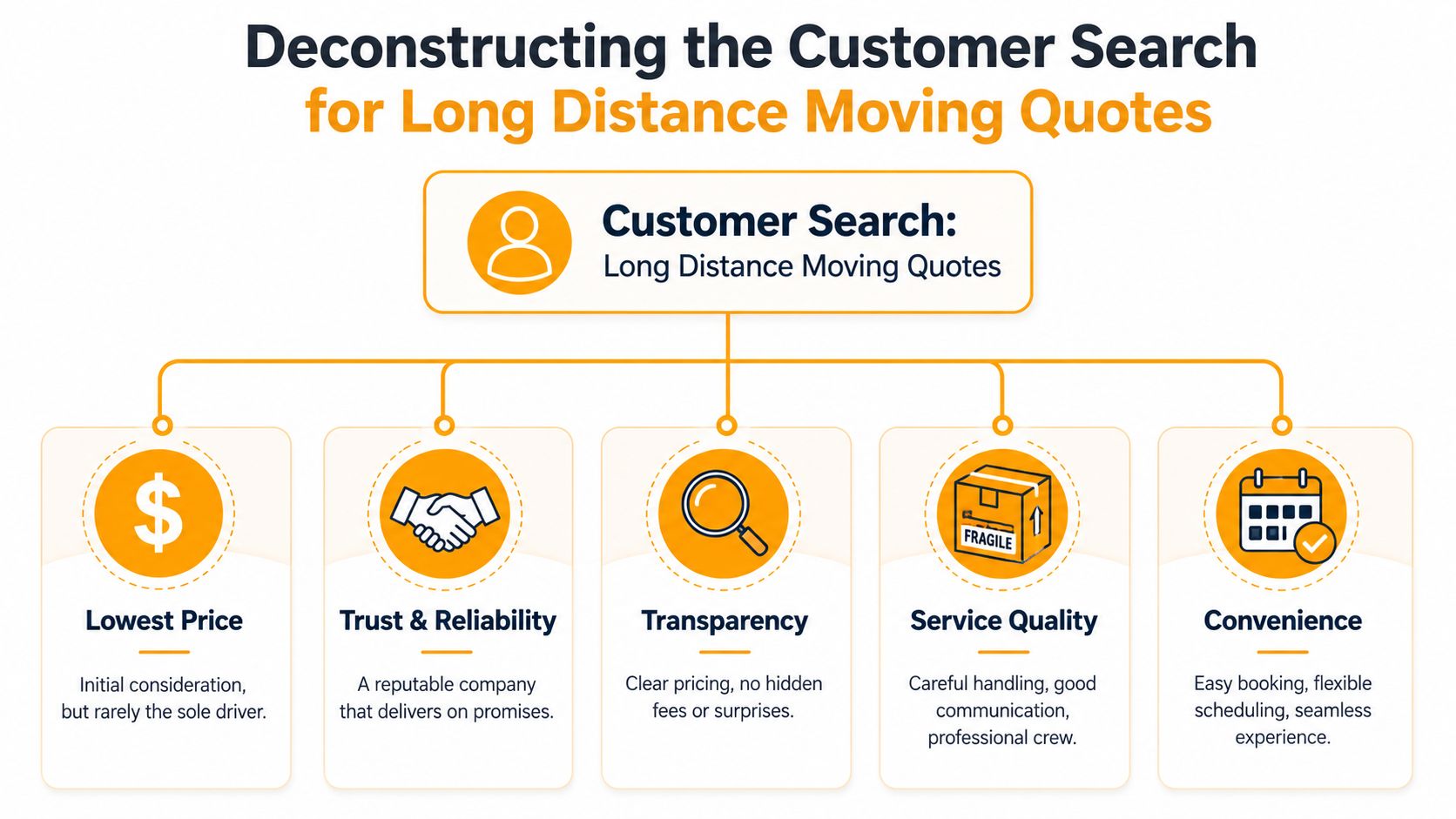
What customers are actually buying
When someone searches “long distance moving quotes,” they are trying to answer five operational questions fast:
| Customer concern | What they mean |
|---|---|
| Price | “Can I afford this move?” |
| Clarity | “Do I understand what's included?” |
| Trust | “Will this company do what it says?” |
| Convenience | “Can I get this handled quickly?” |
| Professionalism | “Does this feel organized or sloppy?” |
For an owner, that matters because a loose ballpark does not close uncertainty. It adds friction. The customer still has to figure out what was included, what was skipped, and why one quote is thousands apart from another.
Price spread is part of the problem. moveBuddha notes that long-distance moves can range from $2,509 to $11,641, depending on shipment size, distance, and services selected (moveBuddha long-distance moving cost guide). If your rep sends a single number without context, the shopper usually assumes one of two things: your company is hiding charges, or your company does not understand the job well enough to price it correctly.
Both assumptions hurt conversion.
What a professional quote needs to show
Customers do not need your tariff logic or dispatch worksheet. They need enough structure to compare offers without guessing.
A quote that books long-distance work at healthy margins should clearly show:
- Move details: Origin, destination, shipment size, and service dates.
- Estimate type: Binding, non-binding, or not-to-exceed.
- Transportation charges: The base linehaul charge the customer expects to see.
- Accessorial services: Packing, storage, shuttle, long carry, stairs, bulky-item handling, or other cost drivers tied to the actual move.
That format does two jobs at once. It gives the customer confidence, and it protects your revenue by making scope visible before the job hits operations.
A vague number invites more shopping because it gives the buyer nothing to defend internally. A structured estimate gives them a cleaner decision. It also gives your sales team a stronger follow-up position because they can talk through line items instead of arguing over a total.
Lead quality also improves at this stage. Better intake questions filter out bad-fit inquiries, expose high-revenue add-ons early, and help your coordinator spot jobs that need a virtual survey before a price goes out. If you want more of those higher-intent opportunities, this guide on generating long-distance moving leads that are easier to quote and close connects lead flow with the intake process that protects margin.
The Three Estimate Types and Why Most Movers Get Them Wrong
Too many movers treat estimate type like paperwork. It isn't. It's a sales decision and a margin decision.
If your rep can't explain the estimate clearly, the customer gets nervous. If your company uses the wrong estimate type for the wrong job, your team either creates disputes or gives away profit.
moveBuddha reports that 12.1% of Americans moved in 2023, with 2.3% moving out of state, which it translates into about 7.7 million interstate movers, and says the average interstate move covered 569 miles. It also notes that these distances help explain why interstate quotes are usually weight- and mileage-based rather than hourly. In the same market context, Allied estimates around $6,300 for a 2 to 3-bedroom household moving over 1,000 miles (moveBuddha moving industry statistics).
That's not a casual purchase. It's exactly why estimate structure matters.
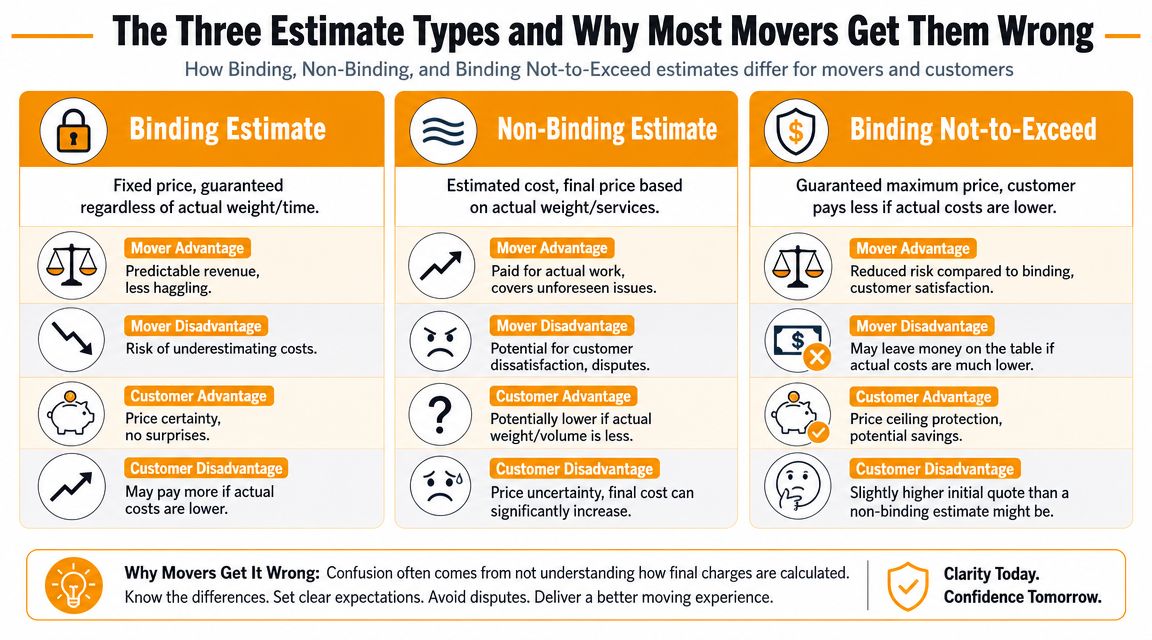
Binding estimates
A binding estimate gives the customer price certainty. If the scope matches what was surveyed and documented, the price is fixed.
This can help close shoppers who are anxious about budget. It also reduces haggling later because everyone is working from the same agreed number. The problem is obvious. If your intake is sloppy, you own the error.
Binding estimates work best when:
- The inventory is well documented.
- Access conditions are clearly captured.
- Your team has discipline around exclusions and change orders.
They fail when reps use them to “lock in the deal” before they really understand the move.
Non-binding estimates
A non-binding estimate gives you more protection if actual weight, services, or conditions differ from the initial conversation.
Operationally, that can look safer. Sales-wise, it often creates friction. The customer hears one number early, then experiences the final bill as a surprise, even when your paperwork is technically correct.
Use non-binding estimates carefully. They tend to create the most tension when your sales process leads with a soft number and doesn't explain what could change.
If your team relies on non-binding estimates because your intake is weak, the estimate type isn't the real problem. The intake process is.
Binding not-to-exceed estimates
For many independent movers, binding not-to-exceed is the most practical middle ground on qualified long-distance jobs.
It gives the customer a ceiling, which lowers fear and improves trust. It also leaves room for the final charge to come in lower if actual shipment or services justify it. That structure is often easier to sell than a pure binding estimate and easier to defend than a loose non-binding one.
A simple internal decision framework looks like this:
| Situation | Estimate type that often fits |
|---|---|
| Clean survey, stable scope, well-defined access | Binding |
| Scope is still developing and details are incomplete | Non-binding, with strong explanation |
| Good survey, but some normal uncertainty remains | Binding not-to-exceed |
If you want your sales team to stop guessing and start quoting with consistency, build estimate-type rules directly into your process and training. This breakdown of how to estimate moving costs is a good operational reference for standardizing that logic.
Building Your Ironclad Long-Distance Rate Card
You can't scale quoting if your pricing lives in one owner's head.
That's the hidden problem in a lot of mid-sized moving companies. They think they have a rate card because they have a spreadsheet, a few old quote templates, and one experienced person who “knows how to price these.” That's not a system. That's dependency.
North American's benchmark pricing shows just how much variability you're dealing with. It lists long-distance moves at an average of about $4,500 with a range of roughly $2,200 to $10,500, and cross-country moves at about $7,650 with a range of roughly $4,400 to $17,000. It also notes that a 2 to 3-bedroom household moving over 1,000 miles averages around $6,300, and that the spread is driven by weight, item count, and added services, which is why precise quoting depends on a detailed survey and a robust rate card (North American estimated relocation cost calculator).
Your rate card needs operational detail
A profitable long-distance rate card has to reflect how your company performs work.
That means you need one source of truth for the variables that consistently change job cost. If your sales team, dispatcher, and owner all answer the same pricing question differently, you don't have pricing control.
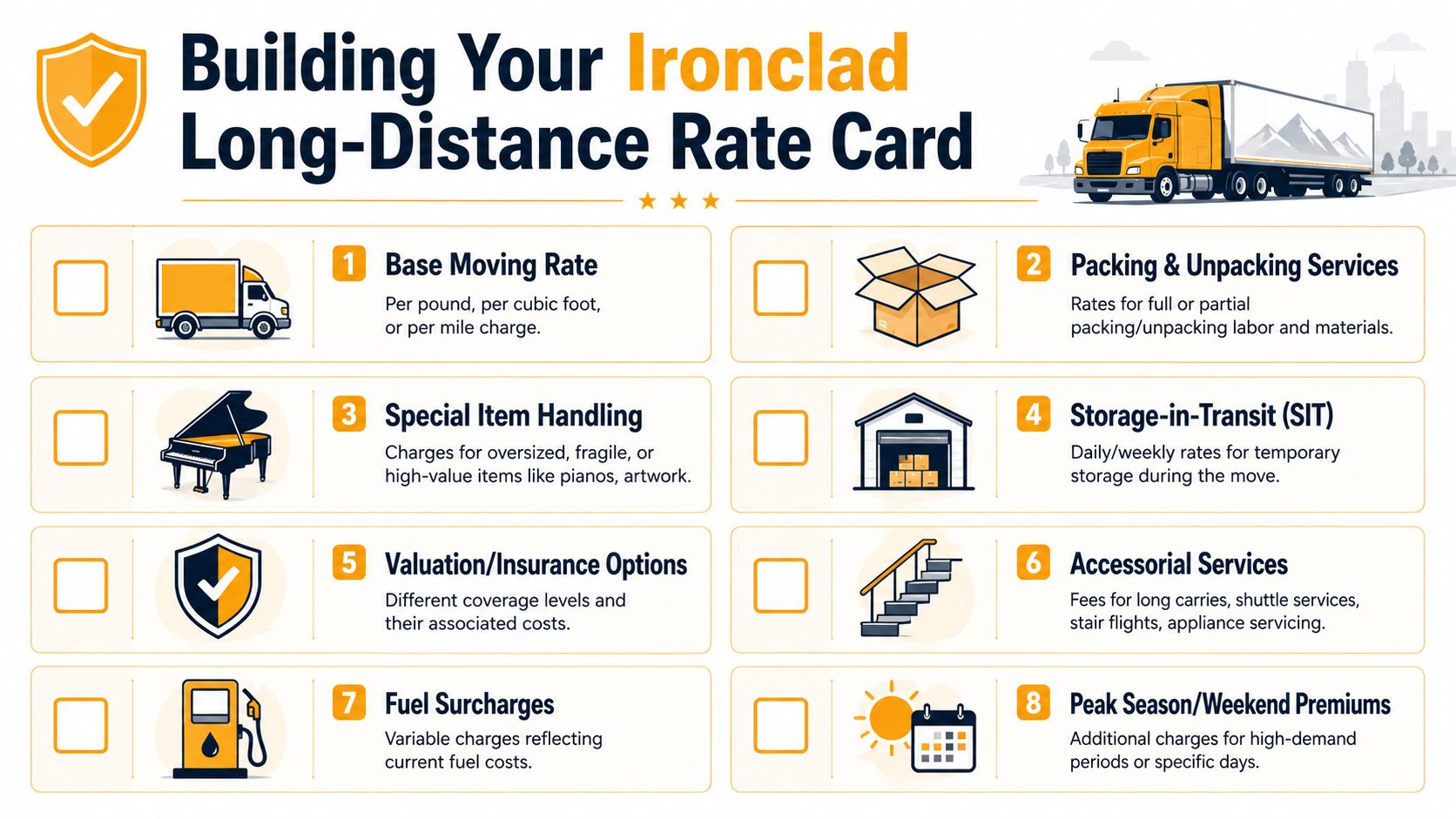
Start by separating the quote into core cost buckets:
- Transportation base
- Packing and unpacking
- Accessorials
- Special handling
- Storage
- Valuation options
- Seasonal and schedule premiums
Don't hide these inside one flat number internally. You may present a clean customer-facing quote, but your team should know what drives margin inside the file.
The rate card checklist that protects margin
Here's the structure that usually works best for a 5 to 20 truck operator.
- Base transportation logic: Define how you price the linehaul portion. However you structure it, the team needs one consistent method.
- Packing labor and materials: Full pack, partial pack, unpacking, carton packages, and specialty materials need their own pricing rules.
- Special item handling: Piano, safe, oversized furniture, fragile pieces, and anything that requires extra labor or equipment should never be improvised on the call.
- Storage-in-transit: If a move can convert into storage, your team needs a clean way to quote it without rebuilding the job.
- Valuation options: Document what your company offers and how the customer chooses it.
- Accessorial charges: Long carry, stairs, elevator constraints, shuttle, parking issues, appliance servicing, and difficult building rules belong on the intake form and the rate card.
- Fuel surcharge logic: If fuel is handled separately, document when and how it applies.
- Peak-season and weekend rules: Busy-season pricing should not be a rep-by-rep judgment call.
The best rate card is boring. It removes heroics, protects margin, and makes quoting repeatable.
A good stress test is simple. Hand the same long-distance lead to two different people in your office. If they produce meaningfully different quotes from the same information, your rate card still has gaps.
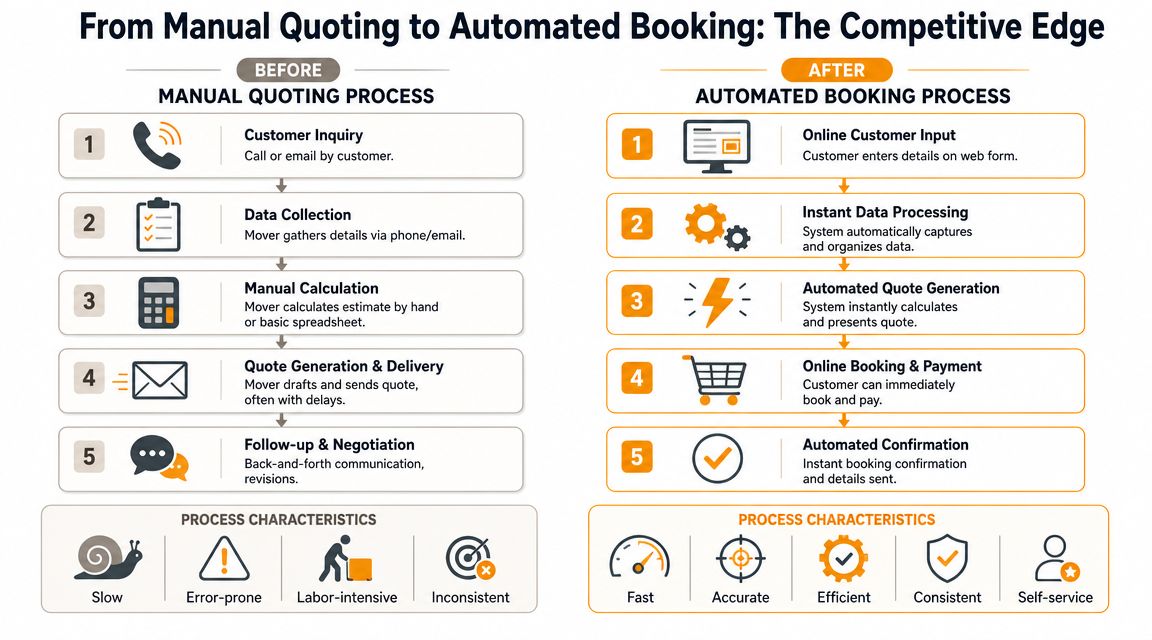
From Manual Quoting to Automated Booking The Competitive Edge
Most moving companies don't lose long-distance jobs because nobody answered the phone. They lose them because nobody closed the loop fast enough.
A human answering service can take a message. A generic voice tool can capture contact info. Your CRM can store the lead after someone enters it. None of that solves the front-end problem if the caller still has to wait for a real quote.
United's quote guidance, framed around FTC-style consumer concerns, emphasizes that customers should understand whether an estimate is binding or non-binding, what's included, and how add-ons like stairs, long carries, packing, shuttle service, storage, and valuation affect the final bill. It also notes that the gap between a simple ballpark and the final bill is a major pain point, which is why detailed home surveys matter before a final quote is produced (United Van Lines moving quotes process).
Manual quoting loses on speed and consistency
The manual workflow breaks in predictable places:
| Manual step | What goes wrong |
|---|---|
| Call intake | Details get missed because the rep is rushing |
| Quote calculation | Pricing varies by who built it |
| Follow-up | The lead goes cold while your team is busy |
| Revisions | The customer starts shopping because the process feels messy |
That's why long-distance quoting gets harder as you grow. With more trucks and more inbound volume, the cost of inconsistency rises. Busy season makes it worse because the people who should be selling are also firefighting dispatch and customer service.
Plenty of operators are now looking beyond message-taking and into workflow automation. If you want a broader non-moving example of that shift, this article on automating sales for growth is useful because it frames automation as a speed and consistency play, not just a labor-saving one.
What an automated front-end should actually do
Automation only matters if it gets you from inquiry to booked job faster.
For moving companies, the useful version of automation should:
- Capture complete intake data: Inventory, distance, timing, and access conditions.
- Apply your own rate card: Not a generic estimate model.
- Explain quote structure clearly: Especially estimate type and included services.
- Book the next step or the job itself: Into the tools you already use, such as SmartMoving, Supermove, MoveitPro, or Google Calendar.
- Follow up automatically: Because not every caller books on the first contact.
One example is moving company estimate software that uses your rate card to qualify the lead, generate a quote, and move the customer directly into the booking workflow instead of stopping at lead capture. That distinction matters. Capturing a lead isn't the same as closing a job.
Fast quoting wins attention. Accurate quoting wins margin. A process that does both wins the booking.
The competitive edge isn't that automation answers after hours. It's that your company can respond with structure, pricing logic, and a clear next step when competitors are still relying on callbacks.
Stop Quoting and Start Closing Your High-Value Moves
Owners often think their long-distance quote problem is a pricing problem. Usually it's a process problem.
The customer wants clarity fast. Your company needs protected margin. Those goals are not in conflict if the intake is disciplined, the estimate type is chosen correctly, and the rate card reflects real operating conditions.
The process that wins profitable jobs
The movers who close more long-distance work tend to do three things well.
First, they collect the details that affect cost. Not just zip codes and move dates, but access, shipment scope, special handling, and service add-ons.
Second, they price from a defined system instead of improvising. That keeps quotes consistent across reps and keeps your margin from disappearing one forgotten line item at a time.
Third, they shorten the time between inquiry and usable quote. That's what stops the customer from turning your quote into one more tab in a comparison session.
A practical sales reminder from outside the moving space also applies here. This piece on how to close sales effectively reinforces something many movers overlook. Closing doesn't start at the end of the conversation. It starts when the buyer feels enough certainty to move forward.
What to change this week
If your long-distance quoting process still depends on callbacks, handwritten notes, and one person who “knows the pricing,” fix that first.
Use this short checklist:
- Audit your intake script: Make sure it captures every operational cost driver your crews complain about later.
- Standardize estimate-type rules: Don't let reps choose based on gut feel alone.
- Rebuild your rate card: Include accessorials, packing, storage, special handling, valuation, and schedule rules.
- Shorten quote turnaround: Your target should be a process that feels immediate to the customer.
- Connect quoting to booking: A quote without a next step is unfinished sales work.
The payoff is straightforward. You stop treating long-distance inquiries like admin tasks and start treating them like the high-value sales opportunities they are.
If you want to tighten your front-end quoting process and book more profitable long-distance jobs, explore MoveJoy. It's built for moving companies that need to capture the lead, generate an accurate quote from their own rate card, and move the customer straight into booking without the usual delay.