Every time your phone rings and goes to voicemail, you're not just missing a call—you're handing a paid job directly to your competitor. For a moving company, a standard phone system simply isn't built to handle the chaos of peak season. It can't keep up with after-hours inquiries or the simple reality that your team is often out on a job, not waiting by the phone.
This isn't just a small inconvenience. It's a direct leak in your revenue pipeline. This guide explains how to use inbound call management software to plug that leak and turn every call into a potential job.
Why Your Current Phone System Is Costing You Moving Jobs
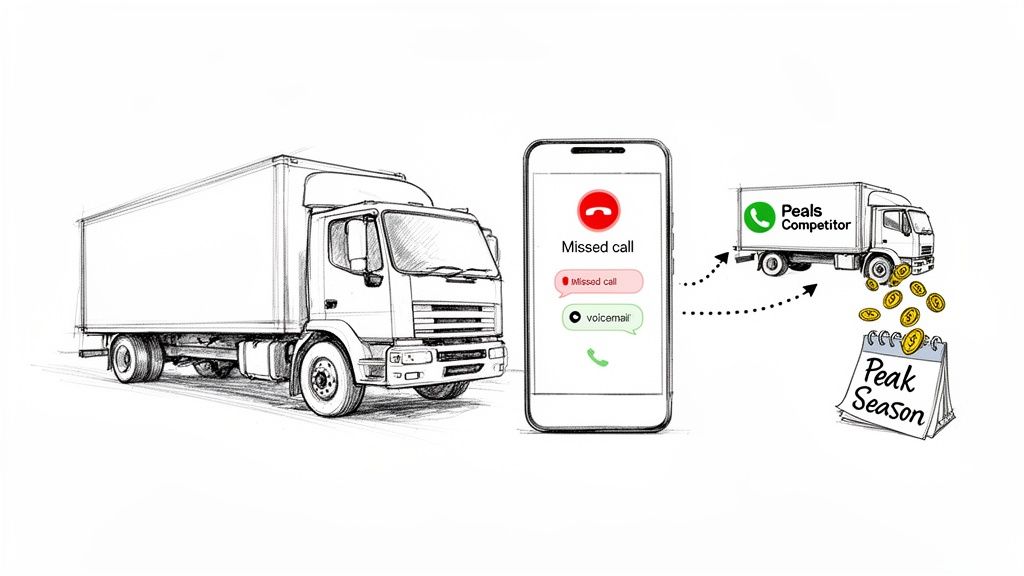
For a moving company owner, the phone is the single most important tool for growth. It’s the front door to your business. But what happens when that door is locked? A traditional phone system quickly becomes a major bottleneck for any moving business running 1–20 trucks.
The Real Cost Of A Single Missed Call
Let's break down the actual numbers. A typical local move can be worth anywhere from $900 to $2,500. When a potential customer calls for a quote and gets your voicemail, they don’t patiently wait for a callback. They hang up and dial the next mover on their list.
Today's customers expect immediate answers. Studies show that the first business to respond wins the job over 70% of the time. Being second is the same as being last.
If you miss just one call per day, you could be losing thousands of dollars each week. During the busy season, when call volume spikes, this problem multiplies. Your team is out on jobs, your office manager is handling dispatch, and legitimate, high-value leads are slipping right through your fingers.
To see how this adds up, let's look at the financial impact.
The Real Cost Of A Missed Call For Your Moving Company
| Missed Calls Per Week | Potential Lost Jobs Per Month | Average Job Value | Estimated Monthly Revenue Lost | Estimated Annual Revenue Lost |
|---|---|---|---|---|
| 3 | 4 | $1,500 | $6,000 | $72,000 |
| 5 | 6 | $1,500 | $9,000 | $108,000 |
| 7 | 8 | $1,500 | $12,000 | $144,000 |
Even missing just a handful of calls a week quickly turns into a six-figure problem. That’s enough money to buy a new truck, hire another crew, or fund your marketing for the entire year.
The Problem With Traditional Call Handling
Your current phone system creates several critical business challenges that directly impact your ability to book more moving jobs:
- No 24/7 Coverage: Most moving inquiries happen when people are off work—evenings and weekends. If your phone only rings from 9-to-5, you're missing out on the most motivated customers. Our guide to after-hours answering services explains just how crucial capturing these leads is for growth.
- Inability to Scale: During the spring and summer rush, your call volume can easily double or triple. A single person in the office can't possibly answer every call, provide quotes, and manage the schedule. This leads to long hold times, frustrated callers, and abandoned calls.
- No Lead Capture for Hangups: When a caller hangs up without leaving a message, that lead is gone forever. A basic phone system offers no way to identify or recover that potential revenue. You don't even know you lost it.
These operational gaps are exactly where your competitors gain an edge. While your phone is ringing unanswered, they are speaking with your potential customer, providing a quote, and booking the job.
The solution isn't to hire more receptionists or chain yourself to the office phone. The answer lies in modernizing how you handle inbound calls. This is where inbound call management software becomes a game-changer, turning your phone from a source of missed opportunities into a powerful, automated engine for booking jobs.
What Is Inbound Call Management Software?
Let's cut through the jargon. Inbound call management software isn't just another piece of tech to figure out. For a busy moving company owner, it’s best understood as your digital front-office assistant—built with one goal in mind: turning every phone call into a potential job.
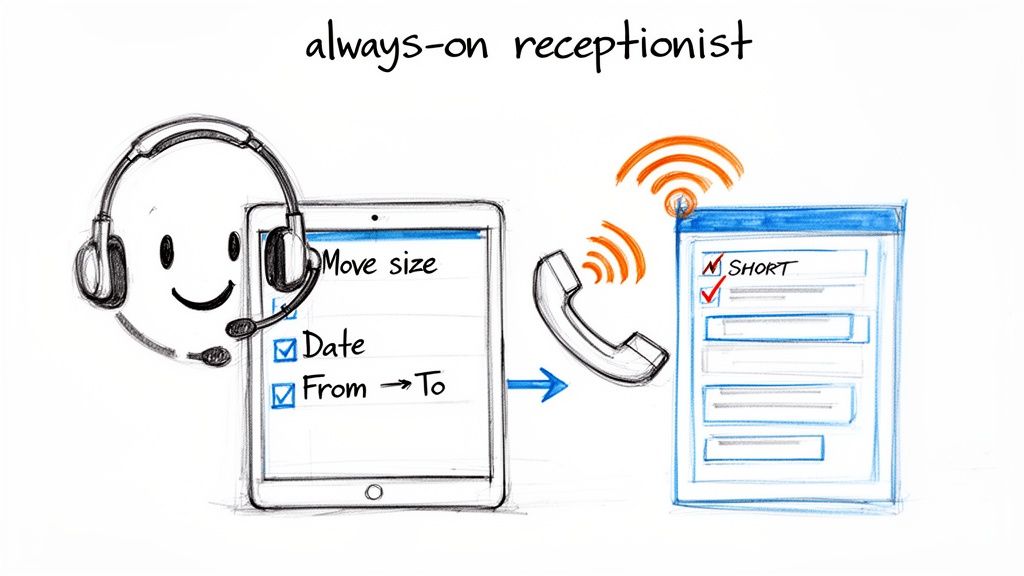
Imagine a perfect receptionist. This person never takes a sick day, never misses a call after hours, and picks up the phone every single time it rings, day or night. That's the core of what this software does.
More Than Just an Answering Machine
A standard business line just sends callers to voicemail. A traditional answering service might take a basic message for you to deal with later. In both scenarios, the customer waits. And as any mover knows, a customer who has to wait usually becomes a competitor's customer.
This is where inbound call management software changes the game. It’s not a passive message-taker; it’s an active participant in your business.
Think of it this way: A voicemail box is a dead end for a hot lead. An answering service is a detour. Modern call management software is a direct highway to getting a quote and booking a job.
This tech is built to do more than just answer the phone. It’s designed to intelligently handle and convert calls into revenue, moving a customer from their first call to a booked job with almost no manual work from you or your team.
How It Works for Your Moving Company
At its heart, this software automates the most critical first steps of your sales process. When a potential customer calls your business line, the system engages them instantly.
It follows a set of rules you define, designed specifically for how your moving company operates. Key functions include:
- 24/7 Instant Response: It answers every single call, so you finally capture those valuable leads from customers who call on nights and weekends.
- Intelligent Qualification: The system asks the same crucial questions you would: move date, number of bedrooms, and the origin and destination zip codes.
- Lead Capture: It automatically records the caller’s name, phone number, and all the move details they provide, so you never lose a lead just because they hung up before you could grab a pen.
This isn't about replacing your people; it's about making them more effective. The software handles the repetitive, time-sucking work of initial lead intake. This frees up your office staff to focus on high-value tasks like building detailed quotes, managing crew schedules, and delivering great customer service on move day.
The result is simple: a ringing phone is no longer a disruption or a missed opportunity. It becomes a qualified lead, automatically captured and ready for you to turn into a booked, profitable job.
Core Features That Drive Revenue For Movers
Let's be honest: generic call software wasn't built for a moving company. To turn your phone from a cost center into a money-maker, you need features that solve the real problems you face every single day. These aren't just shiny bells and whistles; they're specific tools designed to capture leads, stop wasting your time, and directly boost your booking rate.
The right features work together, creating a system that puts every caller on a fast track to becoming a booked job on your calendar. This is what separates growing movers from those stuck losing jobs to the competition.
24/7 AI Answering
The hard truth for most moving companies is that your best calls come in after 5 PM and on weekends. This is exactly when your office is closed. Every one of those calls that hits voicemail is a job you just handed to a competitor who was ready to answer.
An AI receptionist is the answer. It’s your employee who never sleeps, never takes a break, and is always professional. It works around the clock to:
- Instantly Answer Every Call: No more phones ringing off the hook. No more "I'll call them back from voicemail" lists. The AI answers professionally every single time, making sure a potential customer is never ignored.
- Capture After-Hours Leads: It effortlessly handles those evening and weekend calls—a time when your most motivated customers are actually planning their moves.
- Provide a Professional First Impression: A fast, helpful response builds immediate trust. It shows customers you’re an organized, serious business, not just a couple of guys with a truck.
This one feature single-handedly changes your business hours from 9-to-5 to 24/7, ensuring you get a shot at every lead in your market.
Automated Lead Qualification
Not every caller is a customer. Some are just price shopping, while others aren't a good fit for your company. Spending your time—or your dispatcher's time—on unqualified leads is a massive productivity killer, especially during peak season.
Automated qualification acts as your front-line screener, asking the exact same critical questions you would.
An intelligent system doesn't just take a message; it gathers intel. It asks for the number of bedrooms, move date, origin and destination zip codes, and if there are any specialty items like a piano.
This means that by the time a lead gets to you, it’s not a cold call—it’s a warm, qualified prospect ready for a real quote. It filters out the time-wasters so you can focus on the jobs you actually want to win. This kind of automation is a competitive advantage, allowing you to respond faster and more effectively than movers still doing everything manually.
Direct Calendar Integration
The endless back-and-forth of scheduling an in-home estimate or booking a move is a huge bottleneck. The emails and phone tag waste time and give the customer a perfect excuse to call another mover who can book them faster.
Direct calendar integration fixes this by plugging the call system straight into your dispatch or sales calendar. When the AI qualifies a hot lead who is ready to book, it can see your real-time availability and schedule the appointment right then and there. This creates a seamless path from the first call to a confirmed job, often without a human needing to lift a finger.
Beyond just routing calls, you should look for powerful features like advanced agent-to-human handoff strategies that create a smooth customer experience, especially when things get complicated.
Missed Call Recovery
Even with the best system, some calls will get dropped. Or a customer might just hang up before the AI can help them. With a normal phone line, that lead is gone forever. Missed call recovery is your safety net.
If a caller hangs up, the system can instantly fire off an automated text message. Something simple like:
"Hi, this is [Your Moving Company]. We saw we just missed your call. How can we help you with your move today?"
This simple, immediate text can re-engage a customer who was seconds away from dialing your competitor. It shows you’re paying attention and you’re responsive, and it often recovers revenue that would have otherwise vanished into thin air.
Choosing The Right Call Management Solution
As a moving company owner, you know that standing still means falling behind. Once you realize your phone system is a bottleneck—and for most movers, it is—the next question is what to do about it. This isn't just about answering calls; it's a critical business decision that impacts your revenue, your team's sanity, and your ability to grow.
The good news is you have options. The challenge is that each one comes with its own set of costs, benefits, and operational headaches. Let's break down the three main paths a moving business can take.
Option 1: The In-House Receptionist
This is the old-school approach: hire a full-time person to sit at the front desk, be the voice of your company, and route calls. They are 100% dedicated to your business, which is great. It's the classic personal touch.
But the downsides are brutal. First, the cost. You’re not just paying a salary. Add in benefits, payroll taxes, and vacation time, and you're easily looking at $40,000–$60,000+ per year. This person only works 9-to-5, which means you're still missing every call that comes in after hours, on weekends, or during holidays. And what happens during the spring rush? One person can't handle a sudden spike in call volume. Leads you paid good money for will go straight to voicemail.
Option 2: The Traditional Call Center
When an in-house receptionist can't keep up, outsourcing to a generic call center seems like the next logical step. They promise 24/7 coverage and can handle high call volumes.
Here’s the problem: The agents are generalists. They don't know the difference between a 2-bedroom apartment and a 4-bedroom house with a piano. The leads they pass along are often poorly qualified, wasting your sales team's time. Worse, they just take a message. By the time you get it and call back, that lead has already called two other movers and booked the job. Speed to lead is everything, and a call center just adds another delay.
Option 3: Modern AI Call Management Software
The third path is a modern, automated solution built specifically for service businesses like yours. This isn't just a fancy answering machine; it's an intelligent system designed to act as your digital front-office assistant.
It's far less expensive than a receptionist and often pays for itself by booking just one or two extra moves per month. The system never sleeps, providing true 24/7/365 coverage.
Every single call is answered professionally, and every lead is qualified using the exact questions you want asked. The system doesn't just take a message—it captures lead details, integrates with your calendar to book estimates, and can even trigger automated follow-up texts.
The ROI is clear and immediate. While a receptionist costs thousands per month and a call center gives you inconsistent leads, an automated system turns a fixed, low cost into a powerful revenue-generating engine.
For a moving company owner looking to grow, an automated solution provides the scalability of a call center with the deep industry knowledge you'd want from your best employee, all at a fraction of the cost.
Comparing Your Call Handling Options
Deciding how to manage your phones can feel overwhelming. To make it simpler, here’s a head-to-head comparison of your main options. Think about where your business is today and where you want it to be in a year.
| Feature | In-House Receptionist | Traditional Call Center | AI Call Management Software |
|---|---|---|---|
| Cost | High ($40k-$60k+/year) | Moderate ($800-$2k/month) | Low (Pays for itself with 1-2 moves) |
| Availability | 8 hours/day, 5 days/week | 24/7 | 24/7/365, including holidays |
| Scalability | Poor (Overwhelmed by call spikes) | Excellent (Handles high volume) | Excellent (Handles unlimited simultaneous calls) |
| Industry Knowledge | Excellent (with training) | Poor (Generalist agents) | Excellent (Trained on moving-specific terms) |
| Action Taken | Schedules, transfers calls | Takes a message, sends an email | Qualifies leads, quotes jobs, books appointments |
| Consistency | Dependent on the individual | Inconsistent (Varies by agent) | 100% Consistent (Follows your script every time) |
| Best For | Small companies with low call volume and a big budget | Companies needing basic 24/7 coverage for messages | Growth-focused companies wanting to maximize every lead |
At the end of the day, a receptionist is expensive and limited, and a call center just creates a different kind of bottleneck. An AI-driven system is the only option that scales with your business, captures leads around the clock, and directly contributes to your bottom line.
To dive deeper into the tools available, check out our guide on the best moving company software for modernizing your operations. This is how you turn your phone system from a liability into your most effective sales tool.
How Automation Ties Your Whole Operation Together
Good inbound call management software does way more than just answer your phone. It becomes the brain of your entire front-office operation. The real magic isn't just catching a lead—it's the chain reaction of automated tasks that kicks off the second that call is answered. This is how you get back hours of your day and give customers a slick, professional experience from the first hello.
Think about it: a customer calls you on a Saturday morning. Instead of hitting your voicemail, an AI system picks up instantly. Within minutes, a whole series of actions starts firing off automatically, and you haven't lifted a finger.
From First Call to Booked Job, Hands-Free
A truly smart system doesn't just add another piece of software to your plate; it gets all your existing tools talking to each other. It’s about connecting the dots in your customer’s journey.
Here's how one single phone call can automate your entire workflow:
- Lead Capture & Qualification: The system answers, asks the questions you would—move size, date, locations—and logs every detail straight into your CRM. No more scribbling notes.
- Instant Quoting: Based on the info it just gathered, it can fire off an accurate quote immediately.
- Smart Follow-Up: If the customer doesn't book on the spot, an automatic sequence of texts and emails kicks in, making sure you stay top of mind without being annoying.
- Direct Calendar Booking: Once they accept the quote, the job gets booked right onto your dispatch calendar, blocking out the time and assigning the crew.
- Automatic Confirmations: The customer gets an instant booking confirmation. Your team gets one, too. Everyone is on the same page.
This process shows just how far call handling has come. We've moved from a simple receptionist, to a clunky call center, and now to sharp AI software that can run the whole show.
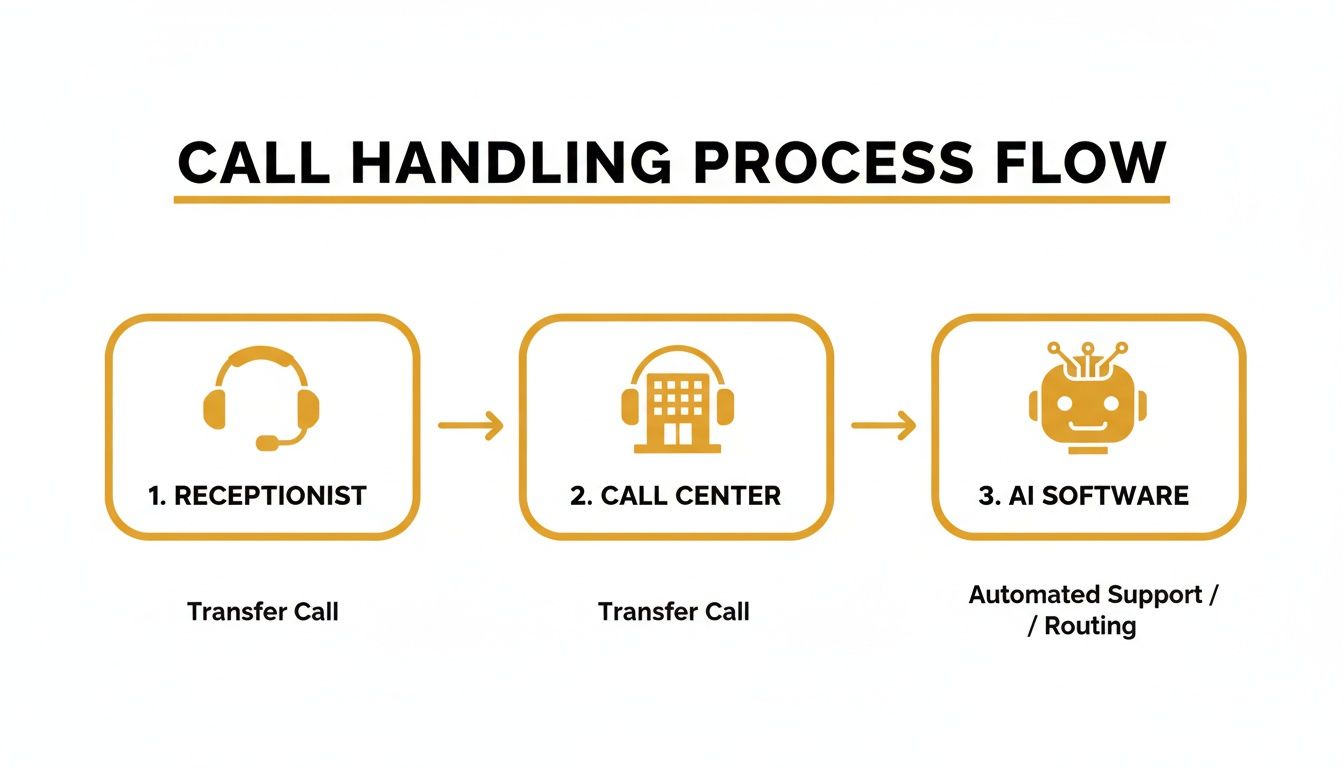
That diagram says it all, really. It shows how AI takes a messy, multi-step process and turns it into one clean, efficient workflow. This frees your dispatcher from being a data-entry clerk so they can focus on what they do best: managing crews and solving real-time problems on the road.
Automation Doesn’t Stop When the Move Is Over
The value you get from automation shouldn't end when the truck pulls back into the yard. A good system keeps working for you long after the job is done, helping you build your reputation and bring in new business.
The post-move experience is your single best marketing opportunity. A happy customer is your most powerful tool for getting reviews and referrals, but most moving companies are just too swamped to ask for them consistently.
This is another spot where automation gives you a huge leg up. You can set up workflows that automatically:
- Send Review Requests: A few days after the move, the system can text the customer a link to leave a review on Google or Yelp.
- Ask for Referrals: A week or so later, it can send a friendly follow-up, asking if they know anyone else planning a move.
These simple, automated touches are how you build social proof and a strong word-of-mouth pipeline. It's why cloud-based call management software is taking off. The no-code setups and quick integrations are perfect for growing moving businesses that need to automate lead qualification and get real-time data without a big IT headache.
To really get your business running like a well-oiled machine, it's worth looking into the 7 automations every business should set up, especially those powered by your phone system. When you connect your call handling, scheduling, and post-move marketing, you create a system that doesn't just make you more money—it cuts down the manual work for everyone on your team. You can learn more about how this works with our guide on an AI phone answering system.
It’s Time to Stop Losing Jobs to Your Voicemail
For moving companies running on tight margins, the game has changed. Customers don’t wait for callbacks anymore. They call down a list, and the first mover who answers the phone, sounds professional, and gives them a quote gets the job. Speed isn't just an advantage; it’s the only thing that matters.
You don't have to take my word for it. Just look at where the money is going. The market for inbound call tracking software—a key piece of these systems—was valued at $2.36 billion in 2024. It’s expected to shoot up to $6.47 billion by 2032. This isn’t just some tech trend; it’s a massive shift. Businesses are realizing that letting calls go unanswered is like throwing money away—as much as 40% of potential revenue is lost this way. You can see the data on these market trends here.
Your New Competitive Edge Isn't a Bigger Truck—It's Automation
Let's be real. The problems every moving company owner faces—missed jobs, messy scheduling, and giving a bad first impression—are all symptoms of the same thing: an outdated, manual process. Relying on a single office manager or just hoping voicemail catches the overflow is a recipe for failure, especially when things get busy.
Inbound call management software hits these problems head-on. It creates a system that finally works for you, not against you.
- It captures every single lead, 24/7. You’ll never hand a paying customer to your competitor again just because you were on a job.
- It automates the repetitive stuff—the quoting, the scheduling, the follow-ups—so your team can focus on running the crews and keeping current customers happy.
- It guarantees a professional, consistent answer every time the phone rings. No more rushed greetings or background noise.
This isn't just another piece of software you have to learn. Think of it as your most reliable employee—one that works around the clock to bring in new jobs, clean up your front-office chaos, and make your business stronger.
The most successful movers today aren't the ones with the most trucks. They're the ones who answer the phone the fastest. By bringing in automation, you can finally go head-to-head with the bigger guys, grow your operation without piling on more payroll, and stop that sinking feeling of losing another profitable job to your voicemail. The future of this business isn’t about working harder; it's about working smarter.
Your Questions, Answered
When you're running a moving company, every new piece of tech has to pull its weight. It's smart to have questions. Here are some straight answers about what it's really like to use an AI receptionist.
Will My Customers Know They’re Talking to an AI? Will It Sound Robotic?
Not like they used to. The old, clunky "press one for sales" robots are a thing of the past. Modern AI, especially one built for the moving industry, is trained on thousands of real-world conversations with actual moving customers.
It’s designed to be conversational, professional, and genuinely helpful—just like your best human dispatcher. It can understand different accents, complex questions, and the natural back-and-forth of a booking call. The goal isn't to trick anyone; it's to give your customers a smooth, positive experience from the second you pick up.
How Long Does It Actually Take to Get This Running?
This isn’t a six-month IT project. You can be live and capturing leads in under an hour. Seriously.
Most of these systems are cloud-based and made for guys who don't have an IT department. The setup is usually just forwarding your current business number and linking your calendar. There's no hardware to install or complicated software to download. You can literally start catching calls you were missing the same day you sign up.
Is This Actually Affordable for a Small Mover?
Yes, because it’s built for small and mid-sized movers—the ones running 1-20 trucks. The better question isn't "what does it cost?" but "what's the return?" Think about the cost of a full-time receptionist's salary, or even the price of just one solid job you missed last month because no one picked up the phone.
The ROI is the whole point. Most AI receptionist services pay for themselves by booking just one or two extra moves each month. It stops being an expense and becomes a machine for generating more revenue.
Can It Handle the Specific Questions My Customers Ask?
Absolutely. A system designed specifically for movers isn't just a generic answering machine. It’s built to be customized with the exact qualifying questions you need to give a solid quote.
It knows to ask about things like:
- The number of bedrooms in the house
- Specialty items like pianos, gun safes, or hot tubs
- Job site access issues (flights of stairs, long carries, tricky elevators)
- The customer's ideal move date
This means that when a lead hits your desk, it’s not just a name and number. It’s a well-qualified customer who is ready to book, which saves your team a ton of time on follow-ups and quoting.
Ready to stop sending good, paying jobs to voicemail? See how automation can get you off the phone and back to running your business. Learn how MoveJoy helps movers like you capture every lead, book more jobs, and grow your revenue—without adding more people to the payroll. Explore MoveJoy today.