
If you own a moving company, you know the feeling. The phone rings off the hook during the busy season, but when you look at the numbers at the end of the month, you know you left money on the table. Jobs that just slipped through the cracks.
It’s a frustrating paradox. You’re swamped with work, but your revenue isn’t actually growing. The real problem isn’t a lack of customers. It’s the small, everyday leaks in your operation—the missed calls, the delayed quotes—that are draining your revenue and keeping you stuck.
Stop Leaking Revenue and Start Scaling Your Moving Business
For owners of small to mid-sized moving companies running anywhere from 1 to 20 trucks, the busy season feels like trying to fill a bucket with a hole in it. Every missed call while you’re on another line or dispatching a crew is a lost job. Every call that goes to voicemail after 5 PM is a customer who just called your competitor.
These aren’t tiny drips; they’re revenue leaks that add up fast. Most local movers lose 3-7 jobs every single month from unanswered calls alone. At an average job value of $1,500, that’s $50,000 to $125,000 in lost revenue every year. That’s a new truck. That’s a top-tier crew leader’s salary. It’s the money you need to actually scale your business.
The Real Cost of “We’ll Call You Back”
The old-school method of scribbling a name and number on a notepad is a recipe for staying small. Today’s customers don’t wait. If you don’t answer the phone and give them an accurate quote right then and there, they’re already dialing the next mover on their Google search.
This is where you have to change your thinking. The goal isn’t just to answer more calls; it’s to book more jobs. There’s a huge difference between a basic answering service that just takes a message and a system that can generate an accurate quote using your rates and book the job directly into your CRM or calendar. One captures a lead; the other closes a job.
This is how you plug the leaks. An intelligent automation system like MoveJoy’s 24/7 call answering service for movers is built on this exact principle—turning every single call into a booked job, not just another message to call back.
Here’s a look at how these common leaks kill growth and what the modern fix looks like.
Common Revenue Leaks vs. Modern Growth Solutions
| Common Revenue Leak | Traditional Method (The Problem) | Modern Solution (The Growth Engine) |
|---|---|---|
| Missed After-Hours Calls | Calls go to voicemail after 5 PM and on weekends. You try to call back Monday, but the lead has already booked with a competitor. | AI-powered automation that answers, provides an accurate quote using your rates, and books jobs 24/7, capturing high-intent leads while others are closed. |
| Phone Tag with Leads | You and a potential customer trade voicemails for days. They eventually book with a more responsive company that gave them an instant price. | Instant quoting and automated SMS follow-ups that allow customers to book on their own time and stay engaged without you lifting a finger. |
| Inaccurate Quotes | Your new office hire gives a bad quote, either losing the job because it's too high or locking you into an unprofitable move because it's too low. | Centralized AI-driven quoting that ensures every quote is accurate and profitable, whether it’s from a call, a web form, or a text message. |
| Call Overflow During Peak Season | Your dispatcher is on one line, and three more calls come in. The other two go to voicemail, becoming lost revenue. | Scalable overflow handling that automatically picks up any call your team can't get to, ensuring you never miss a lead, even during the morning rush. |
These aren’t just minor tweaks; they represent a fundamental shift from a reactive, manual operation to a proactive, automated growth machine. By fixing the leaks, you stop losing the revenue you’ve already worked hard to generate.
To truly grow, you must transition from just surviving the busy season to capitalizing on it. This requires a system that captures, quotes, and converts leads automatically, so you can focus on running your operations.
This guide is your playbook for fixing these core problems. While this guide on how to start and grow a small business provides a broad overview, here we’ll get specific for moving company owners. We’ll show you exactly how to master lead capture, speed up your conversions, and build an operation that can handle real growth.
From First Call to Booked Job: Nailing Your Lead Funnel
If you want to grow your moving company, it really comes down to two things: getting leads and closing them fast. In this business, customers shop for movers at lightning speed. Your response time isn’t just a nice-to-have; it’s your biggest competitive advantage. If you’re not the first to answer the phone and give them a price, you’ve probably already lost the job.
You need a system that engages every single interested customer and gets them booked before your competition even has a chance to call them back. Let’s break down how to build that high-speed, high-conversion funnel.
Show Up Where Customers Are Looking
Your lead funnel begins where your customers are searching: online. There are plenty of strategies for Mastering Services Lead Generation, but for a local mover, your Google Business Profile (GBP) is king.
You have to rank high in local search. Period. The data is clear: the top 3 spots on Google get the vast majority of all the clicks. If you’re not there, most customers will never even see your name. That means claiming your GBP and optimizing it obsessively—add recent photos, get a constant stream of new reviews, and make sure your service areas are dialed in.
Capture Every Call and Quote on the Spot
Once a lead finds you, the clock starts ticking. A call that goes to voicemail is a job you’re about to lose. Customers who leave a message rarely wait for you to call back; they just move on to the next company on the list. This is where the difference between just answering a call and actually closing a job becomes painfully clear.
A traditional answering service might take a message, but that’s just kicking the can down the road. The real power is giving an instant, accurate quote right then and there, on that first call.
A lead who gets an immediate, accurate quote is far more likely to book on the spot. You’ve solved their biggest problem—figuring out the cost—so they have no reason to keep shopping around.
This simple flow is how you turn leads into booked jobs, every single time.
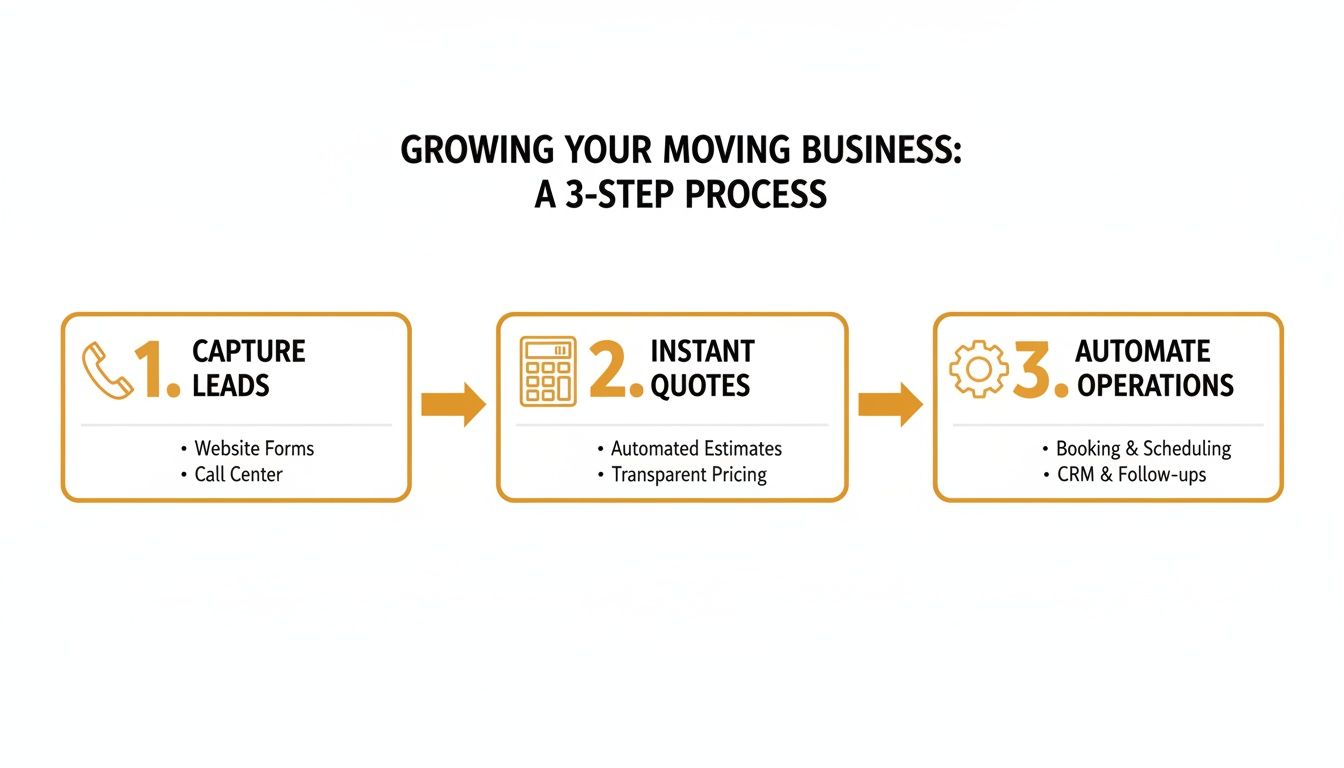
It’s straightforward: capture every lead, give them an instant price based on your rates, and let automation handle the booking and follow-up. This turns your phone from a simple contact method into a machine that generates revenue.
Turn Your Phone Into a Revenue Machine
Picture this: It’s 10 PM on a Friday. A customer needs to book a move for next month and they’re ready to do it now. Your office is closed, but their call gets answered instantly. In minutes, an AI-powered system gathers their move details, generates a perfect quote using your company’s rate card, and books the job right into your SmartMoving or Supermove calendar.
This isn’t just about being available 24/7. It’s about having a system that acts like your best salesperson—one that never sleeps, never makes a math error, and never takes a day off. It closes the gap between a potential customer calling and you getting paid, ensuring that even when you’re busy on another call or out on a job, you’re still booking work.
To see exactly how this works from start to finish, check out our guide on turning a prospect into a paying customer.
Perfect Your Pricing and Quoting Strategy
This is where you either make real money or run your business into the ground. Get your pricing wrong, and you’re either scaring off perfectly good customers with high quotes or running your crews ragged on jobs that barely cover fuel.
Nailing your pricing isn’t just about a bigger paycheck. It’s about building a sustainable business that can actually grow without you losing your mind.
Quoting too low is a race to the bottom you can’t win. Quoting too high is just free marketing for your competitors. The sweet spot is a strategy that’s competitive for your local market but engineered for real profit.
Choosing Your Pricing Model
There’s no single right answer here. The best model for your moving company really boils down to your market, the kinds of jobs you typically handle, and where your operational strengths lie.
Hourly Rates: The go-to for most local residential moves. It’s simple for customers to understand and, more importantly, it protects you from the unexpected—like a customer who swore they were packed but definitely is not. The trick is setting a rate that truly covers all costs: labor, fuel, insurance, truck maintenance, and your profit margin.
Flat-Rate Pricing: This works best for long-distance moves or large, predictable local jobs. Customers love the cost certainty of a flat rate, and it can be a powerful closing tool. But be careful. This model puts all the risk on you. Underestimate the job, and you eat the cost.
Hybrid Models: Many smart movers mix and match. You could offer a flat rate for the transport portion of the move and then charge an hourly rate for packing services. This gives the customer some cost certainty while protecting your bottom line on the most variable parts of the job.
The industry is always changing. To keep up with rising costs, 66% of moving companies are raising their prices, and another 20% are adding new services like junk removal or short-term storage to boost revenue. You can get more details on how other movers are adapting in this insightful industry report.
From Quoting to Closing Jobs Instantly
In this business, speed and accuracy are everything. The biggest roadblock I see for moving company owners is getting consistent, profitable quotes out the door fast. When your dispatcher is on another call or you’re out on a job yourself, that new lead isn’t going to wait around. They want a price, and they want it now.
This is where quoting bottlenecks absolutely kill growth. A manual process—relying on a new hire or a busy dispatcher to calculate drive time, stair fees, and packing materials—is a recipe for inconsistent pricing.
An inconsistent quote doesn’t just lose you one job. It damages your reputation for being a professional, reliable company, making it harder to win the next one. Quoting accuracy determines whether a lead converts or shops elsewhere.
The goal has to be to get rid of this friction completely. Imagine a system that already knows your unique rate card inside and out. A customer calls at 8 PM on a Sunday. Instead of taking a message, it asks all the right questions, calculates the cost based on your pricing rules, and instantly sends a perfect quote via text and email.
That’s the difference between just capturing a lead and actually closing a job. Modern automation tools built for movers can handle this entire sequence. They don’t just answer the phone; they generate revenue by giving customers the instant, accurate pricing they need to hit “book now.” This frees your team from the endless game of phone tag and manual math, letting them focus on managing crews and making customers happy.
For a deeper look at getting your numbers right, check out our guide on how to estimate moving costs. It’s filled with practical tips to help you price every single job for maximum profit.
Scale Your Operations Without the Chaos
Booking more jobs is what we all want. But if your operations are a house of cards, growth feels less like a victory and more like a punishment.
Unplanned growth is the fastest way to burn out your best crews, blow past service windows, and watch your five-star reputation go up in smoke. It’s pure chaos.
Going from a few trucks to a dozen isn’t just about buying more metal. It’s about building systems for dispatch, scheduling, and crew management that don’t crack under pressure. This is the real work—moving from a guy putting out fires to the leader of a predictable, growing business.
Squeeze Every Dollar Out of Your Trucks and Crews
Your trucks and your crews are your revenue-generating assets. Every hour a truck sits idle in the yard or a crew is driving between far-flung jobs, you’re lighting cash on fire. Profitable growth means maximizing truck utilization and billable hours.
It all starts with getting smarter about your schedule. Stop playing Tetris and start playing chess.
- Cluster your jobs. See two smaller moves in the same part of town? Get them done on the same day with the same truck to kill pointless drive time.
- Kill the deadhead legs. If you’re doing a one-way move out of the city, are you trying to find a small job to bring back? An empty truck on a return trip is a huge missed opportunity.
- Right-size your crews. Don’t send a three-man crew for a two-man job just because it’s easier. Matching labor to the actual work is how you control costs and boost margins on every single move.
Treating your schedule like a puzzle isn’t just a fun exercise; it directly increases the revenue you pull in per truck, per day. This is the nitty-gritty of sustainable growth.
Get Ready for the Busy Season Onslaught
Every mover knows the feeling. The phone starts ringing off the hook in March and doesn’t stop until September. It’s a tidal wave of calls and pressure. If you don’t have a plan, this is where things break. Your service quality nose-dives, your best people get overwhelmed, and you miss out on thousands in revenue.
Prepping for this spike isn’t a “nice to have.” It’s about survival.
The only difference between a chaotic busy season and a wildly profitable one is having systems that can scale. You need a way to handle the flood of calls and leads without having to hire a bunch of office staff you’ll just have to lay off in October.
This is where technology stops being an expense and becomes your most valuable employee. Imagine every one of those extra calls being answered instantly, quoted perfectly, and booked automatically. Your ability to earn is no longer capped by how many calls a single person can physically handle.
Automate the Grunt Work So You Can Grow
Growth shouldn’t mean hiring more people to push paper or answer phones. The smartest operators I know are figuring out how to automate the repetitive tasks that clog up their front office.
The real game-changer is connecting your front-end lead capture directly to your back-end operations. When your lead automation system talks to your CRM—whether it’s SmartMoving, Supermove, or MoveitPro—you eliminate the friction and human error.
Think about this workflow:
- A potential customer calls you at 9 PM on a Tuesday.
- An automated system answers, asks the right questions, and generates an accurate quote based on your rates.
- The customer accepts the quote and books the job right then and there.
- That job—with all the details like inventory and special instructions—is instantly created in your CRM. Nobody on your team touched a thing.
This isn’t some sci-fi fantasy; it’s how top movers are scaling their businesses right now.
This kind of automation means nothing gets lost between the first call and the dispatch team. Your ops manager wakes up to a perfectly booked job, ready to be assigned. This is the backbone that finally gets you out of the day-to-day weeds and lets you focus on the big-picture moves that actually grow the company.
Your Reputation Is Your Best Growth Strategy
In the moving business, growth isn’t just about hauling more boxes. It’s about reputation. A five-star review is your best sales pitch, and a referral from a happy customer is the key to getting jobs without spending a dime on ads.
Creating a standout customer experience is what turns a one-time client into a walking, talking billboard for your company. It’s the difference between being just another mover and becoming the go-to name in your area.

This process starts way before moving day. It begins the moment they first contact you, with professional, reassuring communication that builds trust from the get-go.
Master the Pre-Move Experience
Let’s be honest: your customer is stressed. Moving is one of the most anxious times in a person’s life. This is your chance to be the calm in the storm. Don’t leave them guessing—be proactive.
Your pre-move communication should be dialed in. Here’s what that looks like:
- Instant Booking Confirmation: The second they book, an email and a text should hit their phone. It needs to clearly state the move date, time, estimated cost, and what they can expect next. This isn’t optional. It’s day-one professionalism.
- Pre-Move Reminders: Set up automated reminders to go out a week before and then again 24-48 hours before the move. Confirm the details one last time and maybe include a quick link to your packing tips or FAQ page. It shows you’re on top of it.
- “Crew is on the Way” Text: On moving day, a simple automated text saying, “Your crew is on the way!” is a tiny touch that makes a huge difference. It kills that last-minute anxiety of “Are they actually going to show up?”
These little touchpoints prove you’re an organized, reliable operation—not just a few guys with a truck. You’re calming nerves and setting the stage for a smooth day.
Remember, the difference between an answering service taking a message and a system that books the job is also about the customer experience. A customer who gets an instant quote and booking confirmation feels confident and taken care of from the very first interaction.
Turn Happy Customers into Your Sales Team
The job isn’t over when the last box is unloaded. The post-move follow-up is where you secure future business. This is what separates the top-tier moving companies from everyone else.
Get this: Elite moving operations pull 43% of their revenue from repeat and referral customers. And 60% of the best movers have affiliate programs that consistently bring in new jobs. That’s not luck; it’s a system. You can discover more insights about moving company profitability on smartmoving.com.
Building this system is simpler than you think. It just requires an automated follow-up sequence that kicks in right after the move is done.
Here’s your playbook for a post-move follow-up system:
The 24-Hour Quality Check
A day after the move, send an automated email or text. Thank them for the business and ask a simple, direct question: “How did everything go with your move?” This gives you a chance to jump on any small issues before they blow up into a bad review.
The 48-Hour Review Request
If the feedback from your quality check was positive, now’s the time to strike. Send another message with a direct link to your Google Business Profile. Make it dead simple for them to leave a review. Don’t make them search for it.
The 1-Week Referral Ask
A week later, follow up with a friendly message. Offer a small discount or a referral bonus for any friends or family they send your way. Frame it as a thank you for being a great customer.
This proactive approach turns your existing customer base into a predictable, low-cost engine for growth. It’s how you build a business that thrives on its reputation, not just how much you spend on ads.
Your Top Questions About Growing a Moving Company, Answered
As a moving company owner, you’re always looking for an edge. You’re not just trying to survive the busy season; you’re trying to build something that lasts. I talk to movers every day, and the same questions keep coming up. Here are the honest answers to what’s really on your mind.
We’ve all been there—staring at the numbers, wondering how to get ahead. Below are some of the most common questions I get from moving company owners who are ready to scale their business.
| Question | Answer |
|---|---|
| How can I get more moving jobs without spending a fortune on ads? | Focus on two things that don't have a line item on your P&L: your reputation and your local network. First, aggressively pursue Google reviews after every single move. Those stars directly impact how you rank in local searches. Second, build relationships with real estate agents, apartment managers, and local storage unit operators. A simple, reliable referral partnership can feed you high-quality leads that cost you nothing upfront. |
| What's the biggest mistake small movers make when trying to grow? | Trying to fill a leaky bucket. I see owners pour money into more marketing or another truck while they’re still losing thousands to missed calls, slow quotes, and non-existent follow-up. Every call that goes to voicemail after hours is a potential job you just handed to a competitor. Before you spend another dime trying to make the phone ring more, you need a bulletproof system to capture and convert every call you get, 24/7. |
| Is a traditional answering service good enough to stop missing calls? | No. Just answering the phone isn't the same as booking the job. A classic answering service only takes a message. That means you’re still playing phone tag the next day, and by then, your lead has already booked with the mover who gave them a price on the spot. An answering service captures a lead; automation that quotes and books closes the job. |
| How do I make sure my quotes are competitive but still profitable? | Accuracy and consistency are key. First, you need a rock-solid rate card that accounts for everything—labor, drive time, fuel, stairs, long carries, and packing materials. Second, you have to get that logic out of one person’s head and into a system. When you rely on a dispatcher or a new hire to remember every rule, you get mistakes. Those mistakes either lose you the job or kill your profit margin on it. |
Let’s dig a little deeper into some of these.
“Is an Answering Service Really That Bad?”
Think about it from the customer’s perspective. They call at 7 PM on a Tuesday, ready to book. They get a polite person who says, “Someone will call you back tomorrow.” What do they do next? They don’t wait. They hang up and call the next name on their list.
The goal isn’t just to take a message; it’s to close the loop on the very first call. You need a solution that can instantly generate an accurate quote from your rate card and book the job right into your calendar or CRM.
That immediate action is what stops a customer from shopping around. It’s what wins the job.
“How Can I Systemize My Quoting?”
Your pricing is your lifeblood. Relying on memory or a messy spreadsheet is a recipe for disaster. One dispatcher quotes high and loses the job; another quotes low and you end up paying to do the work.
Automation that uses your specific rates is the only way to guarantee every quote is perfect. It protects your bottom line, builds trust with customers who get a consistent price, and lets you scale without worrying that new hires are giving away the farm.
The moving sector is growing fast—it hit $23.1 billion in revenue back in 2024. To claim your piece of that pie, your pricing needs to be as smart as your crew. Read more on how top movers are boosting profitability.
Ready to stop leaking revenue and start growing with a system that books jobs for you 24/7? See how MoveJoy turns your missed calls into booked moves by providing accurate quotes and booking jobs directly into your CRM.