For a small business, especially a moving company, the “best” call center software isn’t the one with the most bells and whistles. It’s the one that solves your single biggest revenue leak: missed calls. For movers, every unanswered ring is a job worth thousands of dollars that you just handed to a local competitor.
This guide is written for moving company owners and operators who are tired of losing jobs to voicemail and want a practical, no-fluff way to use technology to book more moves.
How Missed Calls Quietly Cost Your Moving Business Thousands
Every time the phone rings and you can’t get to it, that’s not just a missed connection. It’s a direct hit to your bank account. A potential customer looking to book a move needs an answer now. They aren’t going to leave a voicemail and patiently wait for a callback; they’re just going to dial the next mover on their list. Speed determines who wins the job.
This cycle is relentless, and it’s happening all day long. Whether your dispatcher is tied up on another line, your crew is out on a job, or a hot lead calls after you’ve closed for the day, that opportunity is gone in an instant. For a small moving company running 1–20 trucks, losing just 3–7 jobs a month this way can easily add up to tens of thousands of dollars in lost annual revenue.

Why The Old Fixes Don’t Work Anymore
For years, movers have tried to patch this problem by hiring more office staff or just hoping voicemail would catch the overflow. But in today’s competitive market, these old-school methods are bleeding you dry.
- Hiring More People: Putting another person on payroll just to answer phones is a huge expense, especially with seasonal demand fluctuations. You’re paying for someone to sit around during the slow season, and during the summer peak, even two dispatchers can get swamped.
- Relying on Voicemail: In the moving business, speed is everything. Over 80% of customers will book with the first company that actually answers the phone. A voicemail box is where your most valuable leads go to die.
- Generic Answering Services: Those traditional answering services just don’t get the moving industry. They can take a name and number, but they can’t answer real questions about truck sizes, packing materials, or your availability. All they do is create a frustrating first impression for a customer who’s ready to buy.
Key Insight: The problem isn’t a lack of people. It’s the lack of an efficient system that can handle every single customer inquiry instantly, 24/7. Booking just one job you would have otherwise missed often pays for an entire month of an automated solution.
To stop this silent financial drain, you have to Never Miss Another Customer Message. The goal is to stop thinking of call center software as a complex IT project and start seeing it for what it is: an essential, revenue-generating tool. The right systems are built to plug the leaks in your sales pipeline, turning every single ring into a real shot at a booked job.
What Movers Actually Need From Call Center Software
Most call center software is built for massive corporations with hundreds of agents, not for a moving company owner juggling a dozen things at once. I’ve seen it time and again. The flashy dashboards and complex feature lists are often just noise. For a local mover, the best software isn’t about having the most features; it’s about having the right features that stop you from losing money and help you book more jobs.
When a customer calls you, they have one specific need: they’re moving. They don’t want to be put on hold or get lost in a complicated phone menu. They need to know if you’re available, get a rough idea of the cost, and figure out how to book. A generic system can’t handle this; it just takes a message. A system built for movers, however, understands the difference between a simple question and a thousand-dollar job hanging in the balance.
This Isn’t About Another Answering Service
Look, your business doesn’t need another administrative task to manage. You need a tool that acts like your best employee—one that works 24/7, never misses a call, and actually understands the details of your operation.
Think about the questions your customers ask every single day:
- “Are you available on the last Saturday of the month?”
- “I have a 3-bedroom house with a piano. Can you give me a ballpark cost?”
- “Do you service moves from downtown out to the suburbs?”
A standard answering service will just fumble these questions and take a message. By the time you call back, that lead is already talking to your competitor. A purpose-built system for movers can handle those questions on the spot, turning a simple phone call into a qualified, bookable lead.
You don’t need more software to manage; you need automation that “just works.” The goal is to capture every single lead and streamline the booking process so you can focus on running the moves, not the front office.
The Non-Negotiable Features For Moving Companies
When you’re looking at call center software for your moving business, forget all the corporate jargon. You need to focus on a few core functions that will give you an immediate return.
24/7 Automated Lead Capture: Your phone rings the most when you’re on a job site or after hours. An automated system that can answer every call, gather essential move details (like location, move size, and dates), and text the customer a link to your booking form is non-negotiable. This one feature can stop you from losing revenue to missed calls, literally overnight.
Seamless Calendar Integration: The software absolutely has to sync directly with your live scheduling calendar. When a customer asks about availability, the system needs to know your crew’s schedule and be able to offer specific dates or even hold a tentative spot. This eliminates the endless phone tag that kills deals.
Automated Quoting and Follow-Up: Speed is everything in this business. A system that can generate a preliminary quote based on the initial call and then automatically follow up via text and email is a game-changer. It ensures your company stays top-of-mind while the customer is still shopping around.
The demand for better, faster customer interactions is exploding, and the technology is finally catching up. While the global call center software market is projected to grow, the real story for movers is how this competition makes powerful, revenue-focused automation more accessible than ever. You can explore more about these industry trends and see how they’re impacting small businesses just like yours.
Comparing Cloud Vs. On-Premise Solutions
When you’re looking at call center software, one of the first big forks in the road is where the system actually lives. Is it on a server in your back office (on-premise), or is it hosted online by a provider (cloud-based)? For a moving company owner with 1–20 trucks, this isn’t just a technical detail—it has huge consequences for your budget, your team’s sanity, and your ability to handle the summer rush.
Let me be direct: an on-premise solution is almost never the right call for a small moving business. Setting one up means buying expensive server hardware, hiring an IT specialist to install and maintain it, and then managing all the updates yourself. It’s a massive upfront cost and a constant operational headache that pulls you away from what you actually do: booking and running moves.
Cloud-based software, on the other hand, is built for the kind of agility movers need. Instead of a huge initial investment, you pay a predictable monthly fee. The provider handles all the software, security, and updates. This means you can be up and running in an afternoon, not weeks, and your team can access everything from anywhere—the office, their home, or even a job site.
Breaking Down The Costs And Realities
Cloud-based solutions now dominate the market because they’re quicker to set up, cheaper to start, and can scale up or down instantly. These are critical advantages for a moving business that can’t afford to be down for a lengthy installation or sink tens of thousands into hardware.
This decision tree gives you a visual for why this choice is so clear for a mover. It’s all based on what you actually need, like 24/7 availability, calendar syncing, and automated quotes.
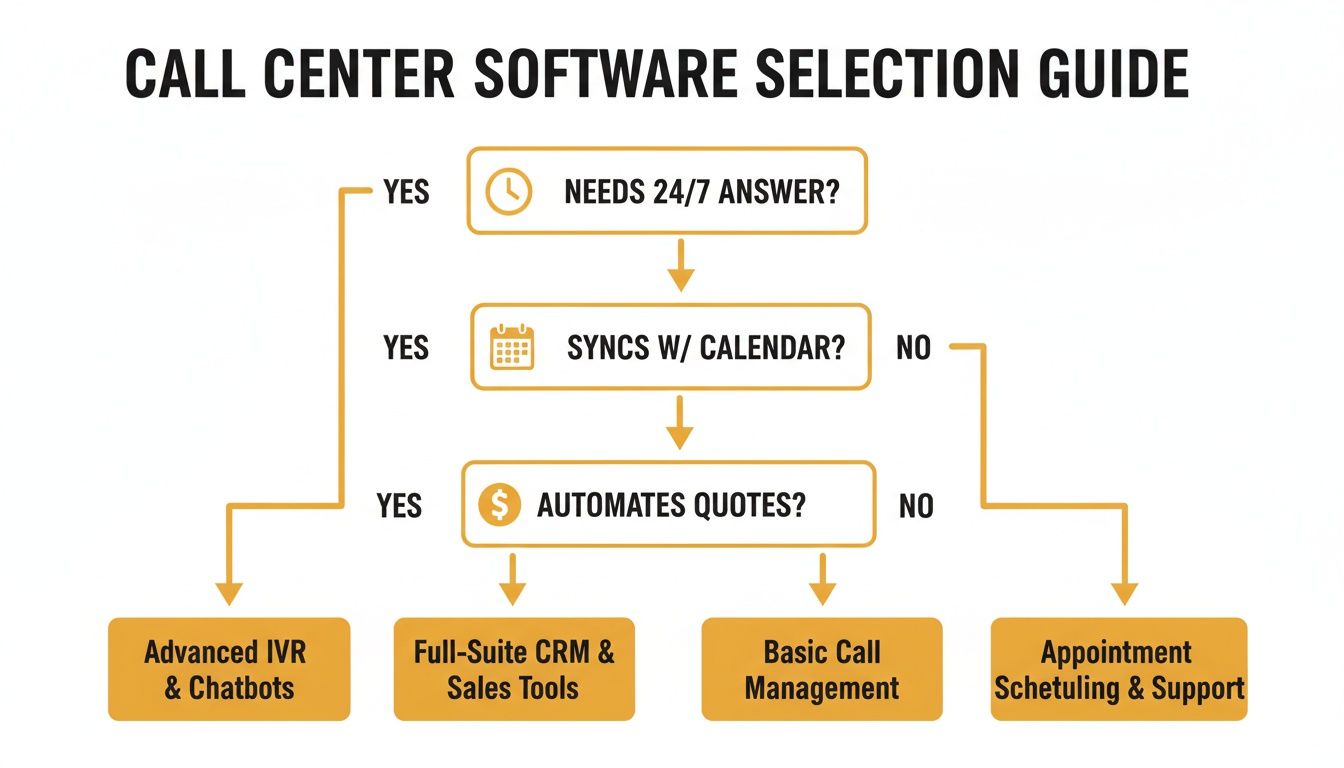
As you can see, if your goal is to capture every single lead and tie your phone system into your operations, a cloud-based, automated system is really the only path that makes sense.
The Bottom Line: On-premise software forces you to become an IT company. Cloud-based software lets you focus on being a moving company. The choice determines whether your energy goes into managing servers or managing growth.
A Mover-Focused Comparison: Cloud Vs. On-Premise
To make this crystal clear, let’s break down how these two models stack up on the things that actually matter to a moving company owner.
Below is a table that directly compares the two options side-by-side.
Cloud Vs On Premise Software For Your Moving Company
| Consideration | Cloud-Based Solution (Recommended for Movers) | On-Premise Solution |
|---|---|---|
| Initial Investment | Low monthly subscription. No hardware costs. | High upfront cost for servers, software licenses, and IT setup. |
| Setup Time | Can be operational in hours. Just forward your number and sync your calendar. | Weeks or even months. Requires hardware installation and complex configuration. |
| Scalability (Peak Season) | Instantly scales to handle more calls during busy season without you lifting a finger. | Very difficult and expensive to scale. You have to buy more hardware. |
| Accessibility & Remote Work | Accessible from any device with an internet connection. Perfect for a mobile team. | Tied to your physical office. No flexibility for remote dispatchers or owners. |
| Maintenance & Updates | The provider handles all maintenance, security, and updates automatically. | You are responsible for all IT maintenance, troubleshooting, and security patches. |
| Data Backup & Recovery | Your data is securely backed up by the provider, protecting you from loss. | You must set up and manage your own backup systems, which is risky and time-consuming. |
If you want a deeper look at how these factors play into your total investment, it’s worth understanding the full range of call center costs for a small business.
Ultimately, a cloud-based system just fits the reality of running a modern moving company. It gives you the power of an enterprise-level phone system without the cost or complexity. This lets you compete with bigger players and guarantees you never miss another high-value call. It’s a tool for growing your revenue, not an IT burden you have to carry.
How AI Automation Turns After-Hours Calls Into Booked Jobs
For most movers, the day doesn’t punch out at 5 PM. Your phone rings the most when you and your crew are in the middle of a job, or after hours when a customer is finally home from work and ready to plan their move. This is where “AI” stops being some tech buzzword and starts being your most valuable employee—one that works 24/7, never calls in sick, and is laser-focused on turning every single call into a booked job.
This isn’t about complicated, futuristic tech; it’s about practical automation that solves your single biggest problem: missed calls. For a moving company, modern AI is a system trained to handle the exact calls your business gets, making sure you never miss another lead. It’s the edge that helps a small mover win against bigger operations that have huge call center teams.
Turning a 10 PM Call into a Booked Job
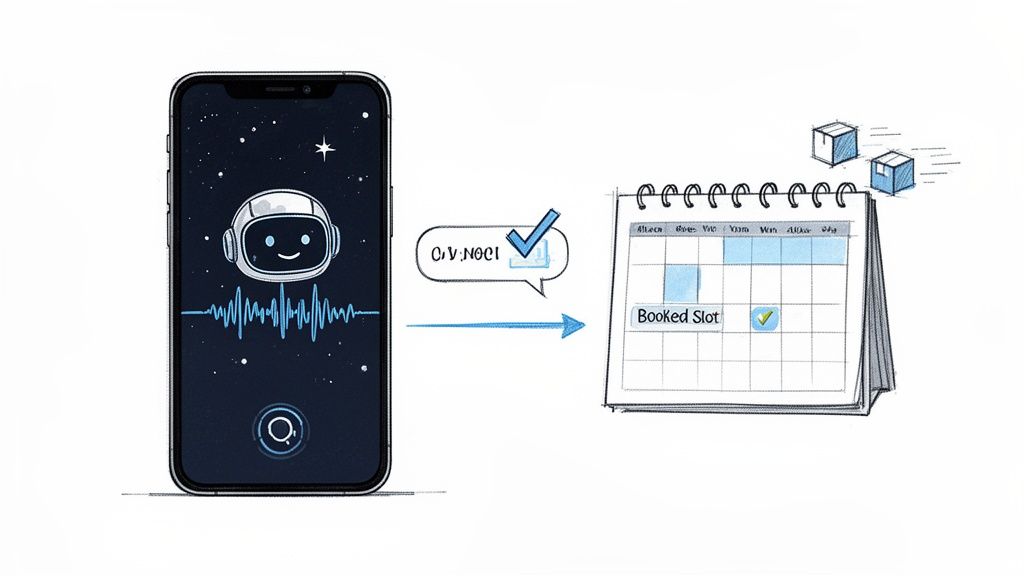
Let’s walk through a real-world scenario. A motivated customer, fresh off getting a quote from your competitor, calls your company at 10 PM on a Friday. Without automation, that call goes straight to voicemail. It’ll sit there until Monday morning, long after that customer has booked with someone who actually picked up the phone.
Now, let’s rewind and see what happens with an AI receptionist:
- Instant Answer: The call is picked up immediately with a professional greeting that represents your company perfectly.
- Lead Qualification: The AI asks the right questions. “What’s your current address and where are you moving to?” “Is it a one-bedroom apartment or a larger house?” “What’s your ideal move date?”
- Live Calendar Check: It then checks your actual booking calendar in real-time, sees you have an opening on their preferred Saturday, and offers to tentatively hold the slot.
- Automated Follow-Up: Seconds after the call ends, the customer gets a text with a link to their preliminary quote and a prompt to confirm their booking online.
Before your team even clocks in for their next shift, a hot lead has been captured, qualified, and moved down the funnel. This isn’t a fluke; it’s a repeatable system that gives you the speed-to-lead you need to win in a packed local market.
More Than Just Answering Calls
A smart AI system for movers does more than just take messages. It creates an automated workflow that pushes your business forward, even when you’re not there. This is how you scale your company without having to scale your payroll.
The single biggest factor in winning a new moving job is response time. An AI receptionist ensures your response time is measured in seconds, not hours or days, giving you an immediate edge over competitors who rely on voicemail.
These systems are built to handle the repetitive but crucial front-office work that eats up your day. This frees you and your crew up to focus on what you actually do best: providing great moving services. If you’re curious, you can learn more about how an AI receptionist for small business works in practice.
The Real Value of 24/7 Coverage
For a broader look at how this technology is changing things, many resources, like this guide to AI Automation for Business, show how accessible these tools have become.
The bottom line for moving company owners is that this tech directly fixes your operational bottlenecks. It solves the problem of seasonal call spikes without you having to hire temps. Most importantly, it ensures every dollar you spend on marketing doesn’t get wasted on a call that rings and rings. Booking just one extra job from a previously missed call often covers the entire monthly cost of the service, delivering an ROI you can see immediately.
A Smart Buyer’s Checklist For Moving Company Owners
Choosing the right call answering system can feel like wading through a swamp of tech jargon. It’s overwhelming, and frankly, most of it doesn’t matter for a mover. Instead of getting lost in a sea of features, let’s focus on what actually gets more jobs on your calendar. A fancy system that doesn’t book moves is just another monthly bill. The right one pays for itself, often in the first week.
Use this checklist when you’re looking at any provider. I’ve designed these questions specifically for a moving company owner. They’ll help you cut through the sales pitches and find a tool that drives real revenue, not just adds another login to your password manager.
The Core Functionality Checklist
This is where the rubber meets the road. If a system can’t do these things, it’s not built for a modern moving company. Period.
- Does it provide true 24/7 automated call answering? Your business doesn’t stop at 5 PM. You need a system that can instantly engage every lead that calls at night, on weekends, or when your lines are tied up. Voicemail isn’t a solution; it’s a black hole where 70-80% of your leads go to die.
- Can it integrate directly with my booking calendar? This is non-negotiable. To kill double-bookings and endless phone tag, the software must see your crew’s live availability. It’s the only way to turn a phone call into a confirmed job without you or your dispatcher lifting a finger.
- Does it automate quote follow-ups via text and email? People shop around. That’s a fact of life in this business. A system that automatically sends a follow-up text or email a few hours after a quote keeps you top-of-mind. This simple step can single-handedly boost your booking rate by making you the most persistent and responsive option.
Moving-Specific Operations
Generic software just can’t handle the realities of a moving job. It stumbles over the details. The right solution has to prove it understands your world.
A system that gets your business should feel like an extension of your best dispatcher, not a clunky piece of software you have to fight with. It should ask the right questions to qualify a lead so you don’t have to.
Ask vendors these two critical questions:
- How does it handle moving-specific details? Can the system ask about things like pianos, safes, building access issues (stairs, elevators), or the number of bedrooms? This information is everything. It’s what separates a real quote from a wild guess and qualifies a lead properly before they ever get to your team.
- What does the setup process look like for someone who isn’t a tech genius? You’re a mover, not an IT expert. The setup should be as simple as forwarding your phone number and connecting your calendar. If a company talks about weeks of complex configuration, it’s a major red flag for a small business like yours.
Pricing and ROI
Finally, the numbers have to make sense. You’re not buying software; you’re investing in a tool to generate more revenue than it costs. The pricing should help you grow, not hold you back.
- How does the pricing scale as my business grows? You need predictable, transparent pricing. Find a partner that makes it easy to add capacity during your peak season without locking you into a long, expensive contract. Be wary of systems with high setup fees or complicated, usage-based billing that’s impossible to predict.
- What is the real path to ROI? Ask them point-blank: “How does this system pay for itself?” The answer should be dead simple: by booking jobs from calls you would have otherwise missed. If just one booked move can cover the monthly cost, you’ve found a tool with a clear and immediate return on your investment.
How to Implement Your New System For a Fast ROI
Buying new software is the easy part. Getting it to pay for itself—fast—is what really matters. For a busy moving company owner, the thought of a complicated, tech-heavy implementation is a complete non-starter. You just don’t have the time.
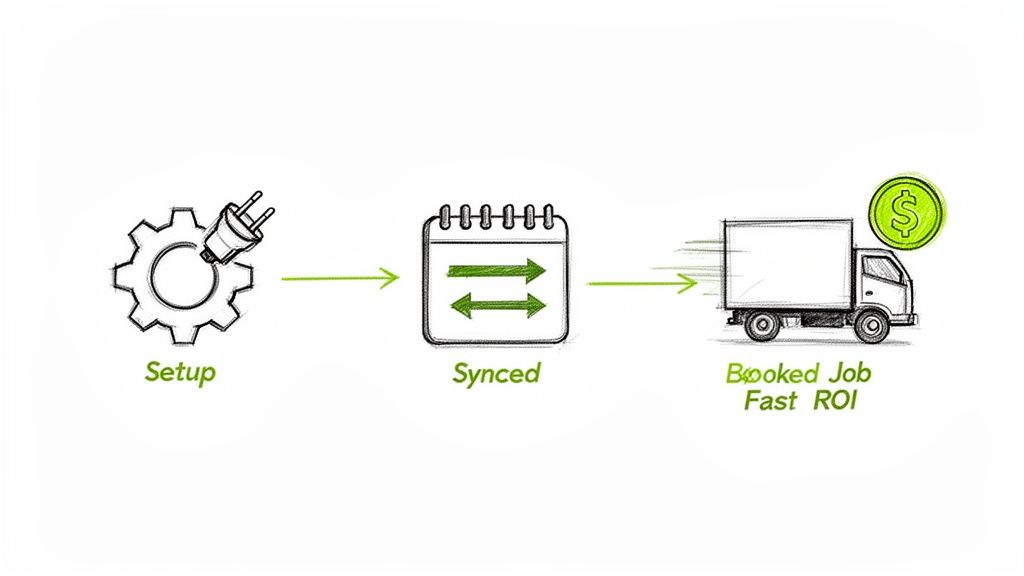
The good news is that modern call center automation isn’t like the clunky software of the past. A good system is built for speed and simplicity. You should be able to go from setup to booking jobs in a single afternoon, not weeks. The whole point is a fast, tangible return on investment (ROI).
A Simple Plan For A One-Day Rollout
You don’t need an IT department to get this done. This is a straightforward plan for an operator who needs to see results immediately.
1. Set Up Your Call Forwarding: This is the first and most critical step. Just forward your main business phone number to the new number your software provides. This instantly activates your 24/7 automated receptionist, making sure no call ever goes unanswered again—whether you’re on a job or it’s 10 PM.
2. Sync Your Booking Calendar: Next, connect the software to your Google Calendar or whatever scheduling tool you use. This is where the magic happens. It allows the system to check your crew’s real-time availability and offer customers actual, bookable time slots. This step alone cuts out the endless phone tag that kills deals.
3. Customize Your Automated Messages: A great system will come with proven scripts, but you should take 15 minutes to tweak them. Make them reflect your company’s unique voice. Ensure your automated greetings and text follow-ups sound like you, not a robot. This small touch builds trust and makes the whole experience feel personal.
Pro Tip: Your ROI becomes real with the very first job you book from a call you would have otherwise missed. For most movers, that single job covers the entire month’s service cost, making implementation a direct path to immediate profit.
Train Your Team The Right Way
Getting your team on board doesn’t need to be some long, drawn-out process. Your dispatcher or office manager is the key person here.
Here’s how to get them up to speed quickly:
- Focus on the Handoff: Show them how the system flags complex calls that need a human to follow up. They need to know where to find the call transcripts and how to jump in when a customer needs more specific help.
- Review the Dashboard: Walk them through the reporting dashboard. They should see how many calls were answered, how many leads were captured, and which ones turned into booked jobs. This data proves the system’s value and helps them manage new leads way more effectively.
That’s it. A good system is intuitive. It’s not about learning complex software; it’s about understanding a new, more efficient way to capture leads. The entire setup, from forwarding your number to training your dispatcher, can be done in a few hours. By the end of the day, you can have a powerful automation engine working to grow your revenue.
Frequently Asked Questions
Choosing a new system for your business is a big deal, especially when you’re already swamped running a moving company. I get it. Here are some straight answers to the questions we hear most often from movers just like you. No fluff, just the information you actually need.
I’m not a tech person. Is this kind of software hard to set up?
Not at all. The best systems today are built for business owners, not IT wizards. The whole setup process is surprisingly simple and fast.
Honestly, you can be live in under an hour. It’s usually just a matter of forwarding your existing business phone number and syncing your scheduling calendar. The goal is to get you capturing leads right away, without any technical headaches.
How can an AI possibly handle the specifics of a moving quote?
This is a great question. The AI’s main job is to handle the first, most critical step: initial lead capture and qualification. It’s a master at asking those first key questions—move size, dates, locations—to get all the essential details.
Based on that info, it can give a solid preliminary estimate to get the customer engaged instantly. If a move is more complex, like one with specialty items or tricky logistics, the system is smart enough to flag that conversation for a human to follow up. It captures every detail so your team can create an accurate final quote without wasting time.
The Takeaway: The AI handles the repetitive, 24/7 task of gathering information. This frees up your skilled team to focus on the high-value work—finalizing complex quotes and closing deals—instead of just answering the phone.
What happens if a customer asks a complex question the AI can’t answer?
This is a common concern, and modern systems are built to handle it smoothly. If the AI gets a question it can’t answer, it’s programmed to hand off the conversation without creating a frustrating dead-end for the customer.
Here’s how it usually plays out:
- The system can offer to have a team member call the customer back right away.
- It can ping your dispatcher with an instant notification and a full transcript of the conversation.
- During business hours, it can route the call directly to a live person on your team.
You stay in complete control. The point is to use automation to make your team more effective, not to replace them. No lead ever falls through the cracks.
How much does this kind of service actually cost a small mover?
The pricing is designed to be a small, affordable operational expense, not a massive investment. Most providers offer a flat monthly subscription based on your call volume or the features you need.
For most small moving companies, the entire monthly cost is easily covered by booking just one additional job that you would have otherwise missed. Think about that one after-hours or overflow call you couldn’t get to. That’s an immediate, easy-to-measure return on your investment.
Ready to stop losing money to missed calls and see how automation can book more jobs for you? MoveJoy provides a 24/7 AI-powered receptionist that captures, qualifies, and schedules leads for your moving business—all on its own.
Learn how you can get set up in minutes and turn every single call into an opportunity.