AI for Sales Prospecting to Book More Moving Jobs
When people talk about using AI for sales prospecting, it sounds complicated. For a moving company owner, it's not. It's an intelligent assistant that works 24/7 to find, qualify, and follow up with potential customers. Think of it as your best crew member who never sleeps, making sure you never miss a lead and every single inquiry gets a smart, immediate response. One extra booked job a month, and it pays for itself.
Why the Old Way of Getting Jobs Is Costing You Money
If you're running a moving company with anywhere from one to twenty trucks, you know the daily grind. Your crews are out on jobs, you're juggling dispatch, and the phone rings. If you miss that call, you've probably lost the job. It’s that simple. The customer isn’t going to wait around for you to call back; they’re just going to dial the next mover on their Google search list.
That's the brutal truth about trying to win jobs in a packed local market.
Relying on flyers, hoping for word-of-mouth, or just waiting for the phone to ring during office hours is leaving a ton of money on the table. Every missed call isn't just a missed chance—it's real revenue that could have paid for fuel, your crew's wages, or a down payment on another truck. We see movers lose 3-7 jobs every single month this way.
The Real Price of a Slow Response
In the moving business, speed is everything. A customer calling for a quote is in a hurry. They're shopping around, and the first company that gives them a professional, quick answer is usually the one that gets the booking. Speed determines who wins the job.
When you and your team are slammed, following up manually becomes a massive bottleneck. A lead from your website might sit in an inbox for hours. A voicemail might not get returned until the end of the day. By that point, your competitor has already scheduled the move.
This delay is way more damaging than most moving company owners think. Research from Harvard Business Review is clear about this: you are 7 times more likely to qualify a lead if you respond within an hour. An AI receptionist or automated call answering system obliterates that gap, engaging a potential customer the second they reach out. You can dive deeper into how AI sales tools impact response times to see just how much this is changing the game.
The biggest threat to your growth isn't a lack of leads—it's the delay in getting back to the ones you already have. Automation isn't a luxury anymore; it’s what you need to capture all the revenue that's slipping away after hours and during your busiest days.
Finding High-Value Moving Leads with AI
Imagine knowing exactly who needs a mover before they even start Googling. That’s the real power of using AI in your sales process. It flips the script from waiting for the phone to ring to actively finding customers who are already showing clear signs they're about to move.
It’s about filling your calendar with profitable jobs, not just waiting for whatever comes your way. Modern AI tools aren't just selling you a stale list of names; they're digging through mountains of local data to pinpoint genuine opportunities. This isn't about casting a wide, generic net. It’s precision targeting for local movers.
What Kind of Data Does AI Analyze?
AI systems are incredibly good at connecting the dots between different public data sources to flag people who are likely planning a move. The signals are already out there; you just need a tool that can see them.
Here are the key data points an AI looks for:
- Real Estate Listings: A house going "under contract" or being marked as "sold" is one of the strongest moving signals you can get. An AI can immediately flag these addresses right in your service area.
- New Rental Agreements: Big apartment buildings have constant turnover. This creates a steady stream of smaller, often highly profitable, local jobs that can fill gaps in your schedule.
- Commercial Property Leases: AI can keep an eye on business registries and commercial real estate data. When a new lease is signed, that's your cue that an office move is on the horizon.
- Building Permits: When someone files a permit for a major home renovation, they often need to move their belongings into storage or a temporary apartment.
By piecing this information together, the AI builds a list of prospects who aren't just thinking about moving—they're in the thick of it. This means your outreach arrives at the perfect time and feels helpful, not like another piece of junk mail.
Failing to act on these signals quickly is costly. Every missed opportunity follows a predictable, painful path.
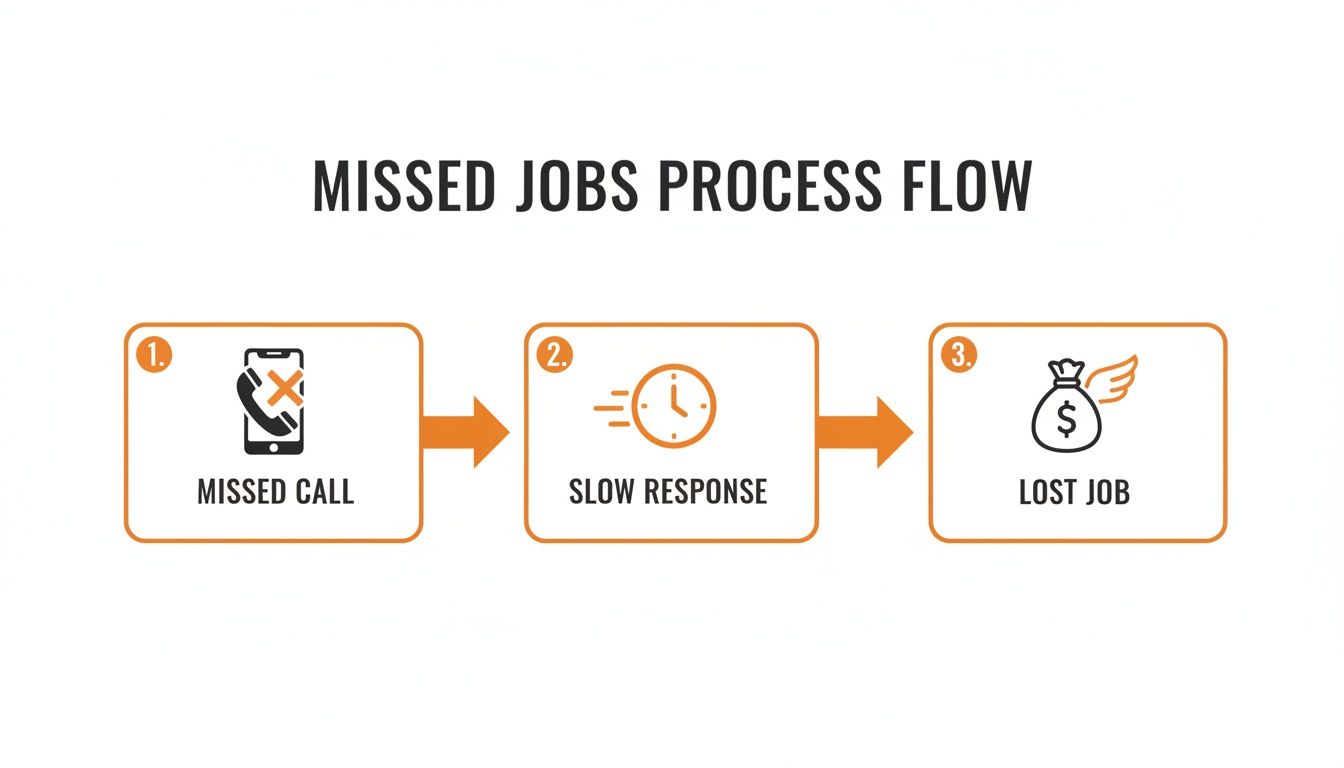
This flowchart shows the brutal reality of slow, manual follow-up. One missed call quickly spirals into lost revenue—a cycle that smart, AI-driven prospecting is designed to break.
Turning Data into Booked Jobs
Once the AI identifies these high-intent leads, it can kick off the first touchpoint automatically. Instead of your team burning hours digging through Zillow and county records, the system handles the initial outreach.
This could be a perfectly timed, personalized email or text message that lands in their inbox right when they need it most. Suddenly, you're the first mover they've heard from.
The goal is simple: get in front of customers before they're buried under quotes from five other movers. Smarter prospecting means you're not just another name on a list; you're the first helpful voice they hear.
To really get a handle on this, it helps to understand the core principles of AI-powered lead generation. It's all about shifting your marketing budget away from a broad, uninterested audience and focusing every single dollar on prospects who are ready to book. This is how small and mid-sized movers can punch above their weight and win against the big national players.
How AI Scores and Prioritizes Your Best Leads
You already know that not all leads are created equal. A call for a studio apartment move across the street just isn't the same as a four-bedroom house heading to another county.
The problem is, when leads flood in during your busy season, they usually get handled first-come, first-served. Your dispatcher might spend 20 minutes on the phone quoting a small, low-profit job while a massive, high-value opportunity sits in the queue, getting impatient.
This is where AI prospecting completely changes the game. It acts like your sharpest salesperson, instantly analyzing and scoring every single inquiry the moment it arrives. It doesn't just see a "new lead"—it sees the potential revenue behind that lead.
Think of it as an instant triage system for your sales pipeline. An AI receptionist or automation tool immediately flags the "hot" leads, so your team can focus their energy where it actually counts: booking your most profitable jobs.
How AI Determines a High-Value Lead
An AI system isn't guessing. It uses specific data points from the initial inquiry—whether it's from a call, text, or web form—to assign a priority score. This isn't some complex tech wizardry; it's based on the exact same factors you'd consider yourself.
It looks for clues like:
- Size of the Move: The AI picks up on keywords like "four-bedroom," "estate," or "large office," immediately flagging these as high-priority.
- Move Distance: Inquiries for long-distance or cross-state moves are automatically ranked higher than simple in-town jobs.
- Urgency: Phrases like "need to move next week" or "closing on my house" signal a serious buyer who is ready to book, bumping them to the top of the list.
- Services Needed: Any mention of packing services, storage, or specialty items (like a piano or safe) tells the system this is a higher-ticket job.
This automated scoring process has a massive impact on your team's efficiency. Gartner backs this up, reporting that companies using AI-based scoring slash lead follow-up time by 60% and see a 30% jump in conversion rates. You can dig deeper into AI's impact on sales tools to see how this speed translates directly into more jobs on your calendar.
By automatically sorting your leads, you ensure your team’s first call of the day is to the most valuable prospect, not just the one who called earliest. This simple shift can dramatically increase your average job value and overall revenue.
The Impact of Smart Prioritization
Let's look at the practical difference between the old way and the new, AI-powered way of handling your leads. The contrast shows exactly how this automation hits your bottom line.
Lead Handling Before vs After AI
The table below breaks down the real-world shift when you move from a manual, first-come-first-served system to an automated, value-based approach.
| Task | Traditional Method (Manual) | AI-Powered Method (Automated) |
|---|---|---|
| Lead Handling | First-come, first-served. A small job inquiry may tie up your salesperson. | Leads are scored and prioritized instantly based on revenue potential. |
| Response Time | Delayed, especially during peak hours or after business hours. | Immediate, automated engagement 24/7, with hot leads flagged for follow-up. |
| Staff Focus | Divided between high and low-value inquiries, leading to inefficiency. | Focused on pre-qualified, high-value leads most likely to book. |
| Revenue Impact | High-value leads are often lost to faster competitors due to delays. | Higher booking rates for profitable jobs, maximizing revenue per lead. |
This AI-driven approach ensures that even with a small team, you're operating with the efficiency of a much larger company.
It’s all about making sure your best opportunities always get the immediate attention they deserve, turning more high-value inquiries into booked jobs on your calendar.
Automating Outreach That Feels Personal
Let’s be honest: today’s customers expect an immediate response.
If someone fills out a quote form on your website at 9 PM on a Tuesday, they aren't waiting until the next morning for you to reply. They're going to book with the first professional mover who gets back to them. Period.
This is where AI-driven prospecting becomes your secret weapon. It’s not about blasting out generic, spammy messages. It’s about delivering an instant, helpful, and surprisingly personal response the second a lead hits your system. It's about automation that "just works."

Making Automation Feel Human
An AI-powered system can do what your team simply can’t: be on the clock 24/7. But more importantly, it can understand the context of an inquiry and respond like a real person would.
Imagine a potential customer fills out your website's quote form. Instead of getting that stale, "Thanks, we'll be in touch" email, their phone buzzes a moment later with a text that says:
"Hi Sarah, thanks for your quote request for the 3-bedroom move from Brooklyn to Queens. We have crews available that week. I'm just pulling together an estimate for you now. Can I text it over in about 5 minutes?"
That single, automated text does three critical things:
- Confirms you got it: The customer knows their request didn't disappear into the ether.
- Shows you're paying attention: It references the specific details of their move.
- Sets a clear expectation: It tells them exactly when to expect the quote.
This kind of instant, personalized service builds trust right out of the gate and massively increases your odds of booking the job before a competitor even sees the lead. This is what automated quote follow-up should feel like.
Beyond the First Touch
The conversation doesn't have to stop after that first text, either. To really scale this up, you need a solid grasp of mastering marketing automation workflows. An AI system can handle the initial follow-ups, gently nudging a prospect who hasn't responded to their quote or asking if they have any questions.
This ensures no lead ever falls through the cracks, even when you're in the middle of your busiest season. It’s a safety net that catches revenue you'd otherwise lose. For any mover looking to capture every single opportunity, looking into an after-hours answering service for small business provides a great model for how this 24/7 coverage can work.
The goal isn't to replace your team. It's to give them a powerful assistant that handles the initial back-and-forth, teeing up warm, qualified leads so your people can focus on what they do best: providing great quotes and closing jobs.
Hooking Your AI into Your Booking System
Great technology should make your life simpler, not add another layer of complexity. Getting leads with AI for sales prospecting is one thing, but the real breakthrough happens when that brainpower plugs directly into your booking calendar and CRM. The mission here is to build a smooth, automated path from the first call to a confirmed job on your schedule.
This connection is what turns a cool new toy into a machine that actually prints money. It stops you from losing all the speed and smarts you gained in prospecting to a clumsy, manual handoff. Your team shouldn't be copying and pasting lead info between spreadsheets and calendars. The AI should handle that grunt work.
From First Text to Confirmed Job
Picture this: It's 10 PM on a Friday. A potential customer lands on your website and fills out the quote form. In a typical setup, that lead just sits in an inbox until Monday morning. By then? They’ve already booked with the competitor who responded instantly.
Now, let's replay that with an integrated AI system:
- Instant Connection: The second they hit "submit," the AI texts them. It confirms you got their request and asks a couple of quick qualifying questions.
- Automated Quoting: Based on their answers (like "3-bedroom house," "local move"), the AI shoots back an accurate quote via text or email. No waiting.
- Smart Follow-Up: If the customer goes quiet, the system gives them a polite nudge a few hours later.
- Direct Booking: Once they approve the quote, the AI checks your crew's availability and sends a link to book a time slot right on your calendar. This is call-to-calendar integration at its best.
This all happens on autopilot, capturing jobs while your team is at home with their families.
The whole point of integration is to build a system where a good lead can go from a simple website inquiry to a scheduled job without a single person on your team having to lift a finger. This is how you win business 24/7.
Stopping the Bottleneck During Your Busy Season
For a 5-truck operation getting slammed during the spring rush, this kind of automation is a lifesaver. When your call volume suddenly triples, the front office can turn into a massive bottleneck. A properly integrated AI makes sure every single lead gets captured, qualified, and moved down the line without overwhelming your staff.
It cuts out the chaos of juggling phone calls, manually updating calendars, and typing in customer details over and over. You're essentially connecting your phone and website directly to your operations, turning inquiries into booked jobs without friction. Of course, managing that incoming flow is only half the battle; your dispatchers need the right tools to handle the schedule. To get a better handle on optimizing your team's workflow, check out our insights on effective moving company crew schedule software. It’s the key to making sure that as your AI books the work, your crews are ready to roll without confusion or double-bookings.
Is This AI Thing Actually Making You Money?
Look, investing in new tech is only worth it if it puts more cash in your pocket. End of story. So how do you know if this whole AI for sales prospecting thing is paying for itself?
You don’t need a fancy spreadsheet or a data science degree. You just need to watch a few numbers that directly impact your bottom line. Forget the fluff. The only question that matters is this: Is my AI receptionist or automation system booking more jobs and making my operation more profitable?
The Only KPIs That Matter for Movers
To figure this out, you need to track a few key performance indicators (KPIs). These are the numbers that cut through the noise and tell you if the AI is pulling its weight.
Here’s what I’d keep an eye on:
- Booking Rate from AI-Qualified Leads: This is the big one. What percentage of the leads your AI touches actually turn into booked, confirmed jobs? If your overall booking rate is climbing, the system is working. Simple as that.
- Cost Per Booked Job: Figure out what you're spending on ads and sales to get a single job on the calendar. A good AI setup should drive this number down by converting the leads you're already paying for more efficiently.
- Revenue Recovered from Missed Calls: Your AI should act as a safety net, grabbing all those calls that come in after 5 PM or when your lines are swamped. Track the total dollar value of jobs booked from these "recovered" leads each month. Honestly, booking just one or two extra moves this way usually pays for the tech itself.
At the end of the day, the proof is simple: are you booking more high-margin jobs without having to hire more people for the office? If the answer is yes, you've got a winner.
Your Quarterly AI Gut Check
Every three months or so, take a quick look at these numbers. This isn't about creating more work for yourself; it's a quick gut check to see what's working and where you can tweak things.
It’s all about efficiency. A recent ZoomInfo survey pointed out that teams using AI-powered systems see a 47% jump in productivity. They're saving about 12 hours a week on grunt work like prospecting. That’s exactly the kind of time-saving, money-making impact you should be looking for in your own operation. You can read more about these AI productivity gains and see how they lead to closing more deals.
Got Questions? We've Got Answers
"Is AI Too Complicated for a Small Moving Company Like Mine?"
Not a chance. Honestly, the best new AI tools are built for business owners, not Silicon Valley engineers.
Think of it less like complicated software and more like a plug-and-play “AI receptionist.” These systems are designed to hook right into your existing business phone number and website. All the heavy lifting happens in the background. You don’t need to write a single line of code. You just need to know what you want: more jobs on the calendar and zero missed calls.
"Am I Going to Have to Fire My Sales Staff or Dispatchers?"
Absolutely not. The goal here is to make your current team better, not replace them.
AI is perfect for handling the repetitive, time-consuming tasks—answering the same basic questions at 10 PM, collecting lead info, and firing off instant quotes. This frees up your human crew to focus on the stuff that actually requires a human touch.
Imagine your best dispatcher having more time to walk a high-value client through a complex cross-country move, build real relationships with customers, or solve a tricky logistical problem. That’s the idea. The AI handles the grind; your people handle the relationships.
"Okay, But What's This Going to Cost Me? And Is It Worth It?"
It's way more affordable than you'd guess. Most of these platforms run on a simple monthly subscription, often costing less than the profit you’d make from one single extra move.
The return on investment (ROI) is ridiculously easy to see. If the system helps you book just one or two jobs a month that would’ve otherwise gone to voicemail, it’s already paid for itself. The real win comes from capturing leads 24/7 and watching your overall booking rate climb without you lifting a finger.
Stop losing jobs to your voicemail. See how MoveJoy can answer every call, provide instant quotes, and book more moves for your company, even while you sleep. Discover the AI-powered solution built for movers.