Your Guide to After Hours Answering Services for Movers
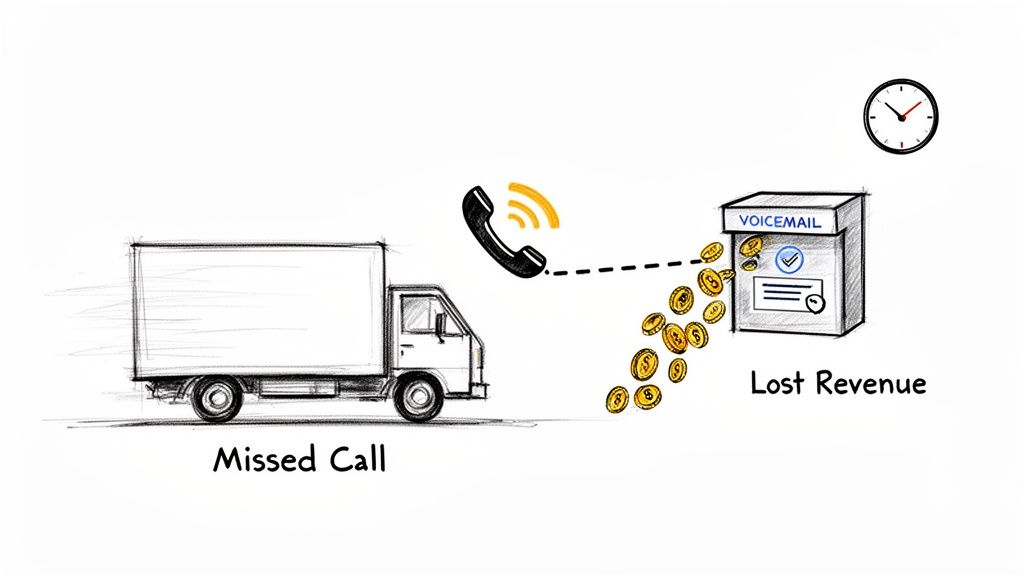
For a moving company owner, the most expensive piece of equipment isn't a truck—it's the voicemail system. Each missed call is a potential job that evaporates the second a customer hangs up and dials your competitor. An after hours answering service is how you plug that leak, making sure every lead gets captured, day or night.
Why Your Voicemail Is a Revenue Leak
Think about your last five missed calls. Chances are, they came in after 5 PM, during a weekend move, or while you were on the road dispatching a crew. For most moving companies with 1-20 trucks, those calls go straight to voicemail, and that’s where the trouble starts. In this business, speed is everything. A customer looking for a quote isn't going to wait around for a callback.
The Modern Customer Won't Wait
Today's customers expect answers instantly. When they’re ready to book a move, they call the first few movers they find on Google. The first one to actually answer and sound professional is overwhelmingly likely to win the job. Your voicemail greeting is basically an invitation for them to move on to the next company on their list.
This isn't just a minor inconvenience; it's a direct leak in your sales funnel that drains profit, month after month. Missed calls equal lost revenue, simple as that.
The hard truth is that most customers who hear your voicemail greeting will not leave a message. They will simply hang up and call a competitor who is available to speak with them right away.
Quantifying the Financial Damage
Let's break down the real financial hit with a conservative example. Assume your average moving job is worth $1,200. If you miss just four calls a week after hours or during busy times, that's a lot of lost opportunity. Even if only one of those four calls would have booked, you're losing $4,800 in potential revenue every single month.
Over a year, that single missed call per week adds up to over $57,600—enough to buy a new truck, hire another crew member, or fund a serious marketing campaign. This isn't just a theory; it's the real cost of relying on an outdated system like voicemail. To stop this from happening, it's critical to Never Miss Another Customer Message.
The problem gets even worse during your peak season when call volume shoots up. Your ability to answer calls is limited, but the number of potential customers is at an all-time high. This is when voicemail becomes a true operational bottleneck, actively stopping your business from maximizing its busiest—and most profitable—months. To see exactly how this plays out, you can explore the real cost of missing just 4 calls per week.
What Exactly Is an After-Hours Answering Service?
So, what are we really talking about here? At its core, an after-hours answering service is your guarantee that a potential customer never hits voicemail. Ever. Think of it as the perfect front-desk person—one who never sleeps, calls in sick, or takes a vacation.
This service becomes the face of your company the second you lock up for the day. We're talking evenings, weekends, and holidays. Instead of a high-value lead getting your voicemail and immediately dialing your competitor, they’re greeted by a professional system that’s ready to help. This isn’t just about catching calls; it's about capturing revenue you’d otherwise lose.
For a moving company owner, this means turning a missed call at 9 PM on a Tuesday into a booked job. A customer can call, give all their details—like moving from a tricky 2-bedroom walk-up—and have their needs met right on the spot. No phone tag, no waiting until morning. Automation is becoming a competitive advantage.
The Three Flavors of Answering Services
Not all answering services are created equal. For a moving business, your choice really boils down to three distinct models, and each fits a different kind of operation.
-
Traditional Live Agents: This is the classic call center model. A team of human operators answers your calls, follows a script you give them, and takes messages. They’ll pass the lead’s info along for you to deal with the next business day. It’s better than voicemail, but it doesn't move the sale forward.
-
Virtual Receptionists: Think of this as a step up. You get a dedicated agent (or a small team) who acts more like a remote employee. They can handle more complex tasks, like poking around in your calendar or CRM, but you're still limited by human schedules, training, and the high cost of 24/7 coverage.
-
Modern AI Assistants: This is the new kid on the block, and it's a game-changer for movers. We're talking about conversational AI that’s been specifically trained on the moving industry. An AI receptionist can answer calls 24/7, ask the right qualifying questions, calculate an accurate quote based on your specific rates, and book the job directly into your calendar.
From Passive Message-Taker to Active Revenue-Generator
The real shift here is moving away from a system that just tells you who called to one that actively books the job for you. A basic answering service is passive; it just takes a message. A modern AI solution, on the other hand, is an active part of your sales team.
It captures the lead, qualifies them, quotes the job, and turns them into a paying customer before your competitor even knows that lead exists.
An after-hours answering service doesn't just stop you from losing money. It actively books more jobs by engaging customers the second they’re ready to pull the trigger.
That immediate response is everything in the moving industry. Faster responses equal higher booking rates. The first company to respond wins the job the vast majority of the time. When every caller gets an instant, professional answer, you get a massive leg up on the competition. The goal is to kill the delay between a customer’s call and a booked job, protecting your bottom line around the clock.
Comparing Your Options: Live Agents, Virtual Receptionists, and AI
So, you've decided to stop losing money to voicemail. Good. The next question is, what kind of after-hours answering service is right for your moving company?
It's a critical choice. The options might sound similar, but they operate in completely different ways, and what works for a dentist's office won't work for a mover who needs to quote complex jobs. Your decision will directly impact your costs, how efficient your operation is, and, most importantly, how many of those after-hours leads actually turn into paying customers.
Let's break down the three main players—live agents, virtual receptionists, and AI assistants—to see how they stack up for a real moving business.
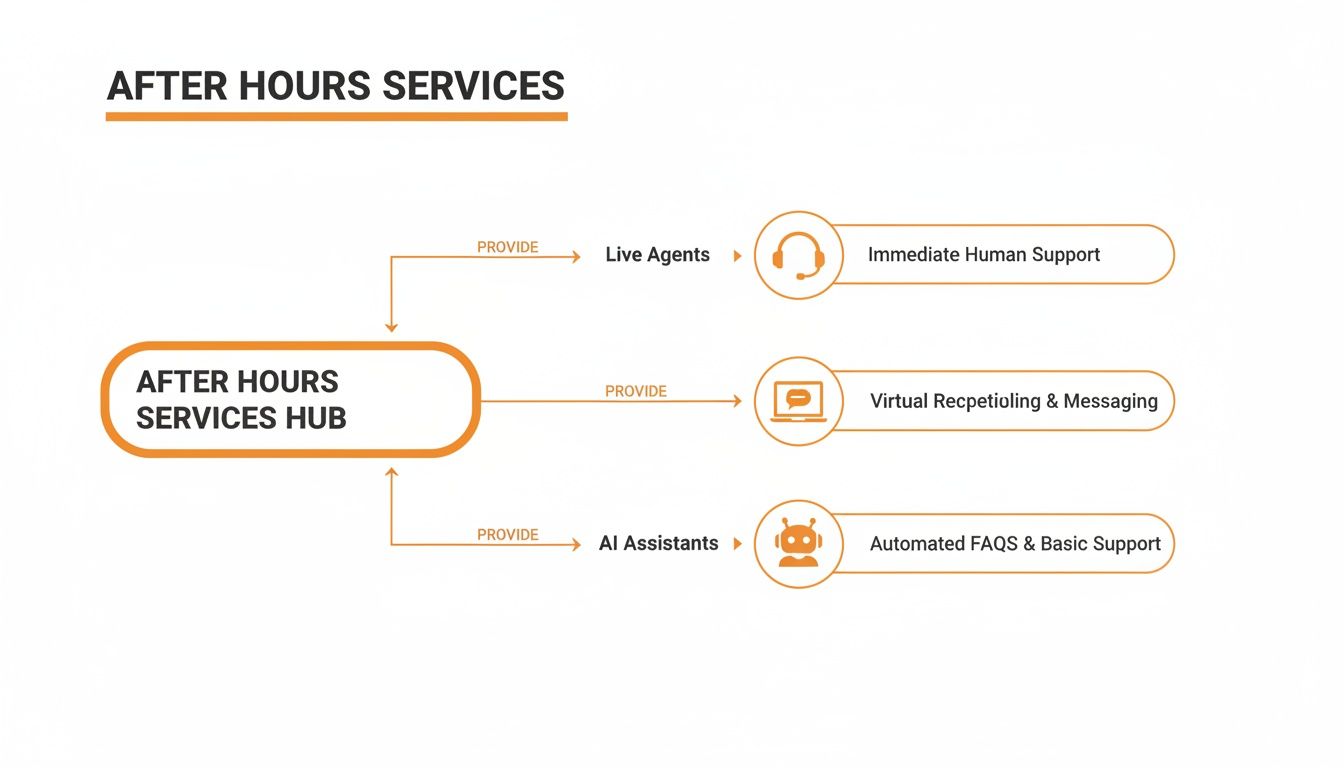
As you can see, the solutions range from basic message-taking to fully automated booking systems, each with its own pros and cons.
Traditional Live Answering Services
This is the classic call center you’re probably picturing. When a potential customer dials your number after hours, they get a human operator in a remote location who follows a simple script.
- How They Work: The live agent’s job is straightforward: get the caller's name, number, and a quick note about why they called. They then shoot that information over to you in an email or text. You handle it the next day.
- The Bottom Line: Look, it’s better than voicemail. At least you get the lead's info. But this is a purely passive approach. It does nothing to move the sale forward. You still have to play phone tag the next morning, and by then, your prospect has probably already called three other movers and booked with the one who answered and gave them a quote on the spot. That delay is a killer.
Virtual Receptionists
Think of a virtual receptionist (VR) as a step up. Instead of a random operator in a huge call center, you often get a dedicated person or a small team who gets to know your moving business a little better.
- How They Work: With some training and access to your systems, a VR can handle more than just taking a message. They might be able to check your calendar for availability or answer basic questions about your services.
- The Bottom Line: The two big problems here are scalability and cost. You're paying for a person's time, which gets expensive fast, especially if you need true 24/7 coverage. And what happens during your busy season? A single VR gets slammed with calls, leading to long hold times or missed calls—the very thing you were trying to solve. Plus, accurately quoting a move is an art. It takes deep industry knowledge that’s incredibly difficult to teach a remote receptionist.
Modern AI-Powered Assistants
This is where technology gives you a real competitive advantage. A true AI assistant isn't just a fancy voicemail; it’s designed to handle the entire booking process from start to finish without a human touching anything.
Picture this: It’s 10 PM on a Friday. A customer calls, frantic, needing a quote for a 2-bedroom apartment move with a long carry. A live agent would just take a message. A virtual receptionist might promise a callback on Monday. An AI assistant asks all the right questions, calculates the quote based on your specific rates, and books the job right into your calendar. The whole thing takes less than two minutes.
That kind of instant, accurate service is what wins jobs in 2024. The demand for this is why the after-hours answering service market, currently valued at $2,397.5 million, is projected to rocket to $4,500 million by 2035. For movers, this means you never miss a lead from late-night calls about emergency moves or weekend bookings again. You can read more about this growth in this detailed industry report.
Answering Service Comparison for Moving Companies
To make the choice crystal clear, we need to compare these options on the metrics that actually matter to a moving company's bank account. This table breaks down how each service handles the core tasks you rely on every day.
| Feature | Live Answering Service | Virtual Receptionist | AI-Powered Assistant |
|---|---|---|---|
| Response Speed | Instant answer, but delayed action (message taking). | Instant answer, but potential hold times during peak hours. | Instant answer and instant action (quoting & booking). |
| Quoting Accuracy | Cannot provide quotes. Only takes messages. | Limited. Prone to errors without extensive training. | 100% accurate. Uses your pre-set rules and rates. |
| Lead Conversion | Low. Relies entirely on your callback speed. | Moderate. Can schedule, but may struggle with complex jobs. | High. Captures, quotes, and books the job on the first call. |
| Scalability | Poor. Easily overwhelmed during peak moving season. | Limited. Scaling requires hiring and training more people. | Infinite. Can handle any number of calls simultaneously. |
| Cost | Moderate. Typically charges per call or per minute. | High. You're paying for a dedicated person's time. | Low. Fixed monthly cost, often less than one booked job. |
| 24/7 Availability | Yes, but with varying agent quality. | Yes, but extremely expensive to staff around the clock. | Yes. Consistent, flawless performance 24/7/365. |
For most small and mid-sized moving companies, the conclusion is pretty clear. An AI-powered assistant delivers the best blend of performance, affordability, and scalability. It turns your after-hours phone line from a frustrating cost center into a powerful machine that generates revenue while you sleep.
What to Look for in an Answering Service
Let’s be honest: not all after-hours answering services are the same. A generic service built for a doctor’s office will absolutely crater when it tries to handle a moving lead. When a potential customer calls you, they don’t just need someone to take a message. They need answers, they need a quote, and they need to book the job right now.
Picking the wrong service is like hiring a dispatcher who doesn’t know the difference between a studio apartment and a three-bedroom house with a grand piano. You need a tool that actually understands the moving business.
Think of this as your buyer’s checklist. If a service is missing these core functions, it’s not just a bad fit—it’s a waste of money that will leave jobs on the table.
Real-Time Calendar Integration
This is the absolute, non-negotiable starting point. An answering service that can’t see your crew’s availability in real-time is nothing more than a glorified voicemail. It might catch a name and number, but it can’t close the deal.
True call-to-calendar integration means the service can instantly see your dispatch calendar, know which crews are free, and book the job directly into an open slot. This is what eliminates the nightmare of double-bookings and the frantic "we messed up" phone calls that kill your reputation. As this Tab Booking System Guide points out, a solid booking system is make-or-break for any service-based business.
Without it, you’re stuck in the old, painful cycle: get a lead notification in your inbox, check the calendar in the morning, and call the customer back, praying they haven't already booked with a competitor who answered the phone and gave them a time slot instantly.
Accurate and Instant Quoting
Telling a customer, "We'll call you back with a price," is the fastest way to lose them to the next company on their Google search. Your answering service has to generate accurate, binding quotes right there on the call, using your company's specific pricing.
This isn't just about a simple hourly rate. The system needs to understand the real math behind a moving estimate:
- Your hourly rates vs. your flat-rate pricing
- How you calculate truck fees and travel time
- Charges for add-on services like packing, unpacking, or handling specialty items (pianos, gun safes, etc.)
- How inventory details like number of bedrooms, stairs, or long carries affect the price
A well-trained AI assistant can be programmed with your exact rate card, ensuring every quote is consistent, profitable, and given to the customer in seconds. No more guesswork.
Detailed Lead Capture and Qualification
Just getting a name and a phone number is useless. To give a real quote and schedule a move correctly, you need details. A top-tier answering service for movers should act like your best salesperson, asking all the right qualifying questions, every single time.
The system should be smart enough to gather the essentials without being told:
- Pickup and drop-off addresses (and zip codes!)
- Type of home (apartment, house, storage unit)
- Size of the move (number of bedrooms is a good start)
- Stairs or elevators involved at either location?
- Any huge or tricky items that need special planning?
This isn't just about getting the quote right. This detailed intake process immediately shows the customer that you're a professional, thorough operation, right from the very first call.
Automated Follow-Up Capabilities
Booking the job is only half the fight. The best systems automate the next steps to lock in the sale and make the customer feel taken care of. As soon as a job is booked, the service should fire off an automatic confirmation text or email.
Customer expectations are reshaping after-hours answering services, with 77% of callers demanding immediate connections and 60% defining 'right away' as within 20 seconds. For moving businesses, this means using a system that delivers quotes, checks live calendars, holds slots, and confirms bookings without human delay. Data shows businesses using these services see customer satisfaction scores climb to 75-85%.
This immediate follow-up does two crucial things: it reassures the customer that their move is officially on the books, and it drastically cuts down on no-shows or last-minute cancellations. It solidifies their decision to hire you and frees up your team from the morning ritual of manually sending out confirmation emails.
These four features—calendar integration, instant quoting, detailed lead capture, and automated follow-up—are what separate a basic message-taker from a true revenue-generating machine for your moving company.
Calculating the ROI of an Answering Service
Let's get straight to the point: what does an after-hours answering service actually do for your bottom line? This isn't just another monthly expense to stick on your profit and loss statement. It’s a direct investment in your company’s growth, and the return is easier to calculate than you might think.
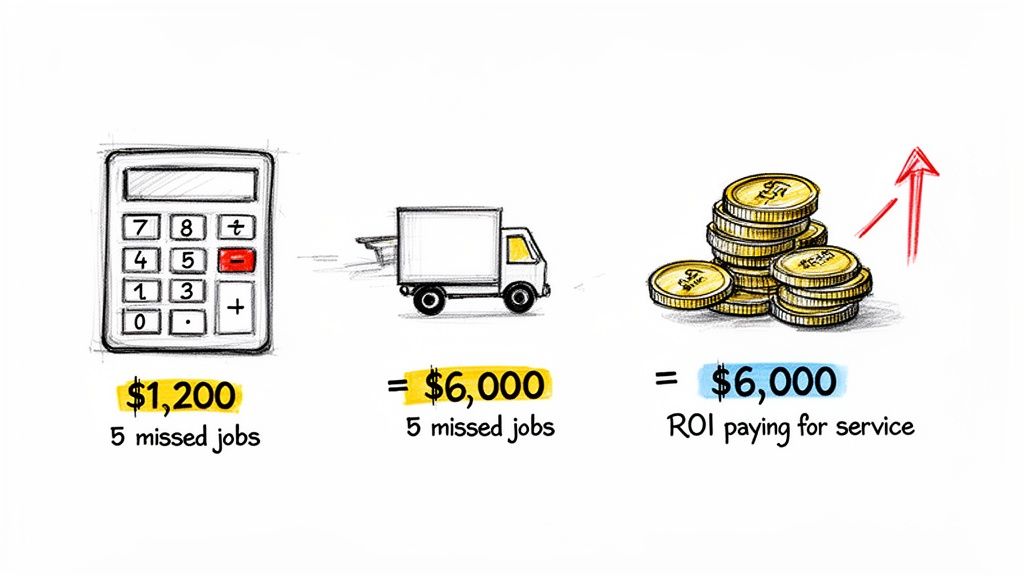
The math is simple. First, what’s your average job worth? For most local movers, a conservative estimate is around $1,200 per move.
Now, think about all those calls you miss after 5 PM or on weekends. The calls that come in while you’re on a job or having dinner with your family. If you miss just five of those calls a month—calls that go straight to voicemail—that’s $6,000 in potential revenue that just disappeared. Poof. Gone to a competitor who picked up the phone.
The One-Job Payback Rule
Here’s the simplest way to think about it for your moving business. A modern answering service might cost you a few hundred bucks a month. If that service captures just one single job you otherwise would have missed, it pays for itself several times over. One booked job pays for the cost of automation.
Every single job booked after that first one is pure profit. It goes straight to your bottom line, funding new equipment, better marketing, or just giving you some breathing room.
This isn't just about plugging a leak in your sales funnel; it's about funding growth. The money from one single move that would have gone to the other guy can cover the cost of the system that captures all your future after-hours leads.
If you want to get specific numbers for your own business, you can calculate your moving company's ROI by plugging in your own figures. It takes about 30 seconds.
The "Soft ROI" That Builds Your Brand
The hard numbers are a no-brainer. But there’s also the “soft” ROI—the stuff that’s a little harder to measure but can be a total game-changer for a small moving company.
These are the benefits you feel every day:
- Less Stress for You, the Owner: You can actually switch off after hours. No more checking voicemails during dinner or waking up at 2 AM wondering if you missed a big job. You know your business is still running.
- Instant Customer Trust: Imagine a customer calls at 9 PM expecting voicemail but gets an instant, professional response. That immediately builds confidence. It tells them you’re a serious, reliable operation, not just a couple of guys with a truck.
- A Stronger Reputation: Answering every call, every time, reinforces your brand as the dependable local mover. That consistency leads to better online reviews and more word-of-mouth referrals, which are the lifeblood of any moving business.
This isn’t about just having someone take messages anymore. Today's services are smarter, using things like sentiment analysis to tailor responses and boost customer satisfaction by up to 20%. It's the same trend we're seeing in other industries where a fast, smart response is everything. When you add the hard financial return to these powerful brand benefits, the case for an answering service becomes impossible to ignore.
How to Implement Your Answering Service Solution
Worried about a complicated, tech-heavy setup? Relax. Modern after hours answering services are built for busy moving company owners, not IT gurus. The whole point is to get you up and running fast so you can stop leaking revenue and start booking jobs almost immediately.
Getting started is far simpler than you think. You can break it down into a handful of straightforward steps that usually take less than an hour. This isn't about learning a whole new piece of software; it's about making a simple change to how your phone rings.
Your Step-by-Step Implementation Plan
The setup is designed to be painless. It starts with figuring out what you need and ends with your phone system automatically capturing leads while you're busy running the business.
-
Get a Handle on Your Call Volume: First, pull up your phone records. How many calls are you actually missing after 5 PM and on weekends? Knowing this number shows you the immediate impact and makes the ROI crystal clear.
-
Choose the Right Partner: Using the feature checklist we just went over, pick a provider that lives and breathes the moving industry. A generic service just won't cut it. You need a partner who understands quoting, scheduling, and the unique language of moving.
-
Set Up Call Forwarding: This is the most "technical" part, and I promise it's incredibly simple. You’ll just call your phone provider (like Verizon, AT&T, or your VoIP service) and ask them to forward calls to the new number from your answering service. You can set rules like "forward all calls after 5 PM" or "forward calls if the line is busy." It’s a five-minute phone call, tops.
-
Configure Your Rules: This is where you teach the system how to act like your best employee. You’ll plug in your quoting rules, connect your dispatch calendar so it can see your availability, and set up your automated text message follow-ups. Any good provider will walk you through this, step-by-step.
The goal of implementation isn't to add another complicated tool to your plate. It's to install a system that works in the background, capturing revenue and booking jobs so you can focus on what you do best—moving customers.
Once these steps are done, you're live. The very next call that comes in after hours gets handled professionally, turning what used to be a missed opportunity into a booked job.
For a deeper dive into the strategy, our guide on how to stop losing after-hours leads offers some extra insights. The switch is seamless, and the impact on your bottom line is almost immediate.
Let's Tackle the Tough Questions
Look, I get it. Even when the numbers make sense, bringing a new system into your business feels like a big step. You’ve got practical questions, and you deserve straight answers. Here are the most common ones I hear from moving company owners just like you.
"How Can a Robot Possibly Understand the Details of a Move?"
This is probably the biggest—and most valid—concern. Quoting a move is an art. You can't afford to get it wrong.
But here’s the thing: modern AI assistants built for movers aren't just generic chatbots. They’ve been trained specifically on the language of our industry. They follow smart, conversational scripts that gather the critical details, just like your best dispatcher would.
The system knows exactly what to ask:
- Inventory: Is it a small studio or a 4-bedroom house with a packed garage?
- Logistics: Are we dealing with three flights of stairs, a long carry from the truck, or a tricky service elevator?
- Specialty Items: Is there a piano, a gun safe, or some other monster item that needs special handling?
- Services: Does the customer need help with packing, unpacking, or a few months of storage?
Because it’s built for this business, the AI understands what "long carry" and "COI required" actually mean. It plugs that info directly into your quoting formula and cranks out a perfect estimate, every single time.
"Won't Customers Get Annoyed Talking to an AI?"
Honestly, today’s conversational AI is a world away from the robotic "Press 1 for…" nightmares of the past. It sounds surprisingly natural.
But more importantly, customers care about two things above all else: speed and results.
Think about the alternative. A customer calls you at 9 PM on a Tuesday. Would they rather get an instant, accurate quote from an AI, or get dumped into a voicemail box? The experience of getting their problem solved on the first try is infinitely better than waiting for a callback that might not come until tomorrow—long after they’ve booked with your competitor who actually picked up.
What truly annoys customers isn't automation; it's delay. An AI that solves their problem on the first call delivers a better customer experience than a human who promises to call them back later.
"Is This Actually Affordable for a Small Moving Company?"
Absolutely. In fact, this technology is designed to be most profitable for small and mid-sized movers.
The cost is tiny when you put it in perspective. Capturing just one single job you would have missed pays for the service for months, sometimes the whole year.
Most modern services have pricing that scales with your business, making it a no-brainer investment even if you're a one-truck operation. This isn’t just another overhead expense; it's a tool that generates revenue. It turns your missed calls directly into booked moves, contributing to your bottom line from day one.
Ready to stop losing money to voicemail and start booking jobs 24/7? MoveJoy is the AI-powered assistant built by movers, for movers. It answers every call, provides instant quotes, and books jobs directly into your calendar—turning your after-hours line into your most profitable salesperson. Discover how MoveJoy can transform your operations.