How to Earn Referrals and Grow Your Moving Business
In the moving business, you can spend a fortune on ads, but your most powerful growth engine doesn't cost a dime. It’s referrals.
This is about turning every happy customer into your best, most believable salesperson. But here's the catch: the opportunity for a referral doesn't start after the move. It starts the second a potential customer picks up the phone to call you. A single missed call or a slow, clunky quoting process can kill a potential referral before you've even booked the job.
Why Referrals Are Your Most Valuable Leads
In a sea of local moving companies, trust is everything. A referral isn't just another name on a list; it's a lead that comes with trust already built-in. They're calling you because someone they know—a friend, family member, or coworker—already did the hard work of vetting you.
These leads are far more likely to book, and they rarely waste time shopping around. This is crucial in a business where speed determines who wins the job.
The Referral Advantage in Action
Picture a scenario that plays out every day for moving company owners.
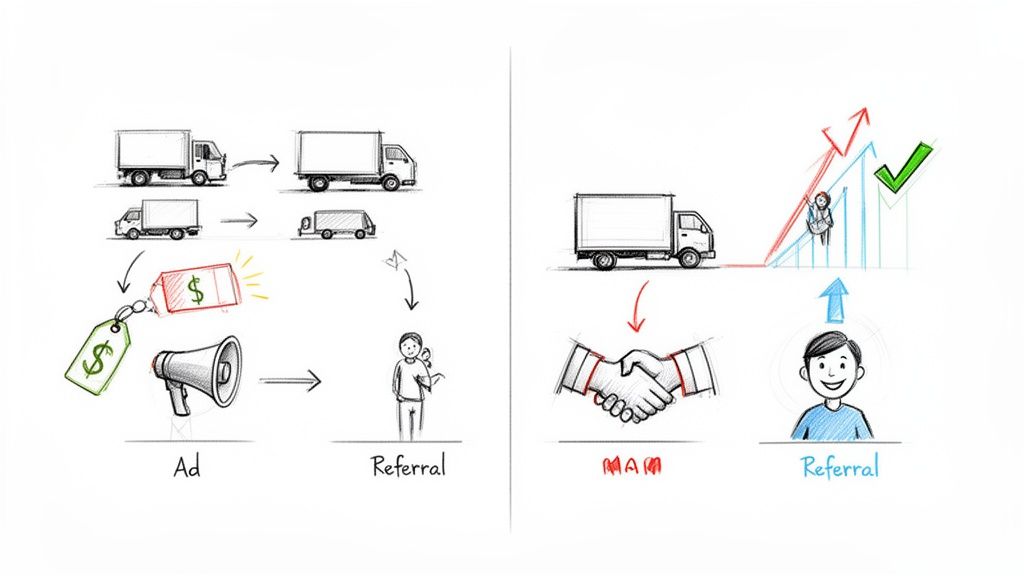
Mover A is running Google ads. A prospect finds them, calls for a quote, and then immediately calls two other movers to compare prices. This lead is skeptical, price-sensitive, and has no loyalty. Your team spends time building a quote for someone who is just shopping for the lowest price.
Mover B gets a call from a prospect who says, "My friend Sarah used you guys last month and told me not to call anyone else." This lead is warm. They already trust you. And they're not going to haggle over a few dollars because Sarah already told them you're worth it.
Who books that job? It's Mover B, every time. The best part? That lead cost nothing to acquire, meaning every dollar from that job goes straight to your bottom line. Referrals are the secret to staying booked solid, especially when the slow season hits and paid leads dry up.
Let's look at the lead sources movers rely on. It's pretty clear where the real value is.
Comparing Lead Source Quality for Movers
| Lead Source | Typical Conversion Rate | Acquisition Cost | Lead Trust Level |
|---|---|---|---|
| Referrals | 40-50% | $0 | Very High |
| Past Customers | 25-35% | Low | High |
| Organic Search (SEO) | 5-10% | Medium | Medium |
| Paid Search (PPC) | 3-5% | High | Low |
| Lead Providers (Thumbtack, etc.) | 2-4% | Very High | Very Low |
The table doesn't lie. While you need a mix of lead generation strategies, nothing comes close to the ROI of a referral. They convert better, cost nothing, and come from a place of genuine trust.
The numbers back this up across the industry. With over 21,892 moving businesses in the US fighting for a piece of a projected $23.2 billion market by 2026, you need an edge. For 68.6% of moving companies, that edge is word-of-mouth. It consistently delivers the highest-quality prospects.
The entire referral process begins the moment a customer first contacts you. A flawless, professional experience—from the initial call to the final box—is the seed for every future referral.
This is where most movers drop the ball. A missed call that goes to a sloppy voicemail is lost revenue. A quoting process that takes hours tells the customer you're inefficient. You’ve lost the chance for a glowing recommendation before the move even happens. That first impression sets the tone for everything.
If you want to dig deeper into the different ways to get your phone ringing, check out our complete guide on how to get more moving leads.
Building a Referral Program That Actually Works
Many movers think a referral program is just telling a happy customer, "Hey, tell your friends about us!" The problem is, hope isn't a strategy. If you want a steady stream of referral jobs, you need an actual system—something structured and repeatable that makes it dead simple for people to send business your way.
Asking vaguely gets you vague results. A real program with clear, motivating incentives is what turns a happy customer into a source of new jobs. We'll walk through how to build one, but if you want a deep dive, this guide on how to build a referral program is a great resource.
Single-Sided vs. Dual-Sided Incentives
Your first big decision is the reward. This choice has a massive impact on whether your program takes off or fizzles out. You've got two main paths.
Single-Sided: Only one person gets a reward—either the original customer who sent the lead or the new customer who booked the move. It's easier to track, but it's less motivating.
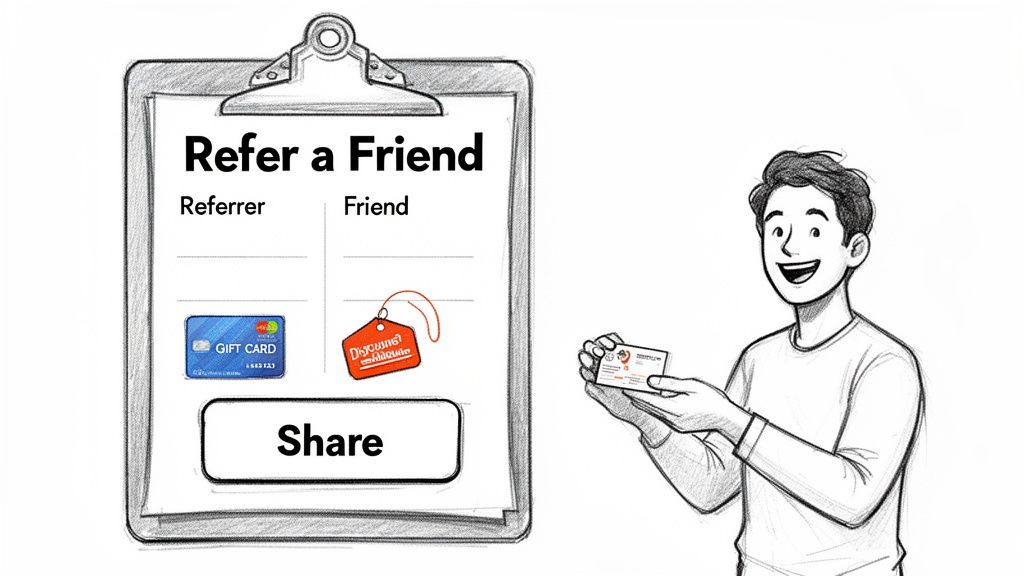
Dual-Sided: You reward both people. The original customer gets a kickback, and their friend gets a discount. For example, your customer gets a $50 Amazon gift card, and their friend gets $50 off their move.
As an industry expert, I’ll be blunt: Dual-sided incentives almost always win. It makes your original customer feel good because they're giving their friend a real discount, not just shilling for you. Plus, they get a tangible reward. It’s a true win-win that gets people to actually share.
Keep Your Program Simple
If your referral program is confusing or requires jumping through hoops, people won't do it. Complexity is the enemy. The goal is to remove every ounce of friction.
Let's say you run a 5-truck operation. You don't need a fancy online portal. Just create a simple, one-page PDF that lays it all out.
- The Headline: "Refer a Friend & Get $50!"
- How It Works: "Tell a friend about us. When they book their move, they get $50 off, and we'll send you a $50 Amazon gift card. Just make sure they mention your name when they call!"
- Your Info: Your phone number and website, big and clear.
That's it. You can attach that PDF to every "thank you for your business" email you send after a move. It's easy to understand, easy to share, and the value is obvious. A straightforward offer with a good reward gets people to act. This kind of simple, effective plan is a crucial piece of your overall marketing for your moving company.
The Art of the Ask: When and How to Request Referrals
Even a great referral program will fall flat if your timing is off. Asking at the wrong moment feels awkward and almost never gets you a new lead. Getting this right isn't about a single, desperate plea. It's about knowing the perfect moments to plant a seed and turn a happy customer into someone who actively sends new jobs your way.
Think of it as a one-two punch that feels natural, not pushy.
The Final Walkthrough Ask
The absolute best moment to ask for a referral is during the final walkthrough. All the boxes are in, the furniture is set, and the customer is looking at their new home with a huge sense of relief. The stress is gone. To them, your crew members are heroes.
This is the peak of their satisfaction. Don't miss it.
Train your crew leader to make a soft, low-pressure ask right then and there. It can’t sound like a corporate script. It needs to feel like a genuine, friendly conversation.
What Your Crew Leader Can Say:
"Alright, Ms. Johnson, looks like we're all set! We're so glad we could get everything moved in for you safely. Hey, if you know anyone else moving soon, we'd be honored if you'd send them our way. We always take great care of friends of our customers."
This works because it’s personal and doesn't put them on the spot. You're simply planting the idea while their positive feelings are at an all-time high, making them far more likely to remember you when a friend mentions they're moving.
The Automated Post-Move Email
The on-site mention is a great start, but people get busy. They have boxes to unpack, and even with the best intentions, they'll forget. That’s why you need a system to follow up.
Send a dedicated follow-up email 2-3 days after the move.
This timing is deliberate. They've had a chance to settle in, but the memory of your crew’s excellent work is still fresh. This email does double duty: it officially asks for the referral and makes it easy for them to leave a review.
Here's a simple template you can adapt:
Subject: A quick thank you from [Your Company Name]
Hi [Customer Name],
It was a pleasure helping you with your move to [New City/Neighborhood]! Our crew really enjoyed working with you.
As a local business, we grow by word-of-mouth, and a recommendation from a happy customer like you means the world to us. If you happen to know any friends or family who are planning a move, we'd be grateful for a referral.
As a small thank you, we offer [Your Incentive, e.g., a $50 Amazon Gift Card] to you and [Friend's Incentive, e.g., $50 off their move] for anyone you send our way.
If you have a moment, leaving us a review on Google also helps other families find a trustworthy mover. You can do that right here: [Link to Google Review Page]
Thanks again for choosing us!
Best,
The [Your Company Name] Team
This email makes the ask official, spells out the incentive clearly, and gives them a one-click way to help you out. It reinforces that you value their business and makes them feel like a partner in your success.
Putting Your Referral Engine on Autopilot
Let's be honest. When busy season hits and the phone won't stop ringing, what's the first thing to go? It's the "nice-to-have" stuff: the follow-up emails, referral requests, and thank-you notes.
You know these things matter, but they fall by the wayside. You end up relying on sticky notes and memory to track referrals, which means opportunities are constantly slipping through the cracks. A real referral program shouldn't depend on you having a slow day.
Automating the whole process changes the game. It makes sure every happy customer gets the right message at exactly the right time, turning your referrals from a nice surprise into a predictable source of your best leads. And you don't have to lift a finger.
How to Set Up an Automated Workflow
This whole thing can kick off the second a job is marked "complete" in your CRM, whether you use SmartMoving, Supermove, or something else. That one click triggers a sequence designed to do two things: get you a five-star review and earn a referral.
This is where you pull ahead of the competition. While other movers are too swamped to follow up, your system is working 24/7 in the background, making customers feel valued and asking for business. It frees you up to run your crews, not chase down paperwork.
Here’s a look at how these touchpoints flow together, blending the personal on-site ask with automated follow-ups.
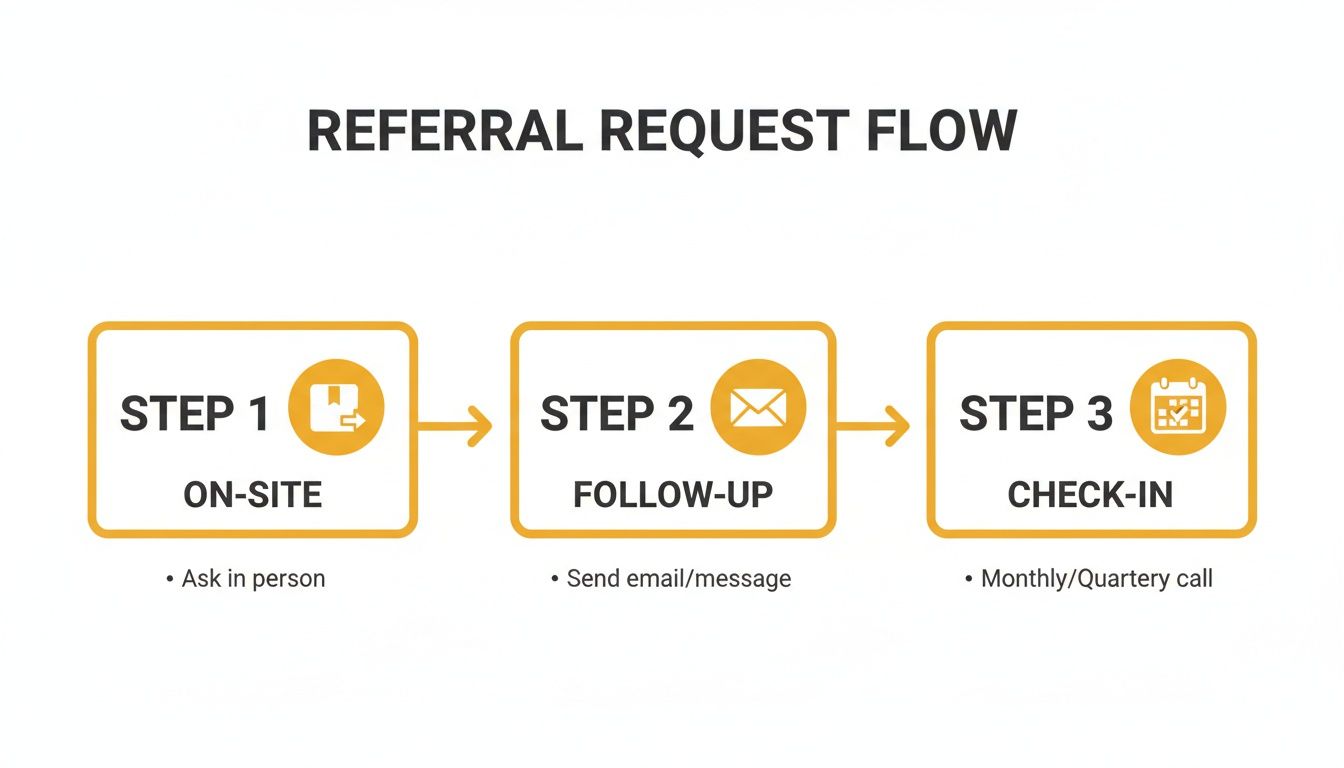
As you can see, it’s not just one email. It’s a series of steps that combine personal interaction with smart automation to maximize your chances of turning a happy client into your next great lead.
But First, You Have to Earn It
Here’s the catch: automation can’t fix a bad experience. The opportunity for a referral doesn't start after the move is done. It starts the very first time a potential customer calls you.
A missed call, a quote that takes 24 hours, or an inaccurate estimate kills the "wow" factor before you've even started. No post-move email is going to fix a terrible first impression.
This is where you separate yourself. The difference between simply answering a call and actually booking a job on that first call is everything. An answering service that just takes a message is telling your customer to wait—and today's customers won't.
Think about it. When a lead calls and instantly gets an accurate quote based on your rates right then and there, you’ve already won. You've set the stage for a five-star experience from the very first minute. That seamless first interaction is what people remember and talk about.
That's exactly what AI-powered tools like MoveJoy were built for. By answering every call 24/7, generating an accurate quote from your own rate card, and booking the job directly into your CRM, the customer journey starts perfectly. This front-end excellence is the real engine behind your referral program. It creates happy customers who are ready to recommend you before a single box is on the truck. You can read more about the impact of business process automation tools and see how they're working for movers just like you.
How To Track And Measure Your Referral Success
So, you’re putting in the work to get referrals. That’s great. But are they actually growing your revenue?
If you can’t answer that question with a specific number, you’re flying blind. Simply counting the number of referred jobs isn't enough. You need to know if the effort is paying off in real dollars and cents.
This isn’t about creating fancy spreadsheets. It’s about proving that a great customer experience directly leads to more profit. It’s how you justify investing in tools that make your customers happy and turn word-of-mouth into a predictable revenue stream.
Key Metrics For Your Referral Program
You don't need to track a million different things. To get a real grip on your program's performance, just focus on a few key numbers. These are the metrics that tell the whole story, from how many leads you’re getting to how profitable they really are.
Here's what every moving company owner should be watching:
| Metric (KPI) | What It Measures | How to Calculate It | Why It Matters |
|---|---|---|---|
| Referral Rate | The percentage of total jobs that come from referrals. | (Number of Referred Jobs / Total Number of Jobs) x 100 | This is your headline number. It shows how much of your business is driven by word-of-mouth and tells you if your efforts are paying off over time. |
| Cost Per Acquisition (CPA) | The cost to acquire one new customer through a referral. | Total Cost of Referral Incentives / Number of Referred Jobs | Your referral CPA should be extremely low, often just the cost of a gift card. Comparing this to your ad spend CPA highlights the incredible profitability of referrals. |
| Lifetime Value (LTV) of Referred Customers | The total revenue a referred customer generates over time. | Average Job Value + Revenue from Repeat Moves or Additional Referrals | Referred customers often become your most loyal clients. Tracking their LTV shows that they aren't just one-off jobs; they're long-term assets for your company. |
Tracking these few numbers gives you a crystal-clear picture. You’ll know exactly how much your happy customers are contributing to your bottom line, which is all the proof you need to keep investing in your program.
Setting Up Your Tracking System
You don't need complicated, expensive software to get started. Honestly, a simple spreadsheet or a custom field in your existing CRM is all it takes.
The most important thing—and I mean the single most crucial step—is to make “How did you hear about us?” a mandatory question on every single call. This has to be a non-negotiable part of your intake process. No exceptions.
For your team: Train your sales reps to never skip this question. They need to log the answer accurately every single time in your CRM, whether that's SmartMoving or Supermove. The easiest way is to create a dropdown menu with options like "Referral," "Google Search," "Repeat Customer," etc.
For automated systems: This is where technology gives you a massive advantage. An AI-powered tool can be programmed to ask this qualifying question on every call, 24/7. It never forgets, never gets lazy, and never skips a step.
Think about it. When a caller says, "My friend Sarah Jones recommended you," that information is gold. A system like MoveJoy doesn't just capture this detail; it can book the job and automatically tag the lead source in your CRM. This means Sarah Jones gets her reward and you get perfectly clean data—without anyone on your team lifting a finger.
This data is the bedrock of a smart growth strategy. It shows you who your biggest fans are, proves the financial impact of your referral program, and gives you the confidence to make decisions that grow your moving business for the long haul.
Even with a solid plan, you're going to have questions. I've heard them all from moving company owners trying to get their referral engine humming. These are the little roadblocks that can kill your momentum, but a bit of clarity goes a long way.
Let's tackle the most common ones I hear.
What's the Best Incentive for a Referral Program?
You need something generous enough to get someone to act, but that doesn't sink your margins. The sweet spot is almost always a tangible reward for the person referring you. A $50-$100 Visa or Amazon gift card works wonders. It's a real, immediate "thank you" they can actually use.
For the new customer they send your way, a simple, flat discount like “$50 off your move” is a powerful nudge to get them to book with you over a competitor.
Pro Tip: Go with a dual-sided incentive where both people get something. It almost always performs better. And please, don't offer a discount on "future moves" for the referrer. Most people don't move often enough for that to be even remotely compelling.
My Customers Say They'll Refer Me, But Never Do. What am I Doing Wrong?
This is a classic. I've heard it a hundred times, and it almost always comes down to one thing: friction. Good intentions are great, but they disappear the second life gets busy. When you just ask them to "spread the word," you're putting the work on them.
You have to make it dead simple. Don't just ask; equip them.
Send a follow-up email with a specific, shareable link or a digital referral card they can forward in two clicks. The key is automating this. A single "hey, thanks for the business" isn't enough. An automated email that goes out 3 days after the move, maybe followed by another check-in a few months later, keeps you top-of-mind and puts the referral tool right in their hands.
How Can I Track Referrals If People Just Tell Friends to Call Me?
Your intake process is your secret weapon here. This is where you turn word-of-mouth into hard data you can actually use.
Every single person who answers your phone—and any automated system you use—must be trained to ask one simple question on every call: "How did you hear about us?"
Make this a mandatory, non-negotiable field in your CRM for every new lead. If you use an AI tool for call handling, it can be programmed to ask this right out of the gate. When a caller says, "My friend John Smith used you," you can instantly connect that new lead to the original customer, track the referral, and make sure John gets his well-deserved gift card.
Should I Focus on Getting Referrals or More Google Reviews?
The answer is simple: do both. They're two sides of the same trust-building coin, and they work together.
- A referral is a "push." It's a trusted friend actively sending a high-intent, ready-to-book lead straight to your phone.
- A Google review is a "pull." It's the social proof that convinces all the other people searching online to pick up the phone and call you in the first place.
The best strategy is to bake both requests into the same follow-up. In your post-move email, you can frame it like this:
"We'd be honored if you'd refer us to friends and family. As a thank you, we offer [Your Incentive]. If you have another moment, leaving us a Google review also helps other families find a trustworthy mover."
This approach squeezes every last drop of value out of a happy customer, turning one great experience into both direct leads and public praise.
A steady stream of referrals isn't about luck. It's the direct result of a great customer experience combined with a smart, automated system that makes sharing easy. It all starts with that very first interaction—answering every call and providing an accurate quote instantly.
When you nail that first impression and deliver a flawless move, your customers will want to talk about you.
Ready to automate your front end and create more customers worth referring? MoveJoy answers every call, provides instant quotes using your rates, and books jobs right into your CRM. We make sure every caller gets a 5-star experience from the jump. Explore how MoveJoy turns your calls into booked jobs and happy customers.