
What if you could pay your crews for the jobs they complete, not just the hours they work? That’s the big idea behind piece rate pay. Instead of a fixed hourly wage, your movers earn a set amount for each task—say, a flat fee for a 2-bedroom apartment move. It’s a pay-for-performance model that ties your labor costs directly to your revenue.
For a moving company owner staring down a packed schedule, this sounds like a dream. Faster crews, predictable labor costs, and motivated movers. But while the upside is tempting, the reality is full of legal traps and operational risks that can cost you far more than you stand to gain.
What Is Piece Rate Pay in the Moving Industry?
Think of it this way: instead of clocking in and earning $25 per hour no matter what, a mover on piece rate might get a flat $300 to complete a specific local job. If they hustle and finish efficiently, their effective hourly rate shoots up. But if the job drags on due to a slow elevator or poor customer prep, their effective rate plummets.
This is a totally different mindset from the standard hourly pay most moving companies are built on. It's important not to get this confused with other financial terms; for instance, there's a big difference between what you pay your crew and what you charge a customer, which is why understanding the difference between bill rate and pay rate is so critical for owners.
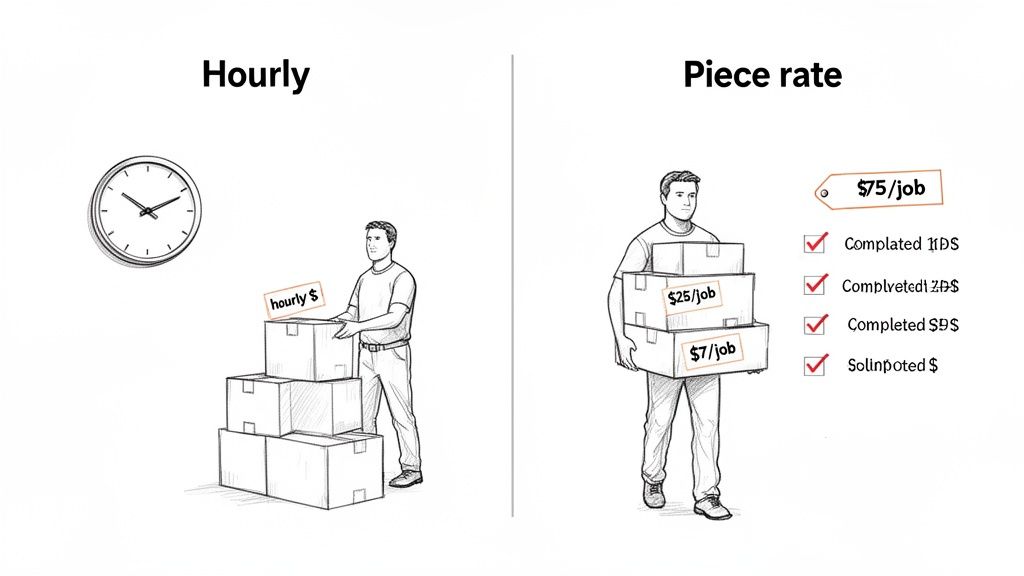
Piece Rate Pay vs. Hourly Pay at a Glance
For moving company owners, seeing the fundamental differences between paying for performance and paying for time is key. Here’s a quick comparison to break it down.
| Attribute | Piece Rate Pay | Hourly Pay |
|---|---|---|
| Basis of Pay | Based on output (jobs, tasks, items moved) | Based on time (hours worked) |
| Worker Incentive | Speed and efficiency | Presence and time on the clock |
| Labor Costs | Predictable per job, but variable per hour | Fixed per hour, but variable per job |
| Productivity | Can be significantly higher | Can be inconsistent |
| Admin Complexity | High (requires FLSA compliance, tracking) | Low (simple time tracking) |
| Risk | Shifts risk of inefficiency to the worker | Shifts risk of inefficiency to the company |
While piece rate looks great on paper for boosting productivity, that "high" administrative complexity hides some serious legal and operational headaches you absolutely need to know about.
A Tale of Two Crews
Let's walk through a real-world scenario to see how this plays out. You've got a standard 3-bedroom house move on the books for today.
- Crew A (Hourly Pay): You pay them your standard $25/hour. The job takes them 8 hours from start to finish. Each mover walks away with $200 for the day ($25 x 8 hours). Your labor cost for the job is fixed at $200 per mover.
- Crew B (Piece Rate Pay): You offer a flat rate of $600 for the entire job, split among the three-person crew. They get the same job done in just 6 hours. Each mover still earns $200 for their work ($600 / 3 movers).
See what happened? Crew B had a reason to hustle. They worked smarter, finished two hours earlier, and freed up their afternoon. For you, that might mean squeezing in a small, last-minute job—a clear win for both sides, especially during the peak season between March and September.
But this simple example glosses over massive risks. What happens when a job is badly underestimated? What about unexpected traffic, a broken elevator, or a client who isn't packed? And most importantly, how do you stop crews from cutting corners and damaging furniture when their only incentive is speed? One bad review or a single expensive damage claim can wipe out any efficiency gains.
The Real Pros and Cons of Piece Rate Pay for Movers
Switching to a piece-rate system can feel like strapping a rocket to your moving crews. On paper, it looks perfect, especially when you’re staring down the barrel of peak season from March to September. More jobs, faster moves, happier high-performers.
But that rocket can just as easily blow up on the launchpad. The pressure to move faster brings a whole new set of headaches, from angry customers calling about broken heirlooms to serious trouble with the Department of Labor.
Let's get real about what you stand to gain versus what you could lose.
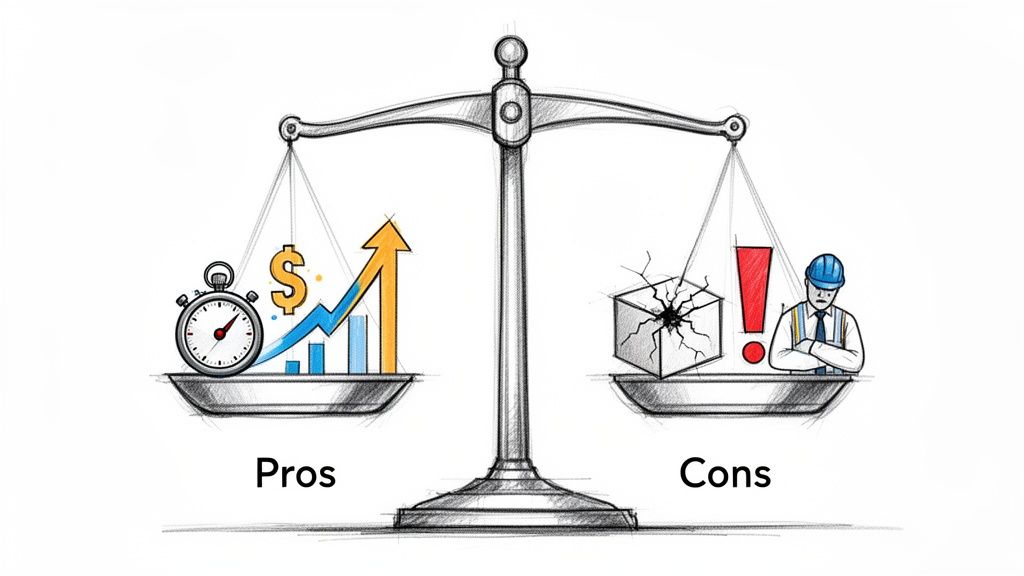
The Upside: Why It’s So Tempting
The appeal of piece rate is simple: it directly connects a mover's paycheck to their performance. For a moving business owner constantly battling the clock, this can feel like a game-changer.
- Lightning-Fast Crews: When guys get paid by the job, they suddenly find a new gear. They hustle. This means faster completion times, which opens the door to squeezing another job into a busy day.
- Rock-Solid Labor Costs: Your labor cost for a 3-bedroom move becomes a fixed number. You know exactly what you’re paying before the truck even leaves the yard, making your quotes sharper and your budget way more predictable.
- Your A-Team Makes Bank: Your best movers—the ones who are strong, smart, and efficient—can seriously boost their income. This not only rewards them for their skill but also helps you attract other top-tier guys who are confident they can hang.
- Less Babysitting: The incentive is baked right in. Crews tend to manage themselves because every wasted minute is money out of their own pockets. You don't have to push them to stay on task.
The Downside: Where It All Goes Wrong
While the benefits look good, the risks are severe. The pressure cooker environment you create can poison your company's reputation, finances, and culture.
The single biggest risk is that you accidentally build a culture where speed matters more than safety and quality. When movers are just trying to beat the clock, corners get cut.
That’s when the real problems start. Damaged furniture, dinged walls, and careless handling of fragile boxes become the norm, not the exception.
- A Flood of Damage Claims: Rushed work is sloppy work. That tiny bit you saved on labor gets wiped out fast by one big damage claim. A spike in claims doesn't just cost money; it torpedoes your reputation.
- Terrible Customer Service: When time is money, movers don't have patience for a customer's questions or that "one last thing" they need moved. Good reviews and referrals dry up quick.
- Crew Burnout and a Revolving Door: The constant push to work at 110% is exhausting, physically and mentally. This model burns out even your best people, sending your turnover—and your hiring and training costs—through the roof. Good truck driver retention strategies are about more than just pay; they're about creating a sustainable work environment.
- Unsafe Shortcuts: To save a few minutes, crews might overload dollies, lift with their backs, or skip safety checks. This is how you end up with a workers' comp claim that haunts you for years.
- Payroll and Legal Nightmares: As we'll get into, piece-rate pay is a minefield of federal and state labor laws. Mess up one overtime calculation, and you could be facing crippling fines.
At the end of the day, you have to ask yourself a tough question: is the dream of higher output worth the nightmare of declining quality, burned-out employees, and a constant stream of costly damage claims? For most modern moving companies, the answer is no.
3 Common Piece Rate Pay Models
Alright, you're still curious about the idea of piece rate pay. But what does it actually look like on a paycheck? It's one thing to talk about the theory, but it's another thing entirely to see how the numbers play out on a real move.
Let’s break down the common ways you can structure this for your crews. Each one has its own vibe and level of complexity, so seeing them with real-world job numbers is the only way to figure out what might work for your operation, whether you're running two trucks or twenty.
Model 1: The Straight Piece Rate
This is as simple as it gets. You pay a flat dollar amount for a specific, completed job. Period. It doesn't matter if it takes the crew three hours or six—they know exactly what they’ll earn before they even start the truck.
How It Works:
The focus here is 100% on the outcome. The crew gets paid to get the customer from Point A to Point B, and that’s it.
- Example Calculation: You book a 2-bedroom apartment move and decide the job is worth $600 in crew pay. A three-person crew knocks it out.
- Result: Each mover gets a flat $200 for that job ($600 / 3 movers). Simple and clear.
But a word of caution: while this model is easy to explain, it carries the biggest legal headaches if you're not extremely careful about minimum wage and overtime rules.
Model 2: The Group Piece Rate
This is a close cousin to the straight rate. You still set a total payout for the entire job, but the key difference is that it’s built for teamwork. The whole crew shares one big pot of money.
This structure is all about lighting a fire under the team to work together. If one person is dragging their feet, it costs everyone a little bit of money. It’s a classic in the moving industry for a reason—it’s designed to get everyone hustling as a single unit.
- Example Calculation: A four-person crew is assigned to pack and load a 4-bedroom house. You set the group rate at $1,200.
- Result: The crew splits the total four ways, meaning each person earns $300 for their share of the work.
Model 3: The Hybrid Model
For most moving companies, this is the safest and most practical way to go. You’re mixing the stability of a regular hourly wage with the get-it-done motivation of a performance bonus. Your movers are guaranteed a base pay for every hour they work, but they can make extra cash by being efficient.
How It Works:
You pay a standard hourly rate—say, $18/hour—for all clocked-in time. Then, you sweeten the deal with a piece rate bonus for jobs done under the estimated time or for hitting other performance goals.
- Example Calculation: Your crew gets a base rate of $18/hour. On top of that, you offer a $150 bonus (split three ways) if they can complete a standard local move in under 5 hours.
- Result: The crew finishes the job in 4.5 hours. Each mover earns $81 in hourly pay ($18 x 4.5 hours). They also get their $50 share of the bonus, bringing their total to $131. Suddenly, their effective hourly rate for that job is $29.11. Not bad at all.
The hybrid model is so popular because it keeps you on the right side of the law. By guaranteeing an hourly wage, you automatically cover your minimum wage obligations and make calculating overtime way less complicated, which helps you avoid some of the stickiest issues with the Fair Labor Standards Act (FLSA).
Piece rate systems can look very different from one industry to another. You can see a wider variety of these pay structures in this detailed employer's guide on Rippling.com.
Ultimately, any pay structure you build has to be tied to accurate quoting. Getting that right means knowing your numbers inside and out, which starts with a solid estimate. You can dive deeper into how to accurately estimate moving costs in our dedicated guide. The perfect model for your business will strike a balance between pushing for productivity and meeting your absolute duty for legal compliance and quality work.
Navigating the Legal Rules of Piece Rate Pay
Thinking you can just start paying your movers per job is a huge mistake. This is where a lot of well-intentioned moving company owners find themselves in a world of legal trouble.
The U.S. Department of Labor has strict, non-negotiable rules under the Fair Labor Standards Act (FLSA). Ignore them, and you’re looking at the kind of fines and lawsuits that can sink a business with just 1-20 trucks.
Getting this right is the single most important part of setting up a piece rate system. The two biggest minefields are minimum wage and overtime. One wrong step, and any productivity boost you were hoping for gets wiped out by legal fees.
The Minimum Wage Guarantee
Even when you pay by the job, your movers are still legally entitled to the federal minimum wage for every single hour they work. There’s no way around this.
To make sure you’re compliant, you have to run this simple check at the end of each workweek for every single employee:
Total Weekly Earnings ÷ Total Hours Worked = Effective Hourly Rate
If that effective hourly rate dips below the federal or your state's minimum wage (you have to use whichever is higher), you must pay the difference. A slow week, a job you badly underestimated, or a customer delay can easily push a mover’s pay below the legal floor if you’re not watching closely.
The Overtime Calculation Nightmare
This is, without a doubt, the #1 reason moving companies get sued over piece rate pay. You absolutely must pay overtime for hours worked over 40 in a week. But here's the kicker: you can't just pay them your standard time-and-a-half. It's more complicated than that.
You have to calculate what the FLSA calls the "regular rate of pay" for that specific week.
Here’s how you do it, step-by-step:
- Add Up All Piece Rate Pay: Calculate the total amount the mover earned from all jobs that week.
- Track Every Single Hour: You need a precise record of all hours worked, from the moment they clock in at the yard to the moment they clock out.
- Find the Regular Rate: Divide their total piece rate pay by the total hours they worked.
- Calculate the Overtime Premium: For every hour over 40, you owe them an extra 0.5 times that week’s regular rate.
Let's See It In Action
Imagine one of your best guys, David, has a monster week during the busy season and works 50 hours.
- He hustles through several jobs and earns $1,000 in total piece rate pay.
- His regular rate of pay for that week is $20/hour ($1,000 ÷ 50 hours).
- He worked 10 overtime hours (50 total hours – 40 regular hours).
- His overtime premium is $10/hour (0.5 x his $20 regular rate).
- You owe him an extra $100 for that overtime ($10 x 10 hours).
David’s total paycheck for the week must be $1,100. Just handing him the $1,000 for the jobs is a major FLSA violation, and it's exactly the kind of thing that gets companies sued.
This quick diagram shows the common pay models, moving from simple to more complex structures.
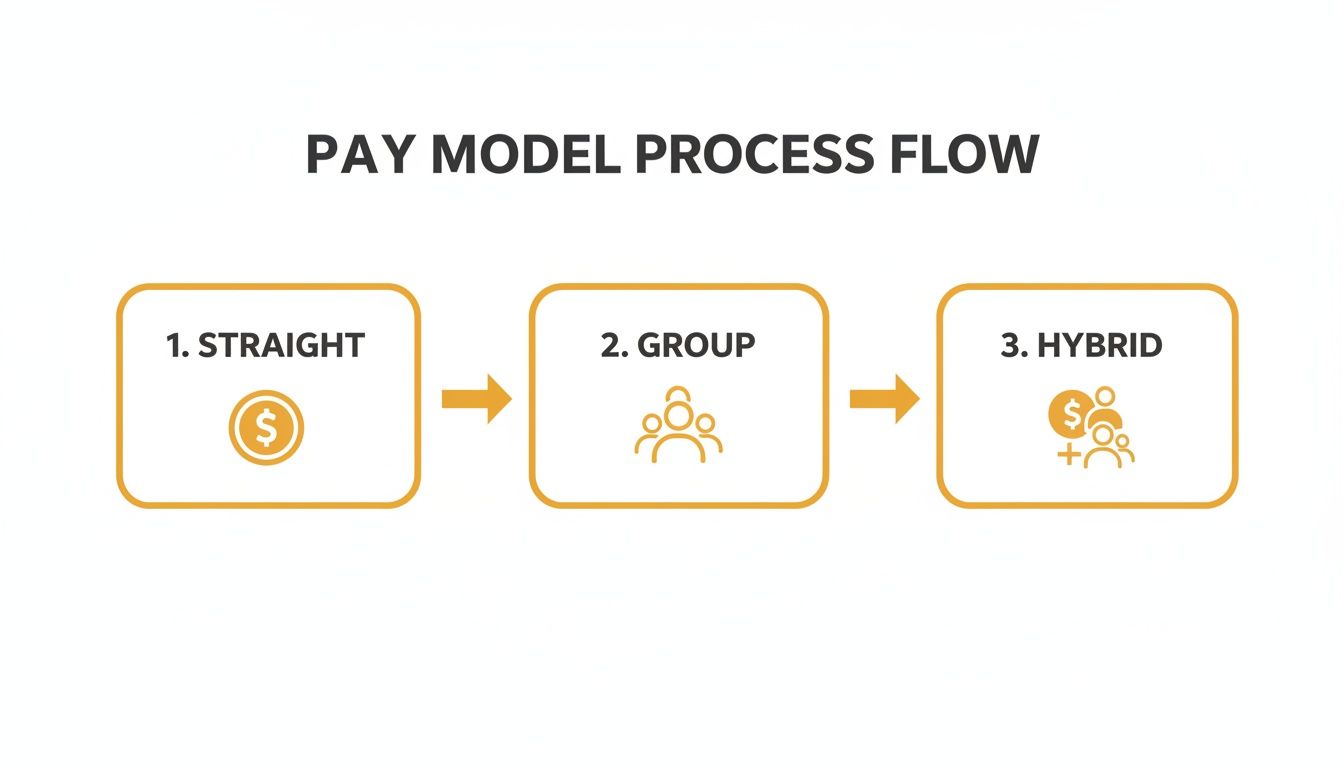
The flow shows that while Straight and Group rates are direct, a Hybrid model often feels safer. It blends a stable hourly base with performance bonuses, which can make staying compliant a whole lot easier.
State Laws Add More Complexity
As if the federal rules weren't enough, many states have their own labor laws that are even stricter than the FLSA. This is especially true in places like California, which has notoriously specific regulations for piece rate work.
For instance, California law says you must pay workers separately for non-productive time. This is any time they're on the clock but not actively completing a "piece" of work.
Think about it. That includes:
- Rest and meal breaks
- Time spent on daily truck safety checks
- Travel time between two jobs on the same day
- Time spent waiting for a customer who's running late
You can't just assume the piece rate covers this. It has to be paid separately, at an hourly rate. Recent lawsuits against major trucking and auto repair companies show this is a huge legal trap.
FLSA Compliance Checklist for Piece Rate Pay
This isn't a substitute for legal advice, but it’s a good starting point to make sure you’re covering the basics.
| Compliance Check | Key Action Required | Why It Matters |
|---|---|---|
| Minimum Wage Floor | At the end of each week, divide total earnings by total hours. If the effective rate is below minimum wage, pay the difference. | Protects your employees during slow weeks and prevents a straightforward minimum wage violation. |
| Accurate Hour Tracking | Log all "portal-to-portal" time, including travel, prep, and wait times. You need a rock-solid record of every minute. | In a lawsuit, the burden of proof is on you. Without accurate timecards, you have no defense. |
| Correct Overtime Pay | Calculate the unique "regular rate of pay" each week. Pay an additional 0.5x this rate for all hours over 40. | This is the most common mistake. Getting the overtime calculation wrong is a guaranteed way to lose a wage and hour lawsuit. |
| Separate Non-Productive Time | (Especially in states like CA) Identify and pay separately for non-productive time like travel, breaks, and meetings. | State laws often go beyond federal rules. Ignoring this can lead to massive class-action lawsuits. |
Ultimately, given how complicated this gets, you should absolutely talk to a labor law attorney in your state before you even think about implementing a piece rate system. The cost of good advice upfront is nothing compared to the cost of defending yourself in court later.
Why Modern Moving Companies Prioritize Smarter Operations
There’s a reason you don’t see piece-rate pay much anymore in skilled trades—it rewards one thing and one thing only: speed. And that often comes at the expense of everything else that actually grows your moving business.
A successful move isn’t an assembly line job. It’s a delicate service that relies on careful planning, solid teamwork, and great communication with the customer. A pay model that only cares about getting it done fast can kill the very qualities that build a 5-star reputation.
The fastest-growing moving companies today aren’t just pushing their crews to work faster. They’re making the entire business work smarter. Real, sustainable growth comes from tightening up the whole operation, from the first phone call to the final signed bill of lading.
Shifting Focus from Crew Speed to System Efficiency
The biggest problem with piece rate is how narrow-minded it is. It puts a laser focus on one single action—the speed of the physical move—while completely ignoring the other parts of your business that actually book jobs and make you money.
This isn't a new lesson. A deep-dive study on pay trends found that pure piece-rate systems have been on the decline for over 50 years. Why? Because industries shifted from simple, repetitive tasks to work that required higher quality standards and problem-solving. It’s easy to measure how many widgets one person makes on an assembly line. It’s much harder to measure teamwork and critical thinking. You can read the full NBER study on this compensation shift if you want to go deeper.
For moving companies, this means the biggest opportunities for growth aren't found on the truck; they're in your front office.
Where True Profitability Is Found
Think about the biggest money leaks in your moving business. Is it really a crew taking an extra 30 minutes on a job? Or is it something like this:
- Missed Calls: A motivated customer calls on a busy Saturday, gets your voicemail, and immediately calls your competitor. That’s an entire job—and thousands in revenue—gone, just because you couldn't pick up the phone.
- Slow Quoting: You get a lead’s info but take hours—or even a whole day—to email them a quote. By that time, they’ve already booked with the company that gave them a price on the spot.
- Bad Estimates: A poorly calculated quote either scares the customer away for being too high or costs you money because it’s way too low, directly impacting your ability to use a piece rate system legally.
- Zero Follow-Up: A perfectly good lead gets a quote from you and then… crickets. A single automated text could have been the difference between a lost lead and a booked job.
These are the real killers. These front-office bottlenecks cost you far more than a slightly slower crew ever will. The fastest way to boost revenue isn’t by rushing the jobs you already have; it’s by booking more of the high-quality jobs you’re currently missing.
The new competitive advantage isn't just about moving furniture well. It's about being the easiest, fastest, and most professional company to do business with from the very first phone call.
Fixing your front-office systems—like having a way to instantly capture every lead and give them an accurate quote 24/7—is what builds a truly profitable and scalable business. It creates a system that wins jobs for you, freeing up your team to deliver the kind of 5-star service that earns referrals for years. A rock-solid operational foundation, which includes smart scheduling, is a huge part of this. You might find our guide on how to choose the right crew schedule software for your moving company helpful.
Your Top Questions About Piece Rate Pay Answered
Even after you've weighed the pros and cons, the legal side of piece rate pay can feel like a minefield. Most moving company owners I talk to have the same handful of nagging questions about how this all works in the real world.
Let's cut through the noise. Here are the straight answers you need.
How do I handle overtime for movers on a piece rate system?
This is the number one spot where companies get into serious trouble with the Fair Labor Standards Act (FLSA). You absolutely must calculate a mover's "regular rate of pay" for each workweek.
First, take their total piece rate earnings for the week and divide it by the total hours they actually worked. That gives you their effective hourly rate for that week. For any hours over 40, you owe them an additional 0.5 times that rate.
For example: A mover earns $800 in piece rates for a 50-hour week. Their regular rate of pay is $16/hour ($800 / 50 hours). You owe them an extra $8/hour (half of $16) for those 10 overtime hours. That comes out to $80 in overtime pay. Their total check for that week must be $880. No exceptions.
Is piece rate pay even legal in my state?
While it’s legal on the federal level, many states have their own, much stricter rules. This is a critical detail you cannot afford to overlook.
Take a state like California. They require you to pay separately for all non-productive time. That means rest breaks, travel time between jobs, and even the time crews spend waiting for a customer to show up. This has to be paid at a standard hourly rate, completely separate from their piece rate earnings. These laws vary wildly and carry massive penalties, so you need to have a conversation with a local labor law attorney.
Can I combine hourly pay with a piece rate bonus?
Yes, you can, and honestly, it’s often the smartest and safest way to go for a moving company. This is what's known as a hybrid model. By paying a base hourly wage that meets or exceeds the minimum wage, you automatically cover your bases on the most common compliance violations. The piece rate then acts as a true performance bonus on top of their guaranteed pay. Just remember: your overtime calculations for this model have to be based on the total earnings for the week—that includes both their hourly wages and any piece rate bonuses they pulled in.
What is the biggest mistake to avoid with piece rate pay?
The single biggest mistake owners make? Failing to accurately track all hours worked. It's a common assumption: "I'm paying by the job, so I don't need to track hours anymore." That thinking is completely false and a direct path to a major FLSA lawsuit. You must have a bulletproof system for tracking every single minute an employee is on the clock. Without those time records, you have zero proof you've met minimum wage and overtime laws.
How does this pay structure affect my quotes?
It ties directly into how accurate your quoting process is. If your piece rate is based on the job, your estimates have to be rock-solid. When you underestimate a job's complexity, it doesn't just eat into your profit margin; it can cause a mover's effective hourly rate to plummet below minimum wage. Suddenly, you've created a legal liability out of thin air. Your quoting process is your first line of defense. Using a well-structured moving company estimate template is an essential step toward protecting both your profitability and your compliance.
How does piece rate affect company culture?
Be careful here. A pay structure that only rewards speed can create a culture where quality and safety get thrown out the window. When crews feel rushed, they start cutting corners. That leads to more damage claims, worse customer reviews, and a reputation you didn't want. The goal is to incentivize efficiency, not recklessness. You have to pair it with strong training and quality control, constantly reinforcing that proper padding, careful handling, and great customer service are non-negotiable.
At the end of the day, while piece rate pay has its perks, it brings a ton of administrative and legal headaches. Many modern moving companies are finding that the best way to grow isn't just by pushing crews to work faster, but by making the entire business operate smarter. Optimizing your front office to capture every lead and provide an accurate quote is what separates growing moving companies from the ones stuck in a revenue leak cycle.
With an AI-powered system like MoveJoy, you can answer every call 24/7, provide an accurate quote using your own rates, and book the job right into your CRM. It closes the jobs you’re currently missing by turning missed calls into booked moves, recovering lost revenue without adding a single ounce of legal risk or operational complexity. Explore how you can grow revenue and streamline your business by visiting getmovejoy.com.