A good follow up call script isn't a complicated document. It's a simple, structured guide your team uses to reconnect with leads who received a quote but haven't booked yet. Think of it as your playbook for turning quotes into booked jobs. It ensures every follow-up call is professional, consistent, and focused on one thing: getting that move on your calendar.
Why Your Follow-Up Process Is Costing You Jobs
It’s a scene every moving company owner knows all too well.
A hot lead calls for a quote right in the middle of the spring rush. Your office manager is completely swamped, or maybe you're out on a job yourself. You finally get a moment to call them back that afternoon, only to hear those dreaded words: "Thanks, but we already booked with someone else."
In this business, speed isn't just a nice-to-have. It's your single biggest competitive advantage. The mover who responds first usually wins the job. Period.
The Real Cost of a Slow Response
Every hour you let a quote sit without a follow-up, your chances of booking that move drop. Dramatically.
When customers request a quote online, they're in a "shopping" mindset. They're actively comparing prices, availability, and how professional you seem. A slow response sends a clear signal: you might be too busy or too disorganized to handle their move well. This isn't just a hunch; the numbers are brutal.
If you can get back to a lead in under five minutes, that lead is 9 times more likely to convert into a booked job. In an industry where one extra booked job can pay for a month's worth of automation, that speed captures revenue that would otherwise go straight to your local competitor.
The real problem is that most moving company owners treat follow-ups as a low-priority task—something to get to "when there's time." But following up is a core sales activity that directly fuels your revenue. Missed calls and slow follow-ups are silent killers of growth.
How Inconsistency Kills Your Booking Rate
An inconsistent follow-up process doesn't just lose you one job here and there. It slowly chips away at your company's reputation and your bottom line.
When one customer gets a call back in 10 minutes but another waits two days, you're delivering a messy and unprofessional customer experience.
Think about these all-too-common scenarios for a 1-20 truck operation:
- Peak Season Chaos: Come May and June, your phone is ringing off the hook. Without a solid system, hot leads from April get buried as you scramble to keep up with the new wave of calls.
- The Voicemail Black Hole: A lead calls, leaves a voicemail, and the message gets lost in the shuffle. That's not just a missed call—it's thousands of dollars in revenue that just vanished.
- No Clear Next Step: Your team emails a quote but has no structured process for what happens next. The lead just sits in an inbox, getting colder by the minute while they book with someone else.
Each of these moments is a crack in your sales pipeline.
A well-defined follow up call script, paired with a clear process, plugs these leaks. It guarantees every lead gets the same prompt, professional attention, reinforcing the message that you’re a reliable and organized company they can trust with their move. Seeing how this fits into your bigger picture is the first step toward building a predictable revenue engine. You might find our guide to creating a moving company sales process flowchart helpful here.
The Anatomy of a High-Converting Follow Up Call
Let's be honest: most follow-up calls feel awkward for both you and the customer. But an effective follow-up call script isn't about reading lines like a robot. It's a game plan that ensures you hit the key points that turn a "maybe" into a booked job.
This is the framework we’ve seen consistently turn quotes into paying customers for local movers. It transforms a cold follow-up into a warm, productive conversation that actually closes deals.
Start with a Strong Opener
You have about 15 seconds to not get hung up on. You need to instantly remind the customer who you are and why you're calling, without sounding like every other salesperson they've dodged this week.
The trick is to connect back to their initial request. It shows you remember them, you're not just cold-calling, and you're following up on something they wanted. This little bit of context builds instant credibility.
Weak Opener: "Hi, is this Sarah? This is Bob from Bob's Movers. Are you still looking to move?"
This is generic, puts the customer on the defensive, and screams "sales call."
Strong Opener: "Hi Sarah, it's Bob calling from Precision Movers. I'm just following up on the quote we sent over yesterday for your move from downtown to the suburbs. Is now a good time to chat for a minute?"
See the difference? It's specific, it's professional, and it respects their time by asking for permission to talk. It puts them at ease right away.
Reinforce Your Value Proposition
Okay, you've got them on the phone. The worst thing you can do now is ask, "So, have you made a decision?" That’s a one-way ticket to "I'll let you know."
This is your shot to remind them why you're the best choice for their specific job. Generic stuff doesn't work here. You have to connect your value directly to a problem they mentioned during the initial call.
Think back to the first call or the estimate.
- Did they mention a priceless antique they were worried about?
- Were they stressed about a tight staircase in their apartment building?
- Did they need a very specific date during a slammed weekend?
Use that intel. It shows you were actually listening.
"Hey Sarah, I remember you mentioned you were concerned about protecting that antique grandfather clock. I just wanted to reiterate that our crews are specially trained in packing and handling delicate items like that, and it's fully covered under our valuation policy."
That’s not selling; it’s solving their problem. You’re reminding them you have a specific solution for their biggest headache. This is what separates your moving business from the guys who just compete on being the cheapest.
Ask Smart Questions to Uncover Hesitations
If they haven't booked yet, there’s a reason. Your job is to find out what it is without coming across as pushy. Open-ended questions are your best friend here. Avoid anything that can be answered with a simple "yes" or "no."
Instead of asking: "Did you have any questions about the quote?"
Try this instead: "What are the most important factors for you when choosing a moving company for this job?"
This question cracks the door open. You’ll hear about price, timing, trust, insurance—whatever is holding them back. Once you know the real objection, you can handle it. If they say, "Your price was a bit higher than another quote," you have the opening to talk about your experienced crew, better insurance, or guaranteed arrival time.
Finish with a Clear Closing
Ambiguity is the enemy of a booked job. Never end a call with a vague, "Well, let us know!" That’s the same as telling them to call your competitor.
You have to guide them to a clear next step. Make it easy for them to say yes.
If they're ready to book: "Great! I have your preferred date of the 25th still available. I can book that for you right now and send over the confirmation. It will only take two minutes. Do you want to go ahead and secure that spot?"
If they need more time: "I understand you need to discuss it with your partner. How about I pencil you in for the 25th to hold the spot, and give you a quick follow-up call tomorrow afternoon to confirm? That way you don't lose the date during the spring rush."
This approach creates a little urgency without being aggressive. It shows you’re on top of things and makes it dead simple for the customer to move forward. This structured follow-up, whether handled by a person or a tool like MoveJoy's AI receptionist, is how you professionally manage every lead and turn more of those expensive quotes into profitable jobs.
Ready-To-Use Follow Up Scripts for Any Moving Scenario
Knowing you need to follow up is one thing. Actually picking up the phone and knowing exactly what to say is another. A solid script isn't about sounding like a robot; it's about being prepared. It's your playbook. It makes sure your team hits the critical points, sounds professional every time, and gently guides the conversation toward a booked job.
Every productive call follows a simple roadmap. The first few seconds are critical, but so is how you wrap things up.
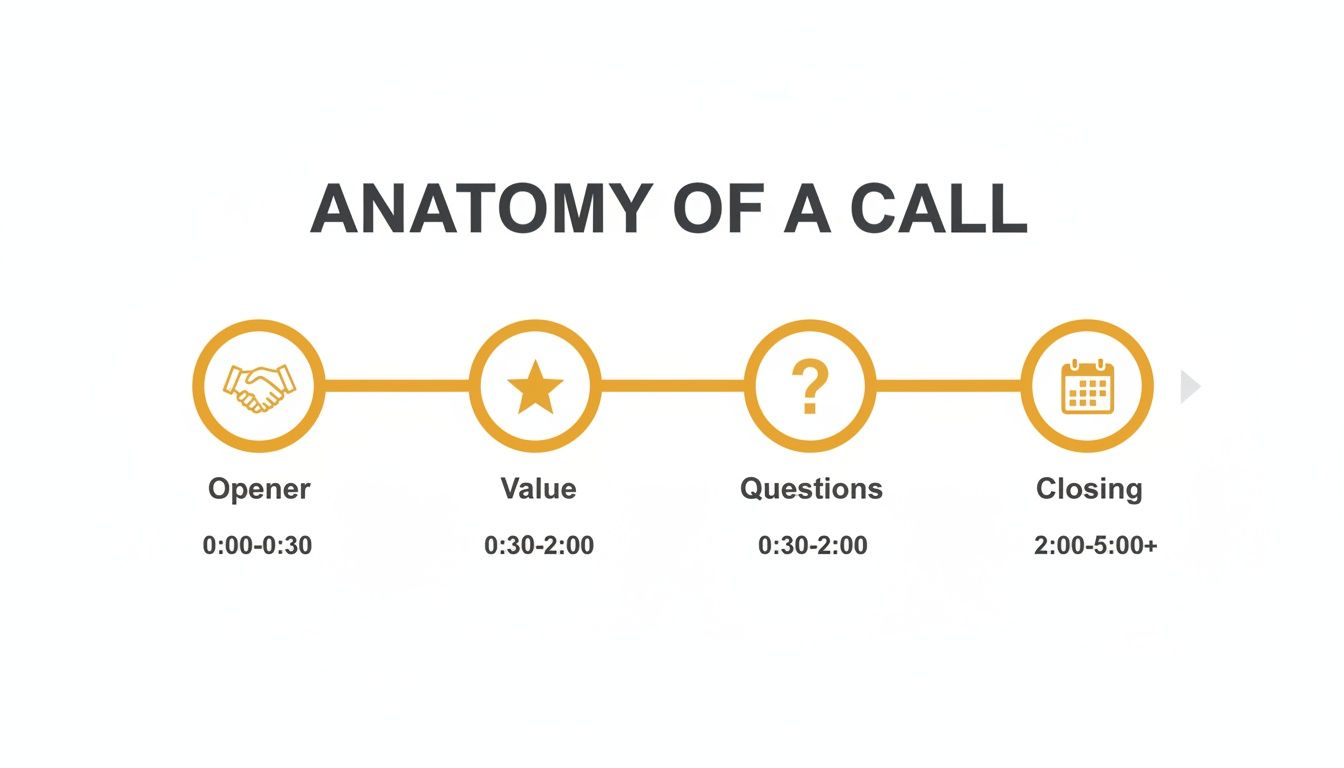
Think of this structure as your guardrails. It keeps the call on track and moves the customer logically from just thinking about it to actually booking with you.
Here are four field-tested scripts you can steal and adapt for your moving business. Each one is built for a real-world situation your team handles every single week.
The Crucial Post-Quote Follow-Up
This is the most important call you’ll make. You're dialing within 24 hours after sending the quote. Your goal is simple: answer their questions, remind them why you're the best choice, and create a little urgency before a competitor swoops in.
Script:
"Hi, may I speak with [Customer Name]?
This is [Your Name] from [Your Moving Company]. I'm just giving you a quick call about the quote we sent over yesterday for your move from [Origin] to [Destination]. Did you have a moment to look it over?
(Pause and actually listen to what they say.)
Great. I know you're probably looking at a few options, so I wanted to quickly mention that our quote includes our [Unique Value Prop #1, e.g., 'full-value protection plan at no extra charge']. I also remember you were concerned about [Specific Customer Concern, e.g., 'moving your large sectional sofa'], and I wanted to confirm our crew is fully equipped for that.
Do you have any questions I can answer to help you make your decision?"
Pro Tip: If they push back on price, don't jump to a discount. That devalues your service. Instead, pivot back to value. Ask, "I understand. Apart from the price, what are the most important things you're looking for in a mover for this job?" This gets them talking about what really matters—safety, reliability, peace of mind—and lets you shine.
The Gentle "No Response" Nudge
Sometimes, a hot lead goes completely cold. Radio silence. This call, made about 3-4 days after the quote, is your gentle nudge. The key is to be helpful, not desperate. Your tone should be, "Hey, I know you're busy, just checking in."
Script:
"Hi [Customer Name], this is [Your Name] again with [Your Moving Company].
I’m just following up one last time on the quote for your upcoming move. I know life gets chaotic when you're planning a relocation, so I wanted to see if there was anything I could do to help.
Our schedule for [Month of Move] is starting to fill up, but I'm still holding that [Date of Move] spot for you for now.
Are you still planning the move, or have you made other arrangements?"
This script is low-pressure but effective. It shows you're on top of your schedule and introduces a soft deadline, which is often all it takes to get someone to make a decision.
The Valuable Post-Move Quality Check
Your job doesn't end when the truck drives away. A follow-up call 1-2 days after the move is where you build customers for life. It’s your chance to handle any issues, gather feedback, and—most importantly—ask for a review. This one call can be your most powerful marketing play.
Script:
"Hi [Customer Name], it's [Your Name] from [Your Moving Company]. I hope you're settling into your new home!
I'm not calling to sell anything, just wanted to personally check in and see how everything went with your move on [Date of Move]. Was our crew professional and did they take good care of your things?
(Listen carefully. If there was a problem, this is your chance to own it and fix it.)
I’m so glad to hear that. We really thrive on feedback from our customers. If you have a spare minute, would you be willing to share your experience by leaving us a review on Google? It makes a huge difference for a local business like ours."
This call proves you care about the entire experience, not just getting paid. If you want to dive deeper into building a rock-solid sales process, you can find more proven strategies on how to close more moving sales.
The Strategic Old Lead Reactivation
Got a slow week coming up before peak season hits? Time to dust off the old leads. This call targets people who got a quote 2-3 months ago but never booked. You have absolutely nothing to lose and a potential job to gain.
Script:
"Hi [Customer Name], this is [Your Name] with [Your Moving Company].
We spoke back in [Month] about a quote for your move. I know it's been a little while, but I was just planning out our spring schedule and your name came to mind.
Did you end up making that move, or are you still in the planning stages?
Our calendar for May and June is already getting tight, but we're offering a [Small Incentive, e.g., '10% discount' or 'free box kit'] for early bookings this month. If you’re still looking, I’d be happy to honor that original quote for you."
This call makes you look proactive and helpful, not desperate. The small incentive is often just the push a procrastinator needs to turn a dead lead into a booked job before your busy season even kicks off. It's a high-reward tactic that costs you nothing more than a few minutes on the phone.
The Power of Persistence: How Many Follow Ups Are Enough?
One of the costliest mistakes moving company owners make is assuming silence means “no.” You send a quote, maybe follow up once, and when you hear nothing, you mark the lead as dead.
But here's the reality: you probably gave up right before the customer was ready to book. Your potential customer isn't sitting by the phone waiting for you. They’re juggling work, family, and the hundred other things that come with planning a move. Their silence isn’t a rejection—it’s just a sign that they’re busy.
Persistence, when done right, isn't pushy. It’s professional. It keeps your moving company top-of-mind while they work through their own chaos.
The Goldilocks Zone of Follow-Ups
So, how many times should you actually reach out before throwing in the towel? The data is pretty eye-opening. A staggering 80% of sales require 5 to 12 follow-up attempts after the first contact.
Now for the kicker: a shocking 92% of salespeople give up after four or fewer attempts.
That gap? That’s where the money is. The customer who finally picks up on the sixth call is the job your competitor gave up on after the third. For moving businesses, where one booked job can pay for a month of automation software, that persistence hits your bottom line directly.
A Cadence That Builds Trust, Not Annoyance
The secret is to mix up your outreach. Bombarding a customer with daily phone calls is a surefire way to get your number blocked. A smart follow-up cadence uses a blend of calls, emails, and texts spread out over a couple of weeks. It keeps you on their radar without becoming a nuisance.
Here’s a non-aggressive approach that works for movers:
- Day 1: Send the quote via email, then immediately follow up with a quick confirmation text.
- Day 2: Make your first follow up call script call. The goal here is to see if they have any initial questions.
- Day 4: Send a follow-up email that adds value, like "3 Things People Forget When Packing Their Kitchen."
- Day 7: Send a brief text: "Hi [Name], just checking if you had any more questions about your move. Happy to help!"
- Day 10: Make one last follow-up call. Reinforce your value and mention your schedule is starting to fill up for the season.
This multi-channel approach shows you’re organized and helpful, not just desperate for the sale.
Key Takeaway: The goal isn't just to make contact; it's to provide value with each interaction. A helpful tip or a reminder of what makes you different demonstrates professionalism and keeps the conversation going.
Trying to manage this kind of sequence manually for every single lead is almost impossible, especially for a busy owner or office manager. During the spring rush, leads will absolutely fall through the cracks.
This is exactly where automation becomes a game-changer. An automated system can run this exact follow-up cadence for every lead, sending the right message at the right time, every time. No lead ever gets forgotten, and your team can focus on warm leads who are ready to talk. To really understand the impact, take a look at these sales follow up statistics that show why a systematic approach wins.
Putting Your Scripts to Work 24/7 with Automation
Having the perfect follow up call script is one thing. Actually using it for every single lead, every single day? That's a whole different ballgame.
This is where even the best-run moving companies stumble, especially when the spring and summer rush hits. Your office team is great, but they can't be everywhere at once. They’re handling dispatch issues, taking calls from current customers, and eventually, following up on old quotes gets pushed to the back burner.
Manual follow-up just breaks down under pressure, and you end up leaking revenue. Automation is what bridges that gap. It turns your follow-up plan from a chore that gets forgotten into an engine that works around the clock to book more moving jobs.
Turning Scripts Into an Automated Workflow
Imagine a system that never gets tired, never forgets a lead, and works 24/7. That's the real power you get when you plug your scripts into an automation workflow. It’s not about replacing your people. It's about freeing them from the repetitive tasks so they can focus on the conversations that require a human touch.
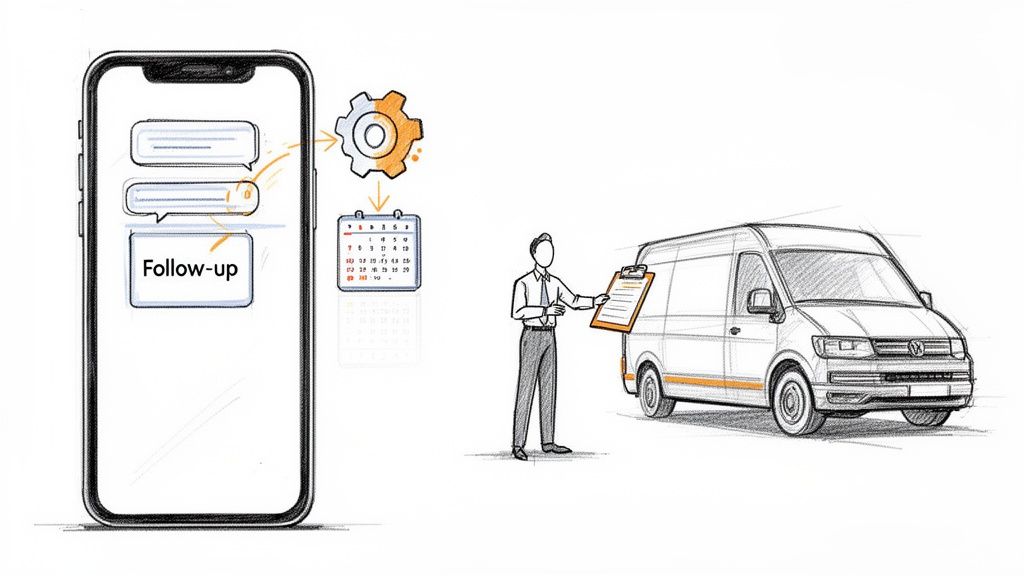
An automated system can execute that "Post-Quote Follow-Up" sequence perfectly every time. For instance, the second a quote is sent, an AI-powered system can kick into gear:
- Instantly Text the Customer: A text goes out immediately: "Hi [Customer Name], just confirming we sent the quote for your move to your inbox. Let us know if you have any questions!"
- Schedule a Human Call: The system can then create a task for your office manager to make a personal follow-up call 24 hours later.
- Nurture a Cold Lead: If you don't hear back after a few days, the system automatically sends the "Gentle Nudge" text or email. Nobody has to remember to do it.
This guarantees every single lead gets prompt, professional communication. It dramatically increases the odds that you're the company they remember and book.
You Can't Just Rely on Phone Calls Anymore
In this business, if you're only calling people, you're falling behind. Your customers are busy. They communicate on their own terms—which means you need to reach them across different channels. Smart automation uses a mix of calls, texts, and emails to connect with people where they actually are.
The data on this is staggering. Following up with a text message can dramatically increase your booking rate. Think about it: SMS open rates are around 98%, while email is lucky to hit 22%.
In fact, prospects who are texted convert 40% more often than those who aren't. An AI receptionist can handle this multi-channel dance flawlessly, sending the first text, an email a few days later, and then flagging a lead for your human team the moment they reply and are ready to talk.
Your 24/7 Front Office Solution
Ultimately, this is how you get a massive leg up on your competition. While their calls are going to voicemail after 5 p.m., your system is still working. An after-hours lead gets captured, qualified, and warmed up automatically.
This is the power of a true after-hours answering service that's powered by AI. It’s not just about taking a message; it’s about starting the sales process the second a lead comes in, ensuring no opportunity is ever wasted. To really get this right, it’s worth understanding how AI Improves Followup Strategies by turning your static scripts into a living, breathing system that brings in real money.
Common Questions About Follow-Up Calls
Even with a perfect script in hand, getting your team to actually use it can bring up a few hurdles. Let's be honest, your crew is killer at loading a truck, but "salesperson" probably isn't on their resume.
That’s completely normal. Here are the questions I hear all the time from moving company owners, along with some straight-up advice to help your team get comfortable, confident, and start booking more of those follow-up jobs.
"How Do I Get My Team to Use a Script Without Sounding Like Robots?"
This is the big one. It’s the number one fear I hear, and it’s a valid one. Nobody wants their company represented by someone reading a monotone script.
The secret is to stop thinking of it as a script and start treating it like a roadmap. Your team doesn’t need to memorize every single word. They just need to know the destination and the main turns to get there.
Drill them on the flow, not the lines:
- The Opener: Get straight to the point. "Hi [Customer Name], this is [Your Name] from [Your Company]. I'm just following up on the estimate we sent over for your move."
- The Value Nudge: Connect the dots for them. "I was just looking over the details, and it seems like a pretty straightforward [type of move, e.g., 2-bedroom apartment] job."
- The Real Question: Find the hesitation. "I just wanted to see if you had any questions I could answer."
- The Next Step: Make it easy for them to say yes. "If you're ready, I can get you booked right now."
Once they understand this simple four-part structure, let them use their own words. The best training you can do is role-playing. Seriously. Have one person be the customer and another use the framework. After a few reps, it stops feeling like a script and starts feeling like a natural conversation. They'll sound like the helpful experts they already are.
"When Is the Best Time to Actually Make These Calls?"
Timing is everything. Call at the wrong time, and you're just another interruption. Call at the right time, and you're a problem-solver.
While there's no single "magic" hour, we see the best results during two main windows: late morning (around 10 AM to Noon) and late afternoon (3 PM to 5 PM). People have settled into their day but aren't yet checked out for lunch or heading home.
Avoid the dead zones: right at 9 AM when everyone is swamped, and the lunch rush from 12 PM to 2 PM. One pro tip for residential moves, though? Try calling between 5 PM and 6 PM. People are home from work, relaxed, and more likely to have a minute to talk about their move.
But don't get paralyzed by picking the "perfect" time. The most important thing is to just make the call. A call at a less-than-ideal time is infinitely better than no call at all. This is where having an automated system like MoveJoy can be a game-changer, handling initial texts or emails to warm them up, no matter the hour.
"What Do We Say When the Customer Says, 'Your Price Is Too High'?"
First, take a breath. This isn't a rejection; it's a buying signal. It means they’re taking your quote seriously and trying to fit it into their budget. Whatever you do, don't get defensive and absolutely do not jump to offering a discount. That just cheapens your service.
Instead, see it as an invitation to talk about value. Your first move should be to ask a simple question that shifts the entire conversation:
"I understand. Putting the price aside for just a moment, what's the most important thing to you when picking a company for your move?"
This is a powerful move. It gets them to stop focusing on dollars and start talking about what they're really worried about: their stuff showing up in one piece, the crew being on time, or not having hidden fees sprung on them.
Now, they're talking about reliability, trust, and peace of mind. And that's your opening. You can then explain how your professional, vetted crew, your comprehensive insurance, and your on-time guarantee are exactly what they need to avoid those headaches. You're no longer the "expensive" option; you're the "done right" option.
Ready to stop missing calls and turn every lead into a booked job? MoveJoy is the AI-powered assistant that answers 100% of your calls, provides instant quotes, and automates your follow-up so you can focus on running your business. Discover how MoveJoy can transform your front office today.