How an AI Answering Service Stops Moving Companies From Losing Jobs
Think of an AI answering service as your best receptionist—one who never sleeps, takes a lunch break, or misses a call. It uses smart, conversational technology to answer your phone 24/7, qualify potential customers based on your exact criteria, and book jobs directly on your calendar. All without you or your crew lifting a finger.
For a moving company owner, it’s the difference between capturing a high-value lead at 9 PM on a Friday and handing that same job to a competitor who was ready to answer.
Why Missed Calls Are Your Biggest Revenue Leak
Picture this: It’s 11 AM on a Tuesday, peak season. Your crew foreman is navigating a piano down a tricky flight of stairs. The main business line buzzes in his pocket. He juggles the phone, one hand trying to guide the crew so they don't ding the wall.
He finally answers, breathless and distracted. The potential customer on the other end hears the chaos. He can't give a quote or check the schedule, so he scribbles down a number and promises a callback. By the time he gets around to it hours later, that customer has already booked with the mover who answered professionally on the first ring.
This isn't a rare mishap; it's a daily profit drain for small and mid-sized moving companies. Every call that goes to voicemail is a job you are actively giving away.
The Real Cost of a Single Missed Call
Most moving company owners I talk to seriously underestimate the financial damage. A missed call isn't just a missed opportunity; it’s a direct hit to your bottom line that suffocates your growth. When a customer is ready to book a move, they don't wait. They just call the next name on their list.
The modern moving customer moves fast. Research shows the first company to respond wins the business over 50% of the time. Voicemail is where your most valuable leads go to die.
Losing just one average local move—let's call it $1,500—is painful. Lose three or four of those every month, and you're looking at tens of thousands in lost revenue each year. That's money that could have gone toward a new truck, better equipment, or higher pay for your crew. It all comes down to lead capture and mastering services lead generation by ensuring every potential customer gets an immediate, professional response.
From Voicemail to a Competitive Disadvantage
In today's competitive local market, just answering the phone isn't enough anymore. Your ability to provide instant, helpful service from that very first call is your biggest advantage. Relying on voicemail or letting your on-site crew answer calls mid-job means you're starting from behind.
Want to learn more about capturing leads outside of normal business hours? Check out our guide on after-hours answering services. An AI answering service turns this huge operational headache into your most powerful tool for booking more jobs, ensuring every call is handled perfectly, every time.
How an AI Answering Service Works for Movers
Let’s pull back the curtain on how this technology actually works for a moving company. Forget the complicated tech jargon.
Think of an AI answering service as a clone of your best office manager—the one who knows exactly what questions to ask, never gets flustered, and never lets a call go to voicemail. Except this one works 24/7, costs a fraction of a full-time hire, and is always ready for the next call.
When a potential customer dials your number, they don’t hit a busy signal or get dumped into a voicemail box. They get an immediate, professional, and surprisingly human-sounding voice on the other end of the line.
The Anatomy of an AI-Powered Call
The magic isn't a clunky, robotic phone tree. It's a genuine, two-way conversation. The AI is trained on thousands of real calls from movers, so it understands the industry lingo, the typical questions, and the flow of a real booking call.
It doesn't just read from a script; it listens and reacts. This isn't the "press one for sales" system everyone hates. It's a dynamic dialogue that feels natural and captures the information you need to book the job.
Here’s how a typical call unfolds:
- Instant Answer, Any Time: A call comes in at 2 PM on a Tuesday or 2 AM on a Sunday—it doesn’t matter. The AI picks up on the first ring. This is huge, because you’re engaging the lead at the exact moment they’re ready to book.
- Smart Qualification: The AI gets right to the point, asking the critical questions you would. "Where are you moving from and to?" "How many bedrooms are we looking at?" It's not just gathering data; it's qualifying the lead in real-time.
- Perfect Detail Capture: It nails down the important details—the move date, specialty items like a piano or a gun safe, and whether they need packing help. Every detail is logged perfectly, every time. No more sloppy handwriting or forgotten questions.
- Seamless Hand-Off: Once the information is gathered, it’s instantly pushed into your systems. A new lead can pop up in your CRM, or if they’re ready to book, the AI can check your calendar for crew availability and schedule the job right then and there.
The alternative? Relying on humans to catch every call, which, let's be honest, is impossible during peak season. This simple chart shows what really happens.
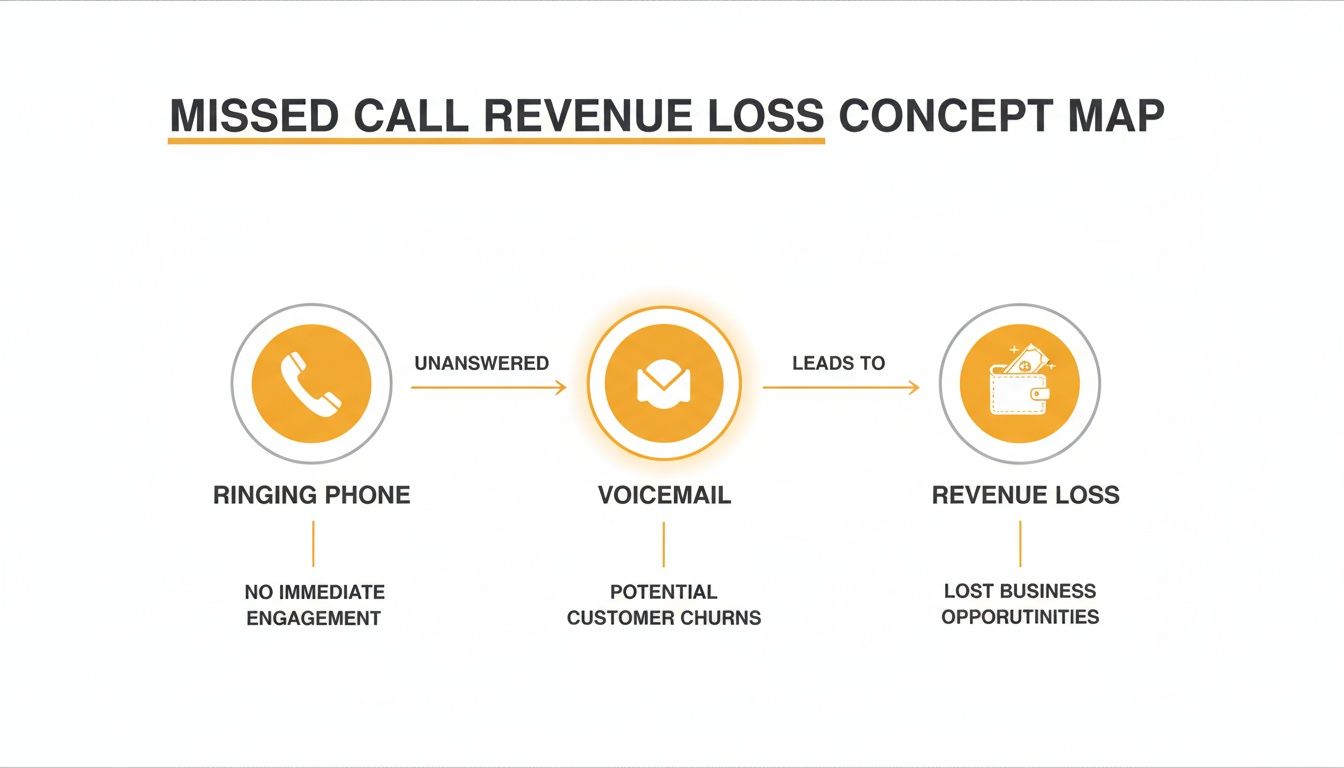
That straight line from a ringing phone to a voicemail box is where thousands of dollars in revenue disappear for movers every single month.
From Answering Calls to Automating Your Business
A good AI answering service does more than just answer the phone. It becomes an extension of your team, automating the repetitive front-office tasks that keep you and your staff bogged down.
The market for AI customer service has exploded, hitting $12.06 billion in 2024 and projected to reach $47.82 billion by 2030. Why? Because it delivers results, especially for local service businesses. You can dive deeper into these AI customer service statistics to see the impact.
An AI service isn't here to replace your people. It’s here to handle the repetitive, high-volume work so your team can focus on complex quotes, managing crews, and actually growing the business.
It turns every inbound call into a perfectly captured lead or a booked job. You stop bleeding money on marketing spend and get the peace of mind that no opportunity is slipping through the cracks, whether you're out on a job or finally home with your family.
Key Features That Drive Bookings and Efficiency
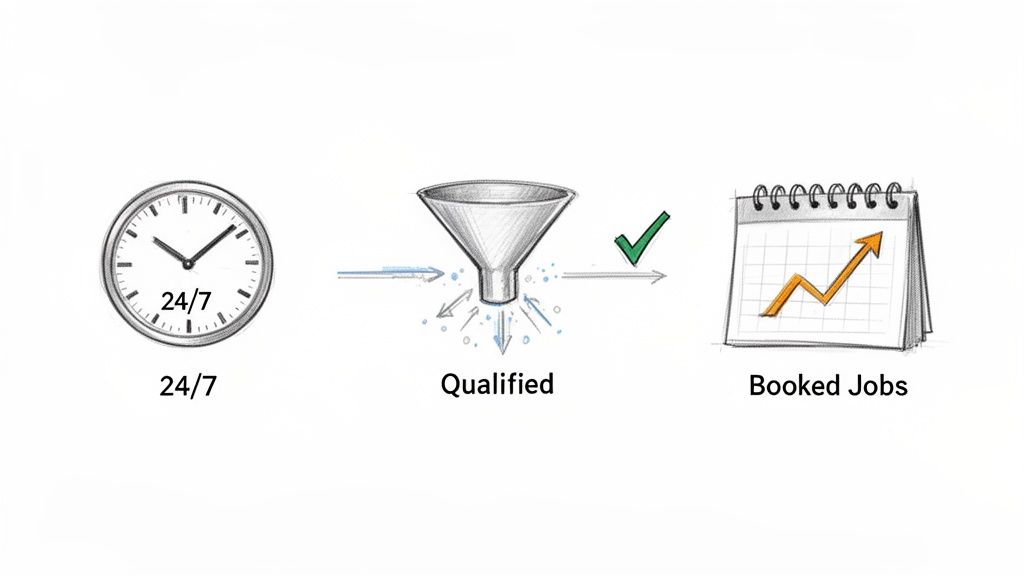
An AI answering service isn't just a fancy voicemail. It's a collection of smart tools working together to turn a ringing phone into a booked job on your calendar.
Understanding these core features shows you exactly where this technology plugs the leaks in your daily operations—the leaks quietly draining your revenue. Each one solves a specific problem that moving company owners face every day.
Capture Every Lead with 24/7 Call Answering
This is the most critical feature. The single most valuable thing an AI service does is answer every single call, every single time. A potential customer doesn't care if you're on another job, stuck in traffic, or if it's 10 PM on a Saturday. When they decide to call, they expect an answer.
With an AI service, your business is always open for booking. A lead that calls on a Sunday morning gets the same professional, detailed intake as one who calls at 11 AM on a Tuesday. This immediately puts you miles ahead of competitors who let those valuable weekend and evening calls go straight to voicemail.
Filter and Qualify Leads Instantly
Let's be honest: not every call is a high-value lead ready to book a 4-bedroom move. Some are tire-kickers. Others ask about services you don’t offer. Many are just fishing for a ballpark price.
An AI receptionist acts as your frontline filter. It asks the right questions immediately to separate serious customers from the noise. This pre-qualification saves your team countless hours. Instead of chasing down every person who dials your number, you can focus your time and energy on the leads that are actually likely to become profitable jobs.
Automate Scheduling with Calendar Integration
How many hours do you lose playing phone tag? Trying to find a time that works for the customer and your crew is one of the biggest time-sucks in the moving business. A modern AI answering service ends this by connecting directly to your live calendar (like Google Calendar).
This integration is a game-changer for moving operations. The AI can see your crew's real-time availability and book jobs directly into open slots, eliminating the risk of double-bookings or scheduling mistakes.
It’s a simple, powerful workflow:
- The caller proposes a date: The customer says they need to move next Friday.
- The AI checks availability: The system instantly checks your connected calendar for open slots.
- The job gets booked: If the time is free, the AI confirms it and books the appointment, sending a confirmation to both you and the customer.
What used to be a 15-minute scheduling headache becomes a 60-second automated action.
Increase Your Booking Rate with Automated Follow-Ups
Many leads don't book on the first call. They need time to think or get other quotes. The problem is, manual follow-up is inconsistent at best. During a busy season, it's often forgotten completely.
An AI service can automatically send a text or email with a quote summary moments after the call ends. It can even send a polite follow-up message a day or two later, asking if they have any questions or are ready to book. This simple, automated touchpoint is often all it takes to revive a "cold" lead and significantly boost your booking rate.
Key Insight: The magic is in the voice. The speech recognition market is set to explode from $12 billion to $50 billion by 2029. Moving is complex, and a natural, helpful conversation is what customers expect—not a clunky chatbot.
The best systems even offer a warm transfer. The AI can intelligently identify a high-value lead or a complex issue, then hand the call off to you or your office manager. You can read more about how a warm transfer works for movers in our guide. This ensures your most important leads get the human touch they need, while the AI handles the rest.
Manual Answering vs AI Answering Service: A Mover's Comparison
When you're running a moving company, every minute and every lead counts. The way you handle your phones can be the difference between a fully booked week and a schedule full of holes. Let's put the old way of doing things head-to-head with a modern AI answering service to see how they stack up.
| Feature | Traditional Answering (Receptionist or Voicemail) | AI Answering Service |
|---|---|---|
| Availability | Limited to business hours (e.g., 9 AM – 5 PM, Mon-Fri). | 24/7/365. Captures every lead, anytime. |
| Cost | $3,000 – $5,000/month for a full-time receptionist. | $149 – $499/month. |
| Lead Capture | Misses all after-hours, weekend, and overflow calls. | 100% of calls are answered. |
| Booking Speed | Manual process. Involves phone tag and back-and-forth. | Instant. Books jobs directly into your calendar in minutes. |
| Accuracy | Prone to human error (wrong dates, incorrect info). | Eliminates scheduling errors with direct calendar sync. |
| Follow-Up | Inconsistent or non-existent, especially when busy. | Automated text/email follow-ups for every qualified lead. |
| Scalability | Can't handle call spikes; gets overwhelmed. | Handles unlimited simultaneous calls without missing a beat. |
The takeaway is clear. While a great receptionist is a huge asset, they can't be everywhere at once. An AI service fills the gaps, ensuring you never miss an opportunity to book a profitable job just because you were on another call or out on a job. It's not about replacing people; it's about making your entire operation more efficient and profitable.
Getting Your AI Service Up and Running
The idea of setting up a new system can feel like a headache. But getting an AI answering service going isn't a massive IT project. For most moving companies, it’s a simple operational tweak you can knock out in under an hour, with no technical skills needed.
This isn’t about learning another complicated piece of software. It’s about flipping a switch to stop losing money on missed calls. The whole point is to give busy owners a solution that just works.
Before we jump into the steps, it helps to see the bigger picture. Understanding how AI automation can transform your business frames why this quick setup can have such a huge impact on your operations and your bank account.
Step 1: Forward Your Business Phone Number
This first step is the easiest. All you have to do is forward your main business phone number to the new number your AI service gives you. This is a basic feature every phone provider offers.
You can usually do this yourself in your online account or with a quick five-minute call. As soon as it's done, any call to your business line gets instantly sent to your AI receptionist. You can forward all calls 24/7 or just the ones you don't answer after a few rings.
Pro Tip: Set up "conditional call forwarding." This lets your office phone ring a few times first, giving your team a chance to pick up. If no one can grab it, the call automatically bounces to the AI instead of a dead-end voicemail. You get the best of both worlds.
Step 2: Connect Your Scheduling Calendar
This is where the magic happens. This is how you turn your AI from a simple message-taker into an automatic booking machine. By securely connecting your scheduling calendar, you give the AI a real-time view of your crew's availability.
Most services connect directly with calendars you already use, like Google Calendar, with just a couple of clicks. No complicated setup required.
- You block off a job: When you schedule a move for Wednesday morning, the AI sees that slot is filled.
- A new lead calls: If someone calls asking for that exact time, the AI politely tells them it’s booked and offers the next available spot.
- It books a new job: When a caller picks an open time, the AI puts it directly on your calendar and sends confirmations to you and the customer.
This simple connection eliminates double-bookings and kills the endless game of phone tag that comes with manual scheduling. It lets you book jobs around the clock, even when you're out on a job or fast asleep.
Step 3: Customize Your Qualifying Questions
The final piece is teaching the AI how your moving business operates. This is where you tell it what to ask to properly qualify a lead and get all the details needed for an accurate quote.
You don't need to write any code. It’s usually as simple as typing your questions into a setup form. You can tell the AI to ask things like:
- "Are there any large or specialty items, like a piano, safe, or hot tub?"
- "Will you need us to handle any packing or unpacking?"
- "How many flights of stairs are at the pickup and drop-off locations?"
- "Is your move date set, or do you have some flexibility?"
By setting these questions up front, you ensure every lead is fully qualified before it ever lands in your inbox. This saves you tons of time and ensures you walk into every quote with the critical info you need to win the job.
The Money Talk: Calculating Your ROI
Alright, let's get down to brass tacks. As a business owner, you don't invest in shiny new tools; you invest in things that make you money. An AI answering service isn't just a piece of tech; it's a revenue engine, and the math behind it is simple.
We can figure out the return on investment (ROI) with a real-world scenario for a small moving company. The logic is simple: compare what you're losing in missed jobs to the small cost of the automation that catches them.
Start with the Value of One Job
First, what's a single booked job worth to you? This number varies by location, but a conservative average for a local residential job is about $1,500.
Sure, some jobs are smaller, but many are bigger, especially with packing services. For this exercise, we’ll stick with $1,500 as our baseline.
Calculate Your Monthly Lost Revenue
Now, be honest with yourself. How many calls do you actually miss? You’re on-site, driving, dealing with paperwork… it's impossible to catch every ring, especially during the busy season. Even the most organized owners miss a few good calls every week.
Let’s be conservative and say your company misses just five solid leads per month—the kind that hit voicemail and immediately move on to the next mover on their list.
- Average Job Value: $1,500
- Missed Leads Per Month: 5
- Total Lost Revenue: 5 jobs x $1,500/job = $7,500 per month
That’s $7,500 in potential revenue that vanished. Gone. All because nobody could pick up the phone when a customer was ready to book. That's a new truck payment, crew bonuses, or a marketing budget you never had a chance to win.
Key Insight: The entire business case for an AI answering service is this: booking just one extra job you would have missed pays for the entire monthly cost of the service. Every job after that is pure profit.
The Clear Financial Case for Automation
Now for the cost. A good AI answering service typically runs a few hundred dollars a month. Let's use $300/month as a realistic figure.
Compare that small, fixed cost to the massive, unpredictable loss of $7,500 a month in missed jobs.
- Revenue Recovered (from 1 Job): +$1,500
- Cost of AI Service: -$300
- Net Profit from Just One Saved Job: +$1,200
In this simple scenario, saving just one of those five lost jobs doesn't just cover the cost of the tool—it adds $1,200 in fresh profit to your month. Every single job the AI books after that first one goes straight to your bottom line.
The numbers don't lie. The cost of doing nothing—of sticking with voicemail and letting good leads slip away—is far higher than the modest investment in automation. Want to see how this looks for your business? Plug your own numbers into our free tool and calculate your moving company's ROI to see exactly what you stand to gain.
Your Questions About AI Answering Services Answered
Bringing new tech into your moving company raises real-world questions. As an owner, you need to know how a tool will actually perform in the thick of it, not just how it looks on a feature list. Let's tackle the most common concerns about using an AI answering service with straight, practical answers.
Will it sound robotic to my customers?
This is always the first question, and it’s a fair one. We’ve all been trapped in those terrible "Press 1 for…" phone trees.
Modern conversational AI is a completely different animal. It’s not about clunky, old-school automated systems. Today’s AI is trained on thousands of actual calls from the moving industry. It learns to understand different accents, filter out background noise, and recognize the way real customers ask about a move.
The goal isn’t to fool someone into thinking they’re talking to a human. It's to give them an immediate, professional, and genuinely helpful response—which is a thousand times better than voicemail. A customer who gets their move details taken down instantly has a much better first impression than one who has to leave a message and wonder if anyone will ever call back.
What if a customer has a complex or unusual request?
A smart AI knows its limits. Its main job is to handle the 80% of calls that are fairly standard: quote requests, booking inquiries, and basic service questions. For these, it's faster and more consistent than a human could ever be.
But what about the other 20%? The complicated commercial move with multiple stops, the customer asking about hoisting a grand piano, or a caller who is just plain confused—those situations need a human brain.
A well-built AI service is designed to spot these calls and escalate them intelligently. When it detects keywords or signs of complexity, the system will politely do one of two things:
- Warm Transfer: It will tell the caller it's connecting them to a moving specialist and then transfer the call live to you or your team.
- Detailed Message: It will capture the caller's name, number, and a summary of their needs, then promise the right person will call them back shortly.
The lead is never lost. The AI acts as a powerful filter, handling the high volume of routine calls so you can save your expertise for the situations that actually require it.
Is this a pain to set up with my current systems?
Not at all. The best AI answering service platforms are built for busy owners, not IT wizards. You can typically get the whole thing up and running in under an hour, meaning you can start catching missed leads the very same day.
The process boils down to two simple steps:
- Forward your phone number: This is a basic setting you change with your phone provider, usually done online or with a quick call. You can forward all your calls or just the ones that go unanswered.
- Connect your calendar: With a few clicks, you securely link your scheduling software, whether it’s Google Calendar or a moving CRM. This lets the AI see your crew’s real-time availability so it can book jobs without double-booking you.
That's it. There’s no software to install or code to mess with. It’s designed to slot right into the tools you already use and make the transition seamless.
How does it handle the busy season rush?
This is where an AI service becomes your secret weapon. When the phone starts ringing off the hook in May, June, and July, it's impossible for one person to keep up. Calls get dropped. Customers get a busy signal. Your voicemail fills up. Every one of those is a job you just handed to your competitor.
An AI service scales up instantly.
It can handle one call or fifty calls at the exact same moment with zero loss in quality. Every single caller gets an immediate, professional answer instead of a busy tone.
This means you capitalize on every single lead during your most profitable months. You get all the power of a fully staffed call center without the massive cost and headache of hiring and training temporary office staff to manage the chaos. It turns your busiest time of year from a frantic scramble into a streamlined, money-making machine.
Ready to see how an AI receptionist can stop missed calls from draining your revenue? MoveJoy answers every call 24/7, qualifies your leads, and books jobs directly on your calendar, so you can focus on running your business.