For a moving company owner, a ringing phone isn't just noise—it's the sound of a booked job. But when you’re out on a move or managing a crew, you can’t answer every call. A call handling service ensures every ring is captured, turning inquiries into revenue instead of missed opportunities. Think of it as your automated front desk, capturing leads 24/7 so you don't have to.
Why Every Missed Call Costs Your Moving Business Real Money
That phone buzzing in your pocket while you're on a job site? It's the lifeblood of your business. Every time it rings, a potential customer is on the other end, ready to book. But when that call goes to voicemail, they don't wait. They just call the next mover on their list. Speed determines who wins the job.
This is a constant leak in your revenue pipeline. During your busy season, a single missed call can mean thousands of dollars lost. Imagine a caller looking to book a three-bedroom house move—a multi-truck job that could easily be worth $2,500 or more. While you're busy coordinating a crew or stuck in traffic, that high-value customer becomes your competitor's new job in just a few minutes.
The True Cost of a Voicemail
The financial hit from one missed call goes beyond that initial booking. You aren't just losing one job; you're losing the entire lifetime value of that customer.
- Repeat Business: A happy customer might call you again for their next local move or for packing services.
- Referrals: That one satisfied client could have referred friends and family, creating a stream of free business.
- Positive Reviews: A booked job is a chance to earn a 5-star review, which directly convinces future customers to choose you.
When a call goes unanswered, all that potential revenue evaporates. The problem is that customers looking for movers are in a hurry. They typically call 2-3 companies and book with the first one who answers professionally. If you’re the second person to call back, you've probably already lost the job. You can see the staggering financial impact for yourself by exploring the real cost of missing just four calls per week.
For a small moving company, losing even 3–7 jobs per month to voicemail can mean a loss of over $100,000 in annual revenue. This isn't just a leak; it's a hole in the bottom of the boat.
The Domino Effect on Your Operations
The damage from missed calls ripples out beyond lost revenue, creating operational chaos. You finish a long day on-site only to face a list of voicemails to return. By then, it’s usually too late—the lead has already booked with someone else.
This constant game of phone tag eats up valuable time you could be spending on dispatch, training your crew, or actually growing the business. A reliable call handling service isn't a luxury; it's a fundamental tool for growth. It plugs the revenue leak, professionalizes your customer experience, and turns every incoming call into a real shot at booking another job.
Deciding How to Handle Your Calls
Once you realize every missed ring is a lost job, the next question is obvious: "Okay, so who's going to answer the phone?" For moving company owners, your options usually boil down to three choices. Each has its pros and cons, and the right one depends on your company's size, call volume, and budget. This isn't just about hiring someone; it's a strategic decision that impacts your bottom line and what customers think of you from that very first call.
The Old School Route: Traditional Answering Services
The most familiar option is a live answering service or a call center. You pay them to have a human answer the phone using a script. They’ll take a message, grab contact details, and email them to you to call back later. The main benefit is you get coverage without the cost of hiring a full-time employee. But for a moving company, this model has serious flaws.
- They Don’t Speak “Mover”: Call center agents are generalists. They won’t know what "long carry" or "accessorial charges" mean, leading to clunky conversations and you getting incomplete information.
- The Deadly Callback Delay: Their job ends after taking a message. The ball is back in your court to call the lead back and quote the job. In the moving business, that delay gives a customer just enough time to call your competitor, who answers and gives them a price on the spot.
- Costs That Creep Up: Most of these services bill you per minute or per call. When your busy season hits and the phone is ringing off the hook, those costs can explode.
It's a step up from voicemail, but it’s more of a message-taker than a true extension of your moving business.
The In-House Hire: A Dedicated Receptionist
Another path is hiring your own receptionist or sales coordinator. This person lives and breathes your business. They learn your services inside and out and can quote, book, and manage the schedule. But this approach brings its own challenges, especially for a small or growing mover.
The fully loaded cost of a full-time employee—including salary, benefits, payroll taxes, and training—can easily exceed $50,000 per year. For a moving business with 1-20 trucks, this is a major financial commitment.
And one person can only work so many hours. What about calls after 5 PM, on weekends, or during your peak season? That’s prime time for people to plan their moves. If your one person gets sick or takes a vacation, you’re right back to missing calls and losing revenue.
The Modern Play: AI-Powered Receptionists
The new alternative is an AI-powered service built specifically for movers. This isn't a frustrating, robotic phone menu. This is smart automation designed to sound human, understand what a customer needs, and actually do something about it, instantly. It delivers the best of both worlds: you get the 24/7 availability of a call center but with the deep, specific knowledge of your best in-house employee, for a fraction of the cost.
An AI receptionist can:
- Answer Every Single Call, Instantly: It’s never on another line, never on a lunch break, and can handle a dozen calls at once during a summer rush.
- Gather the Right Job Details: It knows to ask about addresses, the size of the move (like a "three-bedroom house"), preferred dates, and other details you need for an accurate quote.
- Talk to Your Calendar: A good AI system can check your schedule in real-time and book estimates or even lock in jobs right on your calendar. It turns a phone call into a booked job in minutes, without you lifting a finger.
This way, every caller gets an immediate, intelligent response, giving you a massive competitive advantage.
Comparing Call Handling Solutions for Moving Companies
Making the right choice can feel overwhelming, so here's a simple table to lay it all out for a typical moving business.
| Feature | Call Center / Answering Service | In-House Receptionist | AI-Powered Service |
|---|---|---|---|
| Availability | 24/7 (typically) | 8-10 hours/day, 5 days/week | 24/7/365, Instant |
| Moving Industry Knowledge | Low (uses generic scripts) | High (requires extensive training) | High (trained on industry data) |
| Lead Capture | Basic message taking | Detailed quoting and booking | Detailed data capture, automated |
| Booking Speed | Delayed (requires callback) | Instant (during work hours) | Instant (integrates with calendar) |
| Typical Cost Structure | Per minute or per call | High fixed salary + benefits | Low fixed monthly fee |
| Scalability | Good, but cost increases with volume | Poor (limited to one person) | Excellent (handles unlimited calls) |
As you can see, the game has changed. While traditional options served a purpose, modern AI-powered services are built specifically to solve the biggest pain points for movers: capturing every lead, booking jobs instantly, and scaling effortlessly during your busy season.
How to Measure Call Handling ROI
When you're looking at any new service, it all boils down to one question: "Will this make me more money than it costs?" For a call handling service, the answer should be a definite yes—if you know what to track. Gut feelings are nice, but as a business owner, you need to see the numbers. Measuring the return on investment (ROI) is about drawing a straight line from the service to your profits.
Start with Your Missed Call Rate
The most obvious place to start is your Missed Call Rate. This is simply the percentage of calls that go to voicemail because nobody picked up. Before you do anything else, track it for one week: how many calls came in versus how many a human actually answered?
The Simple Math: (Total Missed Calls / Total Inbound Calls) x 100 = Your Missed Call Rate
If 100 calls came in and 25 went to voicemail, your missed call rate is a painful 25%. That means you're fumbling a quarter of your new business before you even get a chance to quote the job. A good call handling service should get this number as close to zero as possible.
This quick decision tree can help you figure out the best path for your company.
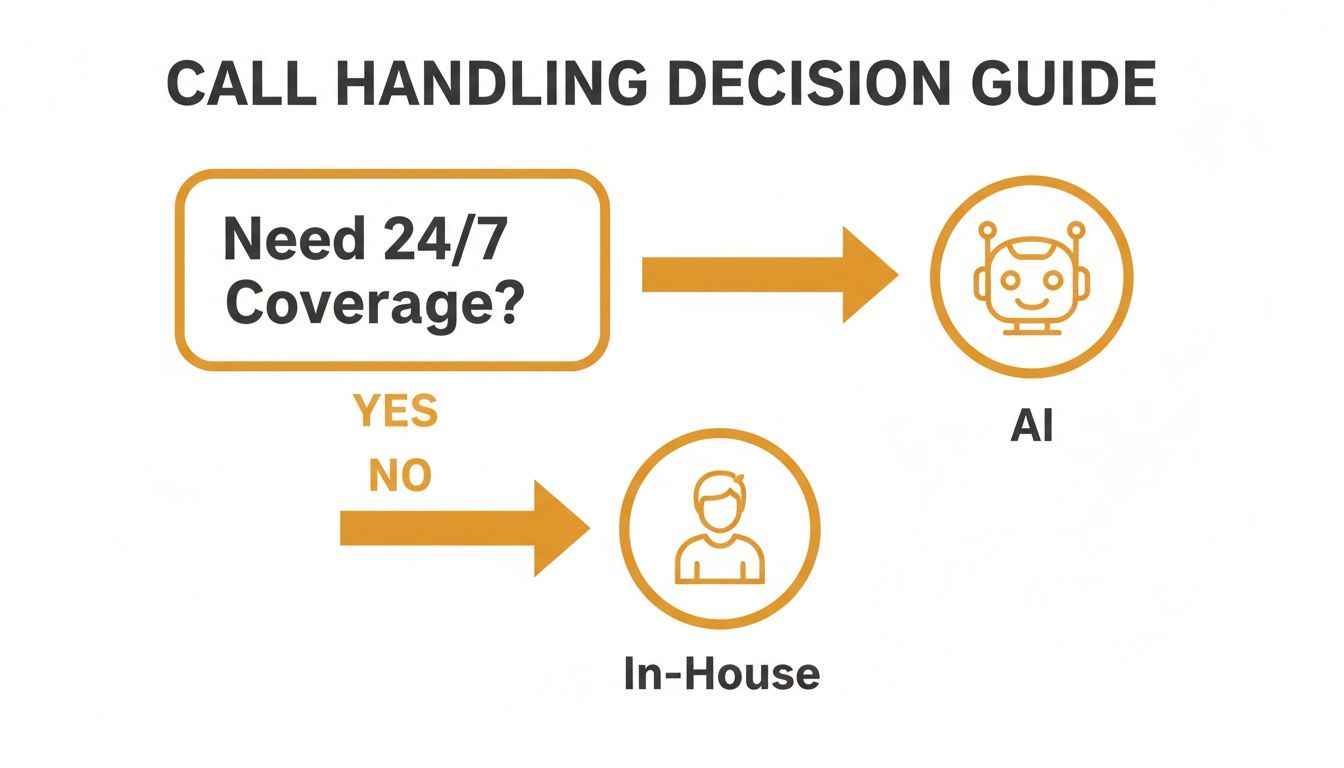
As the flowchart shows, the game changes if you need to capture leads around the clock. At that point, automation becomes the only practical and cost-effective solution.
Track Your Speed to Lead
In the moving business, the first company to provide a quote often gets the job. Speed to Lead measures how fast you engage with a potential customer. Calling someone back two hours later is usually two hours too late. This is where an automated or AI-powered service changes everything. The "response" is instant. That immediate connection stops a hot lead from hanging up and calling the next mover on Google, massively boosting your odds of booking the job.
Focus on Your Booking Conversion Rate
At the end of the day, the number that pays the bills is your Booking Conversion Rate. This is the percentage of qualified leads that become paying customers. A professional, immediate, and smart first impression has a huge impact here. When a caller is greeted by a system that understands their needs, gathers job details, and can schedule an estimate right then and there, their confidence in your company soars. That smooth experience translates directly into more booked jobs. You can play with the numbers yourself using this free moving company ROI calculator.
Industry Benchmarks for Success
Knowing your own numbers is half the battle. How do they stack up? In the service world, answering 80% of calls within 20 seconds is a long-standing benchmark. But today, the best are aiming for 90% in under 15 seconds because they know that's the window before a caller gives up. For a mover, where a single missed call on a Saturday while your crew is busy means thousands in lost revenue, every second counts. When you realize the average customer service call can cost between $2.70 and $5.60, the price of handling things inefficiently adds up fast.
By focusing on these clear KPIs, you can stop seeing a call handling service as just an expense. You’ll see it for what it is: a powerful engine for revenue growth.
How Modern Call Handling Transforms Your Operations
For most moving company owners, the end of a long day means starting a second shift: returning calls from a pile of sticky notes and voicemails, knowing you're already too late to win the job. This manual chaos isn't just stressful; it's a massive operational bottleneck.
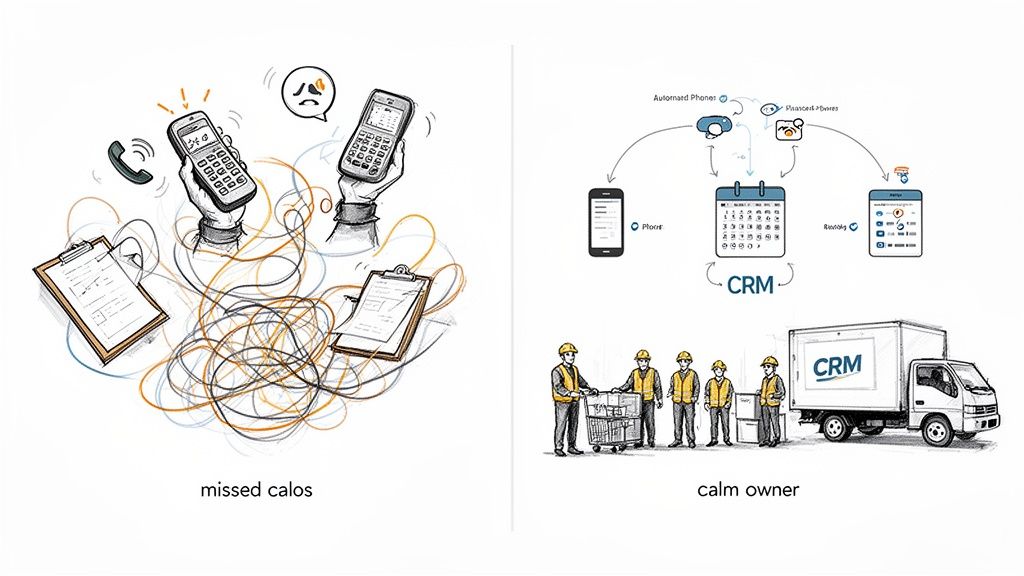
Now, picture this: the phone rings, but you don't have to stop what you’re doing. Every call is answered instantly. Every lead’s info is captured perfectly. Your calendar starts filling up with booked jobs—all while you’re out managing your crew. This isn't just about answering more calls. It's about fundamentally streamlining how your moving business runs.
Eliminating the Manual Grind
The most immediate change is the end of manual data entry and tedious callbacks. A modern call handling service acts as your perfect front-desk assistant, grabbing essential details and organizing the information instantly.
- No More Voicemail Tag: Forget listening to voicemails and calling people back hours later. You get a clean record of every inquiry because the system already handled the initial conversation.
- Automatic Lead Capture: Customer names, phone numbers, email addresses, and move details are captured automatically and accurately. No more scribbled notes or typos.
- Direct Calendar Integration: The best services connect directly to your schedule, booking qualified estimates or jobs into available slots without you lifting a finger.
To maximize this, connect your call handling to CRM solutions for small businesses. This integration turns a phone call into a well-managed customer profile from the very first ring.
Capturing Every Single Revenue Opportunity
Let's be honest, your best leads call when you’re least available—after 5 PM, on a Saturday, or during a chaotic morning dispatch. These aren't tire-kickers; they're high-intent customers ready to book. A modern call handling service with 24/7 availability means you never miss these prime opportunities again. Instead of seeing a missed call from a motivated weekend caller, you wake up to a new, qualified lead already logged in your system. This is a massive advantage over local movers stuck on a 9-to-5 schedule.
An automated call handling service transforms your phone line from a source of stress into a predictable, revenue-generating machine. It just works, tirelessly, in the background.
Automating Follow-Ups to Win More Jobs
How many jobs have you lost simply because you forgot to follow up on a quote? An automated system solves this. Once a customer's details are captured, an automated follow-up sequence can be triggered. A professional email or text gets sent at the perfect time, keeping your company top of mind. It’s a simple way to increase your booking rate without adding to your workload. See how this works in this breakdown of an AI receptionist for small business.
By removing these common bottlenecks, a modern call handling service frees you from the phone so you can focus on growing your business—managing crews, improving processes, and delivering five-star service.
How to Choose the Right Call Handling Partner
Picking a call handling service isn't like buying software. It's like hiring a new dispatcher who works 24/7. Get it right, and they become a seamless part of your team. Get it wrong, and you've bought yourself a new set of headaches. You need to look past the sales pitch and zero in on what actually works for a moving company with 1-20 trucks. A service built for a dentist's office just won't understand your world.
Industry Specialization Is Everything
Your business has its own language. Can the service tell the difference between cubic feet and a flat-rate quote? Do they know what "accessorial charges" or a "long carry" means? A generic service will trip over these terms, leaving customers confused and your team with bad lead info. You need a partner that speaks "mover" from day one.
Ask them directly:
- Have you worked with other moving companies? If they can't show you real examples, walk away.
- How does your system handle our industry's lingo? A solid AI service has been trained on thousands of actual calls from movers, not real estate agents.
It Must Integrate With Your Calendar and Software
The whole point is to book more jobs with less work. That only happens if the service can talk directly to the scheduling software you already use. If all it does is email you lead info, it's only solving half the problem. You're still stuck stopping what you're doing to book the job by hand.
The real magic is in direct calendar integration. A call comes in, the system instantly checks your availability, and a qualified job lands on your calendar in minutes—all without you touching the phone.
Before you sign anything, make sure the service plugs into your existing tools. It should make your life simpler, not add another layer of tech to manage.
It Has to Handle Your Busy Season
The moving business isn't a flat line. You might get ten calls on a Tuesday in February and a hundred on a Saturday in June. Your call handling partner has to absorb those massive seasonal spikes without breaking a sweat. An in-house receptionist gets buried. A per-minute call center gets insanely expensive. But a modern automated system can handle one call or a hundred simultaneously with zero drop in quality. That scalability is what lets you cash in when demand is highest.
Simplicity Is the Most Important Feature
As a moving company owner, you don't have time to become an IT expert. The best solutions are the ones that just work. Look for a simple, no-code setup you can get running in an afternoon, not a complex system that needs a tech team to install. The goal is to solve your missed call problem, not create a new technical one.
The demand for these services is exploding. The global call center market hit $352.4 billion in 2024 and is projected to reach $500.1 billion by 2030. That growth is fueled by businesses like yours looking for smarter ways to handle customer calls. In fact, contact centers using AI see a 14% jump in issues resolved per hour. You can discover more insights about call center statistics on cmswire.com.
By focusing on these four points, you can find a partner that actually understands your moving business and helps you book more jobs.
Your Path to More Booked Jobs
For moving company owners, the path forward is clear. Every day, the choice isn't just between answering the phone yourself or sending another call to voicemail. It’s between capturing every dollar of revenue or watching it go straight to a competitor who picked up faster. Missed calls aren't a minor annoyance; they're a direct, measurable drain on your bank account.

The old ways—like piling more work on your office staff or using a generic answering service—just don't cut it anymore. They weren't built for the speed of the modern moving business. They create delays and fail to solve the real problem: turning every single inbound call into a booked job, especially after 5 PM and on weekends.
Your Competitive Advantage
This is where a modern, AI-powered call handling service changes the game. It’s not about replacing your team; it’s about giving them a tool that makes them more efficient. By automating the repetitive task of answering and qualifying every call, you free up your crew and yourself to focus on what you're best at: running great moves. This technology is your secret weapon. It lets you offer the same 24/7 responsiveness as the big national van lines, leveling the playing field.
The goal is to achieve a high first-contact resolution (FCR)—where a customer's need is met in a single conversation. The industry benchmark is around 70-79%, but AI-driven systems can push this higher by instantly providing info or scheduling jobs, which is a lifesaver when your team is out on-site. And with voice assistants expected to hit 8.4 billion units worldwide, it's clear customers are more than ready for this.
Your Next Step
Stop thinking of your phone as a headache and start seeing it as your most powerful tool for growth. To increase your booking rate, from the first call to a paid invoice, you need a solid process for managing sales leads for faster conversions. By implementing an automated solution that provides instant, smart call answering, you can eliminate the missed call problem for good. You can streamline your front-office operations and put your company on a clear path to booking more jobs.
The technology is here, it’s affordable, and you can bet your competitors are already looking into it.
Got Questions? We've Got Answers.
Switching up how you handle calls is a big decision for your moving business. Here are the most common questions owners like you have.
How Much Money Am I Really Losing From Missed Calls?
The best way to see the impact is with some quick math. First, what's your average job worth? For many local movers, it’s around $1,500. Now, think about a busy week. How many calls do you think you miss? Let's say it's four. If you book about 50% of the qualified people you talk to, you just lost two solid jobs.
The Math: 2 lost jobs a week x $1,500 per job = $3,000 in weekly revenue down the drain. Over a year, that's a staggering $150,000. Often, booking just one of those lost jobs pays for a whole month of an automated call handling service.
Will This Thing Sound Like a Robot?
That’s a fair question, especially if you’re thinking about old "press one for sales" systems. Modern AI assistants are completely different. They use natural language processing to understand what a caller is saying and can respond like a real person—friendly, professional, and helpful. They're trained on thousands of real calls from the moving industry, so they know the difference between a "long carry" and a "COI."
How Long Does This Take to Set Up?
Forget hiring an IT person or clearing your schedule for a week. Most new AI call handling tools are built for business owners, not tech wizards. You can genuinely get one up and running in an afternoon. It's usually as simple as forwarding your current business number to the new service and connecting your calendar. No code, no headaches. The best automation "just works."
Can It Handle My Complex Moving Quotes?
This is a key point. The AI receptionist’s job isn't to provide a complex, final quote on the first call. That’s still your team’s expertise. Its role is to be the perfect first line of defense. It captures every single lead 24/7, asks the important qualifying questions (move size, locations, dates, special items), and then hands your sales manager a warm, detailed lead. It eliminates the time-wasting back-and-forth, so you can focus on providing an accurate quote and closing the deal.
Ready to stop sending good leads to voicemail and see what a 24/7 front office can do for your business? MoveJoy gives you an AI Receptionist that never misses a call, qualifies every lead, and can even book jobs right into your calendar.