10 Essential Call Handling Best Practices for Moving Companies
For a moving company owner, a ringing phone is the sound of opportunity. A missed call? That’s the sound of revenue walking out the door and straight to your competitor. In a market where customers need quotes immediately, the first mover to answer often wins the job. Many small to mid-sized moving companies lose three to seven jobs every single month simply because they couldn't get to the phone while on a job, after hours, or during a seasonal spike.
This isn't just a minor operational headache; it's a significant drain on your bottom line. Every unanswered call represents a potential high-value booking handed directly to another local mover. The reality is that modern customers don’t leave voicemails—they just call the next name on the list. Competing effectively no longer means just having the best crews; it means having the fastest and most reliable front office.
Mastering call handling best practices isn't about hiring more staff to sit by a phone. It's about implementing a smarter, more efficient system to capture every lead, streamline booking, and create a seamless customer experience that converts callers into booked jobs, 24/7. This guide breaks down ten essential practices that successful moving companies use to secure their pipeline and maximize revenue from the very first ring. You'll learn how to stop losing jobs to voicemail and turn every incoming call into a potential high-margin move on your calendar.
1. Answer Every Call Within the First Ring
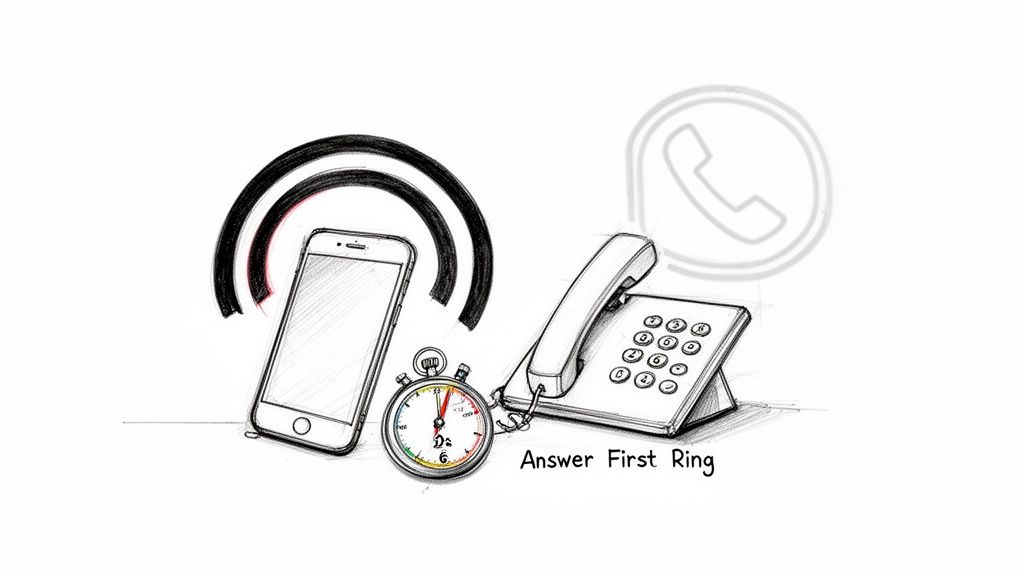
In the moving industry, speed is everything. When a potential customer calls for a quote, they are often calling multiple companies in a short window. Failing to answer immediately hands a high-value, ready-to-book lead directly to your competitor. Answering within the first ring, or within 2-3 seconds, is a foundational call handling best practice that maximizes your chances of capturing every opportunity.
For a moving company, where the owner and crews are often on-site managing a job, this standard can feel impossible. Voicemail is not a solution; a customer in need of a moving quote is not going to wait for a callback. They will simply dial the next number on their list.
Why This Is Non-Negotiable for Movers
An immediate answer communicates reliability and professionalism from the very first interaction. It stops the customer's search process in its tracks and gives you the first chance to win their business. This is especially critical during peak season when call volume spikes and every missed call represents significant lost revenue.
Key Insight: A 2021 study highlighted that 80% of business callers sent to voicemail do not leave a message. For a moving company, that's not just a missed call; it's a lost job, potentially worth thousands of dollars.
How to Implement an Instant-Answer Strategy
Achieving a sub-3-second answer time requires a system that doesn't rely on a single person being available.
- For After-Hours and Weekends: Implement a 24/7 solution like an AI receptionist. An AI system can instantly answer, qualify the lead, collect job details (like move size and locations), and even schedule a quote or book the job directly onto your calendar, ensuring you never miss a lead, even at 10 PM on a Saturday.
- During Business Hours: When your team is busy on a job, an AI system can handle overflow calls. This ensures every inbound lead is captured, even when your primary line is tied up or your team is in the field.
- Escalation Paths: Program your system to escalate complex or high-value calls to a live agent or the business owner directly. This creates a hybrid approach where routine intake is automated, but human expertise is available when needed. Automated systems with real-time dashboards allow you to monitor metrics like answer speed and abandonment rates, providing the data needed to perfect this process.
2. Gather Complete Job Details on First Contact
A vague lead is a dead end. When a customer calls, your primary goal, after answering instantly, is to capture every critical piece of information needed to provide an accurate quote and schedule the job. Incomplete details force you into a game of phone tag, create delays, and introduce errors. A core tenet of effective call handling best practices is to structure the initial intake to be comprehensive and definitive.
For a moving company, this means getting beyond just "I'm moving from A to B." You need the full picture: apartment or house, number of bedrooms, specialty items like pianos or gun safes, and access details like stairs or long carries. Failing to collect this information upfront leads to inaccurate quotes, frustrated customers, and crews showing up unprepared for the reality of the job.
Why This Is Non-Negotiable for Movers
Capturing complete details on the first call transforms a simple inquiry into a qualified, bookable job. It demonstrates professionalism and expertise, building the customer's confidence that you understand their needs. This structured process eliminates the guesswork that leads to under-quoting, which kills your profit margin, or over-quoting, which sends the customer straight to a competitor.
Key Insight: Industry data shows that scheduling errors and inaccurate quotes stemming from poor initial data collection are a leading cause of negative customer reviews and last-minute cancellations. Every detail you miss is a potential point of failure.
How to Implement a Structured Intake Process
A systematic approach ensures no critical detail is overlooked, whether a human or an AI is handling the call.
- Develop Service-Specific Scripts: Create clear, guided question templates for different move types. A script for a 1-bedroom apartment move should be different from one for a 4-bedroom house with packing services. This standardizes data collection across your team.
- Use an AI Receptionist: An AI system like an automated assistant can be trained to execute these scripts perfectly on every call. It can ask about inventory, access conditions, and desired move dates, collecting structured data that syncs directly into your CRM or scheduling software. This ensures 100% consistency, 24/7. For more information on converting inquiries into customers, explore how to streamline your prospect-to-customer journey.
- Integrate Data Directly into Job Tickets: The information gathered on the call must be instantly accessible to your operations team and crew. An automated system can create a detailed job ticket from the call data, giving your movers all the information they need, from gate codes to a list of fragile items, before they even start the truck.
3. Qualify Leads in Real-Time During Calls
Not every ringing phone is a profitable job. One of the most critical call handling best practices is to determine, in real-time, whether a caller is a good fit for your moving company. Real-time qualification means applying your specific business criteria during the initial call to filter out jobs that don't align with your service area, crew capacity, or operational sweet spot. This prevents wasted time on quotes that will never book and allows you to prioritize high-value opportunities.
For a moving company, this isn't about turning away business; it's about protecting your resources. Sending a crew on a small, out-of-area job can cost you a more profitable multi-truck move closer to home. Effective qualification ensures your schedule is filled with the right kind of work, maximizing revenue per truck and per hour.
Why This Is Non-Negotiable for Movers
Real-time qualification acts as a gatekeeper for your sales pipeline, stopping unprofitable leads before they consume valuable administrative time. It ensures your estimators and sales team focus only on callers who have a high probability of booking and being profitable. For movers, this means instantly identifying if a job is too small, too far, or requires specialty services you don't offer.
Key Insight: Top-performing service businesses convert qualified leads at a rate 50% higher than their unqualified counterparts. For movers, this means a well-defined qualification process directly translates to a more profitable calendar and less time wasted on dead-end quotes.
How to Implement a Real-Time Qualification Strategy
A strong qualification process is systematic and can be automated to ensure consistency on every single call.
- Define Your Criteria: Work with your operations team to establish clear, non-negotiable rules. These "hard stops" could include service area boundaries (e.g., must be within a 30-mile radius), minimum job size (e.g., 2-bedroom apartment or larger), or specific service needs you don't support (e.g., piano-only moves).
- Automate the Intake: Use an AI receptionist to ask these qualifying questions upfront. The AI can instantly cross-reference the caller's starting and ending zip codes with your service map or ask about the size of the home before collecting further details.
- Create Tiered Logic: Program your system with both hard stops and "soft flags." A hard stop might be a caller outside your state, while a soft flag could be a last-minute move request that gets escalated to a manager for review. An automated system can be configured to handle these rules automatically, ensuring that only viable leads are scheduled for a formal quote. This frees your team to focus on closing, not just filtering.
4. Provide Instant Availability and Book Appointments Live
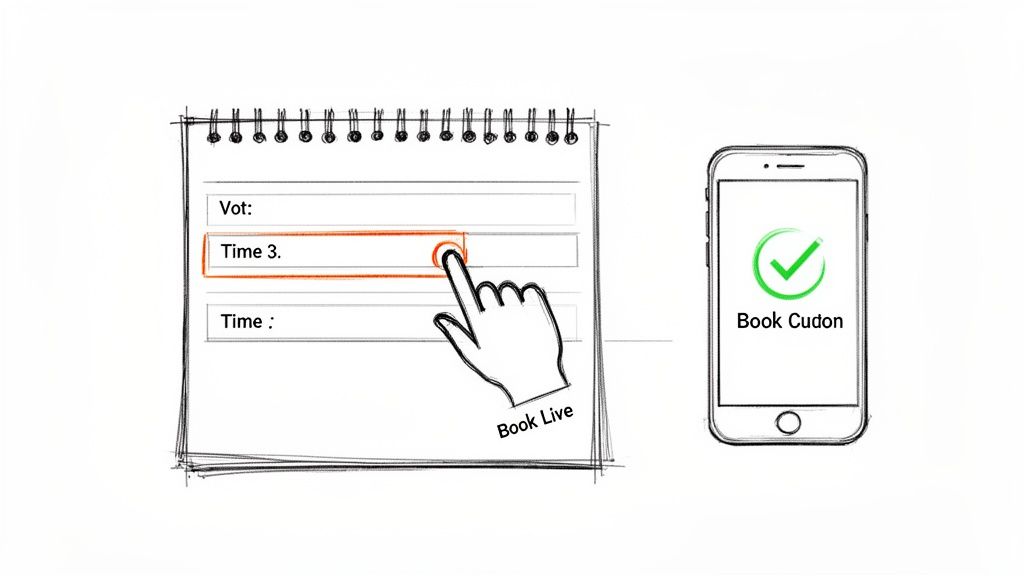
In the moving business, the gap between a customer's inquiry and a confirmed booking is where revenue is lost. A customer who has to wait for a callback to confirm a time for an in-home estimate or the move itself is a customer who is still shopping. A crucial call handling best practice is to eliminate this delay by integrating your phone system directly with your live crew and sales calendars. This allows you to offer available slots and confirm bookings in a single interaction.
This practice transforms a simple inquiry call into a closed deal. Instead of saying, "Let me check our schedule and get back to you," you can confidently say, "We have an opening next Tuesday at 9 AM or Thursday at 1 PM. Which works better for you?" This efficiency not only impresses the customer but also locks in the job before they can call a competitor.
Why This Is Non-Negotiable for Movers
Friction is the enemy of conversion. Every manual step, every callback, and every moment of uncertainty gives a potential customer a reason to look elsewhere. Live calendar integration removes this friction entirely, making the booking process seamless and immediate. It conveys a level of organization and technological sophistication that builds trust from the outset.
Key Insight: According to HubSpot, 51% of customers are more likely to do business with a company they can message or interact with in real-time. Extending this principle to phone bookings means turning conversations directly into calendar appointments, which drastically shortens your sales cycle.
How to Implement a Live Booking Strategy
Integrating live scheduling requires a system that connects your phone to your operational calendar without manual intervention.
- Centralize Your Calendar: Use a digital calendar system like Google Calendar or a dedicated field service management tool. Ensure all crew availability, job durations, and travel times are accurately reflected.
- Automate the Connection: An AI receptionist is the most effective way to bridge the gap. Automation tools can integrate directly with your calendars, allowing the AI to see real-time availability and book jobs or estimates based on predefined rules, 24/7.
- Configure Your Rules: Set up smart booking parameters. For example, add automatic buffer times for travel between jobs, block off lunch breaks, and define service radiuses. This prevents double-booking and ensures your schedule is realistic and efficient.
- Send Instant Confirmations: Once a slot is booked, the system should automatically send an SMS and email confirmation to the customer. This professional touch reduces no-shows and reinforces the customer's decision to choose your company.
5. Maintain Professional, Natural Communication Standards
How you sound on the phone directly reflects the quality of your moving service. A flustered, unprofessional, or robotic greeting can make a potential customer question whether you can be trusted with their belongings. Maintaining professional and natural communication standards is a core call handling best practice that builds immediate trust and sets a premium tone for your brand.
For moving company owners juggling calls between jobs, it's easy to sound rushed or distracted. Yet, every caller is evaluating your competence from the first word. They expect a clear, confident, and empathetic voice that understands the stress of moving and can guide them to a solution, not add to their anxiety.
Why This Is Non-Negotiable for Movers
Professional communication is your first opportunity to differentiate your service. In a competitive market, a customer's decision often comes down to who they trust more. A courteous, knowledgeable, and natural conversation signals that you are a well-run operation that values its customers, justifying a premium price and securing the booking over a cheaper, less professional competitor.
Key Insight: A customer service study revealed that 73% of customers fall in love with a brand and remain loyal because of friendly service reps. For movers, this "love" translates directly into booked jobs, positive reviews, and valuable referrals.
How to Implement Professional Communication Standards
Ensuring every call meets a high standard requires consistency, whether handled by a human or an AI.
- Create Industry Playbooks: Develop simple scripts or talking points for common scenarios like quoting a 3-bedroom house, explaining insurance coverage, or handling a last-minute booking request. This ensures key information is always delivered clearly and professionally.
- Leverage Conversational AI: Modern AI systems are trained on thousands of real mover-customer conversations. This allows them to use natural language, understand regional accents, and respond with human-like empathy, ensuring your brand sounds professional and helpful 24/7.
- Regularly Review Calls: Set aside time each month to listen to call recordings, both from your team and any automated systems. Use these recordings to identify areas for improvement, refine scripts, and ensure your communication style aligns with your brand’s values. Full call transcripts and recordings in a dashboard make quality assurance simple.
- Gather Customer Feedback: Use simple post-call SMS surveys to ask customers to rate the communication quality. This provides direct feedback on what's working and what isn't, allowing you to continually perfect your front-office experience.
6. Eliminate Voicemail and Call Overflow with 24/7 Coverage
For a moving company, every unanswered call is a potential job handed directly to a competitor. Voicemail is where high-intent leads go to die. Customers calling for a move need immediate answers, not a promise of a callback that may never come. Implementing 24/7 coverage is a critical call handling best practice that ensures you capture every lead, whether it comes in at 2 PM on a Tuesday or 10 PM on a Saturday.
This round-the-clock availability isn't just for emergencies; it's about meeting customers at their moment of peak intent. People often plan their moves after work or on weekends, precisely when most moving company offices are closed. Answering these calls live, qualifying the lead, and getting them booked for a quote creates an unbeatable competitive advantage.

Why This Is Non-Negotiable for Movers
A 24/7 presence transforms your business from a standard 9-to-5 operation into a highly responsive, customer-centric service. This is particularly vital for handling call overflow during peak season when your main lines are constantly busy. Instead of a frustrating busy signal or a voicemail box, every caller is engaged, qualified, and moved to the next step, maximizing your revenue potential during your busiest times.
Key Insight: Customers who are able to connect with a business on their first attempt are significantly more likely to convert. For movers, this instant connection can be the single deciding factor between winning a $5,000 job or losing it to the next company on the customer’s list.
How to Implement a 24/7 Coverage Strategy
Achieving true 24/7 coverage without hiring an expensive, multi-shift team requires leveraging automation and smart systems.
- Deploy an AI Receptionist: An AI-powered system can answer every call instantly, day or night. It can gather essential job details, provide basic information, and schedule in-home or virtual estimates directly onto your calendar, ensuring no lead is ever lost to voicemail again. This is a far more effective and scalable alternative when compared to finding the best answering service for small business that often struggles with industry specifics.
- Handle Call Overflow Seamlessly: During business hours, when your team is on another call or out on a job, the AI can act as an intelligent overflow system. It captures the call, qualifies the lead, and prevents the caller from hanging up and dialing your competitor.
- Set Up Smart Escalation: For urgent or complex inquiries, program your system to escalate the call to a designated team member. This hybrid approach ensures routine inquiries are handled efficiently by AI, while high-priority calls get immediate human attention.
7. Send Immediate Confirmations, Follow-Ups, Reviews and Referral Requests
The job isn't over when the customer hangs up. One of the most critical call handling best practices is automating the communication that happens after the call. A booking is only secure once the customer feels confident and informed. Automating confirmations, reminders, and post-job follow-ups solidifies the booking, reduces no-shows, and turns a one-time job into a source for future business through reviews and referrals.
For a moving company, this automated loop is a powerful engine for growth. It professionalizes your operation, keeps your schedule tight, and builds your online reputation without requiring manual effort from your team. This system works around the clock, ensuring every customer gets the right message at the right time, from the moment they book to long after their move is complete.
Why This Is Non-Negotiable for Movers
A verbal "yes" on the phone can easily be forgotten. Immediate written confirmation locks in the commitment and drastically reduces the chance of a customer continuing their search or double-booking with a competitor. Post-move, the window to capture a positive review is extremely narrow. Automating this request ensures you strike while the customer's satisfaction is highest, building the social proof that new leads rely on.
Key Insight: A well-timed SMS has an open rate of up to 98%. Automating confirmations and review requests via text is the single most effective way to ensure your customers see and act on critical information, directly impacting both your operational efficiency and your brand reputation.
How to Implement an Automated Communication Strategy
Setting up this workflow is simpler than it sounds and creates a seamless customer journey that drives revenue.
- Immediate Booking Confirmations: As soon as a job is booked, trigger an automatic SMS and email. This message should confirm the date, time, address, and estimated cost. Including what the customer can expect on moving day adds a professional touch that builds trust.
- Strategic Pre-Move Reminders: Schedule a sequence of reminders: one a week out, another 72 hours before, and a final one 24 hours prior. These messages reduce last-minute cancellations and ensure your customers are prepared, making the move day smoother for your crew.
- Post-Job Review and Referral Requests: Within 1-2 hours of the crew marking the job complete, send an automated text. This message should thank the customer and include a direct, one-click link to leave a review on your Google Business Profile. A follow-up email can offer a small incentive, like a $25 gift card, for referring a friend. The right automation platform can integrate this entire sequence into your booking process, ensuring every customer interaction is optimized for retention and growth.
8. Implement Smart Call Routing and Escalation Protocols
Not all calls are created equal, and not every team member is equipped to handle every type of inquiry. Smart call routing is the practice of automatically directing inbound calls to the most appropriate person or department based on predefined rules. This ensures that a customer with an urgent issue isn't stuck explaining their situation to a new sales rep, and a high-value commercial lead isn't delayed by a dispatcher managing an active job.
This system is about more than just efficiency; it's a critical call handling best practice that reduces customer frustration and dramatically increases the speed of resolution. By establishing clear escalation protocols, you create a safety net, ensuring complex or urgent issues are flagged and handled by senior staff or the business owner without delay, preventing small problems from becoming costly mistakes.
Why This Is Non-Negotiable for Movers
In the moving industry, a single call can represent thousands of dollars. A frantic customer calling about potential damage needs a different level of care than someone asking for a quote for a one-bedroom apartment. Effective routing ensures the right person handles the call from the start, conveying competence and control. It prevents the customer from being bounced between staff, a frustrating experience that erodes trust before your crew even arrives.
Key Insight: Customer service studies show that 68% of customers are willing to pay more for services from a company with a strong history of good customer service. Efficient call routing is a foundational element of that positive experience.
How to Implement a Smart Routing Strategy
A well-defined routing system eliminates guesswork and empowers your team, whether human or AI, to manage calls effectively.
- Define Your Call Tiers: Create a simple decision tree. For example, calls mentioning "damage," "complaint," or "insurance" could be escalated to a manager. Inquiries about "commercial," "long-distance," or "storage" might go to a dedicated sales specialist, while standard "quote" requests are handled by your front line or an AI assistant.
- Leverage AI for Triage: Use an AI receptionist to act as the initial filter. The AI can be trained to recognize trigger words and customer sentiment. If it detects urgency or frustration, it can perform a warm transfer to the appropriate human agent, providing context so your team member is prepared.
- Establish Clear Escalation Paths: Program your system so that if a call isn't resolved by the primary contact (or AI) within a set time or under specific conditions, it automatically moves up the chain. This ensures no high-stakes customer is left waiting. Monitoring these routing patterns helps you identify bottlenecks and refine your protocols for maximum efficiency.
9. Create Comprehensive Call Recordings and Transcripts for Quality Assurance
You can't fix what you can't measure. In a high-stakes service business like moving, the quality of every customer conversation directly impacts your booking rate and reputation. Simply handling calls isn't enough; you need to analyze them. Maintaining detailed audio recordings and searchable text transcripts of customer calls is a critical best practice for quality assurance, training, and uncovering powerful business insights.
For a moving company owner juggling multiple crews and active jobs, reviewing calls might seem like a luxury. However, these recordings are a goldmine of data. They reveal exactly what words, phrases, and processes lead to a booked job versus a lost lead. Without this data, your team is operating on guesswork, potentially repeating costly mistakes with every new customer who calls.
Why This Is Non-Negotiable for Movers
Call recordings provide an objective record of the customer interaction. They allow you to pinpoint communication breakdowns, verify job details, resolve disputes, and identify your top-performing scripts and sales tactics. This isn't about micromanagement; it's about creating a scalable, repeatable process for winning business over the phone and ensuring every customer receives a consistent, professional experience.
Key Insight: Franchises and multi-location service businesses rely heavily on call analytics to standardize their sales and customer service processes. By analyzing call data, they identify the most effective communication patterns and use them to train their entire network, ensuring a uniform brand experience and maximizing conversion rates across all territories.
How to Implement a Call Recording and Analysis Strategy
Implementing this practice is simpler than ever with modern technology. The goal is to capture, store, and review calls systematically.
- Obtain and Announce Consent: Always inform callers that the call may be recorded for quality assurance and training purposes. This is often a legal requirement and can be easily handled with an automated message at the beginning of the call.
- Use an Integrated System: An AI-powered platform automatically records and transcribes every call it handles. This creates a centralized, searchable database of all customer interactions without any manual effort. You can instantly review call details, analyze AI performance, and identify areas for script improvement.
- Establish a QA Cadence: Dedicate time each month to review a sample of calls. To ensure your comprehensive call recordings and transcripts effectively drive improvement, delve deeper into the principles of successful call center quality assurance. Focus on both strong and weak interactions to create training materials that highlight what works and what doesn't.
- Leverage Transcripts for Training: Use searchable transcripts to quickly find examples of specific scenarios, such as handling pricing objections or explaining valuation coverage. Share these exemplary call snippets with your team to model effective communication and ensure everyone is aligned on the best call handling best practices.
10. Monitor Real-Time Analytics and Adjust Processes Continuously
You cannot improve what you do not measure. In the moving business, relying on gut feelings to manage your front office is a recipe for missed opportunities and stagnant growth. A modern approach to call handling best practices involves using real-time data to see exactly what’s working, what’s not, and where the biggest revenue leaks are. This means tracking key metrics to make informed decisions instead of guessing.
Continuously monitoring analytics transforms your call handling from a reactive task into a strategic, data-driven operation. By observing trends in call volume, booking rates, and call duration, you can pinpoint bottlenecks, optimize team performance, and adapt to changing customer behaviors before they negatively impact your bottom line.
Why This Is Non-Negotiable for Movers
Data provides the ultimate proof of performance. Are you missing more calls between 3-4 PM when crews are finishing jobs? Are leads who call on Saturdays converting at a higher rate? Analytics answer these critical questions, allowing you to allocate resources effectively, refine your sales scripts, and prepare for seasonal rushes with precision. This proactive approach ensures you are always operating at peak efficiency.
Key Insight: Companies that use data analytics to drive decisions are 5-6% more profitable than their peers. For a moving company, this could mean thousands of dollars in additional revenue each month just by optimizing how calls are handled.
How to Implement a Data-Driven Strategy
Turning data into actionable insights requires setting up a system for tracking and reviewing key performance indicators (KPIs).
- Define Your Core KPIs: Don't get lost in vanity metrics. Focus on what truly matters: Answer Rate (how many calls are you picking up?), Call Abandonment Rate (how many callers hang up before connecting?), Booking Conversion Rate (what percentage of qualified leads book a job?), and Average Call Duration (are calls efficient and productive?).
- Establish a Review Cadence: Set aside time each week to review a performance dashboard with your operations and sales team. Look for trends, celebrate wins, and collaboratively diagnose issues. For example, if you see a drop in your booking rate, you can investigate if it's related to a new script, a competitor's pricing, or a specific team member's performance.
- Leverage an Automated System: Manually tracking calls is nearly impossible. An AI receptionist provides a real-time dashboard that automatically logs and visualizes every interaction. You can instantly see call volume by hour, track booking conversions, and analyze lead sources without building a single spreadsheet, giving you the power to adjust your strategy on the fly.
Turn Your Phones into a Growth Engine
We've explored ten critical call handling best practices, from answering on the first ring to leveraging real-time analytics. Each principle is a powerful lever for growth. Implementing these strategies is not merely about improving customer service; it's a fundamental shift in how your moving company captures and converts revenue. The difference between a missed call and a booked job is often a matter of seconds.
Mastering these techniques transforms your phone line from a simple communication tool into your most reliable revenue stream. However, the operational reality for most movers, especially during peak season, makes manual execution nearly impossible. A single person cannot be expected to answer every call instantly, qualify every lead perfectly, and manage scheduling while also running the business. This is where automation becomes a competitive advantage.
From Manual Effort to Automated Excellence
True scalability is achieved when these best practices run flawlessly in the background, freeing your team to focus on high-value tasks and delivering five-star moving experiences. Automation is the bridge that closes the gap between knowing what to do and having the capacity to do it.
Consider the compounding impact:
- 24/7 Lead Capture: An automated system captures the lead who calls at 10 PM on a Saturday—a customer you would have otherwise lost.
- Perfect Qualification, Every Time: An AI-powered system follows your script without deviation, providing your sales team with perfectly prepped leads.
- Instant Calendar Integration: The friction of scheduling callbacks is eliminated. An AI receptionist can access your live availability and book qualified jobs directly, securing revenue in a single interaction.
This operational efficiency isn't just about saving time; it's about fundamentally altering your business economics. A single booked job recovered from a missed call often covers the entire monthly cost of an automation solution. This reframes the technology not as an expense, but as a self-funding growth engine.
The Path Forward: Implementing Smart Systems
Your next step is to evaluate which of these best practices presents the biggest bottleneck in your current operation. Is it missed calls after hours? Inconsistent lead qualification? The administrative burden of scheduling and follow-ups? Pinpoint your greatest area of opportunity and begin exploring how automation can provide a targeted solution.
By systemizing your call handling, you are future-proofing your business. You build a scalable foundation that can handle seasonal spikes without sacrificing service quality, allowing you to grow your fleet without the proportional increase in front-office headcount. To truly turn your operations into a growth engine, complementing efficient call handling with advanced digital strategies is key. Explore how modern AI lead generation tools can automate and enhance your lead capture and qualification processes across all channels. Ultimately, adopting these call handling best practices through automation ensures you never again lose a job because you were too busy to pick up the phone.
Ready to transform your call handling from a cost center into a powerful revenue driver? MoveJoy is an AI-powered front-office assistant designed specifically for moving companies, automating everything from 24/7 call answering and lead qualification to live booking and follow-ups. See how MoveJoy can help you book more jobs, eliminate missed calls, and streamline your operations today.