The Ultimate Guide to a Phone Answering Service for Small Business Movers

Every time your phone rings and you can't get to it, a job vanishes. For a moving company owner, a missed call isn’t just a small hiccup; it's thousands of dollars in revenue evaporating into thin air. A phone answering service for small business owners is the tool that plugs that leak for good.
Why Missed Calls Are Costing Your Moving Business Thousands
That ringing phone is the sound of money. But when you’re on-site managing a crew, in the middle of a quote, or driving between jobs, you can't always pick up. The hard truth is, today’s customers don’t wait around. They need a mover now, and they are not going to leave a voicemail. They’ll just hang up and dial the next company on their list. The first mover to answer the phone almost always wins the job.
This isn’t just a gut feeling; it’s a massive hole in your operations that’s draining your profits. Each time the phone rings unanswered, you've lost the chance to book a high-value job. When you think about the average local move being worth $1,500 or more, losing just a few of those calls a week carves a huge gap in your revenue by the end of the month.
The Real Cost of Voicemail
Think of your voicemail as a black hole where jobs go to die. A customer, ready to book, hits your generic recording. What do you think happens next?
- They hang up: Most callers, especially for an immediate need like moving, won't bother leaving a message. They need an answer and a booking right now.
- They call your competitor: Within seconds, they've already dialed another local mover who actually picked up the phone.
- You lose the revenue: By the time you finally check your messages and call back, that lead is ice cold. They've already booked with someone else.
This cycle repeats all day, every day, silently eating away at your bottom line. We've dug deep into this problem, and you can see the numbers for yourself in the real cost of missing just four calls per week here.
Customer Expectations Have Changed
People today expect instant everything. The latest research shows that 91% of customer service leaders are seeing customer expectations rise year after year. They want faster responses and immediate answers, and making them wait is the same as giving them bad service. You can find more stats about these rising customer support expectations on ambscallcenter.com.
A professional answering service flips this whole problem on its head. Instead of watching leads disappear into the voicemail void, every single call gets captured, qualified, and turned into a potential booking. It turns your phone line from a constant source of stress into a reliable, revenue-generating machine that works even when you're out on a job.
How Answering Services Really Work for Modern Moving Companies
If you're picturing an operator in a cubicle somewhere just taking a name and number, you need to update that image. A modern phone answering service for small business movers isn't about covering calls—it's about automating your entire front office. Think of it as an engine that qualifies leads, sends instant quotes, and books jobs the second a customer calls.
The old way was a killer. A human operator would take down some info and promise a callback. In the moving industry, that delay is a deal-breaker. By the time you call back, that customer has already booked with the company that answered and gave them a price on the spot. Speed determines who wins the job.
Today, the process is instant and smart, especially with AI-powered systems.
Traditional vs. AI-Powered Services
This is where the game changes for moving companies. The two main types of answering services offer wildly different value for your operations.
- Traditional Call Centers: You get a live agent who answers the phone using a script you provide. It’s better than sending callers to voicemail, but they hit a wall fast. They can’t see your crew’s real-time schedule or give an accurate quote on the fly. They’re great for basic message-taking, but they create a bottleneck the moment a customer says, "Okay, let's book it."
- AI Receptionists: This is the game-changer. An AI receptionist plugs directly into your business operations. It can check your crew's availability in real-time, ask the caller the critical questions ("Is it a one-bedroom apartment or a four-bedroom house? Are there stairs?"), and generate a professional quote—all within seconds.
A modern AI receptionist doesn't just answer the phone; it automates the whole lead-to-booking workflow. This speed is what wins you jobs when customers are calling three or four movers for quotes.
Failing to answer a call has a direct, painful financial consequence in this business.
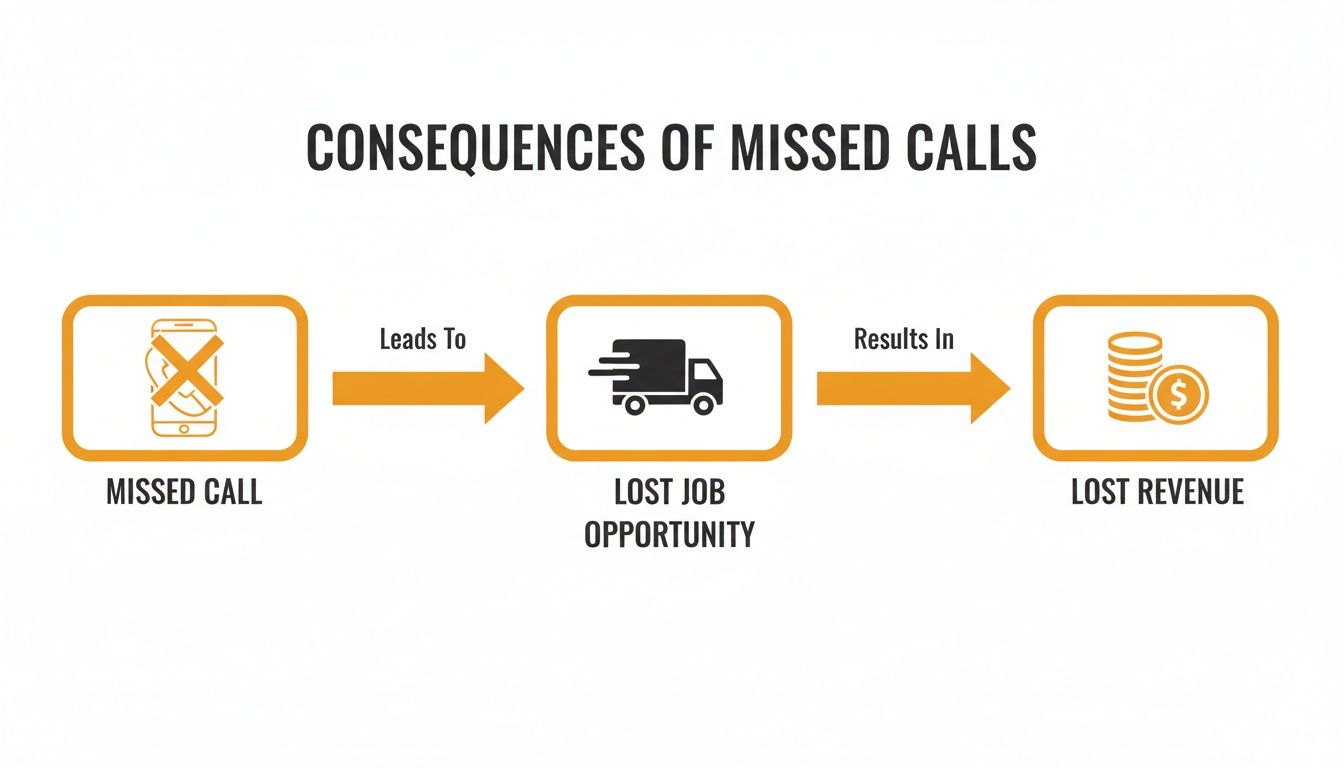
The path is painfully clear: every single missed call is a straight line to lost revenue.
How an AI Receptionist Books a Moving Job
Picture this: It's 8 PM on a Tuesday. A potential customer calls your number. Instead of hitting your voicemail, they get a professional greeting from an AI system that immediately gets to work.
- Lead Qualification: The AI starts asking the important questions: "Where are you moving from and to?" "Are there any stairs or elevators involved?" "Are we moving a piano?"
- Calendar Integration: It instantly checks your crew’s live schedule to see if you're available on the customer's preferred moving date. No more back-and-forth.
- Instant Quoting: Using the details from the call, it texts or emails an accurate quote right to the customer's phone, based on your pricing.
- Automated Booking: If the customer likes the price, the AI can book the job, send a confirmation, and pop it right onto your calendar. You haven't lifted a finger.
The best services also use technology like customer support transcription to log every detail from the call, making sure nothing gets missed and giving you valuable data on your leads. This level of automation ensures you’re always the fastest and most professional mover a customer can reach.
Must-Have Features in an Answering Service for Movers
Let's be blunt: not all answering services are created equal, especially for moving companies where speed and accuracy mean everything. A generic service that just takes messages is the modern equivalent of sending a hot lead straight to voicemail. It's a dead end.
To turn your phone line into a money-making machine, you need a system with specific, powerful features that solve the problems movers face every day. These are the core functions that directly lead to more booked jobs and less chaos for your team.
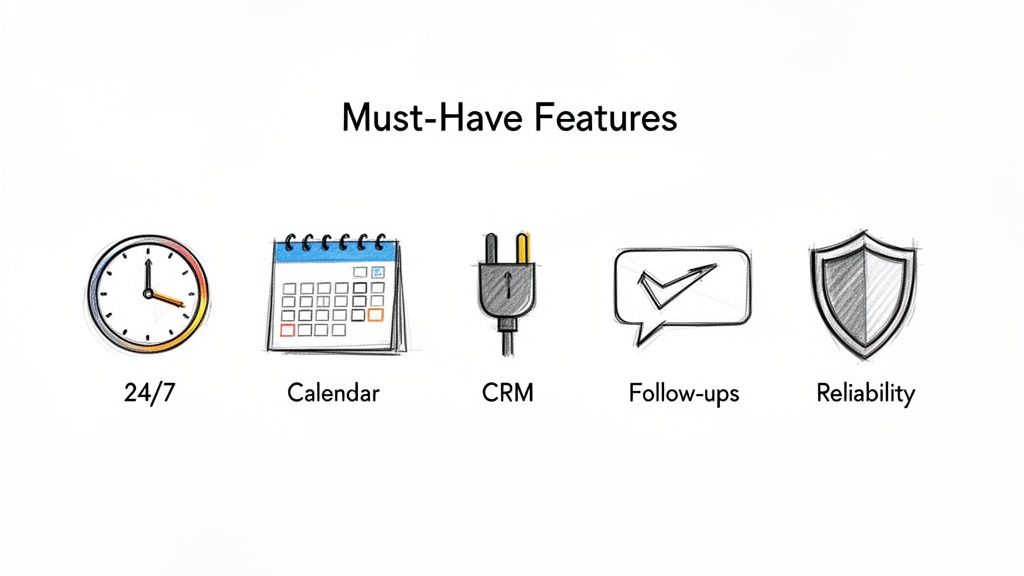
24/7 Availability and Instant Lead Capture
Leads don’t care about your 9-to-5 schedule. A potential customer is just as likely to research their move after putting the kids to bed or on a lazy Sunday afternoon. If you’re not there to pick up, you can bet your top competitor will be.
This is non-negotiable. Your service must offer 24/7/365 availability. Every single person who calls your number needs to be greeted professionally and have their information captured instantly. This simple act turns a missed opportunity into a warm lead in your system, ready for follow-up. It's your first line of defense against lost revenue.
Direct Calendar and Scheduling Integration
This is the feature that separates the pros from the amateurs. A service that can't see your crew’s availability is just creating an extra step. It forces you to play phone tag with the customer later to confirm a date, by which time they’ve probably already booked with another mover.
Your answering service absolutely must integrate directly with your scheduling calendar.
- Real-Time Availability Checks: The system needs to see exactly when your trucks and teams are free and when they’re booked solid.
- Automated Booking: It has to be able to drop a new, confirmed job right onto your calendar without you lifting a finger.
- No More Double-Booking: A smart integration makes it impossible to accidentally schedule two high-paying jobs for the same truck at the same time.
Automated Quoting and Follow-Up Sequences
Speed is king in the moving game. A customer calling for a quote wants it now, not in three hours when you get back to the office. Your answering service should act like an extension of your sales team, asking the key qualifying questions—move size, locations, specialty items—and then immediately texting or emailing a professional estimate based on your rates.
But the work doesn't stop there. Most customers shop around. A top-tier service will have automated follow-up capabilities, sending a polite text a day or two later to check in. That simple, automated nudge is often the difference between a forgotten quote and a booked job.
Call Routing and Warm Transfers
Sometimes, a call really does need your personal touch. It could be a massive commercial lead or a tricky situation an automated system can't solve. For these moments, the service needs to have intelligent call routing.
The best systems can perform a "warm transfer," where the caller is handed off to you smoothly, with the system providing full context on who they are and what they need. Our guide on what a warm transfer is and how it works breaks this down further. This protects your time for the big-ticket items while letting automation handle the rest.
When you're shopping around, it's easy to get lost in a sea of features. Here’s a quick checklist to separate what you absolutely need from what's just nice to have.
Essential vs. Optional Answering Service Features for Movers
| Feature | Impact on Moving Operations | Priority |
|---|---|---|
| 24/7 Live Answering | Captures every single lead, regardless of time or day. Prevents losing business to competitors after hours. | Essential |
| Direct Calendar Booking | Books jobs instantly without manual entry, eliminating phone tag and reducing the risk of a lead going cold. | Essential |
| Automated Quoting | Provides instant quotes to callers, dramatically increasing the chances of winning the job over slower competitors. | Essential |
| CRM Integration | Automatically logs all call details, leads, and bookings into your system (e.g., SmartMoving, Supermove). | Essential |
| Automated Follow-ups | Nurtures warm leads who received a quote but didn't book, recovering otherwise lost revenue. | Essential |
| Bilingual Agents | Expands your potential customer base in diverse markets, but may not be critical in all service areas. | Optional |
| Appointment Reminders | Helps reduce no-shows and last-minute cancellations, but this can often be handled by your CRM. | Optional |
| Outbound Calling | Can be useful for things like customer satisfaction surveys, but isn't a core function for capturing inbound leads. | Optional |
Ultimately, focus on the features in that "Essential" column. They are the ones that directly stop revenue from leaking out of your business and free up your time to actually run your moving company.
Calculating the Real ROI of an Automated Answering Service
Features are nice, but as a moving company owner, you only care about one thing: "Will this make me more money?" Let's ditch the jargon and break down the return on investment (ROI) for an automated phone answering service for small business movers. The math is simpler—and more powerful—than you might think.
Here's the bottom line: booking just one extra move a month almost always pays for the entire service.
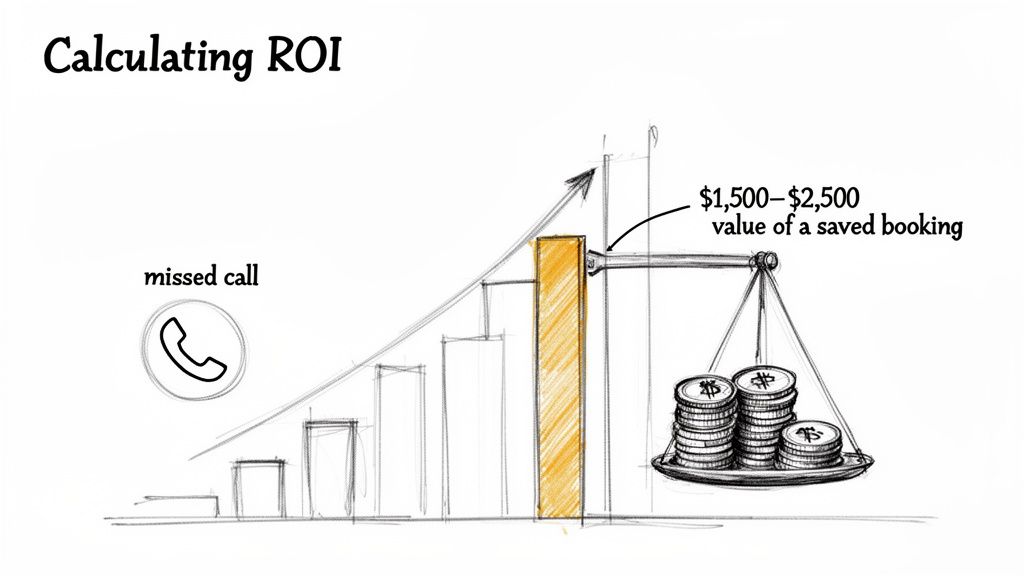
Think about the real-world value of a single missed call. That person looking to book a 3-bedroom local move? That's easily $1,500 to $2,500 in revenue. If your new system stops just one of those leads from hanging up and calling your competitor, it's already paid for itself, probably a few times over.
The Profit Center Mindset
It's tempting to look at an answering service as another monthly bill. That’s a mistake. A reliable automated system isn’t a cost center; it’s a profit center. It’s designed specifically to capture the revenue that’s currently slipping right through your fingers every time the phone rings and you can't pick up.
Let's look at the raw numbers:
- Lost Job Revenue: If you miss just four calls a month that could have become booked jobs, you're potentially leaving $6,000+ on the table.
- Cost of Service: An automated system costs just a tiny fraction of that lost revenue.
- Immediate ROI: The moment the service saves its first job, you’re already in the green on your investment.
The real cost isn’t the monthly fee for the service; it’s the price of your existing missed calls. Automation is simply a tool to turn that consistent loss into a predictable gain.
Secondary Benefits That Boost Your Bottom Line
Beyond the direct cash from saved jobs, an automated answering service adds to your bottom line in other powerful ways. These are the hidden financial perks that lighten your workload and make your entire operation more profitable.
The global answering services market has exploded into a massive $8.4 billion industry for a reason—professional call handling has become a non-negotiable for businesses that want to grow. You can learn more about the growth of the answering services market at kentleyinsights.com.
Here's how that investment pays you back:
- Slash Your Administrative Workload: How many hours do you or your team burn on the phone qualifying leads that go nowhere? Automating that first touchpoint frees everyone up for high-value work like managing crews, following up with high-priority customers, or improving your marketing.
- Improve Your Company's Image: A quick, professional answer makes you sound bigger and more organized than you might be. That instantly builds the trust you need to close a high-ticket move over a competitor who sounds chaotic in the background.
- Scale Up for Peak Season (Without the Headaches): Instead of scrambling to hire and train a temporary receptionist for the summer rush, an automated system can handle an unlimited number of calls without breaking a sweat or costing you more. It lets you scale up and down effortlessly.
How to Get an Answering Service Running Without Wrecking Your Day
I get it. You're a moving company owner, not an IT guy. The last thing you need is another complicated piece of software that promises to make your life easier but ends up stealing a week of your time just to set up.
The fear is real: downtime, confusing settings, and a system that creates more problems than it solves. But here’s the truth about a modern phone answering service for small business movers: it’s built to be painless. The whole point is to get it running fast, so you can stop bleeding money on missed calls without missing a beat in your operations.
The Three Steps to Go Live (It's Faster Than You Think)
Getting an AI receptionist working for you isn’t some massive technical project. It's a quick setup that boils down to a few simple steps. You can knock this out in an afternoon and have it catching leads by dinner time.
Forward Your Phone Line: This is the key, and it’s dead simple. You just tell your phone provider (like Verizon or AT&T) to send calls to your new service number whenever your main line is busy, unanswered, or it's after hours. Your business number stays exactly the same on your trucks and ads. All you're doing is creating a safety net so a paying customer never, ever hits your voicemail again.
Connect Your Calendar: For the service to book jobs, it needs to see when you're available. You’ll connect it to whatever you’re already using—most owners use Google Calendar. It’s a secure, one-time link that gives the AI read-only access. It can see your open slots but can’t mess with anything else. This is how it avoids double-booking you.
Give It the Basics: You'll quickly "train" the system by giving it the same info you'd give a new dispatcher. This includes your service areas, how you price your jobs, and the handful of qualifying questions you always ask. Think things like, "Are there any stairs?" or "Do you need a Certificate of Insurance?" This is how the AI learns to sound like you and quote jobs correctly.
No Downtime, Just More Booked Jobs
Once those three things are done, you flip the switch. It's live.
There's no awkward cutover period. No day where your phones are down. The very next call that rings while you're out on a job or talking to a crew member gets picked up professionally.
The goal here isn't to add another piece of software you have to manage. It's to plug in an automated system that starts capturing revenue from day one, without causing you or your team a single headache.
This is what a seamless setup looks like. You go about your day running your moves, completely confident that your front office is running on autopilot, turning every single phone call into a potential job on your schedule.
Traditional Call Center vs. Modern AI: Which One Is Right for You?
When you’re looking for a phone answering service for small business operations, you’ll run into a big decision: do you go with a traditional, human-powered call center or a modern AI solution? They both promise to answer your phone, but how they do it—and what it means for your moving company—couldn't be more different.
A traditional call center gives you a real person on the other end of the line, following a script. It’s definitely a step up from voicemail. But it often just creates a new problem. The agent can take a message and sound professional, but they can't see your crew’s live schedule, give a customer an accurate quote on the spot, or book a job directly into your system.
That small delay is all a motivated customer needs to hang up and call the next mover on their list.
A modern AI receptionist, on the other hand, is built to do one thing: turn that phone call into a booked job, instantly. It plugs directly into how your moving company actually operates.
Scalability and Cost
When peak moving season hits, your phone starts ringing off the hook. A traditional service just can't keep up without costing you a fortune. You're paying for a human's time, and that time is limited. To handle a surge in calls, they have to add more people, and you can bet that cost gets passed right on to you.
An AI system scales without even blinking. It can handle one call or a hundred calls at the same time, giving every single person the exact same professional experience. You don't pay more when you're busy. This is a game-changer for handling those summer rushes without hiring temps or paying overflow fees. You can take a closer look at the numbers behind call center operational costs to see just how different the models are.
Think about it: an AI receptionist makes sure every single lead that calls during your busiest months gets an immediate, professional answer. It turns what used to be overwhelming chaos into booked revenue.
There's a reason the contact center outsourcing market has exploded to $97.31 billion. Business owners are realizing it's smarter to delegate call handling to a specialized solution instead of trying to manage it all in-house.
Functionality and Integration
It’s not just about phone calls anymore, either. Customers want to text you, too. While you can explore robust SMS routing capabilities with specialized tools, a truly modern AI system brings all of this under one roof.
This is where the difference becomes crystal clear. An AI receptionist can connect to your calendar to see real-time availability, plug into your quoting software to generate accurate prices, and even automate follow-up texts and emails. A human agent at a generic call center just can't do any of that. This deep integration turns your answering service from a simple message-taker into an automated booking engine that works for you 24/7.
Answering Your Top Questions
Even when you know a phone answering service can stop you from bleeding money, it's natural to have questions. Let's tackle the ones I hear most often from moving company owners before they finally ditch their voicemail.
Will It Sound Robotic to My Customers?
This is always the first question, and it's a fair one. We’ve all dealt with those clunky, frustrating automated systems from the bank or the cable company.
But modern AI receptionists are a different beast entirely. Think less "press one for sales" and more like a perfectly trained, always-on dispatcher. They use advanced conversational AI to sound natural and professional. Honestly, most customers appreciate it, especially when it means getting a quote in 60 seconds instead of being sent to a voicemail box that never gets checked.
How Much Does This Actually Cost?
Costs can vary, but an AI-powered service is a fraction of the cost of hiring a full-time person or using a traditional call center. Most run on a simple subscription model.
The real cost isn't the service; it's what you're losing to missed calls right now.
Think about it this way: what’s your voicemail costing you? If the system helps you book just one extra job a month, it almost always pays for itself. The return on investment is immediate.
Can It Really Handle All the Details for a Moving Quote?
Absolutely. A good AI answering service isn't just a script reader. It's configured to ask the exact same qualifying questions your best dispatcher would.
You can train it to gather all the critical details, like:
- Move size (how many bedrooms, square footage)
- Specialty items (pianos, gun safes, antiques)
- Property access (addresses, stairs, elevators, long carries)
- The customer's desired move date and time
It takes all that info, calculates an accurate estimate based on your rates, and books the job correctly. Your crews show up prepared, every single time. It works like your best employee, without ever needing a coffee break.
Ready to stop losing jobs to voicemail and see what automation can do for your front office? MoveJoy provides a 24/7 AI Receptionist that answers every call, qualifies every lead, and books jobs directly into your calendar.