Calculating Cost Per Lead to Boost Your Moving Company’s Profits
Figuring out your cost per lead is simple math: take your total marketing spend and divide it by the total number of new leads you got for that money.
That single number tells you exactly what you’re paying to make the phone ring or get a quote request from your website. For a moving company owner, this isn't just data—it's clarity. It turns a vague, "I think our Google ads are working," into a hard number you can use to grow your business predictably.
Why CPL Is the Most Important Metric You Aren't Tracking
For a lot of owners running 1-20 trucks, marketing feels like a shot in the dark. You’re spending money on Google Ads, Yelp, maybe some local flyers, but you're never 100% sure which one is bringing in the actual booked jobs. You just know some months are busy and some are quiet.
That uncertainty makes it impossible to invest in growth with any real confidence, especially when you're trying to decide whether to add another truck.
Tracking your Cost Per Lead (CPL) cuts right through that noise. It’s not some fancy marketing acronym; it’s a direct measure of your efficiency. It answers the most basic question you have: "How much did I just pay for that phone call?"
Without knowing your CPL, you're flying blind. You could be pouring thousands into a marketing channel that brings in tire-kickers, while a cheaper source that delivers solid, bookable leads gets ignored. All the while, your competitors who do track this stuff are making smarter bets, winning the jobs that should have been yours, and adding trucks to their fleet while you’re stuck.
The Real Cost of Not Knowing Your Numbers
Ignoring your CPL isn’t just about a bloated ad budget. It has real consequences that stall your moving business. It leads to things like:
- Overspending on Dead-End Channels: You might assume that expensive Yelp placement is your golden ticket. But what if a targeted Facebook ad campaign could deliver qualified leads for half the cost? Without the data, you’ll never know.
- Missing Out on Growth: When you find a lead source that’s both cheap and effective, that’s where you double down. If you aren't tracking CPL, you can't spot these winners and scale up what’s actually working to keep your crews busy.
- Getting Your Profit Margins Wrong: A $1,200 job looks great on paper. But if it cost you $300 in marketing to get that lead, your profit is way different than if that same lead only cost $50. Knowing your CPL is the only way to understand true job profitability.
Before we get into the nitty-gritty of calculating your CPL, it’s worth taking a step back. Getting a solid handle on the basics of understanding lead generation provides the foundation for everything that follows.
Ultimately, tracking CPL is the first step toward building a predictable, profitable moving company. Once you know this number, you can start to control it. And that puts you in the driver’s seat.
Gathering Your Data: A Mover's CPL Toolkit
Before you can calculate your cost per lead, you need to pull together the right numbers. This isn't about becoming a data geek; it's about knowing where to look in the tools you already use every day. Think of it as a quick health check for your marketing.
The formula itself is simple. But the number it spits out is only as good as the data you feed it. Let’s break down where to find your total marketing spend and, more importantly, how to count every single lead that comes your way.
This is the basic flow: you take what you spent, divide it by the leads you got, and you have your CPL. Simple as that.
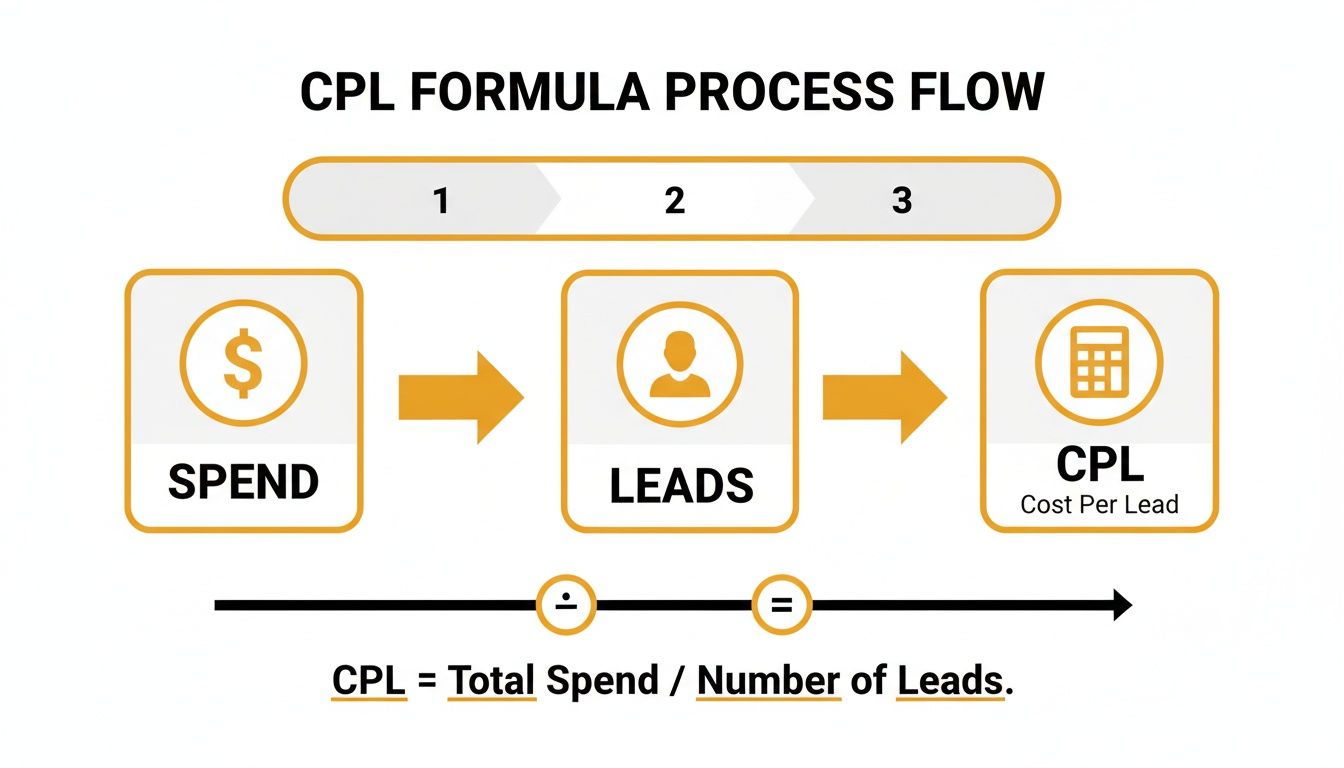
This process shows that when you divide all your marketing costs by all your leads, you get a clear, actionable CPL number to work with.
Tallying Your Total Marketing Spend
Your total spend is more than just your Google Ads bill. It’s every single dollar you put out there to make the phone ring. For a set period—say, last month—start gathering the costs from these common places:
- Digital Ad Platforms: This is the obvious one. Log into your dashboards for Google Ads, Facebook Ad Manager, and Yelp for Business. Find the "Total Spend" or "Cost" column for the date range you’re measuring.
- Third-Party Marketplaces: If you’re buying leads from services like Thumbtack or Angi, grab those monthly invoices.
- Offline Marketing: Don’t forget the old-school stuff. Did you run a $500 ad in the local paper? Spend $200 on new flyers? That all goes into the pot.
- Recurring Software Costs: Any monthly fees for marketing-related software count, too. Think email marketing tools or scheduling platforms.
Add it all up. This final number is the "Total Marketing Cost" you'll plug into the formula. It's the complete picture of your investment in getting new customers.
Counting Every Single Lead Accurately
This is where most movers get it wrong. A lead isn't just a booked job; it's any inbound inquiry from a potential customer, no matter where it came from. You have to count every single one, or your CPL will be a fantasy.
Make sure you're tracking leads from all these sources:
- Website Forms: Check your email inbox or your CRM for every quote request submitted through your website.
- Marketplace Inquiries: Tally up the leads you received from any third-party services you pay for.
- Phone Calls: This is the big one. Your phone is your number one sales tool, but it's also the easiest place to lose track of leads. Every call from a potential customer is a lead, even the ones that go to voicemail after hours.
Key Insight: A missed call isn't just a missed opportunity—it's an untracked lead you already paid for. If you spend $1,000 on ads and miss 10 calls, you haven't just lost potential jobs; your CPL calculation is now completely skewed because those 10 leads were never counted.
This is a huge challenge in our industry. Missed calls mean lost revenue—period. The customer who calls you at 6 PM on a Tuesday isn't going to leave a message and wait; they're going to call the next mover on the list. You paid for that call, but your competitor booked the job.
Tracking every single call—especially after 5 PM or during the summer rush—is next to impossible to do manually. This is where automation becomes a game-changer. An after-hours answering service for small businesses powered by AI ensures every call gets answered and logged as a lead, 24/7. It guarantees your lead count is precise, giving you a true CPL and stopping you from losing the very customers you just paid to attract.
Once you have your total spend and your true total lead count, you're ready to do the math.
The Simple CPL Formula with Real Mover Scenarios
Alright, you’ve got your total marketing spend and you know how many leads came in. Now for the easy part: the math. You don't need a special calculator or complex software. The formula is refreshingly simple.
Total Marketing Cost / Total New Leads = Your Cost Per Lead (CPL)
This single number cuts through all the guesswork. It tells you, straight up, what you’re paying every single time a potential customer picks up the phone or fills out your quote form.
Let's run through a few real-world scenarios that moving company owners deal with every month.
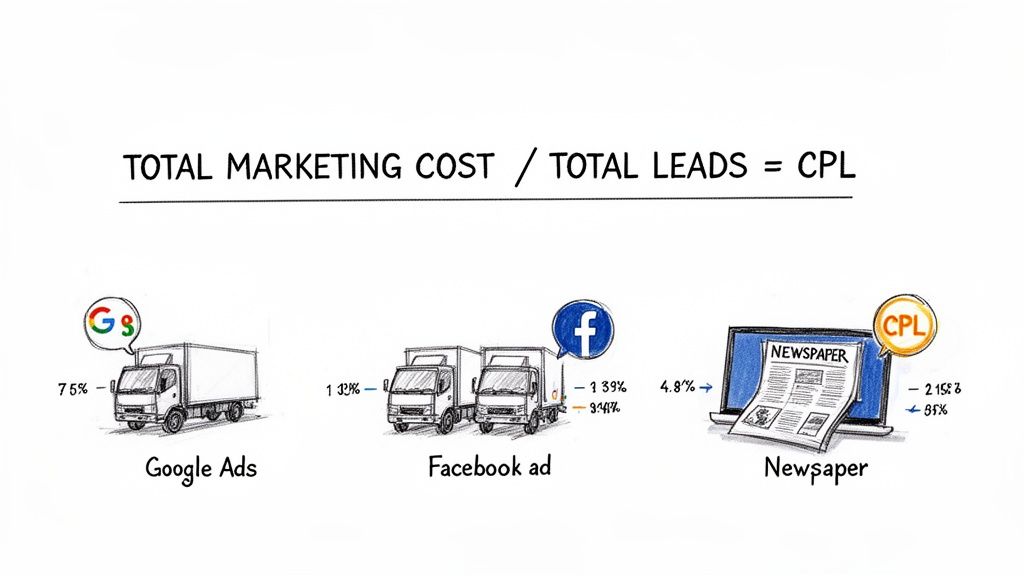
These examples will show you exactly how to apply the formula, whether you're a small operator or running multiple trucks across different ad channels.
Scenario 1: The One-Truck Operation on Google Ads
Let's say you run a one-truck operation specializing in local, in-town moves. Your main advertising channel is Google Ads, where you’re targeting keywords like "movers near me" and "studio apartment movers."
Last month, you spent $800 on your Google Ads campaign. After checking your call logs and website forms, you tracked 25 legitimate inquiries from that campaign.
- Total Marketing Cost: $800
- Total New Leads: 25
Now, just plug those numbers into the formula:
$800 / 25 leads = $32 CPL
For every potential customer who called or submitted a form from that specific campaign, you paid $32. Knowing this helps you decide if your Google Ads budget is actually delivering a solid return for the kinds of jobs you're booking.
Scenario 2: The Three-Truck Company Running Facebook Ads
Now, picture a slightly bigger company with three trucks. You're trying to land more long-distance moves and decide to run a targeted Facebook ad campaign. Your ad is a slick video of your crew professionally packing a home, and you're targeting people who've shown interest in moving or real estate.
Your total spend for the month is a bit more complex:
- Facebook Ad Spend: $1,200
- Video Ad Creation: $300 (a one-time cost, but we'll attribute it to this month's campaign)
- Total Marketing Cost: $1,500
Your campaign analytics show it brought in 40 leads through Facebook Messenger and clicks to your website's quote form.
Here’s how that breaks down:
$1,500 / 40 leads = $37.50 CPL
Even with the higher spend, your CPL is a pretty reasonable $37.50. This number tells you how effective your Facebook strategy is at drumming up interest for those higher-ticket, long-distance jobs.
Scenario 3: Calculating a Blended CPL Across Channels
Most moving companies don't put all their eggs in one basket. A more realistic scenario is calculating a "blended" CPL that averages the cost across all your marketing efforts. This gives you a bird's-eye view of your overall marketing health.
Let's imagine your moving company used three different channels last month:
- Google Ads Spend: $1,000 (generated 30 leads)
- Yelp for Business Spend: $500 (generated 10 leads)
- Local Newspaper Ad: $200 (generated 5 leads)
First, add up your total costs and total leads:
- Total Marketing Cost: $1,000 + $500 + $200 = $1,700
- Total New Leads: 30 + 10 + 5 = 45
Now, let's find your blended CPL:
$1,700 / 45 leads = $37.78 CPL
Your Turn: The real power comes from calculating the CPL for each individual channel. You might discover your newspaper ad CPL is $40 ($200/5), while your Google Ads CPL is just $33.33 ($1000/30). This kind of insight lets you pull money out of the channels that aren't working and double down on your top performers.
This blended CPL is a single, powerful metric you can track month over month. If you see it start to creep up, you know it's time to dig into your individual channels and figure out what’s changed. And if it goes down? You know your marketing tweaks are paying off.
What's a "Good" CPL for a Moving Company?
So you've done the math and have a CPL number staring you in the face. What's the next question? It's always the same: "Is this any good?"
The honest answer? It depends.
There’s no magic number that works for every moving business in the country. A "good" CPL isn't about hitting some universal benchmark. It’s about understanding what’s realistic for your specific company, in your specific market.
A mover in rural Nebraska is going to have a wildly different CPL than a company fighting for leads in downtown Manhattan. The key is to know what factors are driving your costs so you can set realistic goals and actually judge how your marketing is performing.
Setting a Realistic CPL Benchmark
While your local market is the biggest piece of the puzzle, industry-wide data is a good place to start. Getting a customer's attention is getting more expensive for everyone. Recent cost per lead statistics are pretty eye-opening, showing that the average CPL for many service industries can be well over $100.
For a local mover, where a single job can be anywhere from $500 for a studio apartment to over $3,500 for a multi-bedroom house, paying too much for a bad lead will kill your profit margin. Fast.
Here are the big variables that will push your CPL up or down:
- Location and Competition: A high cost-of-living area like New York City or San Francisco means more movers are bidding on the same keywords, driving up ad costs. You're just going to pay more per lead than a mover in a small town with a handful of competitors.
- Seasonality: This one’s a guarantee. Your CPL will spike during peak moving season, from May to August. More people are searching for movers, but all your competitors are cranking up their ad spend at the same time.
- Type of Move: Leads for a big, profitable long-distance move are always more expensive than a local apartment job. The potential payout is much higher, so companies are willing to bid more aggressively to get that call.
Why a Higher CPL Isn't Always a Bad Thing
It's easy to get obsessed with driving your CPL down, but a higher number isn't automatically a red flag. Context is everything.
Think about it: would you rather pay $30 for a lead that books a $500 studio move, or $90 for a lead that books a $4,000 multi-day packing and moving job?
The goal isn't just to get the cheapest leads; it's to get the most profitable ones.
A higher CPL is perfectly fine if it’s attached to a higher-quality lead with a bigger booking value. The trick is making sure you actually convert those expensive leads into paying customers.
This is where speed becomes your secret weapon.
When you pay a premium for a good lead, every single second you waste before responding slashes your odds of booking the job. The modern customer shops fast. If they call and get your voicemail, they aren't waiting around for a callback—they're already dialing the next mover on their list.
Making sure every single call gets answered instantly, especially for those high-value leads you paid top dollar for, is non-negotiable. An automated 24/7 AI receptionist can completely change the game. It guarantees that every expensive lead gets an immediate, professional response, giving you the best possible chance to turn that high cost into an even higher profit.
Actionable Strategies to Lower Your CPL Today
Once you’re consistently tracking your CPL, the real work begins: bringing that number down.
Lowering your CPL isn't about slashing your ad budget. It's about making every dollar you do spend work harder. The single best way to improve your marketing ROI is to get better at converting the leads you already paid for.
Here are a few high-impact strategies you can put into action right away to cut your CPL and book more jobs from the marketing budget you already have.
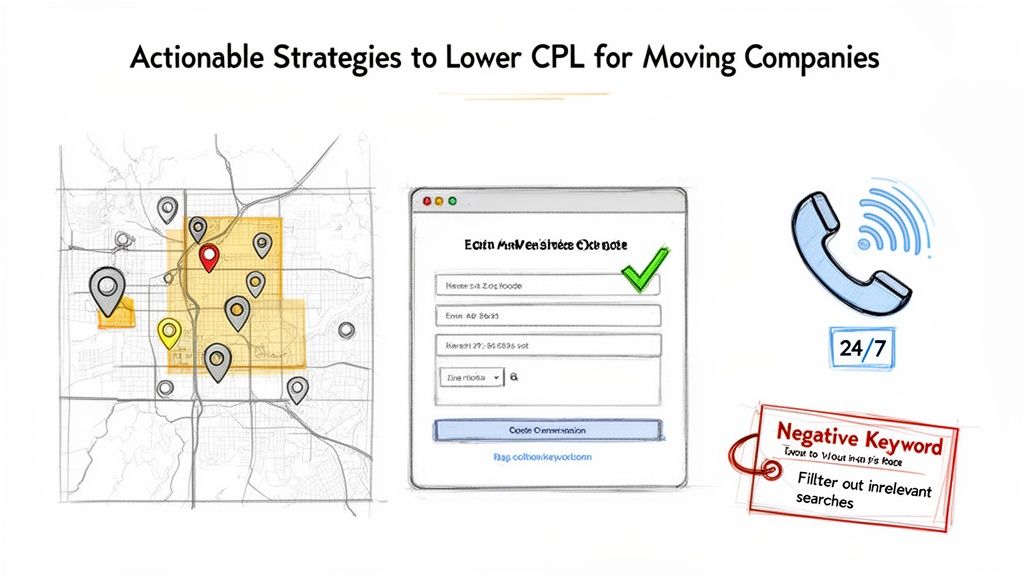
Nail Your Ad Targeting in Profitable Areas
Stop wasting money on tire-kickers and people you can't even service. One of the quickest wins for lowering CPL is to tighten up your ad targeting.
- Zero in on Profitable Zip Codes: Pull up your last six months of jobs. Which neighborhoods or zip codes consistently bring in the highest-value moves? Tweak your Google Ads location targeting to pour your budget directly into those goldmines.
- Embrace Negative Keywords: In your Google Ads account, add "negative keywords" to filter out searches from people you can't help. If you don't do cross-country moves, add terms like "state to state movers" or "interstate moving companies." This immediately stops you from paying for useless clicks.
- Target by Demographics: Are your best customers young professionals in downtown apartments or families in suburban homes? Use the demographic targeting features in Facebook and Google to make sure your ads are only shown to the right audience.
Optimize Your Website for Conversion
Your website is your digital storefront. If it's slow, confusing, or makes getting a quote feel like pulling teeth, you're lighting money on fire. You paid to get them there; don't lose them on the last step.
Make sure your website’s quote form is dead simple. Ask for the absolute bare minimum to start a conversation: name, phone, email, and basic move details. Every single extra field you add is another chance for a potential customer to give up and click away.
If you want to get more creative, think about different ways to capture leads. A lot of companies are finding success by using calculators as lead magnets, which can attract high-quality prospects.
Convert Every Single Lead You Paid For
This is it. This is the biggest lever you can pull to slash your CPL.
Every missed call isn't just a missed opportunity; it's a lead you paid for that gave you zero return. A missed call has an infinite CPL.
When a customer calls, they're ready to book. If they hit your voicemail, they aren’t waiting around for a callback. They are immediately dialing the next mover on the Google results page. That's a lead you lost to a competitor, and you still paid for the ad click that got them to call you in the first place.
The Math Is Brutal: If you spend $1,000 on ads to get 20 calls, your CPL is $50. But if you miss just 5 of those calls, you really only got 15 leads. Your effective CPL just shot up to $66.67. You paid more to get less.
The solution is to ensure every call gets answered, 24/7. An AI receptionist can pick up every call instantly, provide an accurate quote on the spot, and even follow up via text automatically.
By capturing every single lead, you dramatically increase the "leads" part of your CPL formula without spending another dime on ads. The result is a much lower, more accurate CPL and, more importantly, more booked jobs. You can find more practical advice on this in our guide on how to get moving leads.
Beyond CPL: From Lead Cost to Lifetime Value
Calculating your cost per lead is a huge first step, but it's not the end of the road. A low CPL gets customers in the door. A great customer experience is what keeps them coming back and, more importantly, telling their friends about you. This is where you stop thinking about a single transaction and start focusing on what a customer is worth over the long haul.
It’s a simple shift in mindset, but it changes everything. Suddenly, your goal isn't just to get cheap leads; it's to build lasting value and make every marketing dollar you spend work harder for years to come.
From First Call to Repeat Business
In the moving business, Customer Lifetime Value (CLV) isn't some fancy marketing buzzword. It's real, tangible money.
It’s the family that calls you every few years when they move. It’s the referrals they send your way when their friends need a mover. It’s the glowing five-star review they leave online that convinces a complete stranger to call you instead of the other guys.
A single great experience can easily be worth thousands of dollars over time. This long-term value completely changes the math on what you should be willing to pay for that initial lead.
The ultimate goal isn't just a low CPL; it's a high CLV. A lead that costs you $50 but results in $5,000 of business over three years is infinitely more valuable than a $25 lead who has a bad experience and never calls again.
Tying It All Together
This is where your day-to-day operations and customer service directly hit your bottom line. A professional, automated response from the very first interaction doesn't just help you book the immediate job—it lays the foundation for a positive, long-term relationship.
Think about it. When a potential customer gets an instant, accurate quote and a seamless booking process, they immediately feel confident they picked the right company. That initial positive vibe makes them far more likely to become repeat customers and advocates for your brand down the road.
Using the right tools, like advanced moving company estimate software, ensures that this first touchpoint is flawless.
Technology that smooths out the customer journey doesn't just lower your CPL by converting more leads today. It actively increases your CLV by creating happy, loyal customers who will fuel your growth for years.
Common Questions from Moving Company Owners
Once moving company owners start digging into their Cost Per Lead, a few questions always pop up. Here are the most common ones I hear.
How Often Should I Calculate My CPL?
For most moving companies, looking at your CPL on a monthly basis is the sweet spot. It's frequent enough to catch trends and tweak your ad campaigns before you waste too much money, but not so often that you get lost in tiny daily changes.
One exception: during your busy season. When your ad spend is climbing, you might want to check in every couple of weeks just to keep a tighter grip on things.
How Do I Track Leads From a Truck Wrap or Flyer?
Tracking leads from offline sources like a truck wrap or a flyer isn't as hard as it sounds. You just need a dedicated process. The cleanest way to do it is by using a unique, trackable phone number for each source.
You can get these numbers from various call tracking services. Assign one number just for your trucks, another for your flyers, and so on. When a call comes through one of those lines, you know exactly where that lead came from, making it easy to factor into your CPL math.
Pro Tip: Your team is your best tracking tool. Make it a non-negotiable habit for whoever answers the phone to ask every single caller, "How did you hear about us?" This simple question plugs a ton of holes in your data.
What Should I Do If My CPL Is Too High?
First off, don't panic. If your CPL looks scary high, it’s usually a signal to investigate, not a reason to shut everything down. Go back to the basics we covered earlier. Are you targeting the right zip codes? Have you set up negative keywords to stop paying for clicks from people searching for "free moving boxes"?
But honestly, the biggest culprit is usually something simpler. A high CPL is often just a symptom of a much bigger problem: losing leads you've already paid for. Most of the time, this happens because of missed calls. The fastest way to drop your effective CPL isn't to spend less on ads—it's to answer every single call.
Ready to stop bleeding leads and see what a 100% answer rate does for your CPL? MoveJoy is the AI-powered assistant that answers every call, provides instant quotes, and books jobs for you 24/7. See how it works.