A Moving Company’s Guide to a Perfect Sale Process Flowchart
Think of a sales process flowchart as the playbook for your moving company. It's a simple, visual map that lays out every single step a customer takes, from the moment they first call for a quote to the minute their job is booked and confirmed. For a moving company with 1-20 trucks, this isn't just a nice-to-have diagram—it’s your roadmap to stop losing revenue by making sure every lead is captured, quoted, and closed the exact same way, every time.
How Your Current Sales Process Is Leaking Money
Every moving company owner I know has lived this moment. You’re on-site, directing a crew through a tricky three-bedroom pack-and-move, and your phone buzzes. It's a new lead, but you're in the middle of a job. You can’t possibly answer.
So, you send it to voicemail, promising yourself you’ll call back in an hour. By the time you finally get a free minute, the lead has gone cold. They already booked with the competitor who answered on the first ring. Speed determines who wins the job, and right now, your competitor is winning.
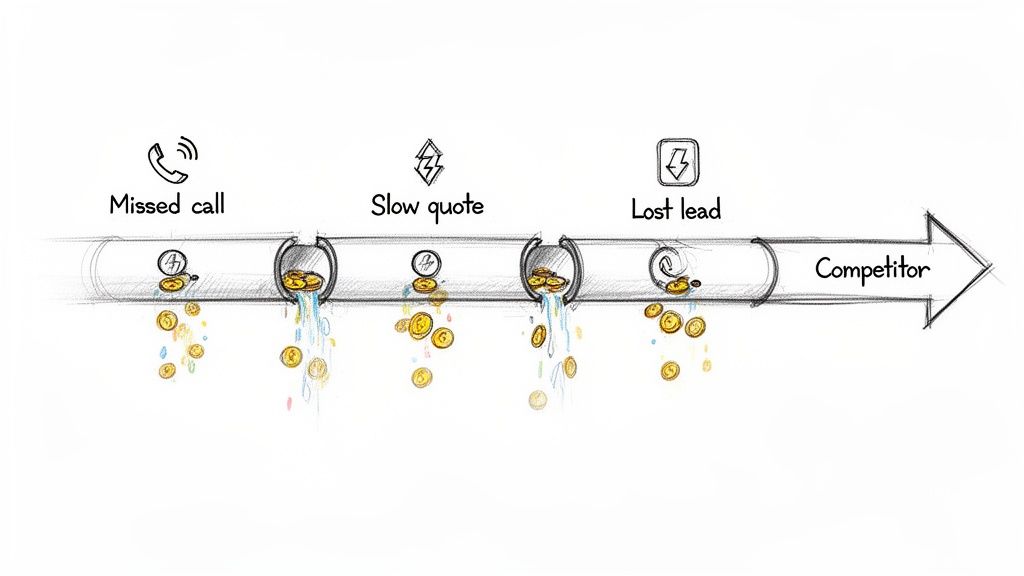
This isn’t a one-off problem. It’s a daily cash leak that’s quietly draining your business. Without a structured process, your sales system is riddled with these small, costly gaps that add up fast. Just one booked job from a call you would have missed can pay for an entire month of an automation solution.
The Real Cost of Winging It
For small and mid-sized moving companies, that first phone call is where most jobs are won or lost. The moving industry is brutally fast, and when a homeowner needs a mover, they need one now. Some market reports show that up to 70% of calls go unanswered during peak hours or after the office closes.
Each of those missed calls isn’t just a missed conversation; it's a booked job you just handed to another local mover down the street. We estimate movers lose 3-7 jobs every month just from sending calls to voicemail.
Think of your sales process like an old garden hose. Without a solid structure, it’s full of holes:
- Missed Calls: This is the biggest leak, by far. Customers looking for movers are speed-dialing. If you don't pick up, they’re already calling the next name on their list before your voicemail greeting even finishes.
- Slow Quotes: A lead from your website form lands in your inbox and sits there for hours. By the time you get around to building a quote, they’ve already gotten three others and probably booked one.
- Inconsistent Follow-Up: You remember to follow up with a few hot leads but forget about others. You're leaving thousands on the table, all because you don't have a system.
These aren't just minor operational hiccups. They're systemic failures that hit your bottom line directly and make your crew scheduling a chaotic guessing game.
A sales process flowchart forces you to see these leaks and gives you a blueprint to plug them for good. It’s how you turn that chaos into a reliable, money-making booking machine.
Mapping Your Current vs. Ideal Sales Flow
Most movers I talk to are stuck in a reactive process, constantly putting out fires. A flowchart helps you build a proactive system where nothing falls through the cracks. The difference is night and day.
| Sales Stage | Common (Leaky) Process | Optimized (Flowchart) Process |
|---|---|---|
| Lead Capture | Miss calls during jobs or after hours. Website forms sit in an inbox. | All calls answered 24/7. Leads are instantly captured and qualified. |
| Quoting | Manually build quotes when you have time, sometimes hours later. | Quotes are generated and sent automatically based on inventory/job details. |
| Follow-Up | Sporadic, based on memory. "Did I call that person back?" | Automated text/email follow-ups trigger if a quote isn't booked. |
| Booking | Manual data entry into a calendar or CRM, prone to errors. | Jobs are booked directly into the calendar and CRM, no double-entry. |
| Confirmation | Send a confirmation email when you remember. | Automated booking confirmation and day-before reminders are sent. |
See the difference? The "leaky" process relies on you being available and remembering everything. The optimized process works for you, even when you're on a truck or asleep. This is where a flowchart becomes more than just a drawing—it becomes your automated revenue engine.
Mapping Your Flowchart From First Call to Booked Job
Alright, let's build your playbook. A sales process flowchart isn't some complex corporate diagram you need an MBA to understand. For a mover, it’s just a simple map of your customer’s journey from a stranger on the phone to a booked job on your calendar.
The whole point is to get a visual of every single step. This way, you can lock in what’s working and, more importantly, see exactly where things are breaking down.
Start with the basics. Grab a whiteboard or even just a piece of paper and sketch out the main stages every customer goes through. This should feel natural because you live and breathe this process every single day. If you want a more structured starting point, checking out a 10x sales funnel template can give you a solid framework for mapping everything from the first call to the final booking.
The Five Core Stages for Any Mover
No matter if you're running two trucks or twenty, your sales process boils down to these fundamental stages. Think of them as the big milestones in your customer's journey.
- Lead Capture: This is where it all begins. How does a customer even find you? It could be a direct phone call, a quote request from your website, a referral from a realtor, or a lead you paid for on a third-party site.
- Initial Contact & Qualification: The first conversation. The moment you or your team engages, you're qualifying them. You’re finding out the move size, preferred dates, and any curveballs like pianos, antiques, or tricky access points (think five-floor walk-ups or long carries).
- Quoting: You take all that info and turn it into a price. This is a huge fork in the road. How fast and accurately you deliver that quote often determines whether you win the job or get ghosted.
- Follow-Up: What happens when they don't book on the spot? This is your system of texts, emails, and calls to stay top-of-mind, answer their lingering questions, and nudge them toward a decision.
- Booking & Confirmation: You get the "yes." This is the finish line—getting them officially on the schedule, taking a deposit, and sending out a confirmation email that lays out all the move-day details.
Building Your Decision Points
Now, let's add the "flow" to the chart. In between each of those big stages are decision points—simple "yes" or "no" questions that send a lead down one path or another. This is where you'll find your biggest operational leaks.
The single most important decision point in your entire flowchart is the very first one: Did we answer the phone? If the answer is "no," the journey ends right there. They hang up, call your competitor, and the rest of your perfectly planned process means nothing.
Let's zoom in on that "Initial Contact" stage. It should immediately split into two paths:
- Answered Path: Awesome. The lead moves right into the "Qualification" stage. Your team builds rapport, gathers the necessary info, and gets ready to send a quote. This is the path to revenue.
- Missed Path: So, what happens here? Does the call just go to a generic voicemail? Do you have a system that automatically texts them back? This is where an automated 24/7 call answering system becomes a total game-changer. An AI receptionist makes sure every single lead goes down the "Answered Path," even at 9 PM on a Saturday. An after-hours answering service for small business is designed specifically to capture these critical leads you’d otherwise lose.
Apply this same logic to every stage. After you send a quote, the decision point is, "Did they book?" If yes, they move to "Booking & Confirmation." If no, they should automatically drop into your "Follow-Up" sequence.
When you visualize these paths, it becomes painfully obvious where a lead can fall through the cracks—and exactly where automation can step in to make sure it never happens again.
Mastering the Quoting Stage Where Most Movers Fail
If there’s one place your entire sales process flowchart will fall apart, it’s the quoting stage.
This isn’t just another box on your diagram; it's the moment of truth. Speed and accuracy here are everything. They determine whether you win the job or get ghosted. Today’s customers are shopping fast, and the first mover to drop a clear, professional quote into their hands almost always wins.
When your sales process depends on a driver pulling over to scribble numbers on a notepad, you've already lost. When a dispatcher is trying to juggle five calls at once, you’re bleeding leads. That manual bottleneck is where you lose price-sensitive customers, leading to abandonment rates as high as 50-60%.
Differentiating Your Quoting Paths
A smart sales flowchart doesn’t treat every lead the same. You absolutely need different paths for different types of moves if you want to be efficient without sacrificing accuracy.
Think about these two classic scenarios:
- The Simple Move: It’s a studio or a one-bedroom apartment with no specialty items. This lead should go straight down an automated path. Your system should be able to instantly calculate a binding estimate and text it to the customer in minutes. No human touch needed.
- The Complex Move: Now you’ve got a four-bedroom house with a piano, a fragile antique collection, tricky stair access, and maybe a stop at a storage unit. This requires a human. Your flowchart needs to route this lead for a manual review, a video survey, or even an in-person estimate to make sure the quote is dead-on.
By building these two distinct paths, you automate the easy jobs and free up your time—and your best people's time—to focus on the more profitable, complex moves. That’s the secret to a quoting system that can actually scale with your business.
The Role of Automation in Modern Quoting
With operational costs like fuel and labor jumping by as much as 80% since 2020, your margins have never been tighter. A badly calculated quote doesn’t just lose a job; it can actually cost you money.
This is where automation becomes your unfair advantage. You can dive deeper into this with our guide on moving company estimate software.
This flowchart breaks down the essential steps of a modern moving sales journey, from the first call to a booked job.
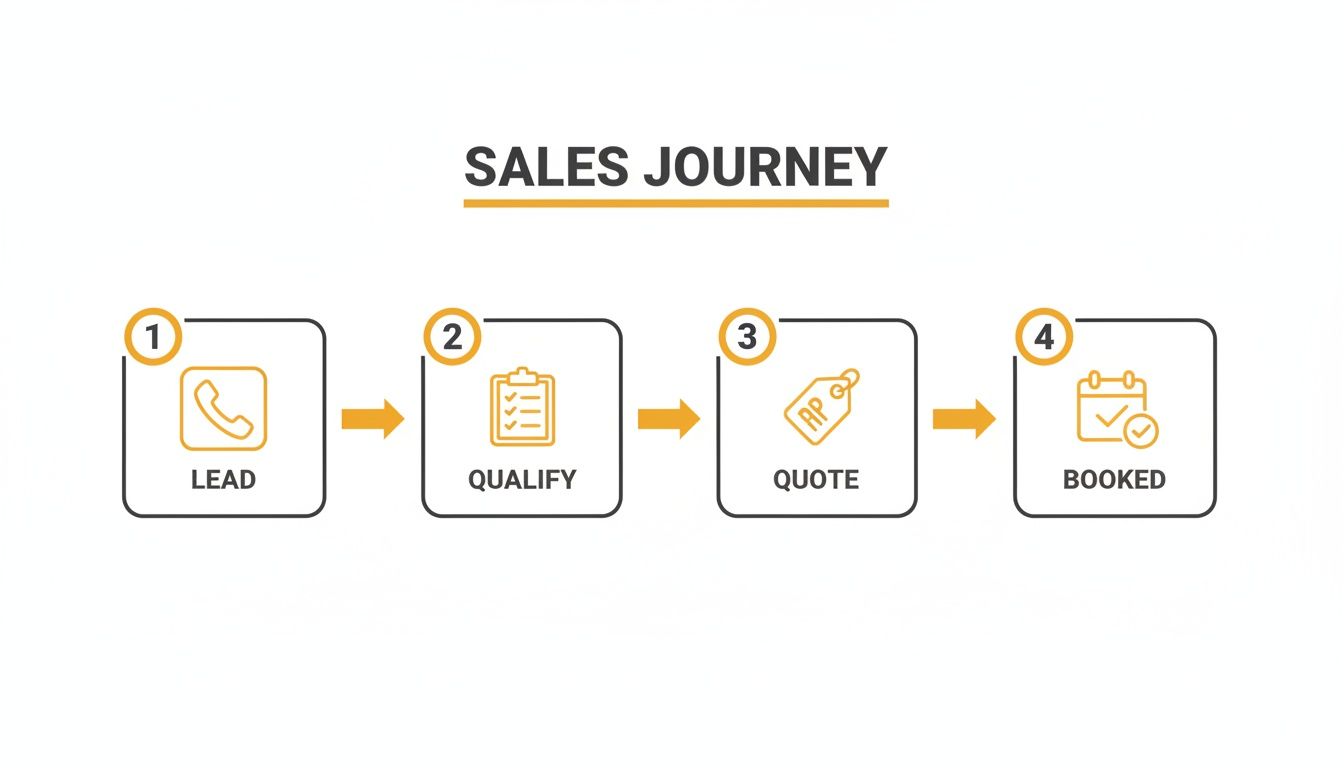
The handoff from lead capture to quoting has to be seamless and fast. Any delay gives customers a reason to start calling your competitors.
An AI sales assistant handles this entire quoting stage 24/7. It instantly qualifies leads, provides accurate quotes via text based on your specific rates, and even checks your calendar for availability in real-time. What was once your biggest bottleneck becomes your strongest sales tool.
Imagine a lead comes in at 10 PM. Instead of waking up to a cold lead you have to chase, you wake up to a fully quoted job, maybe even one that’s already booked. This transforms your flowchart from a passive map into an active, revenue-generating machine that works for you around the clock.
Don't Stop at "Booked": Automating Follow-Ups and Five-Star Reviews
Your sales process flowchart can't just end when a job gets booked. Honestly, that's where the most profitable moving companies really get to work. The post-quote and post-move stages are where you build long-term success, turning a single job into a steady stream of future revenue.
Too many movers draw a line in the sand right after sending a quote. This is a massive mistake. What about the leads who are still thinking it over? Every moment of a customer's indecision is an opening for your competitor.
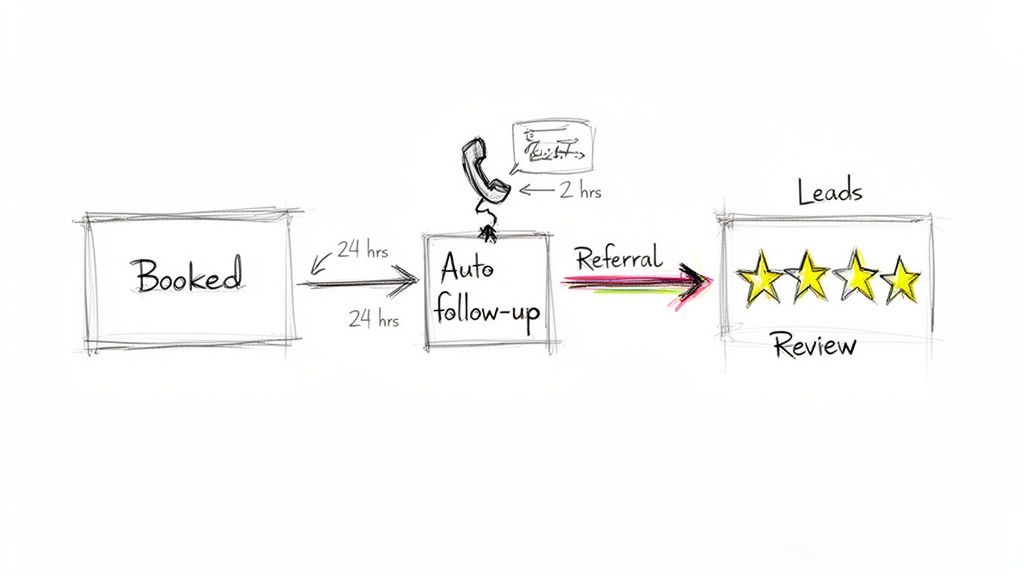
This is precisely why your flowchart needs to include an automated follow-up sequence for every quote that hasn't been booked. It's a simple, powerful system that keeps you top-of-mind without you having to lift a finger.
Designing Your Follow-Up Sequence
A solid follow-up path on your flowchart ensures no lead goes cold just because you got pulled onto a truck. The secret is consistent, timely communication that feels helpful, not like you're desperate for the sale.
Here’s a proven sequence you can map out right now:
- Two Hours Post-Quote: An automated text hits their phone: "Hi [Customer Name], just wanted to make sure you received the quote for your move. Any questions I can answer?" It's quick, it's not pushy, and it works incredibly well.
- 24 Hours Post-Quote: An email goes out, re-attaching the quote and casually highlighting one of your key differentiators—maybe your five-star reputation or expertise with specialty items.
- Three Days Post-Quote: A final, friendly text can create a bit of urgency: "Hi [Customer Name], our schedule for [Move Date] is filling up fast. Just let me know if you'd like to lock in your spot."
This kind of automated persistence is what separates the movers who are growing from the ones who are just treading water. It makes sure you've done everything you can to win the job.
From a Booked Job to a Pipeline of New Leads
The final steps of your sale process flowchart—Confirming the booking, following up, and asking for a review—are what really determine your long-term health. The moving industry runs on word-of-mouth, and this is how you fuel it.
Think about it: traditional flowcharts just stop after the quote, which is why movers are stuck playing phone tag and only converting 20-30% of leads. AI-powered platforms change the game by automatically holding calendar slots, sending confirmations, and—critically—prompting for post-move reviews. This is how you boost referrals without even trying. You can dig into more stats about the industry's reliance on word-of-mouth over on ibisworld.com.
Make sure your flowchart extends beyond the booking to include these crucial steps:
- Job Completion: As soon as the crew marks the job as finished, the clock starts.
- Request for Review: The very next day, an automated text or email should send a direct link to your Google or Yelp page. Make it easy for them.
- Ask for Referral: A week later, another message can pop up offering a small discount for any friends or family they send your way.
Your sales process shouldn't be a straight line that ends with a booked job. It should be a continuous cycle where every happy customer becomes a source for your next lead.
By automating these last few steps, you build a powerful engine for social proof and referrals that just runs in the background. It frees you up to do what you do best: deliver a damn good move.
Putting Your New Sales Flowchart Into Action
A sales process flowchart on a whiteboard is a great start. But turning that diagram into your daily reality is where the money is. This isn't about some massive, expensive software overhaul. It’s about making small, smart changes that plug the leaks in your current system.
The goal is to build a repeatable, reliable machine for booking jobs. When you put a flowchart into action, you’re creating a system. A system that makes sure every lead is captured, every quote is sent fast, and every follow-up happens on time—every single time.
This is how the one-truck operator and the 20-truck fleet alike stop losing jobs to the guys down the street who just answer the phone faster.
Integrating Automation Where It Matters Most
The key to bringing your flowchart to life is finding the manual, repetitive tasks that cause the biggest delays and letting technology handle them. This isn't about replacing your team. It's about freeing them from the constant distraction of the phone so they can focus on high-value conversations and making customers happy.
Modern tools slide right into this new workflow. An AI receptionist, for example, can become the engine that drives the most critical parts of your flowchart:
- Instant Lead Capture: It guarantees the "Answered" path is taken for every single call, 24/7, grabbing job details without fail.
- Automated Quoting: For simple moves, it can generate and text an accurate quote in seconds, pushing the lead to the next stage instantly.
- Systematic Follow-Up: It can trigger the text and email sequences you’ve mapped out for unbooked quotes, making sure no lead ever goes cold.
Once you’ve got your perfect sales flowchart designed, the real challenge is actually implementing it. A good next step is to consider how you can leverage specialized support, like exploring options for assistants specifically for moving companies, to help manage the admin work and keep things running smoothly.
The real takeaway here isn't about adding more software you have to manage. It's about finding a solution that "just works" in the background, executing the steps on your flowchart perfectly. This lets you focus on running your business, not just answering the phone.
Ultimately, a well-implemented sale process flowchart transforms your business from a reactive, chaotic operation into a proactive, predictable revenue generator. You’ll book more jobs, reduce the stress of seasonal spikes, and finally get some real control over your growth.
Got Questions About Sales Flowcharts?
Look, I get it. Moving from a reactive, "answer-the-phone-and-hope" system to a structured sales process can feel like a big leap. It brings up questions. Let's tackle the ones I hear most often from moving company owners who are ready to make a change.
How Complicated Is This, Really?
It’s way simpler than it sounds. You don’t need a marketing degree or some fancy software. Honestly, the best way to start is with a whiteboard or even just a piece of paper. Just start drawing.
Think about your customer's journey, the one you live every single day. Map out the big moments:
- Lead Comes In: How do they find you? Phone call? Website form?
- Quote Goes Out: What happens right after you give them a price?
- Job Booked: What are the exact steps to get them locked in and on the calendar?
- Job Done: What's the process after the last box is off the truck?
The goal on day one isn’t some perfect, polished diagram. It's about getting a visual of your process so you can finally see where leads are coming from and, more importantly, where they’re falling through the cracks. This simple map is your first step toward plugging those leaks in your revenue.
What's the Single Most Important Thing to Fix First?
For almost every moving business I’ve ever worked with, the biggest point of failure is right at the beginning: the Initial Contact. If you're missing calls, the rest of your beautifully designed flowchart is completely useless.
Think about it. A missed call isn't just a delayed opportunity—it's a 100% lost opportunity. That customer is immediately dialing the next mover on their list. Before you waste a single second optimizing follow-up emails or tweaking your quote templates, you have to nail this. You need a bulletproof system to capture every single lead, 24/7. This is exactly where automation, like an AI receptionist, makes the fastest and biggest dent in your bottom line.
Can I Automate This Without Sounding Like a Robot?
Absolutely. Good automation isn’t about replacing you or your team. It’s about handling the repetitive, time-sucking tasks so you have more time for the personal interactions that actually book jobs.
An effective sales flowchart uses automation for speed—instantly answering a call, capturing a lead’s details without any errors, or getting a quote out in seconds. This frees you up to personally call that high-value commercial lead to talk through their complex needs, or to follow up with a homeowner after a move to make sure they're thrilled. The best systems blend instant, automated responses with strategic moments for genuine human connection.
How Does a Flowchart Help During the Busy Season?
The busy season is pure chaos. You can't be everywhere at once, and every missed call feels like a punch to the gut when you're slammed. A flowchart powered by automation acts as your perfect sales manager, even when you're out on a truck.
It ensures every lead gets captured and quoted instantly, no matter how busy you are or if the call comes in at 10 PM. Instead of calls going to voicemail and turning into cold leads you have to chase, your system qualifies them, gives them an accurate estimate, and can even get them on the calendar. This turns the overwhelming flood of your peak season into a smooth, predictable, revenue-generating machine—all without you having to hire more office staff.
Ready to stop winging it and build a sales process that actually works? MoveJoy is the AI-powered sales assistant that plugs directly into your flowchart, answering every call, sending instant quotes, and booking jobs 24/7. See how it works at https://getmovejoy.com.