The Ultimate Guide to an AI Receptionist for Small Business Movers

Think of an AI receptionist as your best employee—the one who never calls in sick, never takes a vacation, and is always ready to answer the phone, 24/7. It’s an automated, voice-based assistant that uses artificial intelligence to understand exactly what a customer needs.
It can answer common questions, capture lead information, and even book jobs directly onto your calendar, all without you lifting a finger. For a moving company owner, this is a game-changer. It means you never miss a lead just because you’re on a job or it’s after hours.
Stop Losing Moving Jobs to Voicemail
Every moving company owner has been there. You’re on-site, focused on the crew and making sure the customer’s antique dresser doesn’t get a scratch. Your phone buzzes in your pocket, but you can’t answer. It rings again.
By the time you get a moment to breathe, you see three missed calls and a voicemail from someone wanting a quote for a 3-bedroom move next month. You call back immediately, but it’s too late. They already booked with the competitor who actually picked up the phone.
That one missed call isn’t just a lost job. It's a silent leak that drains cash right out of your business. In the moving game, speed is everything. Customers who are ready to book don’t wait around—they just call the next name on their list. The first company to give them a professional, quick response almost always wins the job.
The True Cost of a Single Missed Call
The financial hit is way bigger than just the quote you didn't give. Let's break down what that one unanswered call during your busy season really costs your moving business:
- Lost Immediate Revenue: A standard 3-bedroom local move can easily be worth $1,500 to $2,500. That's pure profit you just handed to another moving company.
- Lost Future Business: A happy customer is a repeat customer. They might need storage later or move again in a few years. That first great experience could have locked in years of business.
- Lost Referrals: Nothing beats word-of-mouth. A fantastic move turns a customer into your best salesperson. That one person could have referred friends and family, leading to a steady stream of new jobs.
When you add it all up, that single call you couldn't take on a busy Saturday might have cost you over $5,000 in total value. Multiply that by a few missed calls every week, and the numbers get scary fast. This is the bottleneck that stops so many good moving companies from getting to the next level.
To see how to plug this leak for good, check out our guide on how an after-hours answering service for small business can completely change your lead flow. It shows how simple automation can solve this problem, turning every single call into a booked job and letting you focus on what you do best—running your crews and growing your business.
How an AI Receptionist Actually Works for Movers
Let's pull back the curtain. Forget the tech jargon. Just think of an AI receptionist as the most reliable employee you could ever hire—one who never calls in sick, never needs a lunch break, and never, ever misses a call.
Here’s what really happens when a customer calls your moving company.
When a potential customer dials your number, the AI picks up instantly. You won't hear a robotic, "press one for sales." Instead, a natural, professional voice greets the caller. This isn't some generic bot; it’s been trained specifically on the language of the moving industry. It knows what a "long carry" is and understands the difference between a two-bedroom apartment and a four-bedroom house.
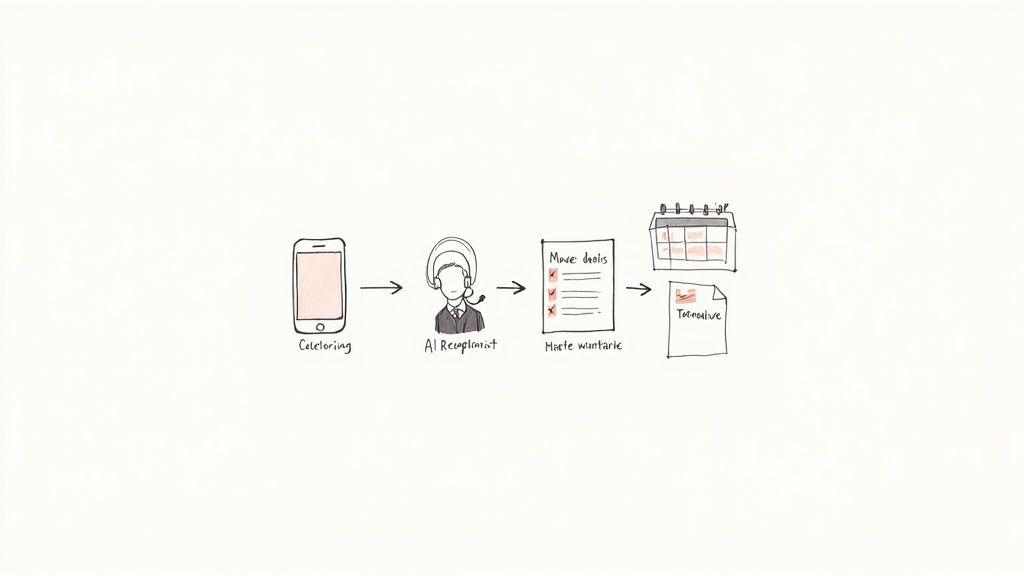
From First Ring to Captured Lead
The AI receptionist doesn’t just answer the phone; it has a real conversation. It’s built to handle all the initial information gathering that eats up so much of your day.
The whole process is seamless and designed to feel completely natural for the caller:
- Instant Answer: The AI picks up in seconds. No more sending paying customers to voicemail. This immediately tells the caller you’re a professional operation.
- Information Capture: It asks the exact same questions you would: the caller's name, phone number, current address, and where they're moving to.
- Job-Specific Questions: You can customize it to dig deeper. It can ask about the size of the move ("Is this for a 2-bedroom apartment or a 4-bedroom house?"), special items ("Do you have anything large like a piano or a safe?"), and their ideal move date.
- Booking & Follow-Up: Based on your calendar availability and rules, it can schedule a tentative booking or an on-site estimate right on the call.
The goal of this entire interaction is first call resolution—a make-or-break metric for turning a curious caller into a booked job. You can get a deeper dive on this in our guide about what first call resolution is and why it matters.
Key Takeaway: Think of the AI receptionist as your front-office filter. It takes care of the repetitive, time-sucking task of qualifying leads. By the time a lead gets to you, it’s already warm and filled with the details you need.
Behind the Scenes: What Happens After the Call
The real magic happens the second the call ends. The AI doesn’t just hang up and move on. It takes all that valuable information and puts it right to work for your moving business.
A detailed summary of the entire call—complete with a full transcription and all the lead's details—is instantly fired off to your email or sent via SMS. This means you can get the rundown on your phone between job sites, without ever having to listen to a long, rambling voicemail again.
But it gets better. A good AI receptionist integrates directly with the tools you already use, like your calendar and your CRM. This creates a completely hands-off workflow. A new lead is automatically created in your system, and the appointment is blocked off on your schedule. It’s a world away from scribbling notes on a pad and doing manual data entry at the end of the day.
This isn't some futuristic fantasy; small moving companies are jumping on this fast. The virtual receptionist market hit $3.85 billion in 2024 and is projected to smash $9 billion by 2033. This growth isn't about hype—it's about solving real-world headaches for moving company owners just like you.
The Game-Changing Benefits for Your Moving Company
Knowing what an AI receptionist is one thing, but seeing how it directly impacts your bottom line is what really matters. An AI receptionist for small business isn't just another piece of software you have to manage. It's a tool that adds revenue, slashes costs, and buys back your time.
When it’s set up right, this kind of tech solves the exact headaches that keep small and mid-sized moving companies from growing. It’s the missing link between answering every call and booking more jobs, turning your biggest bottleneck into your biggest advantage.
Capture Every Single Lead
The most immediate win is dead simple: you stop losing money to voicemail. Most movers can't answer the phone after 5 PM, on weekends, or when they're out on a job. An AI receptionist is on the clock 24/7, making sure every single person who calls gets an instant, professional answer.
This flips your after-hours and weekend calls from missed opportunities into booked jobs.
Think about it. A potential customer calls on a Saturday afternoon while you’re managing a crew. Instead of hearing a beep and calling your competitor, they get their questions answered and their quote request logged on the spot. By Monday morning, that lead is sitting in your inbox—a $2,500 job that would have otherwise gone to the first company that picked up.
Increase Your Booking Speed
In the moving business, the first company to give a quote usually wins. Customers are in a hurry; they aren't waiting around for callbacks. An AI receptionist gives you that critical speed advantage by making an instant, professional first impression, day or night.
- Instant Engagement: The AI answers immediately, gathers the necessary details, and shows the caller you’re a responsive, organized business.
- Immediate Follow-Up: While you're on the road, the AI can send a text with a link to your online quoting tool or confirm an appointment for an in-home estimate.
- Outpace Competitors: While other movers are letting calls ring out, you're already engaging with a hot lead and pushing them toward a booking.
That speed is everything. It shrinks the sales cycle and dramatically raises the odds that a shopper becomes your customer, not someone else's.
Reduce Operational Costs
Hiring a full-time, in-house receptionist isn't just about salary. You have to factor in payroll taxes, benefits, vacation days, and the hidden costs of hiring and training. For a small moving company, that can easily hit $40,000–$50,000 per year.
Let's put that into perspective with a quick comparison.
Human Receptionist vs AI Receptionist Operational Impact
A direct comparison of the daily operational realities and costs associated with a traditional receptionist versus a modern AI solution for a small moving company.
| Operational Factor | Traditional Human Receptionist | AI Receptionist Solution |
|---|---|---|
| Annual Cost | $40,000 – $50,000+ (salary, benefits, taxes) | $1,800 – $6,000 (predictable monthly fee) |
| Availability | 8 hours/day, 5 days/week (with breaks, sick days) | 24 hours/day, 7 days/week (no breaks, no days off) |
| Lead Capture | Misses all calls after-hours, on weekends, during lunch | Captures 100% of calls, day or night |
| Performance | Varies by mood, workload, and training | 100% consistent and accurate every time |
| Training Time | Weeks to months, plus ongoing management | Minutes to set up, no ongoing management needed |
| Scalability | Struggles during busy season; can't handle call spikes | Handles unlimited simultaneous calls instantly |
The numbers don't lie. An AI receptionist replaces that massive overhead with a small, predictable monthly fee. The savings are immediate and significant.
For small businesses, embracing comprehensive VoIP solutions for small business is a foundational step towards understanding how an AI receptionist actually works and delivers value. It leverages this technology to offer a far more cost-effective alternative.
Often, booking just one extra move per month—a move you would have definitely missed otherwise—is more than enough to cover the entire cost. This frees up cash you can put back into your trucks, your crew, or your marketing.
Improve the Customer Experience
Put yourself in your customer’s shoes for a second. Calling a business only to get stuck in a clunky phone menu or dumped into a generic voicemail is frustrating. It’s a terrible first impression that screams, "We're disorganized or too busy for you."
An AI receptionist delivers a smooth, professional, and genuinely helpful experience from the very first ring.
- Callers get instant answers to common questions about services or service areas.
- They don’t get stuck on hold or have to cross their fingers for a callback.
- Their information is captured accurately every single time, avoiding mix-ups down the road.
This level of service immediately sets you apart from local competitors. It builds trust before your crew even pulls up, proving you're a modern, customer-focused operation ready to handle their move like a pro.
What a Good AI Receptionist for Movers Actually Does
Not all AI receptionists are created equal. The system a dentist's office uses won't survive a single Tuesday in the moving industry. You need to ignore the generic fluff and focus on the specific features that will actually book you more jobs and make your life easier.
Think of this as a no-nonsense buyer's guide. A solid AI receptionist for a small business in the moving game needs to do more than just answer the phone. It has to act like your best salesperson—one who knows the business inside and out.
This infographic nails the big-picture goals: capturing every lead, cutting down on chaos, and freeing up your time.
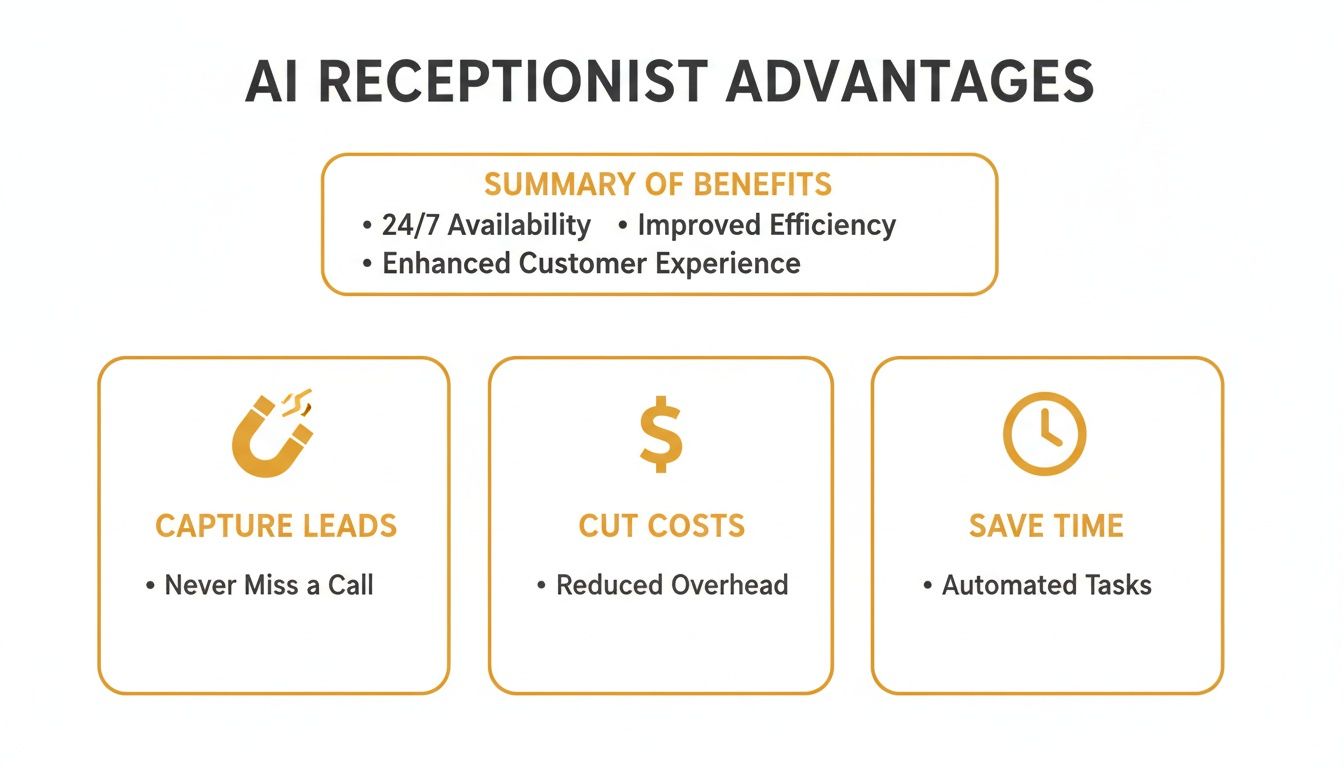
But those results don't just happen. They're driven by a handful of critical features designed to turn a ringing phone into a booked job.
24/7 Call Answering and Lead Capture
This is the absolute baseline. The non-negotiable. The whole reason you're even reading this is to stop losing jobs to voicemail. Potential customers call when it’s convenient for them, not you. That means nights, weekends, and holidays. Your system has to be ready.
Why it matters for movers: Moving isn't a 9-to-5 operation. A lead calling at 8 PM on a Friday is just as serious, if not more so, than one calling on a Tuesday morning. This feature is your guarantee that you’ll never again miss out on a valuable, last-minute booking because you were on a job or at home with your family.
Custom Scripting for Moving FAQs
Your AI needs to speak your language, not sound like a robot reading from a generic script. It must be trained to handle the questions every mover gets a hundred times a week.
- "What are your hourly rates?"
- "Do you guys offer packing services?"
- "Are you licensed and insured?"
- "Can you move a piano?"
Why it matters for movers: When a caller gets a smart, instant answer about your insurance policy instead of a vague "someone will call you back," it builds immediate trust. It shows them you’re a professional outfit that has its act together.
Intelligent Call Routing
Not every call is a hot new lead. Sometimes it's a crew member with a question, a current customer confirming their move, or a supplier. A smart system knows the difference.
Scenario: A customer calls to confirm their move time for tomorrow. The AI recognizes their number from your CRM, pulls up their booking, and confirms the time. It then sends a confirmation text—all without you ever knowing it happened. But if it's a new lead asking for a quote for a 4-bedroom house? That call summary with all the details lands in your inbox immediately.
Why it matters for movers: This is your personal dispatcher. It filters out the noise so you only deal with the leads that need a human quote. The number of interruptions you'll avoid is massive, letting you focus on the move you're actually on. Much of this magic comes from things like integrated AI chat functionality that provide instant, smart responses around the clock.
CRM and Calendar Integration
This is the feature that separates a simple answering service from a genuine business tool. Your AI receptionist absolutely must connect directly to your CRM and scheduling calendar. No exceptions.
When a new lead calls, the system should instantly:
- Create a new contact in your CRM with their name, phone number, and move details.
- Check your calendar for availability on their requested move date.
- Book the job or schedule an estimate right on the spot.
Why it matters for movers: This kills manual data entry, a huge time-waster that’s notorious for causing mistakes. During the peak season when calls are coming in hot and heavy, this automated process ensures no lead ever falls through the cracks. It’s the engine for a front office that basically runs itself.
Calculating the Real ROI for Your Moving Business
Technology should be an investment, not just another expense. When we talk about an AI receptionist for small business, the return isn't some vague promise about "efficiency." It's cold, hard cash that you can see on your P&L statement.
Forget the complicated spreadsheets. For a moving company, the math is refreshingly simple. Let's break down the real numbers that actually matter to your bottom line.
The Simple ROI Formula for Movers
Figuring out your net gain isn't rocket science. It’s about tangible revenue and savings you can track every single month.
Here's the basic framework:
(Value of New Jobs Booked + Labor Cost Savings) – Cost of AI Solution = Your Net Gain
That's it. This simple formula shows you exactly how this technology pays for itself, often from the very first job it snags for you. The impact is immediate.
A Conservative Real-World Example
Let's walk through a realistic scenario for a typical moving company with 1-20 trucks. No inflated numbers here.
- New Jobs Booked: Your AI receptionist now answers every call, 24/7. It catches just one extra weekend job that you otherwise would have missed. A standard 3-bedroom move is worth around $1,500.
- Labor Cost Savings: You’ve been thinking about hiring a part-time receptionist for the busy season, maybe 20 hours a week. At a modest $18/hour, you're looking at over $1,500 per month in wages—and that's before payroll taxes or training time. The AI handles all of this for a fraction of that cost.
In this simple example, the AI has already generated $3,000 in value in its first month ($1,500 from the new job + $1,500 in saved wages). Even after you subtract the monthly cost of a few hundred bucks, the net gain is huge.
The Core Takeaway: An AI receptionist doesn't cost you money; it makes you money. Often, that single after-hours call it catches and converts into a booked job pays for the entire service for the month, with profit left over. Everything after that is pure upside.
This is exactly why small businesses are jumping on board so quickly. They're seeing massive returns. In fact, 58% report saving over 20 hours a week on routine tasks like answering the phone. In some industries, businesses see net returns as high as 2,900%, turning a small monthly fee into significant growth. You can dig into these AI investment returns for agencies to see the broader impact.
Beyond the Initial Calculation
The financial wins don't stop with captured leads and saved salaries. The true ROI also includes the "soft" returns—the stuff that's harder to put a number on but is just as valuable for a growing moving business.
- Your Time Back: What’s an extra 10-15 hours a week worth to you? That’s time you’re no longer spending answering the same repetitive questions, manually typing in lead info, or chasing down voicemails.
- Faster Growth: With a system handling your front office that can scale instantly, you can finally focus on adding another truck or expanding your service area. You don't have to worry about whether your team can handle the flood of new calls.
The financial case is a no-brainer. To see what this could look like for your specific business, plug your numbers into our simple tool. You can calculate your moving company's ROI in just a couple of clicks and see for yourself how quickly this pays for itself.
Getting Started is Painless—No, Really.
Thinking about adding new tech can bring on a headache. You're already juggling crews, schedules, and a phone that won't stop ringing. The last thing you need is a complicated software installation that takes weeks and an IT degree to figure out.
The good news? Setting up an AI receptionist for your small business isn't like that. Modern solutions are built for owners like you—people who are too busy running their business to mess with complex setups. The whole point is to get you the benefits of automation without the operational nightmare. You can be up and running in days, not weeks.
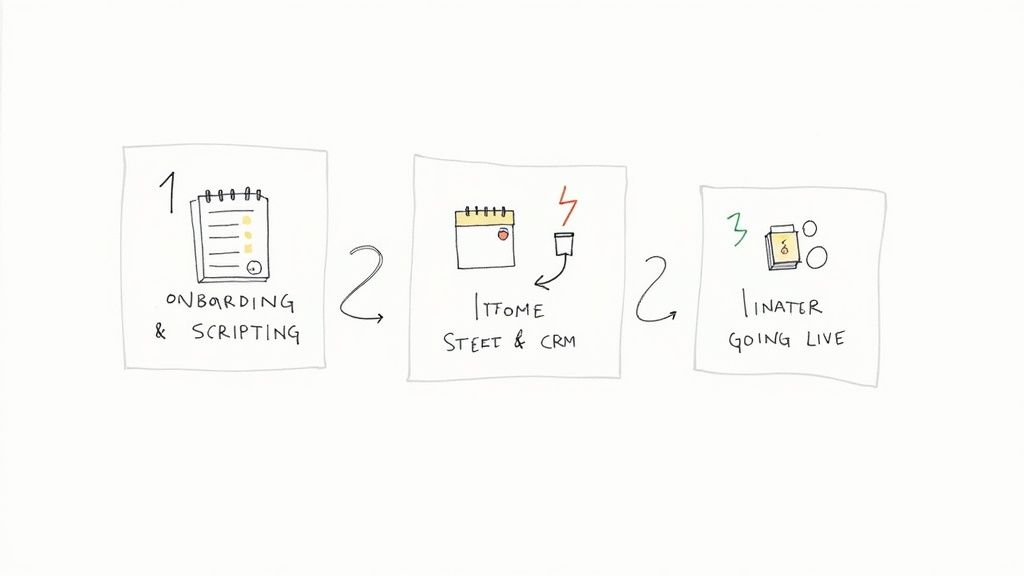
Step 1: Teach the AI How Your Business Works
First, you need to teach the AI how to be the perfect front-desk person for your moving company. This isn't about writing code. It's a simple Q&A session where you give it the essential details that make your business tick.
You'll answer straightforward questions like:
- What are your business hours?
- What specific zip codes or neighborhoods do you cover?
- Are you fully licensed and insured?
- Do you move specialty items like pianos or offer packing services?
This information becomes the AI's brain. It's what allows it to answer caller questions with the same accuracy you would, ensuring every single person gets a consistent and professional experience. You set it up once, and it's done.
Step 2: Connect It to Your Existing Tools
An AI receptionist should make your life easier, not create more work. Its real magic comes from plugging right into the tools you're already using to run your company. During this step, you'll connect the system to your calendar and, most importantly, your CRM software.
This is the key to automating your front office. When the AI fields a call from a new lead, it doesn't just take a message—it automatically creates a new contact in your CRM and books the estimate directly on your calendar. No more manual data entry. No more leads falling through the cracks.
Step 3: Flip the Switch and Go Live
This is the easiest part. Once the AI knows your business and is hooked into your other tools, all you have to do is forward your main business number to the new system.
That’s it. No hardware to install, no confusing tech stuff to manage. The second you forward that number, your AI receptionist is live, ready to handle every call, 24/7.
If you want to ease into it, you can start by forwarding calls only after hours or on weekends. But you’ll quickly see the value in having every single call answered, qualified, and logged. It’s how you finally reclaim your time and get back to focusing on what you do best—booking jobs and managing your crews.
Got Questions About AI Receptionists? Let's Talk.
Look, I get it. Bringing any new tech into your moving company is a big deal. You're running a business where every dollar and every minute is already stretched thin. So, it’s not just smart to ask tough questions, it's necessary.
Let's dig into the common worries I hear from moving company owners about using an AI receptionist for small business operations.
"Will It Sound Like a Robot and Annoy My Customers?"
This is always the first question, and for good reason. We’ve all been trapped in those horrible automated phone menus from the 90s. But modern AI isn't that. Not even close.
Today's systems use voice tech that’s surprisingly natural and conversational. The goal isn't to fool anyone into thinking they're talking to a person. It's about giving them a fast, professional, and genuinely helpful answer instead of dumping them into voicemail. Plus, the AI is trained specifically on moving lingo, so it understands what your callers are asking for and gets them what they need without the runaround.
"What Happens When Someone Asks a Weird or Complicated Question?"
An AI receptionist is built to crush the 80% of calls that are the same thing over and over—quote requests, questions about your service area, and scheduling. It's a machine for handling repetitive tasks. But what about the other 20%?
A good AI knows what it doesn't know. When a caller asks something complex or gets frustrated, it doesn't just get stuck in a loop. It’s smart enough to say, "Let me get you to someone who can help with that," and seamlessly transfers the call to you or someone on your team. It acts as the perfect filter, handling the grind so you can focus on the calls that actually need a human touch.
The AI’s job isn’t to replace your team. It's to make sure your experts only spend their time on the calls that require their expertise.
"Is My Customer Data Actually Safe?"
Absolutely. Protecting your data isn't just a feature; it's the foundation. Any reputable AI provider uses serious, enterprise-grade security like data encryption to make sure every piece of information is locked down tight.
Your lead lists and customer details are the lifeblood of your company. A professional system treats that data with the respect it deserves, keeping it secure and private.
The financial upside is just as clear. CMOs consistently see a strong return from these tools. Think about it: a small business can replace the $42,500–$61,000 per year cost of a human receptionist with a solution that starts as low as $49 per month. That's a 40-60% cut in overhead right there. Meanwhile, 51% of people actually prefer getting an instant AI response over waiting for a human. For a deeper dive into the numbers, you can discover more about AI receptionist ROI.
Ready to stop missing calls and start booking more jobs? MoveJoy is the AI-powered receptionist built specifically for movers. It answers 100% of your calls, captures every lead, and plugs right into your operations.