How to Close More Moving Jobs: Scripts to Convert Quotes into Bookings

When a customer is looking for a mover, it all boils down to one thing: who makes it easiest to book? It’s not just about price. It’s about a fast, professional response, a quote that feels right for their specific move, and clear, confident communication that walks them from a hesitant inquiry to a booked job on your calendar.
In the moving business, speed and trust are the only currencies that really matter. Any delay gives a potential customer time to call your competitor, and in this industry, the first mover to provide a confident quote often wins the job.
Why Moving Companies Leave Money on the Table
It’s a story every moving company owner knows by heart. You spend time putting together a solid, competitive quote. The customer sounds interested, asks all the right questions, and then… radio silence. They vanish into thin air.
This isn’t just bad luck; it’s a massive drain on revenue, especially for small and mid-sized movers trying to compete in a crowded local market. A single missed call on a busy Saturday morning—when customers are actually free to plan their move—can literally hand a profitable job to the next company on their list.

This isn’t just a sales problem; it’s an operational bottleneck. The reasons are simple, but they’re costly:
- Instant Price Shopping: Customers can request three or four quotes in minutes. If your response isn't immediate and professional, you’re already out of the race.
- The Speed-to-Book Connection: The first mover to provide a clear, confident quote often wins the job. Any delay you have gives the customer just enough time to find another option.
- The Cost of Voicemail: When you’re out on a job or driving the truck, every lead that hits your voicemail is a potential sale lost forever. Most customers simply won’t wait for a callback.
We're not talking about a few missed opportunities. This is about plugging a major leak in your revenue stream. In a competitive local market where every job counts, letting leads go cold is the fastest way to hurt your bottom line.
The real challenge isn't just sending a quote; it's the entire conversation that happens before and after. How you build trust, handle questions, and follow up determines whether you book the job or become just another estimate in their inbox.
The good news is, these are solvable problems. By tightening up your initial response, refining your quoting process, and putting real systems in place for follow-ups, you can capture that lost income. With the right techniques and tools—like a modern moving company estimate software—you can turn those frustrating near-misses into solidly booked jobs on your calendar.
Winning the Job in the First Conversation
That first phone call isn't just a discovery call; it's your audition. In a market where customers dial three or four local movers in a row, the company that answers first and builds instant trust often wins the job before anyone else even has a chance to send a quote.
Every second a potential customer waits for a callback, their motivation to book with you plummets. This is where an immediate live answer—whether from you, your dispatcher, or a 24/7 AI receptionist—becomes a massive competitive advantage. It stops the customer from dialing the next number on their list and gives you control of the conversation.

Go Beyond the Basic Questions
Anyone can ask, "Where are you moving from and to?" To stand out, you need to go deeper and show you're actually listening. This simple shift turns the call from a transaction into a consultation. Suddenly, you're not just another mover with a truck; you're a helpful expert.
A couple of rapport-building questions can make all the difference:
- "That's a great neighborhood you're moving to. What are you looking forward to most about the new place?"
- "Moving with kids can be a handful. Have you thought about how we can make the day less stressful for them?"
These questions show you care about the person, not just the inventory list. That emotional connection is often the tie-breaker when all the quotes look the same.
Transition From Information Taker to Problem Solver
Your real goal during that first call is to uncover the customer's hidden anxieties. Are they worried about that priceless antique piano? Staring at a narrow staircase and wondering how their couch will ever fit? Are they completely stressed about a tight timeline?
This is where you shift from just taking notes to actively solving their problems. The ability to spot and address these pain points is what separates a standard mover from a premium one.
Pro-Tip: Frame your value around solutions. Instead of just saying, "We charge X for packing," try this: "To make sure your fragile items arrive safely, we offer a full-service packing option with specialized materials. That way, you won't have to worry about a thing."
When you focus on their specific needs, you build a quote that feels custom-made. It makes it much harder for a competitor to swoop in and win them over with a slightly lower price. A detailed, thoughtful quote screams expertise, and our guide on creating a solid moving company estimate template can help you structure your proposals for maximum impact.
Closing Scripts and Techniques That Actually Land Moving Jobs
Alright, you've built solid rapport and put together a quote that makes sense. Now comes the moment many moving company owners dread: asking for the business. You don’t want to come off as a pushy salesman, but you can’t afford to just hang up and hope for the best.
Effective closing isn’t about pressure. It’s about making it simple for the customer to say “yes.” You’ve already done the hard work by listening to their needs. Now, you’re just guiding them to the finish line.
The Assumptive Close: Make Booking the Obvious Next Step
This is one of the most powerful and low-pressure ways to close a moving lead. The Assumptive Close works by changing the conversation from if they’re going to book to when and how. You act like the decision is already made. It projects confidence and makes the customer's choice feel easy.
You skip the big, scary "yes or no" question and move straight to logistics—which is what the customer is actually thinking about anyway.
Here’s how it sounds in the real world:
- On the phone: "Okay, it sounds like we have a great plan for your move. To get you locked in, what day works better for our crew to arrive, the 28th or the 29th?"
- Via text: "Just sent over the full quote. To lock in your spot on our calendar, what's the best email address to send the booking confirmation to?"
You didn't ask if they wanted to book. You asked for the information needed to start the booking. It's a small shift with a huge impact.
The Urgency Close: Turn Scarcity into a Booking
The Urgency Close is your best friend during those crazy spring and summer months when your schedule is genuinely packed. This isn’t about manufacturing fake pressure. It’s about being honest about the reality of seasonal demand. When a customer understands a spot on your calendar might genuinely disappear, they’re motivated to commit.
By framing the decision around your calendar’s availability, you’re not selling—you’re advising. You become the helpful expert looking out for their best interests so they don't miss out on their preferred date.
This works like a charm for weekend moves or those chaotic end-of-the-month slots everyone wants.
- On the phone: "I’m looking at our calendar right now, and that last weekend of June is filling up fast. I have two spots left on Saturday the 29th. Should we go ahead and reserve one of those for you?"
- Via text: "Just a heads-up, that date is very popular. I'd recommend booking today to ensure we can get you on the schedule. Can I go ahead and hold that slot for you?"
Nailing these small interactions can completely change your booking numbers. It’s not about reinventing your entire sales process. It’s about small, consistent improvements. To dive deeper, you can explore more sales strategy insights that show how tiny changes lead to big results.
How to Handle Common Customer Objections
Hearing an objection isn’t a "no." When a customer raises a concern, they're actually inviting you into a conversation. They're engaged and giving you a chance to win them over.
For small to mid-sized movers, these moments are everything. Nailing the response turns a hesitant lead into a booked job. Mess it up, and they're gone.
The good news? Most objections boil down to just a few core issues. Instead of getting flustered, have a simple, confident response ready to go.
The Three-Step Framework for Any Objection
No matter the objection, your response should follow this simple flow. It’s a bulletproof way to sound professional, empathetic, and in control.
- Validate: Start by acknowledging their point. Phrases like "That makes sense" or "I completely understand" instantly disarm them. It shows you're listening.
- Reinforce: Hit them with a brief, confident reminder of why you're worth it. This isn't a long sales pitch. It's a single sentence that connects your price to the quality they'll get.
- Solve: End by offering a tangible next step. This pivots the conversation away from the problem and back toward a solution—and a booking.
Let's see how this plays out with the objections you hear every day.
Objection 1: "Your Price Is Too High"
This is the classic. But it's rarely just about the money. What they're really asking is, "Why should I pay you more than the cheaper guy I just talked to?"
Your Response: "I completely understand that budget is a huge factor in any move. The main reason our price is structured this way is that we're fully licensed, insured, and use our own dedicated crews—we never use day laborers. If the date is flexible, we could look at a mid-week move, which can sometimes bring the cost down a bit. Would that be an option for you?"
You agreed with their concern, justified your price with real value (insurance, dedicated crews), and offered a helpful solution without just slashing your rate.
Objection 2: "I Need to Check with My Partner"
This is often a polite way of saying, "I'm not ready to decide right now." Your job isn't to pressure them. It’s to make it easy for them to have that conversation and choose you.
Your Response: "That makes perfect sense; it's a big decision for both of you. While you chat, would it be helpful if I texted you a quick summary of the key details—like our arrival window and the all-inclusive rate—so you have everything in one place? That way, you’re both on the same page."
You've validated their process and made their life easier. Now you have a natural reason to follow up.
Objection 3: "I'll Call You Back Later"
This is the ultimate stall tactic. Letting a customer hang up with a vague promise to call back is how you lose a sale. Your job is to gently pin down a real next step before they're gone.
Your Response: "Of course, take the time you need. Just so I can keep your preferred date in mind, would it be okay if I follow up with a quick text tomorrow afternoon to see what you've decided? Our schedule for that week is starting to fill up, and I want to make sure you can secure your spot."
This is friendly but firm. You’ve respected their request while professionally setting a follow-up and adding a soft touch of urgency.
Objection Handling Scripts for Moving Companies
Handling objections is a skill that gets better with practice. This table is a quick-reference guide to help your team turn common roadblocks into booked jobs.
| Customer Objection | Your Proactive Response | Goal of the Response |
|---|---|---|
| "Your price is too high." | "I get it, budget is key. We include full insurance and use our own background-checked crew, so there are no surprises. Can we explore a mid-week date to see if that helps the numbers?" | Justify price with value (insurance, quality crew), not just cost. Offer a creative solution. |
| "I got a cheaper quote from [Competitor]." | "That's understandable. It’s smart to compare. Be sure to check if their quote includes fuel, shrink wrap, and insurance—ours is all-inclusive so the price you see is the price you pay." | Highlight your all-inclusive value and plant a seed of doubt about hidden fees from competitors. |
| "I need to check with my partner." | "Of course, it's a big decision. I can text you a summary with our rate and arrival window right now so you have all the details handy for that conversation. Sound good?" | Make it easy for them to "sell" you to their partner. Create a reason for immediate follow-up. |
| "I'll call you back." | "No problem. That date is popular, so would it be okay if I pencil you in and follow up tomorrow afternoon? That way your spot is held just in case." | Create soft urgency and establish a concrete next step. Avoid leaving the call open-ended. |
| "That sounds like a lot of work (stairs, heavy items, etc.)." | "You're right, it's a complex job, which is exactly why you want an experienced team. We've handled hundreds of moves just like this and have the right equipment to do it safely and efficiently." | Turn their perceived negative into a positive for you. Frame complexity as a reason to hire a pro. |
Remember that an objection is just a question in disguise. Answer it with confidence and a clear path forward, and you'll book more jobs.
The Automated Follow-Up That Books Jobs While You Sleep
Here’s a hard truth for moving company owners: more jobs are lost to silence than to a competitor’s lower price. You spend time crafting the perfect quote, send it off, and then… crickets. That lack of consistent follow-up is one of the biggest, most fixable revenue leaks in your business.
Think about it from the customer's perspective. They're juggling a dozen tasks. Expecting them to book after a single phone call is unrealistic. A persistent, professional follow-up sequence keeps your company top-of-mind while your competitors wait for the phone to ring. The key is to be helpful, not pushy.
Building a Simple and Effective Follow-Up Sequence
Your goal is to stay visible and add value with each message. A simple multi-touch sequence using text and email works wonders. The timing is everything—connect while their motivation is high, without being overwhelming.
Here's a proven sequence you can use today:
- Touch 1 (30 Minutes After Quote): Quick Text Confirmation. "Hi [Customer Name], just confirming you received the quote for your move to [New City]. Let me know if you have any questions. – [Your Name] from [Your Company]."
- Touch 2 (24 Hours Later): Value-Add Email. Send a brief email with a link to a glowing customer review or a helpful tip like, "5 Things People Forget on Moving Day." This reinforces your credibility and shows you're a pro.
- Touch 3 (48 Hours Later): Gentle Nudge Text. "Hi [Customer Name], just following up on the quote for your move on [Date]. Our calendar for that week is filling up fast. Are you ready to get your spot secured?"
This approach also sets you up to handle objections that often pop up during the follow-up process.
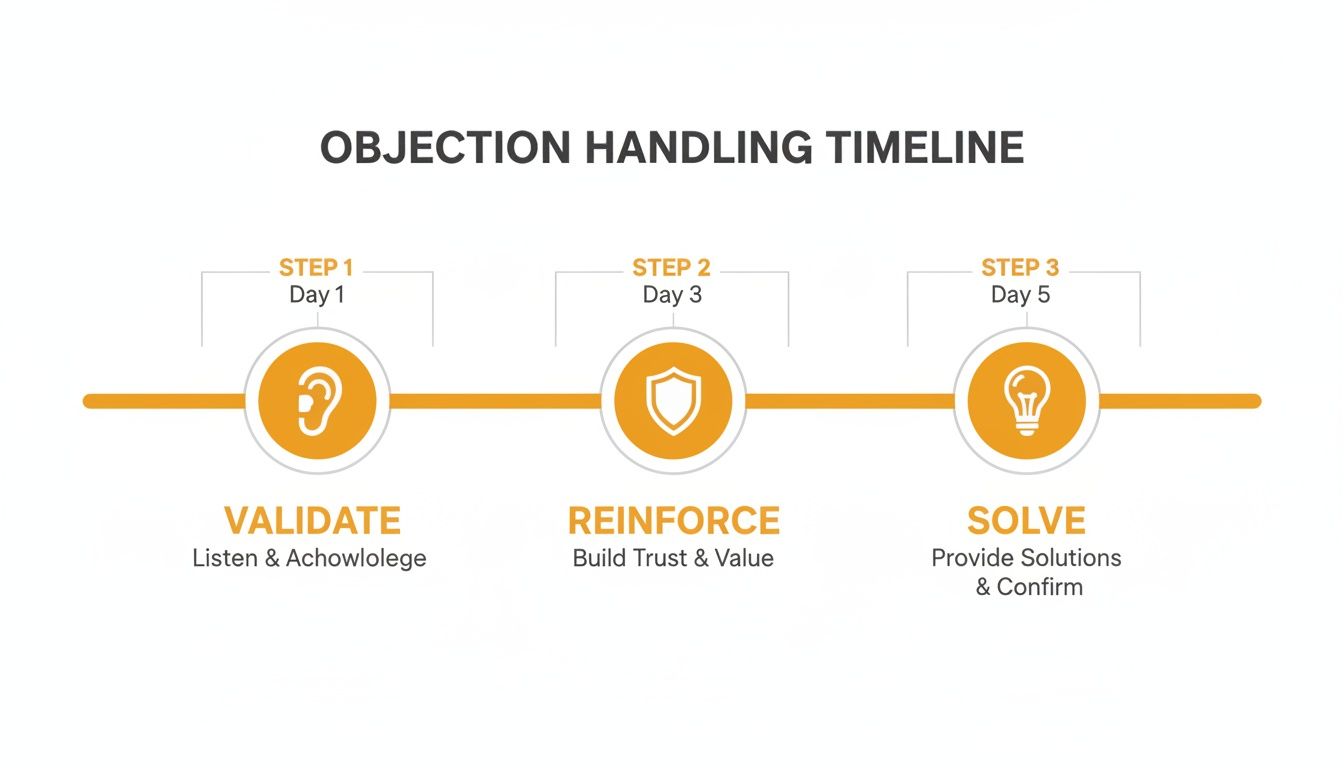
The big takeaway is that acknowledging a customer's concern before trying to solve it is the fastest way to build trust and move the conversation forward.
Automating the Process to Recover Lost Revenue
Let’s be real. Manually tracking and sending these messages for every single lead is nearly impossible when you’re also managing crews and dispatch. This is where automation becomes your most valuable employee.
By automating your follow-up, you guarantee every lead gets the same professional, timely communication—whether it’s a Tuesday morning or a Sunday night. It’s like having a sales assistant who never sleeps, never forgets, and consistently works to book jobs you would have otherwise lost.
Modern moving company software can handle this entire process. Once you send a quote, the system can automatically trigger this sequence of texts and emails. It ensures no lead falls through the cracks because you got busy, directly recovering revenue that used to disappear. Just one booked job from an automated follow-up often pays for the technology for the entire month.
Got Questions About Closing? I've Got Answers.
Putting new sales tactics into play is one thing, but what happens when you run into real-world roadblocks? Here are straight answers to the questions every moving company owner asks.
What Do I Do When a Customer Goes Silent After a Quote?
This is the classic deal-killer. You send a detailed quote, and then… crickets. The good news is, it's rarely because they hated your price. More often, life just got in the way.
Your job is to stay top-of-mind without being annoying. Don’t just sit and hope they call back.
- First, confirm they got it. A simple text 30-60 minutes after you send the quote works wonders: "Hi [Name], just sent that quote over. Did it come through okay?" It’s a low-pressure way to pop back onto their screen.
- Next, give them something useful. A day later, send a quick email with a link to a glowing five-star review or a short tip, like "3 Things Most People Forget to Pack." This makes you look like a helpful expert.
- Finally, create a little urgency. After 48 hours, a final text is fair game: "Hi [Name], just checking in on the quote. We're booking up fast for that week and I'd love to get you on the calendar. Ready to lock in your spot?"
If you still get nothing after those three pings, it’s probably time to move on. This is where automated quote follow-up is a game-changer, making sure every lead gets this professional treatment without you having to think about it.
How Many Follow-Ups Is Too Many?
There's a fine line between persistent and pest. For a local moving company, a three-to-five touchpoint sequence spread over a week is the sweet spot.
Your goal isn't to hammer them into submission. It's to be the most helpful, responsive, and easy-to-work-with mover they’ve talked to. After three or four unanswered messages, your time is better spent on fresh leads.
What's the Single Most Important Metric to Track?
Tracking quotes sent and jobs booked is fine. But if you want to know what’s really working, you need to track your lead-to-booking conversion rate. This number tells you the unfiltered truth about how effective your entire sales process is.
Calculating it is simple. Just divide the number of jobs you booked by the total number of qualified leads you got in a specific period.
The Formula: (Booked Jobs / Total Leads) x 100 = Conversion Rate
If you got 50 solid leads last month and booked 15 of them, your conversion rate is 30%. Watching this number month-over-month is how you know if your new scripts and follow-ups are actually making you more money.
Ready to stop missing calls and start booking more jobs automatically? MoveJoy provides a 24/7 AI receptionist that captures every lead, sends accurate quotes, and follows up until the job is booked. See how it can transform your front-office operations.
Learn more at https://getmovejoy.com.