A Guide to Call Center Costs for Moving Companies
When you think about the cost of answering your phones, what number comes to mind? For most moving company owners, it's a simple calculation: an employee's hourly wage. But that’s not the real number. Not even close.
The real cost is a mix of direct expenses, technology, and the one thing that never shows up on a spreadsheet: the revenue that walks out the door with every single missed call. This total figure is usually a shock to owners who haven’t run the numbers, especially for a small to mid-sized moving company where every job counts.
This guide will break down the true call center costs for your moving business and show you how modern, scalable solutions can ensure you never miss an opportunity again.
The Real Price of Answering Your Phones for a Moving Business
Every time your phone rings, it's a potential job. It's the lifeblood of your moving company. But what does it actually cost to capture that opportunity, especially during the busy season?
As a moving company owner, you're a master of logistics and operations, but the front office often runs on gut feeling. You think you know the cost of handling calls because you know what you pay your office manager. Simple, right?

The reality is way more complex. When you start peeling back the layers, the true cost of an in-house person reveals itself. Beyond that hourly wage, you’re also paying for:
- Recruitment and Training: The time and money spent finding, hiring, and getting a new office manager or salesperson up to speed on your quoting process.
- Benefits and Taxes: Don't forget payroll taxes, workers' comp, and any benefits you offer. That can add another 20-30% on top of their base salary.
- Technology and Tools: The phone system itself, your CRM, and any other moving software needed to manage leads and book jobs all have monthly fees.
- Human Limitations: Your employee can only handle one call at a time. They need breaks. They take sick days. They go home at 5 PM—leaving all your evening and weekend leads to die in voicemail, right when many customers are planning their move.
The Problem of Lost Revenue
The biggest expense, though, is the one you can’t see on a payroll report: lost revenue from missed calls.
A missed call isn't just a missed conversation. It's a customer with a credit card in hand who is now dialing your competitor. We've seen firsthand how the real cost of missing just 4 calls per week can quietly drain tens of thousands of dollars from a moving business every single year. A customer looking for a mover shops fast; the first company to give them a quote often wins the job.
This isn't just a moving company problem; it's why businesses are investing heavily in better solutions. The worldwide call center market is set to explode from $352.4 billion in 2024 to over $500 billion by 2030. This growth is fueled by new tech designed to stop the bleeding from missed opportunities. For a local moving business, this trend is a game-changer. It gives you a powerful new way to compete without the massive overhead.
Breaking Down In-House Call Center Costs
Hiring someone to answer your phones seems simple. You find a good candidate, agree on an hourly wage, and you’re off to the races. But any seasoned moving company owner knows the sticker price is never the real price. The true cost of an in-house employee goes way beyond their paycheck, quietly chipping away at your profit margins.
To really get a grip on what you're spending, you have to look at every single line item—the obvious ones and the ones hiding in plain sight. Only then can you actually benchmark your costs and understand the true financial weight of your current front-office setup.
Direct Labor Costs
The most obvious expense, of course, is what you pay your employee. Let's start there.
- Hourly Wage/Salary: For a reliable front-office person, you're likely paying somewhere between $18 and $25 per hour. For a standard 40-hour week, that works out to $37,440 to $52,000 per year.
- Payroll Taxes & Benefits: This is the big one that catches most owners off guard. You have to factor in Social Security, Medicare, unemployment insurance, and workers' comp. If you offer benefits like health insurance, that number climbs even higher. A conservative estimate adds another 20-30% on top of their base salary, tacking on an extra $7,500 to $15,600 annually.
Right out of the gate, your "$20-an-hour" employee is already costing you between $45,000 and $67,600 per year. And we're just getting started.
The Overlooked Operational Costs
This is where the numbers start to get fuzzy for most operators, but these indirect costs are just as real. Think of them as the hidden operational drag on your bottom line.
- Recruitment and Training: Finding the right person isn't free. You spend money on job ads, time conducting interviews, and more on background checks. Once you hire them, you or your manager will spend weeks—paid weeks—getting them up to speed on your quoting process, your CRM, and the unique lingo of the moving business.
- Technology and Tools: Your new hire needs gear. That means a phone system (like a VoIP service), a computer, and monthly subscriptions for your moving software or CRM. These tools can easily add up to $100–$300 per month, per employee.
- Office Overhead: Don't forget the physical space. Even if they're just in a small corner of your office, that employee contributes to your rent, utilities, and internet bill every single month.
The most significant expense in any traditional call center is labor, consistently making up 60% to 75% of the total operational budget. This figure includes wages, benefits, and hiring, showing just how much of your investment is tied to a single person's productivity. You can explore a detailed analysis of these operational expenses to see how they impact larger businesses.
To put this in perspective, here's a side-by-side look at what a single in-house employee truly costs compared to a typical outsourced BPO plan designed for a small moving company.
True Cost of an In-House Employee vs Outsourced BPO (Annual Estimate)
| Cost Component | In-House Employee (Annual Cost) | Outsourced BPO (Annual Cost) | Notes |
|---|---|---|---|
| Base Salary/Plan Fee | $45,760 ($22/hr) | $12,000 ($1,000/mo) | The BPO fee is a flat rate, while the salary is just the starting point. |
| Payroll Taxes & Benefits | $11,440 (est. 25%) | $0 | The BPO handles their own payroll and benefits. |
| Recruitment & Training | $2,500 (one-time, amortized) | $0 | The BPO covers all hiring and training costs. |
| Technology & Software | $2,400 ($200/mo) | Included in plan | Your in-house employee needs a dedicated computer, phone line, and CRM seat. |
| Overhead (Rent, Utilities) | $1,800 ($150/mo) | $0 | No extra office space or utilities are needed for an outsourced team. |
| Management & Supervision | $5,000 (est. 10% of manager's time) | Included in plan | You have to manage your employee; the BPO manages their own agents. |
| Cost of "Shrinkage" | ~$10,000 (lost productivity) | Minimal | BPOs build redundancy into their models to cover breaks, sick days, etc. |
| TOTAL ESTIMATED COST | $78,900 | $12,000 | The "all-in" cost reveals a massive difference in operational expense. |
As you can see, the "sticker price" of an employee is just the tip of the iceberg. The fully-loaded cost is often nearly double their base salary, while an outsourced solution provides a much more predictable, all-inclusive expense.
The Unseen Cost of "Shrinkage"
Finally, we get to the most elusive—and damaging—cost of all: shrinkage. It’s an industry term for any paid time when an employee isn't actively working on revenue-generating tasks.
This includes totally normal stuff like:
- Breaks and Lunches: A standard part of any workday, but it means your phones are going straight to voicemail.
- Sick Days and Vacation: An essential benefit for your team, but it leaves you scrambling to cover the phones.
- Unproductive Time: The moments spent on non-work tasks, dealing with system downtime, or just waiting between calls.
Even your best, most dedicated employee is only truly productive for a fraction of their paid hours. Every minute they aren't answering a call is a potential lead—and thousands in revenue—slipping away to a competitor who was ready to pick up the phone. This total, all-in figure is the real number you have to use when comparing your options.
Comparing Your Call Handling Options
Now that we’ve pulled back the curtain on the real, all-in cost of an in-house employee, let’s look at the alternatives. For a small or mid-sized moving company, every dollar tied up in overhead is a dollar you can't put toward a new truck, a better crew, or your marketing budget.
You really have three paths: keep it all in-house, hand it off to a traditional outsourced call center, or use a modern, AI-powered receptionist. Each one has a completely different price tag, operational headache, and set of trade-offs, especially when your busy season hits.
Let’s break down each option for a typical 5-truck moving company that gets around 200 calls a month.
Option 1: The In-House Team
This is the old-school model, and the one we just dissected. You hire a full-time person to run the office, answer calls, give quotes, and keep the schedule straight.
- Cost Structure: High fixed costs. You're on the hook for a salary, benefits, and office space whether the phone is ringing off the hook or dead silent. As we saw, this can easily top $70,000 a year.
- Scalability: Terrible. During the summer rush, one person can only handle one call at a time. Every other caller gets dumped into voicemail—a black hole where revenue disappears. To scale up, you have to hire a temp, which is a mess of training and inconsistent service.
- Availability: Limited to 9-to-5. Every single call that comes in after hours or on a Sunday is a guaranteed missed opportunity.
The biggest plus here is control; your employee knows your business inside and out. The massive con is that this control comes at a ridiculously high price, both in direct costs and in all the leads you lose.
Option 2: The Outsourced Call Center
Passing off your calls to a third-party service, often called a Business Process Outsourcer (BPO), can look pretty appealing at first. They promise 24/7 coverage for what seems like a lower price.
- Cost Structure: Variable, usually billed per minute or per call. Rates can run anywhere from $0.90 to $1.75 per minute. For our mover getting 200 calls a month, let's say the average call is 5 minutes. That’s $900 to $1,750 a month, or $10,800 to $21,000 a year.
- Scalability: Excellent. A BPO is built to handle huge call volumes, making them great for seasonal spikes.
- Availability: 24/7 coverage is standard, which is a huge step up.
But there's a giant catch: they don't know the moving business. The agent answering your phone is likely reading from a generic script and has never quoted a three-bedroom apartment with a long carry. This just leads to frustrated customers, wildly inaccurate quotes, and a brand experience that can cost you the job before you even get a chance to compete.
Key Takeaway: Outsourced call centers solve the availability problem but completely fail on the quality problem. They can answer the phone, sure, but they can't speak your language—and that's what turns a caller into a booked job.
Option 3: The AI-Powered Receptionist
This is the modern approach. It uses an AI assistant specifically trained on the moving industry to handle your incoming calls. It’s built to fill the gap between the sky-high cost of an in-house employee and the low quality of a generic call center.
- Cost Structure: A predictable, flat monthly fee. This model gets rid of the crazy fixed costs of a salary and the unpredictable per-minute billing of a BPO. It feels more like a stable software subscription.
- Scalability: Infinite. An AI can handle one call or a hundred calls at the exact same time without breaking a sweat. Your capacity instantly scales the second peak season starts.
- Availability: True 24/7/35. It captures every lead, day or night, and can even text instant quotes, making sure you're always the first to respond.
This infographic really shows where the money goes in a traditional setup.
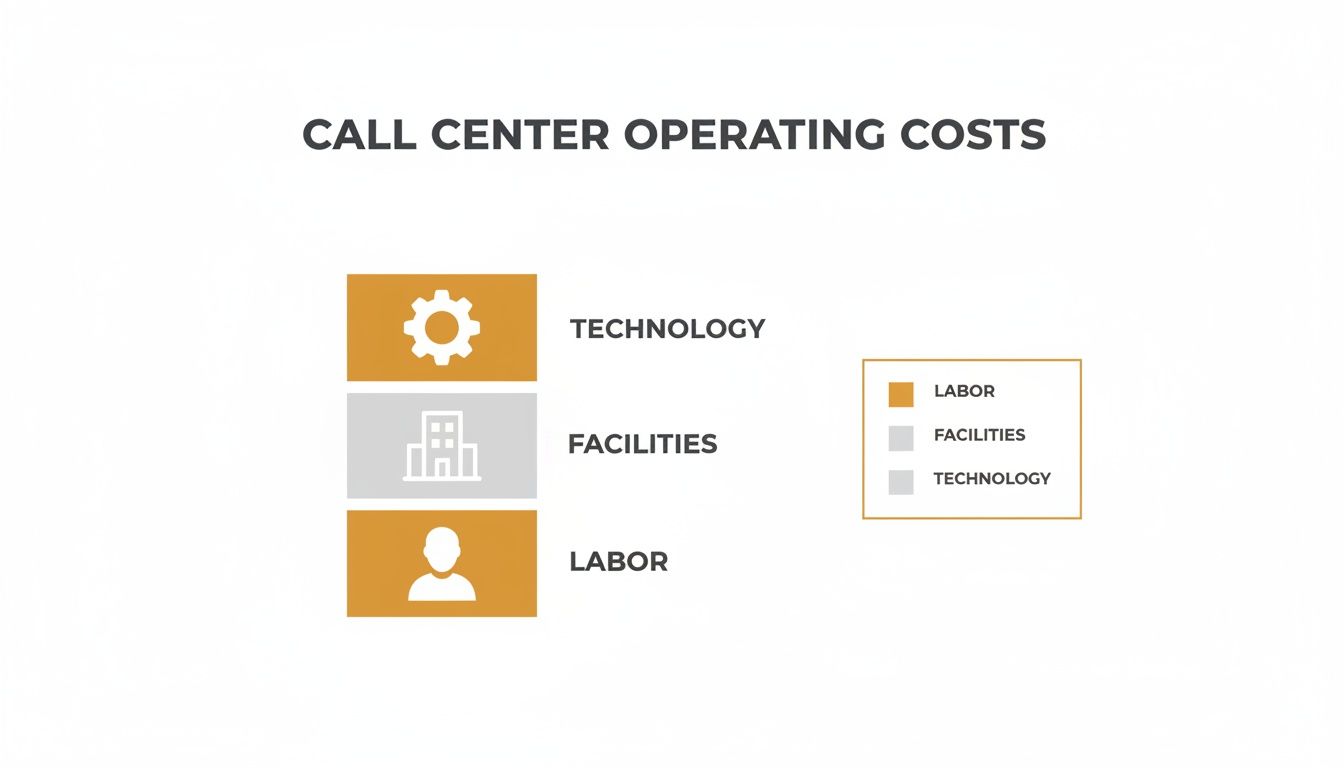
It’s pretty clear that labor is the monster expense, which is exactly what an automated solution is designed to tackle. An AI assistant automates the most expensive part of the equation while making sure every lead gets captured, which is the whole point of an effective after-hours answering service for small business.
This approach transforms your front office from a cost center into an efficient revenue engine. The right AI isn’t just an answering machine; it’s a booking machine that works without needing more software.
The Financial Case for an AI Receptionist
So far, we’ve been talking about the costs tied to handling your phones. But the sharpest moving company owners I know don’t just obsess over saving a buck; they focus on making a buck. This is where the whole conversation around call center costs flips from an expense problem into a revenue opportunity.
An AI-powered receptionist isn't just a cheaper stand-in for a human. It's a tool that actively goes out and grabs the jobs you're currently losing. The return on investment (ROI) isn’t about the salary you save—it’s about the new business it pulls in the door.
From Cost Center to Revenue Engine
Think about every call you've missed. The ones that came in at 8 PM on a Tuesday, during a team meeting, or over a busy holiday weekend. Every single one wasn't just a voicemail—it was a customer who hung up and immediately dialed your competitor.
An AI receptionist completely changes that game. It's on the clock 24/7, making sure 100% of your inbound calls get answered. It grabs lead details, texts instant quotes, and can even book the job right into your calendar. This isn't just about sounding professional; it's about being the first to respond, which is often the only thing that matters to a customer ready to book.
There's a reason the use of AI in customer service is exploding. Conversational AI is projected to cut customer service costs worldwide by a wild $80 billion by 2026. That number shows a massive shift in how businesses are thinking about getting things done and keeping customers happy.
The Power of One Extra Job
Here’s the most powerful math any moving company owner can do. How much is one average local move worth to you? Let's call it $1,500.
Now, be honest—how many of those jobs do you think you lose to voicemail each month? Two? Four? Even if you're super conservative and say just one, the numbers are impossible to ignore.
Booking just one extra moving job—a job you absolutely would have lost to a missed call—often pays for an entire month of an AI service. Every call it catches after that is pure profit.
This simple calculation reframes the entire discussion. An AI receptionist stops being an "expense" and becomes a self-funding growth engine for your company. It’s a system that literally pays for itself by plugging the biggest, most obvious revenue leak you have: missed opportunities.
Let's break that down with a quick, conservative scenario. If an AI receptionist helps you recover just three jobs you would have otherwise missed, the monthly profit is pretty compelling.
ROI Scenario: Recovering Just 3 Missed Jobs a Month
| Metric | Calculation/Value | Result |
|---|---|---|
| Average Job Value | $1,500 | $1,500 |
| Recovered Jobs | 3 per month | 3 |
| Gross Revenue Recovered | $1,500 x 3 | $4,500 |
| Average AI Receptionist Cost | -$299 (Mid-Tier Plan) | -$299 |
| Net Monthly Profit | $4,500 – $299 | $4,201 |
That's over $4,000 in pure profit landing on your bottom line each month, just from plugging a leak you might not have even realized was so big.
Calculating Your True ROI
But the return goes way beyond that one job. A good AI solution creates a ripple effect across your whole operation, boosting your bottom line from multiple angles.
Here’s what that looks like:
- Increased Booking Rates: Responding instantly and following up automatically means you engage leads the second they reach out. That dramatically increases the odds they book with you.
- Higher Revenue Per Job: With consistent, perfect quoting based on your actual rates, you kill the problem of under-quoting that happens with generic call centers or a dispatcher who’s in a rush.
- Reduced Labor Costs: You wipe out the massive $70,000+ annual cost of an in-house hire. That’s capital you can pour back into new trucks, better marketing, or higher pay for your crews.
- Improved Team Focus: Your ops manager is no longer chained to the phone. They can finally focus on high-value work like managing crews, handling escalations, and actually planning for growth.
When you add it all up, the financial case is a no-brainer. An AI receptionist doesn't just cut your call center costs; it turns your front office into your most reliable salesperson. It’s not about replacing your team—it’s about letting them do more of what they do best.
To see how these numbers stack up for your business, a moving company ROI calculator can give you a quick estimate of the revenue you're likely leaving on the table.
Putting a Smarter Call Strategy in Place
Changing how your front office works can feel like a huge project, but it’s not. It’s a series of small, manageable steps. Shifting to a better call strategy isn't about ripping out everything overnight. It's about taking an honest look at what's broken and choosing a path that stops jobs from slipping through the cracks.
Think of it less like a complicated tech upgrade and more like a straightforward business decision to get more efficient and book more moves.
Step 1: Run a Missed Call Audit
Before you can fix a leak, you have to know how big it is. For one full week, commit to tracking every single call that comes into your business. No exceptions.
Grab a simple spreadsheet or even a notebook and log these key details:
- Total Calls Received: The total number of times your phone rang.
- Calls a Human Answered: Any call picked up by you or someone on your team.
- Calls Dumped to Voicemail: Every caller who got a machine instead of a person.
- Time of Day for Missed Calls: When did they happen? After 5 PM? Weekends? During the crew's lunch break?
This simple exercise is a real eye-opener for most owners. I’ve seen moving companies shocked to discover they're missing 20-30% of their inbound leads, especially when things get hectic. That data gives you a hard number—a baseline for how much money you’re leaving on the table.
Step 2: Vet Your Options with the Right Questions
Once you see the numbers, you’ll be ready to find a solution. Whether you’re looking at a traditional answering service or a modern AI receptionist, you need to ask questions that cut through the sales fluff. Generic solutions are a disaster for the moving industry.
Here’s a checklist of questions to ask any provider you’re considering:
- Do you actually know the moving business? A generic agent can’t quote a 3-bedroom house with a piano. Ask for specific examples of how they handle industry scenarios.
- How do you connect with my CRM and calendar? The whole point is to automate. The system should create leads in your software and book jobs on your schedule without anyone having to type it in manually.
- What’s your pricing model? Run from confusing per-minute rates. You want transparent, flat-fee pricing so you know exactly what your call center costs are each month, no matter how many calls you get.
- Can you really handle calls 24/7? Don't settle for "business hours." A huge percentage of moving leads come in after 5 PM and on weekends. True 24/7 coverage is non-negotiable.
A solution that can't speak the language of moving isn't a solution—it's just another operational headache. Real value comes from industry-specific intelligence that gets the lead right every single time.
Step 3: Map Out a Smooth Transition
Putting a new system in place shouldn't throw your business into chaos. The goal is to get up and running fast so you can start catching those lost leads immediately.
A simple, painless rollout looks like this:
- Forward Your Number: Most modern systems just need you to forward your main business line. It’s instant and doesn't require an IT degree.
- Set Your Business Rules: You’ll provide your rates, service areas, and basic quoting logic. For an AI system, this is usually just a quick setup call.
- Run in Parallel for a Bit: For the first few days, let the new system just handle after-hours calls or overflow when your lines are busy. This lets you see it work without flipping the switch entirely.
- Go Live: Once you're comfortable, let the new system become your primary contact. Your team is suddenly free from the constant interruption of a ringing phone and can focus on managing crews and making customers happy.
Your call handling isn't just another line item on your expense report—it's the engine that drives your entire business. Letting it run inefficiently is like leaving a perfectly good truck parked during the middle of May. It’s just a massive waste of potential.
Your Next Move
We’ve walked through the real, all-in call center costs of running a purely in-house team. The fixed salary, the benefits, the overhead… that’s just the cover charge. The real pain comes from the opportunity cost of every single missed call—each one a paying customer who just drove straight over to your competition.
In today's market, speed is the only thing that matters. Moving customers don't leave polite voicemails and wait for a callback. They hang up and dial the next company on their Google search. It’s a brutal, simple truth: the mover who answers first, quotes first, and books first, wins the job.
Switching to a modern setup like 24/7 call automation isn't some big, scary tech project. It's a straight-up business decision with a clear, immediate, and often massive return on investment.
Final Thought: Think of automation as your most reliable employee. It never calls in sick, works around the clock without complaining, and its only job is to turn ringing phones into booked moves. It ensures you are always open for business, even when you're not.
By making this shift, you’re not just plugging leaks. You're building a more profitable, resilient operation, one answered call at a time. It’s how you turn a cost center into a powerful revenue engine and finally get a foundation for real, sustainable growth.
A Few Lingering Questions
When it comes to your front office, every decision hits the bottom line. Here are some straight-shooting answers to the questions I hear most often from moving company owners.
What’s the Biggest Hidden Cost I’m Not Seeing?
It’s not on any spreadsheet. The biggest cost is the revenue you lose from missed calls.
Every single call that hits voicemail—especially after 5 PM or during your peak season—is a customer with a credit card in hand, ready to book. Now they're just dialing the next mover on their list.
Think about it. Losing just three or four of those jobs a month easily adds up to over $50,000 in lost annual revenue. That stings way more than any software subscription or employee salary, making it the most expensive blind spot for most moving companies.
Is an Outsourced Call Center Really Cheaper Than an In-House Hire?
On paper, maybe. A low per-minute rate from a generic call center looks tempting, but it almost always ends up costing you more in the long run.
Why? Because they have zero industry knowledge and their quoting is inconsistent at best. These agents don't know the difference between a long carry and a flight of stairs. They can't properly estimate a three-bedroom house or handle questions about specialty items.
This leads to two bad outcomes: frustrated customers who hang up, and poorly quoted jobs that lose you money. It's a sharp contrast to an AI assistant built specifically for movers. You get the cost-effectiveness of outsourcing combined with the industry smarts needed to capture a lead correctly, every single time. It saves you money without costing you the job.
How Can I Cut Call Costs Without Hurting Customer Experience?
First thing's first: start tracking your missed call volume. You can't fix a leak if you don't know how big it is. This number will probably surprise you.
Next, use technology to offload the repetitive, time-sucking tasks that tie up your phone lines. An AI receptionist can handle the initial lead intake and basic quoting 24/7. This frees up your human staff to focus on what they do best: handling complex customer follow-ups and building relationships.
The goal isn't to replace your people. It's to make them more powerful, ensuring no lead ever gets dropped. This approach cuts your operational costs while actually making your customer service better and boosting your booking rate.
Ready to stop leaving money on the table? MoveJoy is a 24/7 AI-powered receptionist that answers every call, provides instant quotes, and books jobs right into your calendar. See how it turns your front office into a revenue machine. Learn more about MoveJoy.