The Mover’s Guide to a Phone Answering Service
For a moving company owner, a ringing phone is the sound of money. But let's be honest—when you're out on a job, managing a crew, or it's 9 PM on a Friday, that same ring is a major source of stress. Every call that goes to voicemail is more than just a missed connection. It's a potential job, worth thousands, that just went to your competitor down the street.
This guide breaks down exactly how a phone answering service can stop that revenue leak, streamline your front office, and help you book more moving jobs, even when you’re not there to pick up the phone.
The True Cost of a Missed Call in the Moving Business

It’s easy to write off a few missed calls as just part of the grind. You're busy. Your team is stretched thin. You can't be in two places at once. The problem is, this small leak can quickly turn into a flood of lost revenue, especially in an industry where customers need answers now.
When a customer is ready to book a move, they don't wait around. The data is clear: the first mover to answer the phone wins the job. If your phone rings and rolls to voicemail, that customer isn't leaving a message. They're already dialing the next moving company on their Google search list. Speed wins the booking.
Why Every Single Ring Matters
Think about a typical week. Maybe you miss one call while driving the truck. Another while you’re briefing a crew. A couple more over the weekend when the office is dark. Four missed calls might not sound like a big deal, but the financial hit is staggering.
If your average local move brings in $1,500, losing just four potential jobs a month means you're leaving $6,000 in revenue on the table. Annually, that’s over $72,000. That's enough to hire another crew member, buy a new truck, or seriously ramp up your marketing. This isn't a made-up number; it's the reality for countless moving businesses with 1-20 trucks.
The core issue is simple: customers looking for movers are in a high-intent, time-sensitive mindset. They won't wait for a callback when another company can give them a quote and get them on the schedule right then and there.
The Voicemail Black Hole
Let’s be blunt: voicemail is where profitable leads go to die. During the busy season, from April to September, the problem gets even worse. Your call volume spikes, but your capacity to answer stays exactly the same. This operational bottleneck is what holds your moving business back from real growth.
This is where a phone answering service stops being a "nice-to-have" and becomes a critical tool for revenue recovery. By making sure every single call is answered by a professional, you immediately plug the biggest leak in your business. It guarantees that no matter when a customer calls—noon on a Tuesday or 10 PM on a Saturday—their call gets handled, and the lead is secured before your competition even gets a chance.
You can see for yourself just how fast these costs add up by exploring the real cost of missing just 4 calls per week.
How a Phone Answering Service Actually Works for Movers

If you picture a generic, overseas call center when you hear "phone answering service," you're not alone. But that’s not what we're talking about here. A modern service designed for moving company operations is a seamless extension of your front office, using agents (or AI) who understand the quoting and booking process.
Its core job is simple but powerful: make sure a professional, knowledgeable voice answers every single call, 24/7. That's it. No more potential customers hitting your voicemail and immediately dialing the next mover.
Think of it as the perfect receptionist who never sleeps, takes a lunch break, or calls in sick. This is huge for capturing valuable leads from people who do their move planning after your office has closed. Our guide on an after-hours answering service for small business digs into just how much money is on the table after 5 PM.
The Call Handling Process Explained
When a potential customer dials your business number, the call is automatically forwarded to the answering service. Instead of some generic greeting, the call is answered with your company’s name and a custom script you helped create.
Here’s how a typical call from a new lead goes down:
- Professional Greeting: The service answers fast with your business name, making a solid first impression. No fumbling, no background noise from the truck cab.
- Lead Qualification: The service gathers the critical details your estimators need—caller's name, contact info, current and new addresses, move size (e.g., "a two-bedroom apartment"), and any special items like pianos or antiques.
- Information Delivery: This info is instantly sent to you or your sales manager via text, email, or dropped directly into your moving company CRM.
This process ensures that even when you’re out on a job, you’re still building a pipeline of warm, qualified leads to follow up on later.
More Than Just Taking Messages
Look, a basic service just takes a name and number. That’s not good enough for movers. A service built for the moving industry does a whole lot more. The best ones can integrate directly with your calendar to book estimates on the spot, turning a simple inquiry into a confirmed appointment in one call.
A modern answering service isn't just a defensive tool to stop missed calls. It's an offensive strategy to accelerate your sales cycle and book more jobs before your competitors even have a chance to call back.
The need for real voice support isn't going away. The global call center market, which is closely tied to these services, was valued at a staggering $352.4 billion in 2024 and is projected to hit $500 billion by 2030. That growth is fueled by a simple fact: 76% of consumers still prefer calling a live agent for help.
Ultimately, a phone answering service takes your call handling from a reactive, inconsistent process and turns it into a streamlined, professional operation. It flawlessly handles call overflow during your busy season and ensures every lead—whether it comes in at 2 PM on a Wednesday or 2 AM on a Sunday—is captured and secured for your business.
The Features That Actually Book Moves
Not all answering services are built the same. A generic service that just promises to take a name and number is basically a glorified voicemail. That won't cut it when a single booked job is worth over a grand. When a potential customer calls, you have one shot to turn that call into a booked move.
Think of it like buying a new truck for your fleet. You wouldn't just look for something with four wheels and an engine. You'd check the payload capacity, make sure it has a liftgate, and see if the tie-downs are solid. The same logic applies here. The right features directly impact your booking rate, period.
24/7 Availability
This one isn't a "nice-to-have." It's everything. A huge chunk of your best leads call after 5 PM and on weekends—exactly when your office is dark. People plan their moves when they’re not at work. If they hit your voicemail on a Saturday morning, they aren't waiting for you to call back on Monday. They're dialing the next mover on their list.
It's a brutal fact: one study found that 62% of potential clients go with the first company that gets back to them. Being available 24/7 isn't a luxury; it's how you make first contact and lock in the job before your competition even knows the lead exists.
An always-on service turns your off-hours into your busiest booking period. It’s the difference between a silent phone and a booked job waiting for you Monday morning.
Direct Calendar Integration
This is the feature that separates a simple message-taker from a real sales assistant. A top-tier answering service needs to see your crew's availability in real-time and book estimates or walkthroughs straight into your calendar.
Without it, the whole process is a mess of phone tag:
- The service takes down a message.
- Your office manager gets the message and tries to call back.
- The lead is busy. You leave a voicemail.
- By the time you finally connect, they've already scheduled three other estimates.
With call-to-calendar integration, the call is clean and decisive. The service grabs their details and says, "Great, it looks like our estimator is free tomorrow at 10 AM or 2 PM. Which one works for you?" The lead is booked on the spot. No friction, no follow-up delays, just a confirmed appointment on your calendar.
Before you invest in any answering service, it's crucial to map out which features will deliver a real return. Some are just bells and whistles, while others are absolute game-changers for a moving company's bottom line.
Essential Answering Service Features for Movers
| Feature | Why It's Critical for Your Moving Business | Direct Business Impact |
|---|---|---|
| 24/7 Live Answering | Leads call after hours and on weekends. Voicemail is where revenue goes to die. | Captures leads you'd otherwise miss, increasing your booking opportunities by 30% or more. |
| Direct Calendar & CRM Sync | Prevents phone tag by booking estimates directly into your calendar and logging leads in your CRM. | Shortens the sales cycle from days to minutes, securing appointments before competitors can react. |
| Customized Quoting & Scripts | Ensures agents ask the right questions (move size, specialty items, access issues) to qualify leads properly. | Provides your sales team with accurate info for quotes, reduces wasted time, and improves conversion rates. |
| Bilingual & Multilingual Support | Taps into non-English speaking customer segments in your service area. | Expands your total addressable market and builds trust within diverse communities. |
| HIPAA & PCI Compliance | Protects sensitive customer data like addresses and payment information, a must for professional operations. | Builds customer trust, avoids legal liability, and protects your company's reputation. |
Ultimately, the right feature set isn't just about answering calls—it's about creating a seamless, professional experience that funnels qualified leads directly into booked jobs.
Customized Call Scripting
Your moving company needs very specific information to give an accurate quote. A quality phone answering service lets you build custom scripts so their agents sound like your agents, capturing every critical detail.
Your script should force the agent to ask the key qualifying questions:
- Move Size: Is this a studio apartment or a 4-bedroom house with a packed garage?
- Locations: What are the exact pickup and drop-off addresses?
- Heavy Lifting: Any pianos, gun safes, or massive antique armoires we need to know about?
- Access Problems: Are we dealing with five flights of stairs, a narrow hallway, or a long carry from the truck to the door?
This isn't just about taking a message; it's about intake. This level of detail lets your sales team follow up with a confident, accurate quote, which builds trust from the very first call. It also filters out the tire-kickers, so your team only spends time on jobs that are actually a good fit.
Bilingual and Multilingual Support
Depending on where you operate, offering support in more than one language can be a massive advantage. If you're in a city with a large Spanish-speaking community, for instance, having bilingual agents can open up a huge market segment that your competitors are ignoring.
It sends a clear message: your company is accessible and ready to serve the entire community. Customers feel comfortable and understood, which is exactly what you want when they're trusting you with everything they own. It’s a simple feature that can unlock a whole new stream of customers.
Comparing Your Options: Live Agents vs. AI Solutions
When you're looking for a phone answering service, you're not just hiring someone to pick up the phone anymore. You're making a choice between two very different approaches: a traditional live receptionist and a modern AI-powered solution.
Think of it like choosing between an experienced crew foreman and a new, high-efficiency automated packing machine. The foreman brings a personal, adaptable touch that's great for complex situations. The machine, on the other hand, offers unmatched speed, consistency, and scalability—especially when your busy season hits and things get chaotic.
Each has its place. The right fit just depends on your moving company’s specific needs, your budget, and where you're trying to grow. Let’s break down the differences so you can decide what makes sense for your business.
Traditional Live Agent Services
Live agent services are the classic model. A team of human receptionists answers calls on your behalf, following scripts you provide. They can offer a warm, empathetic voice that some customers really appreciate, which is great for building that initial rapport.
But as any moving company owner knows, this model comes with some serious trade-offs, especially during the spring and summer rush.
- Unpredictable Costs: You're usually paying by the minute or by the call. That sounds fine until May rolls around and a flood of quote requests blows your budget completely out of the water.
- Scalability Problems: A live agent team can only handle so many calls at once. During peak moving season, that means longer hold times. And when a hot lead is on hold, they’re just one Google search away from calling your competitor.
- Human Inconsistency: The quality of the call can be a coin toss. A great agent feels like a true extension of your team, but a poorly trained one can misquote a job or mishandle a customer, damaging your hard-earned reputation in a single conversation.
The human touch is valuable, but you have to weigh that against the very real operational bottlenecks it can create. If a live agent is juggling three calls, your high-value lead might be the one put on hold—and that's a risk most movers can't afford to take.
This visual breaks down the core features you absolutely must have, whether you choose a human or AI service.
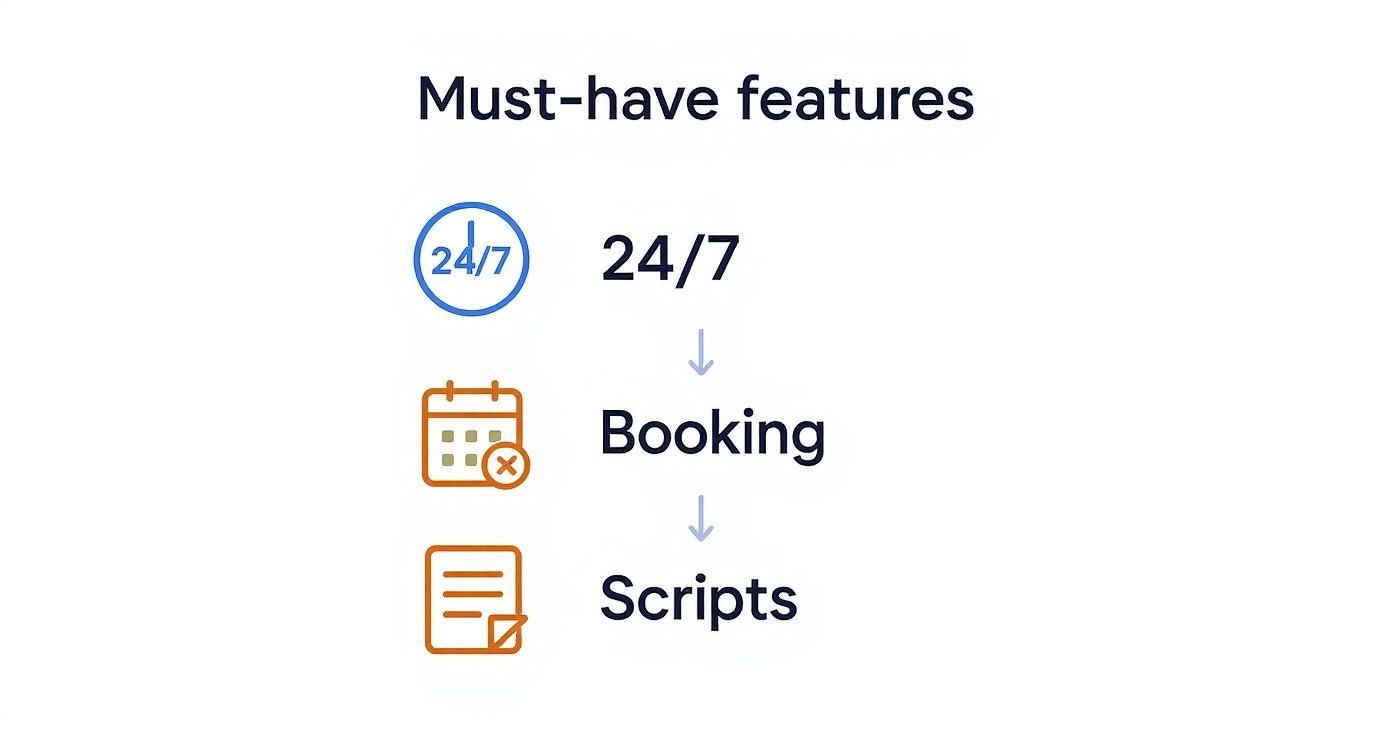
As you can see, basics like 24/7 availability, the ability to book jobs directly, and the use of custom scripts are non-negotiable. These are the things that turn calls into booked moves.
Modern AI-Powered Solutions
The other side of the coin is an AI receptionist. And no, this isn't the clunky chatbot you argue with on a cable company’s website. This is an intelligent system built specifically to handle the conversations a moving company has every day. It answers instantly, 24/7, and can manage an unlimited number of calls at once without ever putting a single person on hold.
Here's where an AI receptionist is changing the game for local movers:
- Cost-Effectiveness: AI services typically have a predictable, flat monthly fee. This makes budgeting a breeze and ensures your costs don't spiral out of control during your busiest months.
- Perfect Consistency: An AI receptionist follows your script perfectly, every single time. It never has a bad day, never gets flustered, and never forgets to ask a key qualifying question about stairs or specialty items. It captures lead info flawlessly.
- Seamless Integration: These systems are designed to plug directly into your CRM and calendar. They don't just take messages; they book estimates, send confirmations, and log customer data automatically. This eliminates hours of manual data entry for you and your team.
This move toward automation is reshaping the entire customer service industry. The global market for AI in call centers is projected to explode from $17.05 billion in 2024 to nearly $50 billion by 2031. This growth isn't about replacing people. It's about augmenting them—using AI to handle the repetitive, high-volume tasks so your human team can focus on closing big deals and running the operations side of the business. You can read more about these transformative call center statistics and what they mean for businesses.
For a growing moving company with 1–20 trucks, an AI solution offers a scalable way to make sure every single lead is captured and qualified. It turns your phone line from a constant headache into a reliable, automated booking engine.
Calculating the ROI for Your Moving Business

As a moving company owner, every dollar you spend has to justify its existence. So when you look at a phone answering service, the first question is always the same: is it worth the cost?
The answer isn't complicated. In fact, the math is refreshingly simple.
A good answering service isn't an expense; it's a direct investment in recovering revenue. It plugs the single biggest leak in your sales pipeline—missed calls. To see the return, you just have to connect the cost of the service to the value of the jobs it saves.
The One-Job-a-Month Rule
Let’s run some straightforward numbers. What’s your average local move worth? For many companies, it’s somewhere around $1,500.
Now, how many of those calls do you think you miss in a typical month, especially during your busy season or after hours? Even a conservative guess of three or four is pretty common.
If an answering service captures just one single job you would have otherwise lost to voicemail, it often pays for its entire monthly cost. Everything after that first job is pure profit that goes straight to your bottom line.
Most moving businesses don't need a massive influx of new leads to grow; they need to stop losing the ones they already have. Booking just one or two extra jobs a month transforms an answering service from a cost center into a powerful profit generator.
This simple calculation changes the entire conversation. You're not "spending" money on a service. You're investing in a system that guarantees you capture revenue that is currently slipping through your fingers.
To get a precise look at your potential return, you can use a moving company ROI calculator and plug in your own numbers.
Understanding Pricing Models
When you start looking at phone answering services, you'll generally run into two main pricing structures. Choosing the right one really comes down to your call volume and whether you prefer a predictable budget, especially when seasonal demand kicks in.
- Per-Call or Per-Minute Plans: This is the old-school model, common with traditional live agent services. You pay for what you use. It can seem cheap to start, but your bill can get unpredictable and expensive fast during your peak season when call volume skyrockets.
- Flat-Fee Monthly Plans: This model, often tied to modern AI solutions, gives you unlimited call handling for a fixed monthly price. Your costs are totally predictable, ensuring your bill doesn't spike in May just as your business is hitting its stride.
Making a Confident Decision
For a moving business running 1–20 trucks, the math is crystal clear. The value of a single booked job is so high that the risk of missing even a few calls far outweighs the cost of ensuring every call gets answered.
An effective answering service doesn't just prevent lost revenue—it actively creates it by turning after-hours inquiries and weekend calls into scheduled estimates and booked jobs.
When you stop seeing it as a monthly bill and start seeing it as a tool for capturing guaranteed income, the decision becomes one of the easiest you’ll make for your company’s growth.
Getting Started Without Messing Up Your Operations
Bringing on a new service, especially one that handles your customer calls, can feel like a recipe for chaos. You're already juggling crews, trucks, and last-minute schedule changes. The last thing you need is a complicated setup process that drops calls or confuses customers.
The good news is that setting up a quality phone answering service is surprisingly painless. It’s designed to be a smooth handoff, not a system overhaul.
The whole thing hinges on a simple process called call forwarding. You just tell your main business line when to redirect calls to the service. You’re in complete control, and your customers will never even know a switch happened. It’s seamless.
Roll It Out in Phases, Not All at Once
You don't have to go all-in on day one. In fact, you shouldn't. The smart move is to ease into it, letting you test the waters and build trust in the system without risking your live calls.
- Start with After-Hours & Weekends: This is the easiest first step. Just forward calls that come in when your office is closed. Right away, you start catching leads you were already losing, and you can see how the service handles things without touching your normal business hours.
- Add Overflow Coverage: Next, set your phones to forward calls only when your line is busy or after it rings three times with no answer. Think of it as a safety net. During a morning rush when your dispatcher is swamped, you won't lose a potential job to voicemail.
- Go for Full Coverage (If It Makes Sense): Once you've seen the results and are comfortable with the process, you can choose to have the service handle all incoming calls. This frees up your office staff from being chained to the phone, letting them focus on high-value tasks like providing detailed quotes, managing dispatch, and doing customer follow-ups.
This step-by-step approach keeps you in the driver's seat and makes the whole transition feel manageable.
Keep Your Call Scripts Simple and Direct
A critical piece of the puzzle is the script. Don't overthink this—it’s not a Hollywood screenplay. It’s just a clear set of instructions so the service knows exactly what you need.
Your script is your playbook. It turns a generic message-taker into a real extension of your front office—someone who knows what to do, who to call, and what information actually matters.
Your script really only needs to cover two scenarios:
- New Leads Needing a Quote: For these calls, the script should be a simple checklist. Get the basics: name, phone number, email, move-from and move-to addresses, and a general idea of the move size. That's it. This info gets fired off to you in a text or email so your team can build the full quote.
- Urgent Move-Day Problems: This is for the customer calling in a panic—"The crew isn't here yet!" or "The truck can't fit down my street!" The script needs a clear escalation plan. Maybe it's an immediate transfer to your personal cell or your operations manager's direct line. No delays, no messages.
By setting up these simple rules, you make sure every call is handled the right way. You’re not just preventing missed calls; you’re building a system that captures leads and solves problems without creating more work for you.
Your Questions Answered
Handing over your phone lines to an outside service is a big deal. It’s your business’s front door, and you need to know it’s in good hands. It’s normal to have questions about how it works, what it costs, and if it can really sound like your company. Here are the straight answers to the questions we hear most from moving company owners.
Will an Answering Service Understand the Moving Business?
A good one will. But here's the catch: you can't just hire a generic message-taker. You need a service that allows for custom scripting.
You should be able to provide them with your exact scripts, the key questions your team asks (move size, distance, special items like pianos), and your service areas. This way, they act as a true extension of your team, gathering the critical details your estimators need, not just scribbling down a name and number.
What’s This Going to Cost a Small Mover?
It really depends on the model. A traditional live agent service might bill you per minute or have a monthly fee with a call limit, and that can run anywhere from $200 to over $1,000 a month depending on how much your phone rings. Newer AI solutions, on the other hand, often come with a flat monthly fee, which is way more predictable for budgeting.
But the real question isn't cost—it's ROI. If your average move is worth $1,500, the service pays for itself the second it books just one extra job for you that month. Everything after that is pure profit.
Can It Book Estimates Directly Into My Calendar?
It absolutely has to. This isn't a "nice-to-have" feature; it's a dealbreaker. Any professional answering service worth its salt must integrate directly with your calendar, whether that’s Google Calendar or a full-blown moving company CRM.
When a customer is ready to schedule an estimate, the service should see your team's real-time availability and lock in the appointment right then and there.
This one feature kills the game of phone tag that loses so many deals. You secure the lead before they even have a chance to call another mover, cutting your sales cycle down dramatically.
It's a massive competitive advantage. You turn a simple phone call into a confirmed appointment in a single touch.
What if a Customer Has a Move-Day Emergency?
You’re still in control. A professional service operates on clear escalation rules that you set. For all the routine stuff—quotes, scheduling, basic questions—they handle the whole conversation from start to finish.
But for a real emergency, like a customer calling because the crew is running late, you can set a rule to have that call patched through to you or your operations manager immediately. This gives you the best of both worlds: you get the efficiency of automated lead capture without ever losing control over the critical, time-sensitive stuff that keeps your business running smoothly.
Ready to stop sending paying customers to voicemail? An AI-powered receptionist can answer every call, 24/7, and turn them into booked moves on your calendar. See how MoveJoy can work for your moving company.