A good closing rate for moving estimates usually starts at 20% to 30%. But that number is almost meaningless without context, because what constitutes a good rate depends on the type of move, the lead source, and how fast your front office responds.
That’s the gap most moving company owners miss. They know how many calls came in. They know how many jobs got booked. What they often don’t know is where the leak sits between those two points.
If you run a moving company with multiple trucks, your closing rate isn’t just a sales metric. It’s an operations metric. It tells you whether your phones are getting answered, whether estimates are getting out fast enough, whether your pricing is clear, and whether anyone is following up when the customer doesn’t book on the first touch.
A company can have decent lead volume and still underperform badly if the office gets buried during peak season. That’s especially true from March through September, when dispatch is noisy, crews are in the field, and missed calls stack up fast. Many owners assume the problem is low-quality leads. In practice, the issue is often slower response, delayed quoting, or no system for recovering estimates that didn’t close the first time.
Why Your Moving Company’s Closing Rate Is the Most Important Metric You Aren’t Tracking
Most owners can tell you their monthly revenue in seconds. Fewer can tell you their estimate closing rate without digging through calls, emails, and spreadsheets. That’s a problem, because closing rate is the clearest signal of how well your front office works.

A low close rate usually doesn’t mean your market is bad. It often means the customer experience broke somewhere between inquiry and booking. The call rang too long. The quote went out late. The price wasn’t explained. Nobody followed up after the estimate.
That’s why the broad “good” range you hear in the industry can be misleading. Many articles say 20% to 35% is solid, but they skip the business impact for operators who stay stuck there because of missed calls and slow follow-up. For smaller and mid-sized movers, that gap can mean $50K to $150K in annual revenue loss, especially during the March to September rush, as noted in this analysis of moving lead close-rate benchmarks and missed-call revenue loss.
Closing rate shows where revenue leaks
If you quote 100 qualified customers and book 25, your close rate is 25%. If another mover books 45 from the same number of qualified estimates, they didn’t just “sell harder.” They probably ran a tighter office.
Practical rule: If your closing rate is weak, look at your process before you blame your sales team.
Owners of 5 to 20 truck companies feel this most during busy season. Dispatch is handling active jobs. The office is juggling schedule changes. Phones spike at lunch, late afternoon, and after hours. The lead that should have become a booked move ends up in voicemail, or gets a quote hours later after the customer has already called three competitors.
It’s a better metric than lead count alone
Lead count tells you activity. Closing rate tells you effectiveness.
A company can buy more leads and still grow slower than a competitor with fewer leads but tighter intake, better quoting, and consistent follow-up. That’s why closing rate deserves a place on the same dashboard as booked jobs, average ticket, and crew utilization.
How to Calculate Your Real Closing Rate
Most movers either undercount or overcount this number. The mistake is usually simple. They use all inbound leads instead of qualified estimates.
The clean formula is:
Booked Moves ÷ Qualified Estimates = Closing Rate
Then multiply by 100 if you want the percentage.
Use qualified estimates, not raw leads
A raw lead is anyone who called, submitted a form, or sent a message. A qualified estimate is narrower. It’s a prospect who made it past initial triage and received a quote. That definition aligns with the benchmark used in this guide to accurate moving estimates.
If you mix raw leads with quoted leads, your number gets distorted. You’ll think your sales process is worse than it is, when lead quality may be the problem. Or you’ll think your close rate is fine because your team only records the easiest prospects.
Use a simple rule:
- Count it if the customer was qualified and got a price.
- Don’t count it if it was spam, a duplicate, outside your service area, or never made it to an estimate.
A simple example
Let’s say your office handled a busy month and produced 80 qualified estimates. Out of those, 24 turned into booked jobs.
Your math is:
24 ÷ 80 = 0.30
That means your closing rate is 30%.
Now the number is useful. You can compare it by estimator, by lead source, by move type, or by month. You can also spot where things are breaking.
If local estimates are closing fine but long-distance quotes are lagging, that’s a process clue. If phone leads close well but web forms don’t, that’s another clue.
Track this weekly, not just monthly. Weekly tracking helps you catch office slowdowns before they cost you a full peak-season month.
Moving Estimate Closing Rate Benchmarks for 2026
A good answer to what is a good closing rate for moving estimates has to be segmented. There isn’t one number that fits every mover.
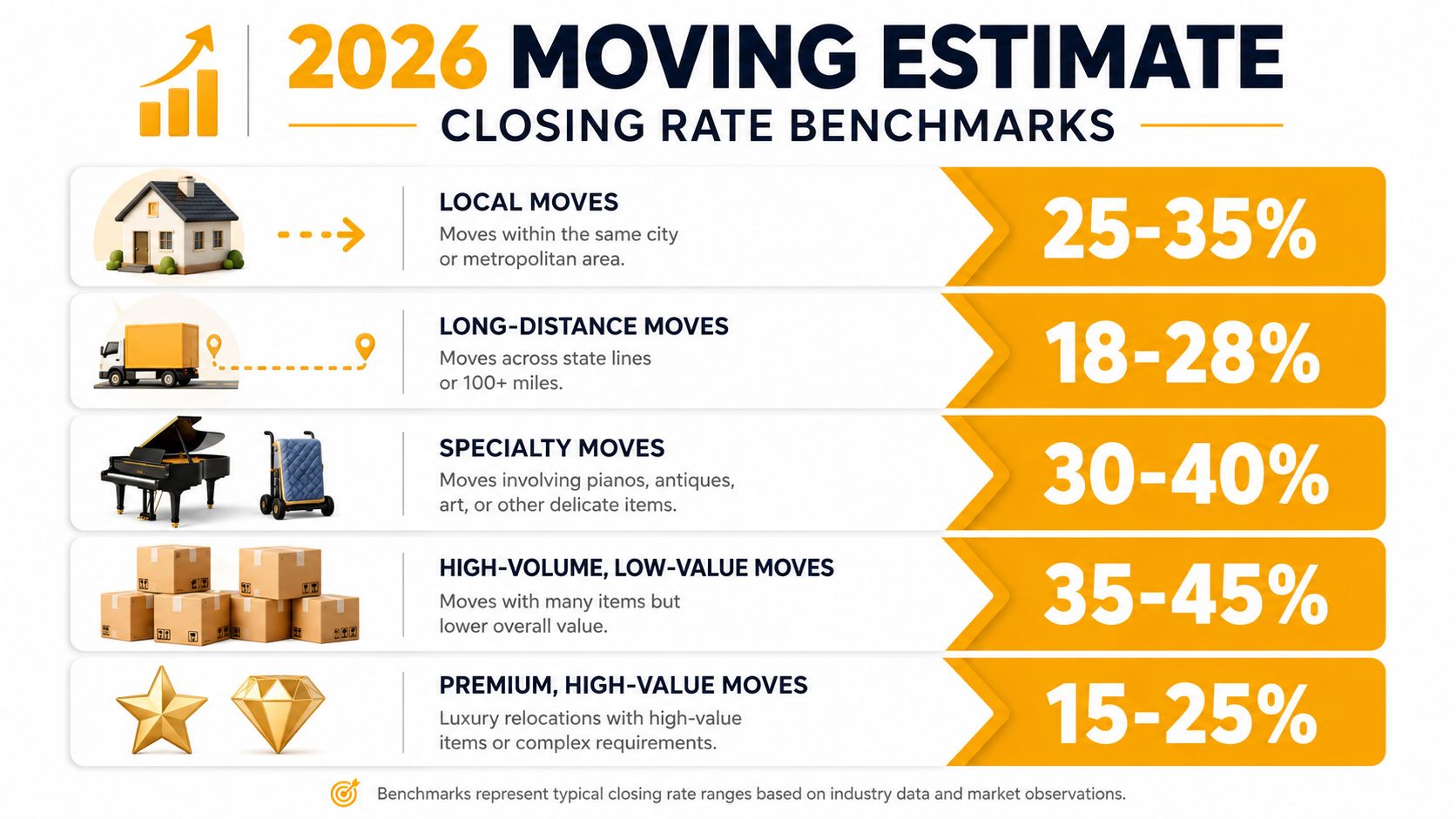
For 2026 projections, a 30% to 35% booking rate is considered solid, while 40% or above puts an operator in the top quartile. Local leads generally average 20% to 40%, while long-distance leads fall to 10% to 25%. Operators using modern platforms with automated follow-up consistently reach 40% to 60% according to 2026 booking-rate benchmarks for contractor services.
What counts as solid, strong, and elite
Here’s the practical way I’d frame it for a moving company owner.
| Category | Average Performance (Manual) | Excellent Performance (Automated) |
|---|---|---|
| Overall qualified estimates | 20% to 30% | 40% to 60% |
| Solid 2026 booking rate | 30% to 35% | 40%+ |
| Inbound phone estimate to booking | Lower if response is inconsistent | 45% to 55% |
The manual side usually means slower callbacks, uneven follow-up, and quoting that depends on whoever is available at the moment. The automated side usually means leads get contacted fast, estimates go out in a consistent format, and follow-up happens whether the office is busy or not.
For owners who like to benchmark other service businesses too, MetricsWatch’s retention guide is useful because it reinforces a bigger point. Revenue performance usually improves when the business manages the full customer journey, not just the first contact.
Why benchmarks change by move type and lead source
Move type matters because buying friction changes.
Local moves often close better because the timeline is shorter, the scope is easier to explain, and the customer usually wants a fast decision. Long-distance moves create more hesitation. The customer is comparing logistics, timing, valuation, and price sensitivity all at once.
Another source breaks it down this way: local moving estimates are generally good at 25% to 35%, with 35%+ considered excellent, while long-distance estimates are good at 18% to 25% in this moving estimate conversion benchmark calculator.
Lead source matters too. Phone leads are usually warmer than web forms because the customer is already engaging in real time. By the time someone picks up the phone, trust-building has already started.
A mover with a 32% overall close rate might be doing fine on long-distance web leads and poorly on inbound local calls. Without segmenting the number, you won’t know which.
One caution on visuals and online benchmark charts. You’ll often see neat categories like specialty moves or premium moves with exact ranges. Those can be directionally helpful, but unless you’re measuring your own book of business consistently, your own mix of local, long-distance, referral, phone, and web traffic matters more than a generic chart.
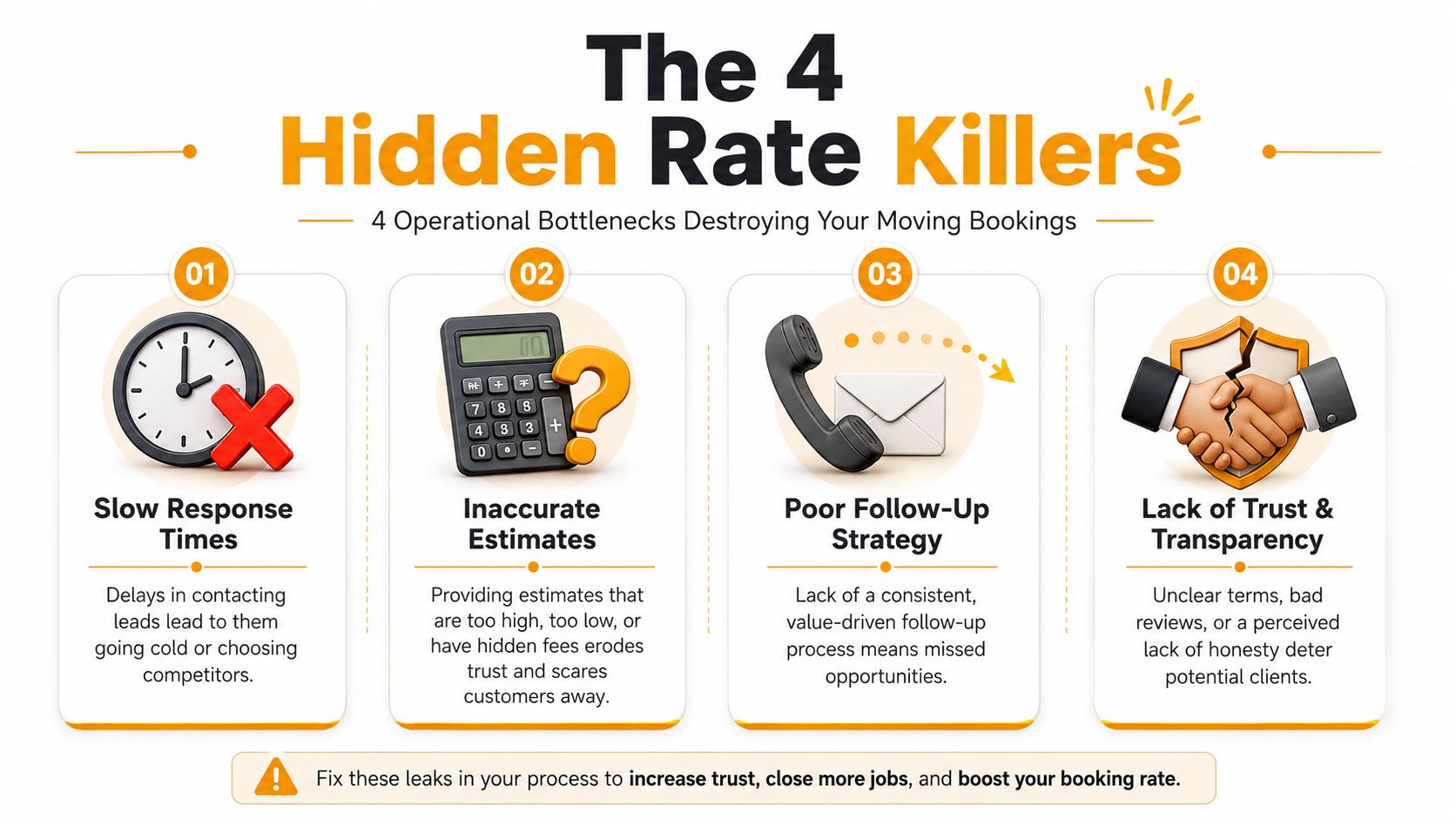
The 4 Hidden Rate Killers Destroying Your Bookings
Most booking problems start before the salesperson ever gets a real chance to close. They begin in the office workflow.
Slow response time
The first killer is delay. A customer who asks for a quote is usually contacting multiple movers in a short window. If your office calls back hours later, you’re no longer the first serious option.
The 5-Minute Rule matters here. Responding to new moving leads within five minutes can double or even triple close rates for both local and long-distance jobs, according to this breakdown of moving quote response speed.
That sounds dramatic until you watch how customers shop. They don’t submit one estimate request and wait patiently. They fill out forms while standing in a kitchen, at work, or late at night after putting kids to bed. The company that answers quickly usually gets the actual conversation.
Missed calls during busy hours
Missed calls destroy close rate because they kill intent at the hottest point.
In a 5 to 20 truck operation, this usually happens when everyone is doing legitimate work. Dispatch is handling route changes. The owner is solving a crew issue. The coordinator is helping an existing customer. Meanwhile, a new caller hits voicemail.
That lead often doesn’t leave a detailed message. They call the next mover.
A lot of owners think they have a follow-up problem when they really have a capture problem. If the call wasn’t answered, there may never be a proper estimate to follow up on in the first place.
The first operational question isn’t “Did we close it?” It’s “Did we even engage the customer while intent was still high?”
Slow or unclear quoting
The third killer is friction inside the estimate itself.
When quotes are delayed, vague, or inconsistent, the customer starts shopping on price because they can’t compare on clarity. If one mover sends a fast, clean estimate and another sends a rough total with no breakdown, the second company often looks less trustworthy even if the price is fair.
This gets worse on long-distance jobs or anything with stairs, long carries, specialty items, or building restrictions. If your quote process depends on a manager manually piecing together details between other tasks, turnaround slows and confidence drops.
Follow-up that stops too early
Plenty of moving companies send one quote and wait. That’s where bookings fade away.
Customers get busy. Spouses need to review. Closing dates shift. A lead that didn’t book today isn’t always lost. It may just need a second, third, or fifth touch.
The mistake is making follow-up optional. During peak season, optional tasks disappear first.
Here’s what weak follow-up usually looks like:
- One email only: The quote goes out and no one checks back.
- No call after sending: The office assumes silence means rejection.
- No text touchpoint: The customer never gets a quick reminder in the channel they check.
- No ownership: Everyone assumes someone else handled it.
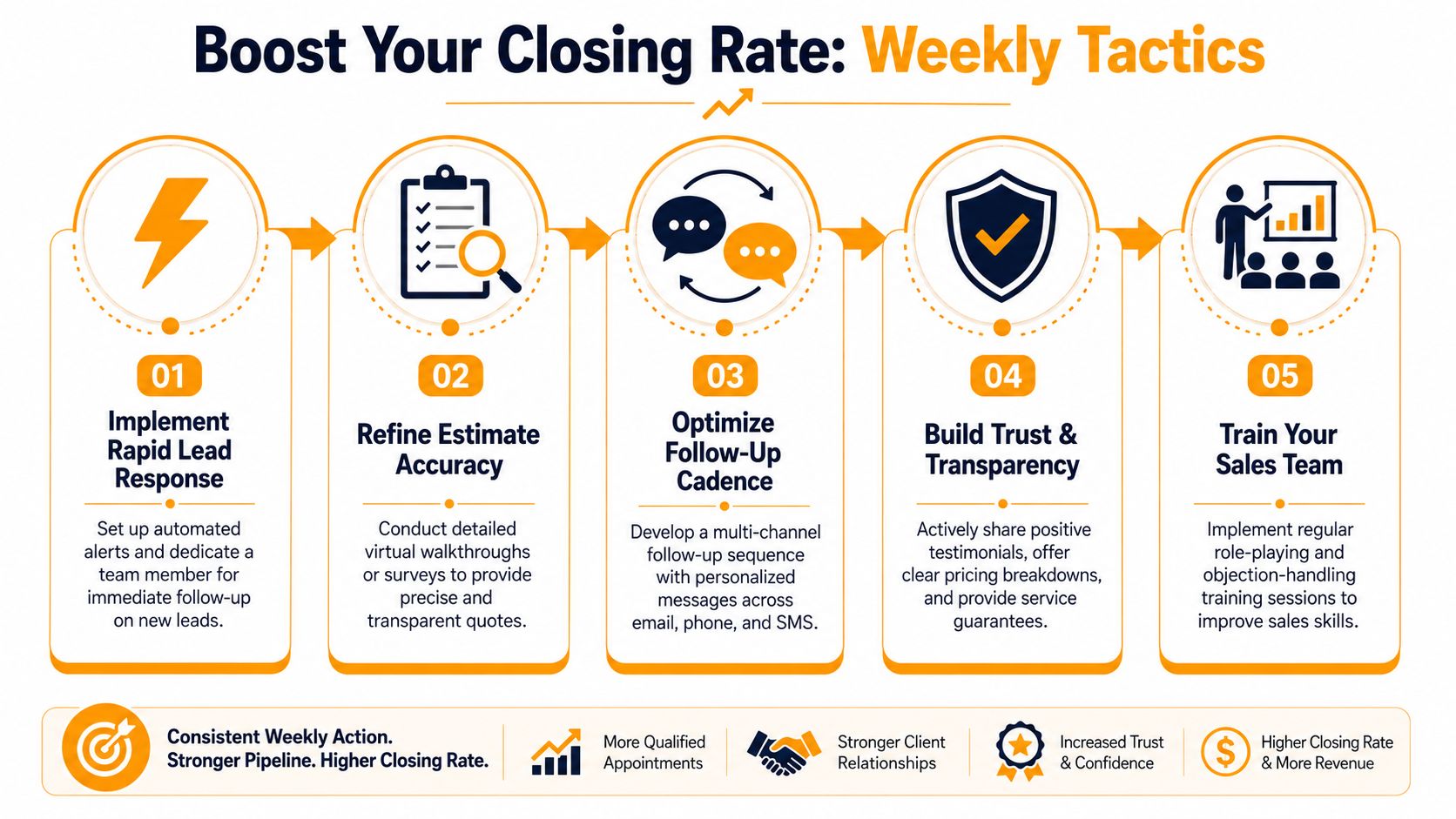
Actionable Tactics to Increase Your Closing Rate This Week
Improving close rate doesn’t require a giant overhaul. Most operators can make meaningful gains by tightening speed, quote quality, and follow-up discipline.
Fix the speed problem first
Don’t start by rewriting scripts. Start by reducing the time between inquiry and human contact.
Use a simple triage rule in the office:
- New inbound calls come first
- Unquoted web leads come second
- Sent estimates waiting on follow-up come third
If your team can’t maintain that during busy periods, the process needs support. That may mean call routing, after-hours coverage, tighter ownership, or automation that keeps intake moving when the office is tied up.
For a broader view on reducing friction across the buying process, I like this piece on optimizing customer journeys. The principle applies directly to movers. Every extra delay, handoff, or unanswered question lowers the chance that the estimate turns into a booked job.
Make your estimate easier to buy
Detailed quotes close better because they reduce uncertainty.
Customers who receive itemized digital estimates that break down labor hours, truck fees, and fuel close at 35% to 40%, compared with 18% to 22% for customers who get a single undifferentiated total price, based on the same 2026 booking-rate benchmark source cited earlier.
That doesn’t mean you need a fancy presentation. It means the customer should understand what they’re paying for.
Use this checklist on every estimate:
- Spell out the scope: Include crew size, truck count, service date, and basic job assumptions.
- Break down charges: Show labor, truck, travel, fuel, and any common add-ons that apply.
- Flag variables clearly: If stairs, long carries, packing, or shuttle conditions may affect price, say so up front.
- Show next steps: Tell the customer exactly how to approve and book.
Use a follow-up sequence your office can actually maintain
A follow-up system only works if it survives a busy week.
I prefer a practical sequence that combines calls, text, and email over a few weeks. Keep the messages short. Focus on clarifying questions, checking timing, and making it easy to book.
A workable structure looks like this:
- Touch 1: Send the estimate promptly.
- Touch 2: Call to confirm they received it.
- Touch 3: Text with a simple check-in.
- Touch 4: Email answering common concerns.
- Touch 5: Call again when the move date is getting closer.
- Touch 6: Text with booking availability.
- Touch 7: Final follow-up with a clear closeout or booking option.
Field-tested advice: The best follow-up doesn’t sound like pressure. It sounds organized, available, and easy to work with.
If your CRM can automate reminders, use it. If you’re on SmartMoving, Supermove, or MoveitPro, make sure estimate follow-up is tied to actual owner action, not just note-taking. CRMs are good at managing jobs that already exist. They’re not always strong at recovering front-end opportunities unless your workflow is built for it.
From Average to Elite How to Turn Your Closing Rate Into a Competitive Advantage
The key difference between average and elite movers isn’t charisma. It’s process discipline.
A company sitting in the baseline range can still be healthy. But if you want to book more moving jobs without constantly buying more leads, you need a front office that responds quickly, sends clear estimates, and follows up even when the day gets chaotic.
Treat closing rate like an operating KPI
Closing rate should sit next to your dispatch board and sales dashboard, not buried in a spreadsheet nobody checks.
When owners review it consistently, they start seeing patterns:
- Local jobs may be strong while long-distance jobs drag
- Phone leads may convert better than website leads
- One estimator may close well because they explain pricing cleanly
- Peak-season weeks may fall off because the office gets overloaded
Inbound phone leads can reach 45% to 55% estimate-to-booking conversion, but only when speed-to-lead automation and structured multi-touch follow-up are in place, according to this inbound phone lead KPI breakdown.
That’s the key lesson. Higher close rates usually come from tighter systems, not harder selling.
Build a front office that closes while crews are working
Owners of growing moving companies don’t need more software tabs. They need fewer leaks.
That means your process should work when:
- the dispatcher is handling active jobs,
- the office manager is out,
- calls spike after hours,
- and the owner is not available to jump on every estimate personally.
If you want a simple next step, audit one week of activity. Look at every missed call, every estimate sent, every job booked, and every estimate that went quiet. Then ask one question: where did the customer experience slow down?
That’s where close rate improvement starts.
For operators thinking beyond “answering the phone” and focusing on the full path to revenue, this guide on how to close more moving sales is a useful next read.
If your company is losing bookings because calls go unanswered, quotes go out late, or follow-up breaks during busy hours, MoveJoy is worth a look. It’s built for movers who want more than message-taking. It helps capture inbound demand, generate accurate quotes using your own rate card, and turn more estimates into booked jobs without adding front-office chaos.